
The Grateful Dead’s “Greatest Story Ever Told,” primarily associated with guitarist Bob Weir and lyricist Robert Hunter, holds a unique place in the band’s extensive repertoire. While many might search for the complete “the greatest story ever told lyrics,” the true richness of the song lies not just in the words themselves but in their fascinating origins and the layers of meaning Hunter wove into them. It’s a song born from unexpected places, blending disparate threads into a narrative that feels both ancient and utterly modern.
The journey of “Greatest Story Ever Told” began not with a guitar riff or a poetic verse, but with a rhythmic pulse captured by drummer Mickey Hart. Hart recorded the sound of a pump on his ranch, adding log drums, and presented the tape to Weir as a challenge. This initial percussive base, known then as “The Pump Song,” set the stage for the lyrical and musical evolution that followed. It first appeared as “The Pump Song” on Mickey Hart’s 1972 solo album, Rolling Thunder, before taking its final form on Bob Weir’s 1972 solo album, Ace.
Interestingly, the song’s title underwent its own evolution. Mickey Hart always referred to it by its percussive beginning, “The Pump Song.” Robert Hunter, initially titling his lyrics “Moses,” found Weir’s eventual choice, “Greatest Story Ever Told,” a different direction entirely. This title, often linked to the biblical narrative of Jesus, adds a layer of potentially ironic or expansive meaning to Hunter’s non-linear, character-filled lyrics.
The song’s connection to everyday, almost folkloric origins is further cemented by Mickey Hart’s early suggestion during the songwriting process: perhaps a song like “Froggy Went a Courtin’” could be laid over the pump rhythm. While the final lyrics stray significantly from that ballad, the opening line, “Moses come ridin’ up,” retains a hint of the “Froggy” spirit, mirroring Froggy’s arrival in the older tune.
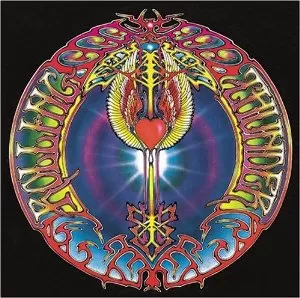 Mickey Hart's Rolling Thunder album cover, featuring "The Pump Song," an early version of "Greatest Story Ever Told" lyrics
The lyrics weave together a cast of characters drawn from the Old Testament: Moses, Gideon, Abraham, and Isaac. Yet, their actions within the song are far from biblical narrative. Moses is encountered, asked for mercy (and yields a gun) and water (and provides wine). Abraham and Isaac are found “sitting on the fence,” digging on a well – a subtle nod, perhaps, to the song’s origin from a pump/well sound. These figures seem almost out of time, placed into a quirky, less-than-heroic scenario.
Hunter’s lyrics are famously sly and filled with unexpected turns of phrase. The line “silver was bold,” instead of the expected “silver was gold,” is a classic example of his playful subversion of cliché, adding a unique texture. The observation that “it’s one in ten thousand that come for the show” offers a moment of detached commentary on participation or engagement. The dialogue with Moses (“I asked him for water, he poured me some wine / We finished the bottle, then broke into mine…”) echoes themes of shared resources or experiences found in other Grateful Dead songs.
One particularly memorable line is the mention of needing a “left-hand monkey wrench.” This phrase introduces the concept of a “fool’s errand” – sending a novice on a search for a non-existent tool. Hunter subtly brings the character of the Fool into the song through this reference, placing it alongside the ancient figures, perhaps suggesting that even these historical characters are engaged in their own form of futile or aimless activity “sitting on the fence.”
“Greatest Story Ever Told” quickly became a live staple for the Grateful Dead after its debut on February 18, 1971. Its inclusion often brought energy to the start of a set. While it saw a hiatus in the mid-70s, its return in 1979 was met with significant fan excitement. The song’s presence in the live show often allowed Jerry Garcia to weave intricate, snake-like guitar lines through the lyrics and driving rhythm, further emphasizing the interplay between the words and the music.
[internal_links]
Ultimately, the power of “the greatest story ever told lyrics” lies in their enigmatic nature, their grounding in unusual origins, and their ability to evoke a sense of timeless, slightly absurd human activity through recognizable, yet decontextualized, figures. It’s a testament to the collaborative and often unconventional songwriting process of the Grateful Dead universe, proving that great stories (or songs) can truly bloom from the most unexpected seeds, like the sound of a pump on a ranch.