
This exploration into the profound nature of poetry was serendipitously sparked by two concurrent events: the completion of “Poetry Is: Jose Garcia Villa’s Philosophy of Poetry,” edited by Robert L King, and the rediscovery of an old poetry magazine from 1976. Reading King’s compilation of Villa’s potent ideas – arguably one of the most insightful books on writing poetry available today – while simultaneously sifting through dated examples of “free verse” offered a striking contrast that underscored the vital arguments made by Villa. The experience highlighted a decades-long divergence in poetic practice and philosophy, prompting a deeper reflection on what constitutes true poetry.
Contents
Having graduated with a First Class Honours degree in English Literature in 1976, one might assume a solid foundation in poetic understanding. Yet, for years following, a subscription to magazines like the UK-based ‘Oasis’ and numerous others persisted, driven by a fervent desire to learn more. Looking back at these publications now, particularly ‘Oasis’ issue 14, the content reveals a prevalent trend that raises questions about the direction of poetry during that era and its lingering effects. The magazine contained not a single poem exhibiting traditional form or musicality, but rather numerous “free verse” pieces, largely indistinguishable from one another. Alongside modernist experiments in prose, it featured articles like ‘The Literary Scene (No 1)’, which seemed more intent on attacking established poets like Philip Larkin (rightly recognized for his understanding of form) and the “Establishment” that published them, while championing Beat poets and lifestyles. This movement often associated “free verse” (a term Villa and others would argue is a misnomer, as it lacks both verse and form) with a perceived freedom – social, political, philosophical, even theological (often leaning towards atheism or a denial of the spiritual source that might inspire a Muse).
This perspective often manifested in a self-congratulatory tone, with proponents of such formless writing intimating that their “chaos of lines” somehow contributed to humanity’s well-being and poetry’s survival. Their work was frequently described using adjectives like ‘spare’, ‘taut’, ‘precise’, ‘bleak’, ‘unflinching’. Yet, when examined closely, these terms often translate to ‘unmusical’, ‘unstructured’, ‘monotonous’, ‘depressing’, and ultimately, ‘unimaginative’. This prevailing consensus, developed over decades, arguably marginalized traditional poetic craft, creating an environment where almost any utterance could be presented as poetry, akin to standing on a street corner and howling – a deliberate echo of Allen Ginsberg’s famous work, ironically often cited as an example of powerful free verse, yet one that perhaps proves the exception rather than the rule for the movement it inspired.
This is precisely where Jose Garcia Villa’s brilliant book, “Poetry Is,” steps in, directly addressing this predicament, particularly in its closing sections. As noted by Jay Parini, “Most poetry written after the mid-twentieth century is ‘free verse’, as anyone will know.” However, Villa offers a profound counterpoint: “when you begin a poem with a meaning in mind, that meaning – instead of building the poem up – undermines it, pulls it down and it has a birth defect.” This is a superb, incisive image. Free verse, by its very nature lacking inherent form, must often begin with a pre-conceived meaning or message it seeks to convey. Villa argues this starting point creates a fundamental “birth defect” in the resulting work. While acknowledging that truly great poets might occasionally overcome this defect to produce a living free verse poem (TS Eliot being a notable example), it remains far from the norm or a healthy foundation for poetic creation.
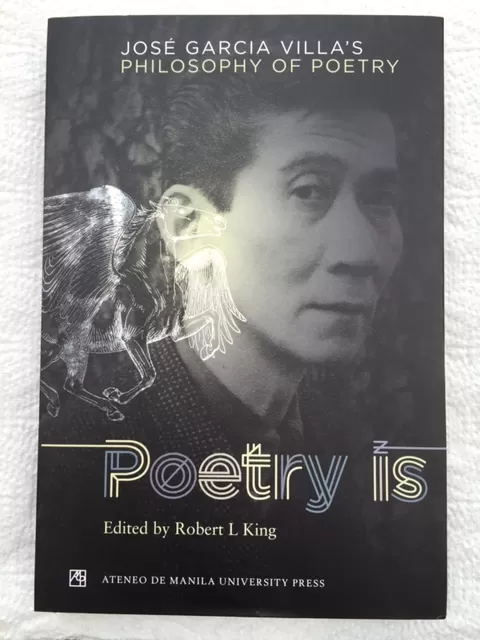 Book cover for Poetry Is by Jose Garcia Villa, edited by Robert L King, a review of his philosophy of poetry
Turning then to the wonders within “Poetry Is,” this book is a compulsory read for any genuine lover or practitioner of poetry. While Villa’s thinking is austere and his strictures severe – potentially challenging for some readers – his arguments are undeniably powerful, and his insights into the creative process are profoundly potent. It’s essential for all serious students and practitioners of the art to engage with his ideas. A word must first be said, however, about the book’s unique creation. Villa himself, who passed away in 1997, did not write it as a finished manuscript. Instead, his devoted student and disciple, Robert L King, undertook a monumental labor of love, meticulously piecing together Villa’s philosophy from surviving lectures and notes housed at Harvard. To write a book is difficult; to synthesize a cohesive, insightful volume like this from fragmented notes is a truly massive achievement. Future generations will undoubtedly be indebted to Robert King for his intricate and dedicated work in bringing Villa’s voice to the fore, allowing the master’s ideas to speak unimpeded by the editor’s ego.
Core Tenets of Villa’s Poetry Philosophy
The essence of Villa’s argument, as presented in “Poetry Is,” is that poetry is a demanding art form requiring rigorous discipline, often estimating at least ten years of dedicated practice before one can produce truly worthwhile work. For Villa, poetry fundamentally concerns language, music, and, crucially, form. However, his conception of form is expansive, extending beyond mere metrics or stanzaic patterns to encompass an intrinsic order and structure that shapes the meaning itself. This rigorous view leads him to describe much of the poetry of his time (a critique that remains highly relevant today) as “self-expression,” which he dismisses bluntly as “nothing but romantic infantilism and baby talk.” This is because, in his view, genuine “good writing doesn’t just happen”; it is the product of conscious craft and discipline, whereas “self-expression always just happens,” lacking the necessary artistic control and formal integrity.
The Irreplaceable Essence of Poetry: Beyond Paraphrase
From this foundation, several crucial consequences emerge. First, poetry, unlike prose, is fundamentally irreplaceable. Prose communicates meaning in a way that can be restated or paraphrased without significant loss. Poetry, however, embeds its meaning within its specific form, sound, and language. To paraphrase poetry is, effectively, to destroy its existence as poetry. The meaning is inseparable from how it is said.
Poetry as a “Civilization of the Human Spirit”
Second, the discipline required for poetry is not merely aesthetic or technical; it is also intellectual and, significantly, ethical. Villa posits, “Poetry becomes a civilization of the human spirit.” This reveals the profound chasm between Villa’s view and the free verse movement’s often anti-establishment stance. The difference isn’t solely about poetic technique; it touches upon lifestyle, values, and the very spiritual dimension of human existence.
Poetry and Mental Well-being: A Powerful Connection
Third, and perhaps most astonishingly, Villa claims that the practice of poetry actively prevents mental disturbances. While seemingly bold, this idea has historical and philosophical precedent. Though Villa doesn’t cite him, GK Chesterton observed the striking rarity of major English poets who succumbed to madness, Cowper being a notable exception. More anciently, Apollo, the Greek god of poetry, was also the god of healing and sanity. Villa supports this claim by quoting Wallace Stevens with approval: “Poetry is not a literary activity – it is a vital activity – a part of life itself.” This highlights poetry’s fundamental role in human flourishing. Villa reinforces this by stating, “In order to be art, form is mandatory.” Mandatory form implies mandatory order. This order in poetry is not the superficial, rigid order of a list or spreadsheet, but an order that emerges from the deep wellsprings of the mind. It is this profound, intrinsic ordering process inherent in creating formal poetry that, according to Villa, cultivates mental stability and health.
The Voyage of Discovery: Finding Meaning Through Form
One final, brilliant observation Villa makes (which, among many others, deserves highlighting) is his citation of Christopher Morley: “Poetry is the perfect expression of something you didn’t know you wanted to say.” This encapsulates the idea that every true poem is a voyage of discovery, not just for the reader, but for the poet themselves. It explains why poems built around pre-fabricated meanings or platitudes, designed solely to convey a message the poet already possesses, may result in effective polemics or propaganda, but not poetry. Genuine poetry surprises the poet as it emerges on the page. This concept is explored further in an insightful chapter dedicated to the final line of a poem – a line incredibly difficult to write precisely because it must simultaneously bring all preceding elements together and unveil a meaning that was not obvious from the outset. The last line must both complete and strike out, a profound paradox.
In conclusion, Jose Garcia Villa’s “Poetry Is,” expertly compiled by Robert L King, is a powerful, essential text for anyone serious about understanding the art and discipline of poetry. It offers a compelling counter-argument to the prevalent trends of formless verse, championing a philosophy rooted in craft, language, music, and the transformative power of form. Robert King deserves immense gratitude for his dedicated work in preserving and presenting these vital ideas, ensuring Villa’s profound insights remain accessible and relevant to contemporary discussions about poetry. This book is not merely a review of philosophy; it is an impassioned call to recognize poetry as a rigorous, vital, and ordering force in human life and consciousness.
Poetry Is by Jose Garcia Villa (Ateneo University Press) is available for purchase via www.theoryofpoetry.com or by contacting editor [email protected] directly.
James Sale, FRSA, is a leading expert on motivation and the creator of Motivational Maps worldwide. With over 40 years of experience writing poetry and seven published collections, including “Inside the Whale,” he brings a deep practical and theoretical understanding to literary analysis. He can be found at www.jamessale.co.uk and contacted at james@motivational maps.com. He was awarded Second Prize in the Society of Classical Poets’ 2015 Competition.