
Romantic poetry often conjures images of roses, sunsets, and declarations of undying devotion wrapped in elegant rhyme schemes. While these traditional forms hold enduring beauty, the landscape of love poetry is far richer and more varied. True passion, vulnerability, and connection can be expressed in ways that are unexpected, raw, and deeply authentic. These are the cool romantic poems – works that capture the nuances, challenges, and unconventional joys of human connection, moving beyond predictable sentiments to reveal love in its most honest and compelling forms.
Contents
- Maya Angelou – “Come, And Be My Baby”
- Craig Arnold – “Bird-Understander”
- Margaret Atwood – “Habitation”
- Margaret Atwood – “Variations on the Word Love”
- W.H. Auden – “The More Loving One”
- Emily Brontë – “Love and Friendship”
- Gwendolyn Brooks – “To Be In Love”
- E. E. Cummings – “[i carry your heart with me(i carry it in]”
- E.E. Cummings – “[love is more thicker than forget]”
- Yrsa Daley-Ward – “Sthandwa sami (my beloved, isiZulu)”
- Emily Dickinson – “Heart, we will forget him!”
- Rita Dove – “Flirtation”
- Rita Dove – “Heart to Heart”
- Carol Ann Duffy – “The Love Poem”
- Faiz Ahmed Faiz – “Before You Came”
- Peter Gizzi – “Lines Depicting Simple Happiness”
- Rebecca Hazelton – “You Are the Penultimate Love of My Life”
- Audre Lorde – “Movement Song”
- Katherine Mansfield – “Camomile Tea”
- Nathan McClain – “Love Elegy in the Chinese Garden, with Koi”
- Edna St. Vincent Millay – “I think I should have loved you presently (Sonnet IX)”
- Pablo Neruda – “Love Sonnet XI”
- Pablo Neruda – “Your Feet”
- Pat Parker – “My Lover Is a Woman”
- Christopher Poindexter – “Untitled”
- Rainer Maria Rilke – “[Again and again, even though we know love’s landscape]”
- Christina Rossetti – “Echo”
- Rumi – “Defeated by Love”
- William Shakespeare – “My mistress’ eyes are nothing like the sun” (Sonnet 130)
- Percy Bysshe Shelley – “Love’s Philosophy”
- Sara Teasdale – “I Am Not Yours”
- Tennessee Williams – “We Have Not Long to Love”
- Conclusion
In this article, we delve into a curated selection of poems that embody this spirit. We’ll explore how poets from different eras and backgrounds have articulated the complexities of love, friendship, and desire with wit, grit, intensity, and profound understanding. These poems offer a refreshing perspective on romance, highlighting the aspects of connection that are messy, challenging, resilient, and ultimately, undeniably cool.
aristotle contemplating the bust of homer
Maya Angelou – “Come, And Be My Baby”
Maya Angelou, a towering figure in American literature and civil rights, offers a vision of love as refuge. In “Come, And Be My Baby,” the poem doesn’t speak of grand gestures or idealized perfection, but rather the simple, profound comfort found in another person amidst the chaos of modern life.
The highway roars
and rages all day long
through the true peace of the forest.When I think of you,
I see a safe place.
This poem is “cool” because it’s grounded. It acknowledges the external pressures (“highway roars and rages”) and positions the loved one not as a savior from these pressures, but as a “safe place” – a quiet, essential comfort within them. The romance is in the sanctuary offered, the understated peace found simply by thinking of the beloved.
Craig Arnold – “Bird-Understander”
Craig Arnold’s work often possesses a striking honesty. “Bird-Understander” is a poem that finds romance not in shared beauty, but in a shared understanding of difficulty, even pain.
These are your own words
your way of noticing
and saying plainly
of not turning away
from hurt
you have offered them
to me I am only
giving them back
if only I could show you
how very useless
they are not
The “cool” factor here lies in the focus on vulnerability and acceptance. The speaker doesn’t praise the beloved’s strength or beauty, but their capacity to “not turn away from hurt” and to articulate their experience plainly. The poem is a recognition and validation of the beloved’s internal world, framed as a gift of profound intimacy. The simple, almost understated language adds to its power.
Margaret Atwood – “Habitation”
From the celebrated author Margaret Atwood comes a poem that tackles the often-unspoken reality of long-term relationships: they require effort. “Habitation” is far from a fairytale; it’s about partnership in the face of enduring challenges.
at the back where we squat
outside, eating popcorn
the edge of the receding glacier
where painfully and with wonder
at having survived even
this far
we are learning to make fire
This is cool romantic poetry because it celebrates survival and effort. The image of squatting at “the edge of the receding glacier” speaks to enduring hardship together, with a sense of “painfully and with wonder at having survived.” The romance is in the shared labor, the mutual learning to “make fire” – a primal act of building warmth and life together, not passively receiving it.
Margaret Atwood – “Variations on the Word Love”
Atwood appears again, demonstrating her incisive approach to language and emotion. “Variations on the Word Love” dissects the very word “love,” revealing its slippery nature and the many forms, some uncomfortable, it can take.

The coolness here is intellectual and honest. Atwood refuses to let “love” be a simple, monolithic concept. By exploring variations – including those that are possessive or even destructive – she forces a deeper consideration of what we mean when we use the word. This analytical, unflinching gaze at an often-romanticized concept makes the poem deeply insightful and anti-cliché.
W.H. Auden – “The More Loving One”
While perhaps melancholic, Auden’s “The More Loving One” offers a powerful perspective on love, loss, and resilience. It grapples with the pain of unreciprocated affection, yet finds a kind of sublime acceptance.
Were all stars to disappear or die,
I should learn to look at an empty sky
And feel its total dark sublime,
Though this might take me a little time.
This poem is cool in its stoicism and self-possession. The speaker acknowledges the pain of being the one who loves more, yet frames it not as weakness, but as a choice or destiny. The ability to find something “sublime” in the “total dark” of an empty sky speaks to a profound internal resilience, a strength of spirit that transcends mere romantic heartbreak. The beauty is in the enduring capacity to love, even when it causes pain.
Emily Brontë – “Love and Friendship”
Emily Brontë, known for the intense passions of Wuthering Heights, offers a surprisingly grounded view of romantic love in “Love and Friendship,” contrasting it with the enduring nature of platonic connection.
Love is like the wild rose-briar,
Friendship like the holly-tree.
The holly is dark when the rose-briar blooms,
But which will bloom most constantly?
This poem is cool because it subverts the typical hierarchy, placing friendship’s constancy above romantic love’s fleeting intensity. The rose-briar (love) is beautiful but temporary, while the holly tree (friendship) endures through all seasons. It’s an honest assessment that resonates with the reality that not all romantic loves are meant to last, and that other forms of connection can be more reliable and beautiful in their steadfastness.
Gwendolyn Brooks – “To Be In Love”
Gwendolyn Brooks, the first African-American Pulitzer winner, captures the transformative power of love with directness and intensity in “To Be In Love.”
To be in love
Is to touch with a lighter hand.
In yourself you stretch, you are well.
This poem feels cool because of its succinctness and deep psychological insight. It doesn’t describe the object of love but the experience of being in love – how it changes the speaker, making them feel expanded (“stretch”) and whole (“well”). It focuses on the internal effect of love, the way it elevates and affirms the self, which is a powerful and relatable aspect of falling for someone.
E. E. Cummings – “[i carry your heart with me(i carry it in]”
E.E. Cummings is a master of unconventional form and syntax, and this poem is arguably his most famous exploration of love. The lack of conventional capitalization and punctuation mirrors the overwhelming, unbounded nature of the feeling itself.
i carry your heart with me(i carry it in
my heart)i am never without it(anywhere
i go you go,my dear;and whatever is done
by only me is your doing,my darling)
The coolness here is in the structural innovation and the raw, possessive intensity of the emotion. The physical form of the poem visually represents the merging of identities. The sentiment is absolute and consuming, expressing a total intertwining of lives so complete that the speaker’s actions feel like the beloved’s doing. It’s a declaration of absolute dependence, expressed with striking originality.
E.E. Cummings – “[love is more thicker than forget]”
Cummings again challenges conventional expression to explore the complex nature of love. This poem uses paradoxical comparisons to articulate the ineffable quality of the emotion.
love is more thicker than forget
more thinner than recall
more seldom than a wave is wet
more frequent than to fail
This poem is cool because it defines love by what it is not and by comparing it to abstract or paradoxical concepts. It resists easy definition, portraying love as something simultaneously rare and common, solid and elusive, sane and mad. This embrace of contradiction reflects the often confusing and illogical experience of being in love, making the poem intellectually stimulating and emotionally resonant.
Yrsa Daley-Ward – “Sthandwa sami (my beloved, isiZulu)”
Yrsa Daley-Ward’s poetry is known for its modern voice and vulnerability. “Sthandwa sami” (my beloved in isiZulu) grounds intense emotion in specific, relatable details.
my thoughts about you are frightening but precise
I can see the house on the hill where we make our own vegetables out back
and drink warm wine out of jam jars
and sing songs in the kitchen until the sun comes up
wena you make me feel like myself again.
This poem is inherently cool because it feels utterly contemporary and personal. The “frightening but precise” thoughts, the image of drinking “warm wine out of jam jars,” and the simple yet profound statement “wena you make me feel like myself again” capture a modern romance rooted in shared, unpretentious moments and the feeling of finding home in another person. It’s a love poem for the age of authenticity.
Emily Dickinson – “Heart, we will forget him!”
Emily Dickinson’s unique voice often tackled intense emotions with unusual punctuation and rhythm. “Heart, we will forget him!” is a stark, almost violent command to overcome heartbreak.
Heart, we will forget him!
You and I, to-night!
You may forget the warmth he gave,
I will forget the light.
The coolness here is in the fierce, almost futile determination. It’s a direct address to her own heart, framing the forgetting process as a deliberate, difficult task undertaken by two separate entities (“You and I”). The acknowledgement that one part (the heart) must forget the physical comfort while the other (the self) forgets the emotional “light” highlights the deep, integrated nature of the loss. The forceful tone contrasts with the underlying pain, creating a powerful tension.
Rita Dove – “Flirtation”
Rita Dove, a former U.S. Poet Laureate, captures the exhilarating beginning of attraction with delicate precision in “Flirtation.”
Outside the sun
has rolled up her rugs
and night strewn salt
across the sky. My heart
is humming a tune
I haven’t heard in years!
This poem is cool because it focuses on a specific, often overlooked, stage of romance – the initial flirtation and anticipation. The imagery is evocative (“sun has rolled up her rugs,” “night strewn salt across the sky”) creating a vivid atmosphere for the internal feeling of a heart “humming a tune.” It’s a celebration of the light, playful, yet exciting energy that marks the very beginning of connection.
Rita Dove – “Heart to Heart”
Dove takes a pragmatic, yet deeply affectionate approach in “Heart to Heart,” rejecting traditional, overly sentimental metaphors for the organ of love.
It’s neither red
nor sweet.
It doesn’t melt
or turn over,
break or harden,
so it can’t feel
pain,
yearning,
regret.
This poem is cool because it’s a form of reverse psychology or perhaps radical honesty in love. By listing all the cliché things the heart doesn’t do, the speaker emphasizes the reality and constancy of their love, suggesting it exists beyond these fragile, metaphorical states. The declaration that “it can’t feel pain, yearning, regret” is perhaps ironic, hinting that while the heart is a physical organ, the love resides elsewhere, perhaps more enduringly, precisely because it isn’t subject to these romanticized fragilities. It’s a grounded, mature take on affection.
Carol Ann Duffy – “The Love Poem”
Former UK Poet Laureate Carol Ann Duffy gets meta-textual in “The Love Poem,” reflecting on the very difficulty of writing about love authentically, especially after encountering so many poems on the subject.
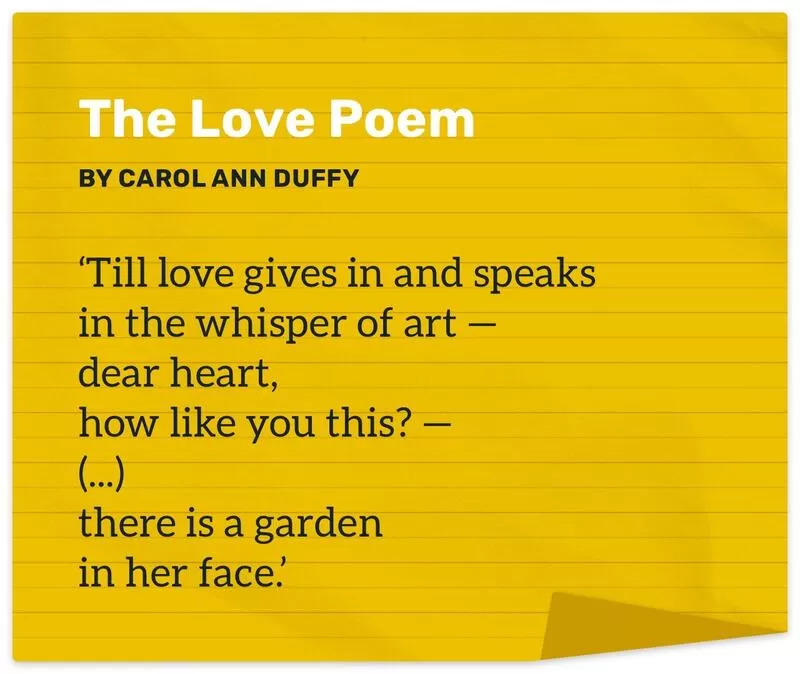
This poem is cool because its subject is the act of trying to capture love in words, and the struggle to avoid clichés. Duffy acknowledges the weight of tradition and the challenge of expressing something unique and true. The romance lies not just in the feeling itself, but in the dedicated, difficult effort to articulate it honestly, highlighting the inadequacy of language while simultaneously using it beautifully.
Faiz Ahmed Faiz – “Before You Came”
Faiz Ahmed Faiz, a celebrated Urdu poet, writes with piercing clarity about the transformative impact of a loved one’s presence in “Before You Came.”
Don’t leave now that you’re here—
Stay. So the world may become like itself again:
so the sky may by the sky,
the road a road,
and the glass of wine not a mirror, just a glass of wine.
The coolness here is in the way the beloved’s presence is shown to restore reality. Before they arrived, the world was distorted, perhaps seen only through the lens of longing or dissatisfaction (“the glass of wine not a mirror”). Their presence allows the speaker to see things as they truly are, grounding them in reality. This idea that love clarifies perception, rather than idealizing it, is a powerful and mature romantic notion.
Peter Gizzi – “Lines Depicting Simple Happiness”
Peter Gizzi finds beauty in simplicity and direct adoration in this poem. It feels modern and unadorned, yet deeply felt.
It feels right to notice all the shiny things about you
About you there is nothing I wouldn’t want to know
With you nothing is simple yet nothing is simpler
About you many good things come into relation
This poem is cool because it is straightforward in its affection without being trite. The speaker delights in observing the beloved (“all the shiny things”), expresses a genuine curiosity to know everything about them, and captures the paradoxical feeling of love being both complex and simplifying. The focus on “good things com[ing] into relation” suggests a harmonious rightness about the connection, stated plainly and sincerely.
Rebecca Hazelton – “You Are the Penultimate Love of My Life”
The title alone signals the unconventional nature of Rebecca Hazelton’s poem. It’s a love poem that acknowledges its own limitations and impermanence, yet finds value in the present reality.
The garden you plant and I plant
is tunneled through by voles,
the vowels
we speak aren’t vows,
but there’s something
holding me here, for now,
like your eyes, which I suppose
are brown, after all.’
This poem is incredibly cool because it’s brutally honest about not being “the one” while still celebrating the genuine connection that exists. It contrasts the idealistic “vows” with the reality that “vowels we speak aren’t vows,” and admits to the imperfections (“garden… tunneled through by voles”) and the uncertainty (“holding me here, for now”). The final, almost dismissive line about the beloved’s eye color underscores the anti-romantic stance, yet the poem as a whole conveys a deep appreciation for the messy, imperfect reality of the relationship as it is.
Audre Lorde – “Movement Song”
Audre Lorde, poet and activist, wrote with searing honesty about identity, love, and struggle. “Movement Song” deals with the painful aftermath of a breakup, yet finds a path towards resilience.

This poem is cool because it doesn’t shy away from the sorrow of loss but emphasizes moving forward. The “movement” is both literal (physical separation) and metaphorical (emotional transition). The beauty lies in the difficult grace of letting go and recognizing the possibility of new beginnings for both individuals, even as the pain lingers. It’s a testament to resilience born from heartbreak.
Katherine Mansfield – “Camomile Tea”
Katherine Mansfield, primarily known for her short stories, captures a quiet, understated kind of romantic happiness in “Camomile Tea.”
We might be fifty, we might be five,
So snug, so compact, so wise are we!
Under the kitchen-table leg
My knee is pressing against his knee.
This poem is cool because it finds deep contentment in the mundane and the familiar. It celebrates the “snug, compact, wise” feeling of being together in a quiet domestic space. The simple act of knees touching under the table, the dripping tap, the saucepan shadows – these details are the landscape of a comfortable, lived-in love. It highlights the underrated joy of peaceful companionship over grand passion.
Nathan McClain – “Love Elegy in the Chinese Garden, with Koi”
Nathan McClain’s poem is steeped in atmosphere and the unspoken anxieties that can shadow potential romance, particularly the weight of past failed relationships.
Because who hasn’t done that —
loved so intently even after everything
has gone? Love something that has washed
its hands of you? I like to think I’m different now,
that I’m enlightened somehow,
but who am I kidding?
This poem is cool because it brings a self-aware, slightly cynical, yet deeply human vulnerability to the act of falling for someone new. It acknowledges the baggage carried from past hurts (“loved something that has washed its hands of you?”) and the internal struggle between hoping for enlightenment and recognizing ingrained patterns (“who am I kidding?”). The setting of the Chinese garden adds a layer of aesthetic beauty that contrasts with the internal turmoil, creating a nuanced portrayal of hesitant hope.
Edna St. Vincent Millay – “I think I should have loved you presently (Sonnet IX)”
Edna St. Vincent Millay’s sonnet offers a poignant reflection on missed opportunities and the regret of choosing superficiality over genuine connection.
I think I should have loved you presently,
And given in earnest words I flung in jest;
And lifted honest eyes for you to see,
And caught your hand against my cheek and breast;
And all my pretty follies flung aside
That won you to me, and beneath you gaze
This poem is cool because it’s a retrospective lament for the road not taken in love. The speaker looks back, recognizing that a deeper love was possible (“should have loved you presently”) if they hadn’t clung to “pretty follies” and “words… flung in jest.” It’s an honest acknowledgement of how immaturity or fear can prevent true intimacy, and the quiet sorrow that comes with that realization.
Pablo Neruda – “Love Sonnet XI”
Pablo Neruda, the Chilean Nobel laureate, wrote with immense passion and intensity. “Love Sonnet XI” is a prime example of his consuming focus on the beloved, bordering on obsession.
I crave your mouth, your voice, your hair.
Silent and starving, I prowl through the streets.
Bread does not nourish me, dawn disrupts
me, all day
I hunt for the liquid measure of your steps.
This poem is cool because of its raw, almost desperate intensity. The speaker’s world is entirely consumed by the absence of the beloved, to the point where basic sustenance and the cycle of day are disrupted. It’s a portrayal of love as a hunger, a primal need that overrides all else. The slightly alarming edge to the “prowling” and “hunting” adds a layer of powerful, untamed emotion that feels far from conventional romance.
Pablo Neruda – “Your Feet”
Neruda again demonstrates his capacity for finding beauty and significance in specific, even mundane, details of the beloved in “Your Feet.”
Focusing an entire poem on the beloved’s feet might seem unusual, which is precisely why it’s cool. It elevates a part of the body often overlooked to an object of reverence and affection. It speaks to a love that is thorough, intimate, and sees beauty in every aspect of the person, not just the idealized features. It’s a testament to finding the extraordinary in the ordinary aspects of the loved one.
Pat Parker – “My Lover Is a Woman”
Pat Parker’s work is rooted in her experiences as a Black lesbian feminist. “My Lover Is a Woman” is a powerful declaration of identity, love, and safety found in connection.
my lover is a woman
& when i hold her
feel her warmth
i feel good
feel safe
This poem is incredibly cool and impactful because it intertwines personal love with identity and social context. In a world that may present challenges or hostility, the love between two women is portrayed as a source of profound safety and affirmation. The simplicity of the language (“feel good, feel safe”) belies the depth of the feeling, highlighting the power of love to create a secure haven against external pressures.
Christopher Poindexter – “Untitled”
Often shared in short, impactful bursts online, Christopher Poindexter’s poetry resonates with modern audiences for its directness and vulnerability. This untitled poem captures a common, paradoxical feeling in deep love.
I miss you even when you
are beside me.
I dream of your body
even when you are sleeping
in my arms.
The words I love you
could never be enough.
This poem is cool because it articulates a relatable, yet slightly irrational, aspect of intense love: the feeling of longing or wanting even when the beloved is physically present. It speaks to a desire that transcends physical proximity, suggesting a continuous internal pull. The final lines highlight the inadequacy of traditional declarations, suggesting the feeling is too vast for simple words. It’s raw, honest, and captures a specific, modern romantic anxiety/intensity.
Rainer Maria Rilke – “[Again and again, even though we know love’s landscape]”
Rainer Maria Rilke viewed love as perhaps the most difficult human task. This poem reflects on the journey of love, acknowledging its known difficulties (“little churchyard,” “terrible reticent gorge”) yet choosing to embark on it repeatedly.
Again and again, even though we know love’s landscape
and the little churchyard with its lamenting names
and the terrible reticent gorge in which the others
end: again and again the two of us walk out together
under the ancient trees, lay ourselves down again and
again
among the flowers, and look up into the sky.
This poem is cool because it’s realistic and resilient. It acknowledges the high stakes and frequent failures of love (“churchyard with its lamenting names,” “gorge in which the others end”), yet finds courage and romance in the repeated, conscious decision to try again, together. The enduring beauty is in the shared journey, the vulnerability accepted, and the hope found in simple acts like lying among flowers and looking at the sky, despite knowing the potential for pain.
Christina Rossetti – “Echo”
Christina Rossetti’s “Echo” is a hauntingly beautiful poem of loss and longing, where the speaker yearns for a lost love to return like an echo – a presence that is felt but not fully present.

This poem is cool because it captures the persistent, almost spectral nature of grief after love is gone. The speaker is trapped in a state of yearning, desiring a return that can only happen imperfectly, like an echo. It’s a raw, emotional exploration of the way past loves continue to reverberate in our lives, a less-than-sweet reality of romantic experience.
Rumi – “Defeated by Love”
The 13th-century Persian poet Rumi’s work is characterized by its ecstatic, spiritual, and often overwhelming passion. “Defeated by Love” is a surrender to the immense power of the beloved.
The sky was lit
by the splendor of the moon
So powerful
I fell to the ground
Your love
has made me sure
I am ready to forsake
this worldly life
and surrender
to the magnificence
of your Bering
This poem is cool because of its sheer, unadulterated intensity and sense of spiritual surrender. Love is portrayed as a force of nature (“splendor of the moon”) that is utterly overwhelming, leading the speaker to fall to the ground and feel ready to “forsake this worldly life.” It’s a depiction of love as a profound, almost religious experience, powerful enough to reshape one’s entire existence.
William Shakespeare – “My mistress’ eyes are nothing like the sun” (Sonnet 130)
In Sonnet 130, Shakespeare famously subverts the Petrarchan sonnet’s typical idealized comparisons, instead describing his mistress in stark, realistic terms.
I grant I never saw a goddess go;
My mistress, when she walks, treads on the ground:
And yet, by heaven, I think my love as rare
As any she belied with false compare.
This is perhaps one of the original cool romantic poems. Shakespeare deliberately avoids hyperbole, stating plainly that his beloved is not a goddess, her breath is not perfume, her eyes are not like the sun. The romance comes in the final lines, where he declares that despite all these realistic descriptions, his love is as “rare” and valuable as any idealized by false comparisons. It’s an anti-idealizing love poem that finds beauty and value in reality over fantasy.
Percy Bysshe Shelley – “Love’s Philosophy”
Percy Bysshe Shelley, a key figure in Romanticism, uses natural imagery to build a logical argument for why the speaker and beloved should be together in “Love’s Philosophy.”
The fountains mingle with the river
And the rivers with the ocean,
The winds of heaven mix forever
With a sweet emotion;
Nothing in the world is single;
All things by a law divine
In one spirit meet and mingle
Why not I with thine?
This poem is cool because it blends the passion of love with a quasi-philosophical argument based on the observed behavior of the natural world. Shelley uses consistent metaphors of mingling and mixing in nature to suggest that union is a fundamental “law divine.” The final question, “Why not I with thine?”, feels like a rhetorical challenge, making the argument for love seem both natural and logically inevitable. It’s a reasoned approach to romantic entreaty.
Sara Teasdale – “I Am Not Yours”
Sara Teasdale’s poem expresses a deep yearning for a more passionate, consuming kind of love than the one currently experienced.

This poem is cool because it’s an honest expression of romantic dissatisfaction and a longing for something more profound. The speaker states plainly “I am not yours,” implying a lack of true belonging or deep connection in the current relationship. The yearning is not for a lover, but for a specific kind of love – one that is overwhelming and makes her feel “lost” in it. It’s a poem about seeking a love that fully encompasses and transforms.
Tennessee Williams – “We Have Not Long to Love”
Known more for his iconic plays, Tennessee Williams also wrote poetry, often reflecting on themes of time, fragility, and desire. “We Have Not Long to Love” is a poignant reminder to cherish fleeting moments of connection.
We have not long to love.
Meet me in the present.
I know the past
and it is dark and futile.
The future is a fancy
painted upon the veil of nihilism.
This poem is cool because it grounds romantic urgency in the awareness of transience and the difficulty of past/future. It’s not a grand declaration of eternal love, but an plea to seize the present moment for connection, acknowledging the darkness of the past and the uncertainty of the future. The romance is in the shared decision to inhabit the ‘now’ together, finding meaning and intimacy in the face of existential realities.
Conclusion
Exploring cool romantic poems reveals that love poetry is far from confined to conventional expressions of beauty and devotion. The poems featured here demonstrate that romance can be found in honesty, vulnerability, resilience, intensity, paradox, and the simple reality of shared life. Whether grappling with heartbreak, celebrating unconventional bonds, finding sanctuary in another person, or dissecting the very nature of love itself, these poets offer fresh, insightful, and deeply resonant perspectives. They remind us that the coolest kind of romantic poetry is often the kind that dares to be most real.