
In the heart of Florence, within the somber yet majestic New Sacristy of the Medici Chapel, lies a profound artistic statement on the human condition and the relentless march of time. Michelangelo Buonarroti’s sculptures of Dawn and Dusk are not merely anatomical masterpieces carved from Carrara marble; they are visual poems, imbued with layers of meaning that resonate deeply with themes explored throughout literary history. Placed upon the sarcophagus of Duke Lorenzo de’ Medici, these figures, along with their counterparts “Night” and “Day” on the opposite wall, form a cycle representing the passage of time, a constant theme in both art and poetry.
The creation of these figures, spanning from roughly 1524 to 1534, coincided with a period of significant political upheaval in Florence. This historical context is crucial to understanding the potential layers of melancholy and weariness that some interpreters find within these forms. The sculptures are substantial, with “Dawn” measuring approximately 155 x 180 x 62 cm.
Analyzing the Form and Feeling
Michelangelo’s “Dawn” (Aurora) is typically depicted as a female figure, stirring from sleep. Her pose is one of reluctant awakening, stretching, body twisting as if burdened by the coming day. This youthful figure, unlike the relaxed pose often associated with morning, appears fraught with a sense of pain or bitterness, her eyes seemingly reluctant to open fully to the light. Early interpretations saw this as a representation of worldly sorrow or melancholy temperament. Later views shifted, seeing “Dawn” as a symbol of divine light breaking through darkness, yet even this interpretation often acknowledges the struggle inherent in the transition.
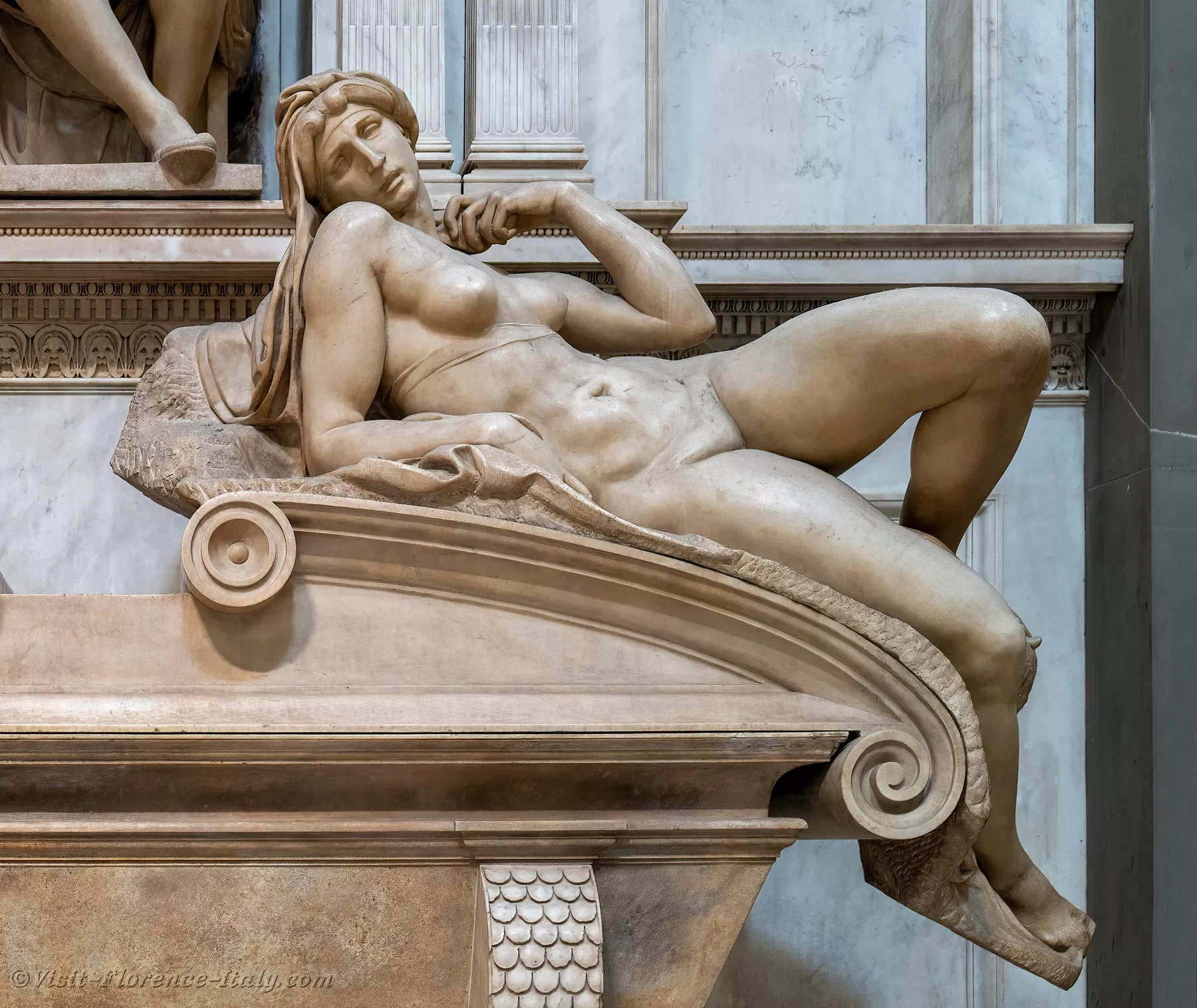 Sculpture of Michelangelo's Dawn in the Medici Chapel New Sacristy, Florence
Across from Dawn rests “Dusk” (Crepuscolo), a male figure. His form is heavy, weary, sinking into repose. This figure embodies the winding down of the day, the descent into night. His expression is often read as contemplative, exhausted, or resigned. Together, dusk and dawn by michelangelo encapsulate the alpha and omega of a single day, the reluctant beginning and the heavy end.
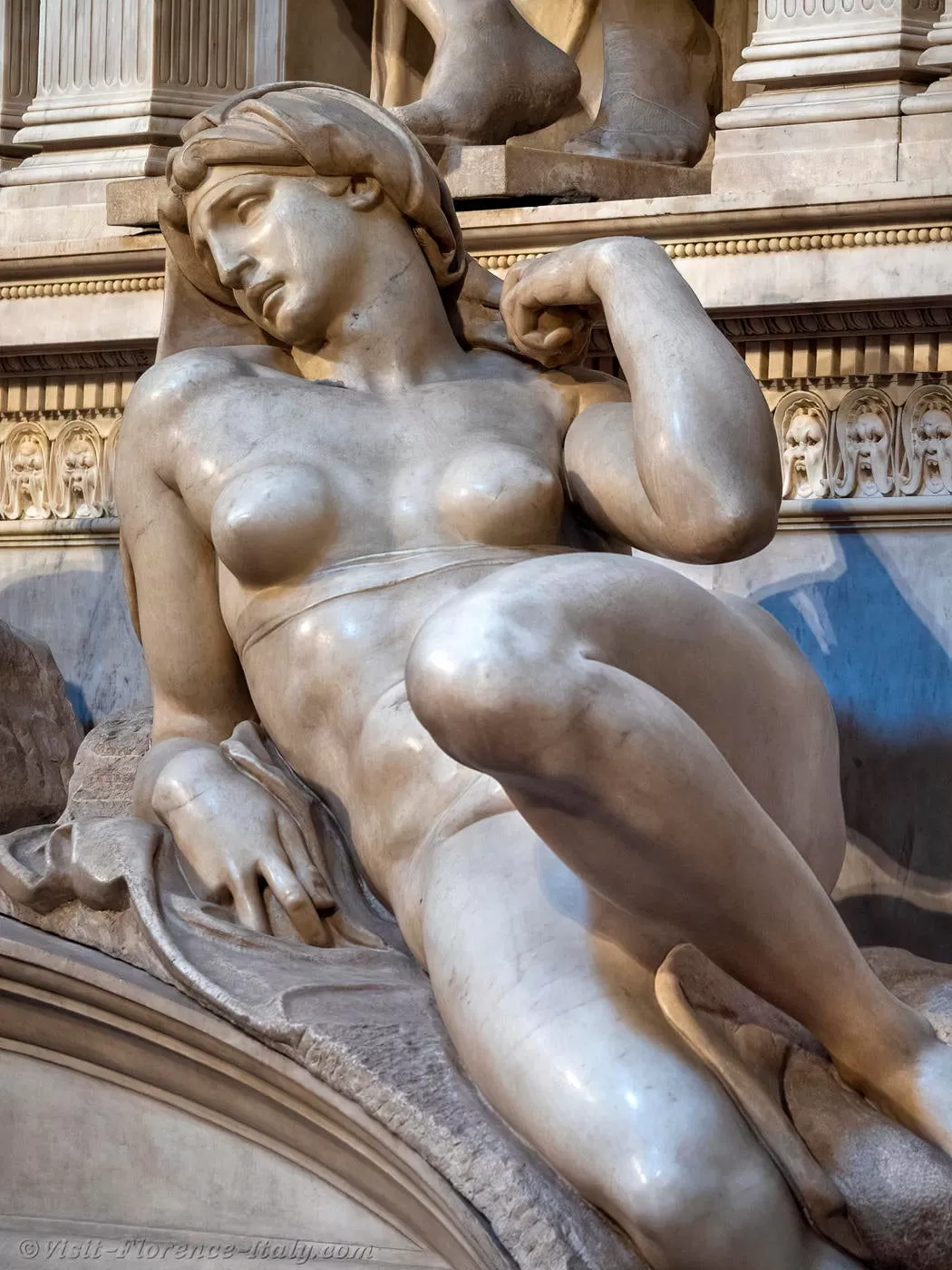 Close-up of Michelangelo's Dawn sculpture's face and shoulders, showing the expression of pain or reluctance
The muscular tension and contorted poses characteristic of Michelangelo’s work, also seen in his Sistine Chapel frescoes, are present here. The unfinished quality of parts of the marble only adds to the sense of raw energy and struggle. These figures are not idealized, serene representations of times of day; they are deeply human, embodying the fatigue, reluctance, and existential weight often associated with temporal cycles.
Symbolism and Poetic Interpretations
The pairing of dusk and dawn by michelangelo on Lorenzo’s tomb invites contemplation on mortality, the passage of life, and the legacy left behind. The relentless cycle of day and night continues, indifferent to the individual figures below. This indifference of time is a classic poetic theme, explored by poets from the ancients lamenting tempus fugit (time flies) to Romantic poets meditating on nature’s cycles, and modern poets grappling with existential transience.
The weary “Dawn” can be seen as a metaphor for the painful process of creation or awakening – the struggle to bring something new into existence, or the harsh reality of facing another day with its attendant burdens. This resonates with poetry exploring themes of inspiration, artistic struggle, or the difficulty of simply existing in a challenging world.
Similarly, “Dusk,” with its heavy, sinking form, speaks to themes of endings, weariness, and the approach of final rest. It is a visual representation of the melancholic beauty of twilight, a time often captured in verse as a moment of reflection, fading light, and inevitable conclusion. Poets frequently use dusk as a symbol for old age or the approach of death.
The fact that these four figures (Dawn, Dusk, Day, Night) do not look towards the central Madonna and Child or the Dukes they adorn, but seem lost in their own world, emphasizes their role as symbols of perpetual, abstract time. They exist in their eternal cycle, independent of human concerns, yet they profoundly affect the human experience. This duality – the abstract nature of time versus its concrete impact on life – is a rich source of poetic inquiry. The sculptures embody this paradox in stone.
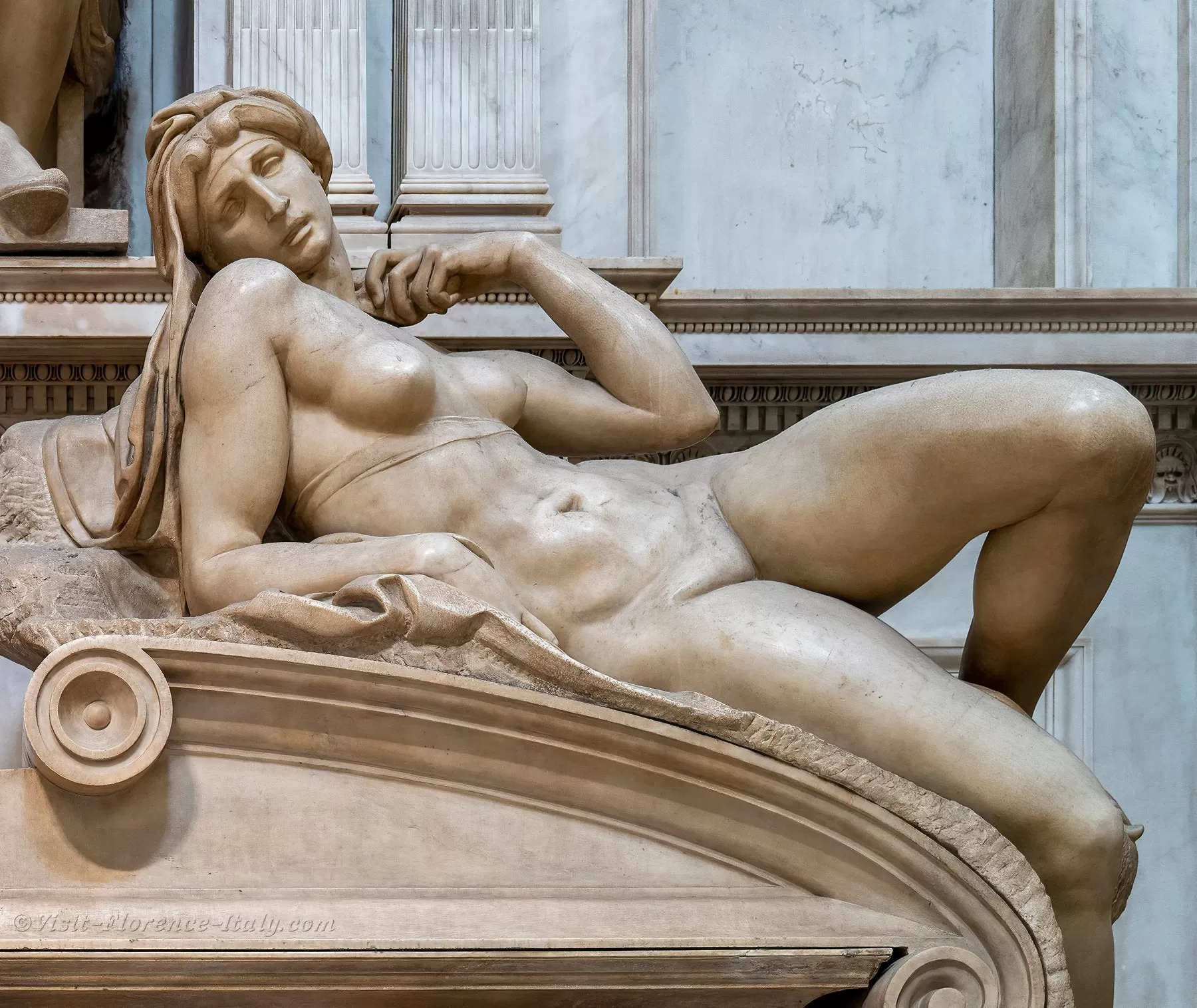 Full view of Michelangelo's Dawn sculpture from the side, showing the figure's posture and musculature
Some art historians tie the sculptures’ somber mood specifically to the political climate of Florence after the siege of 1529-1530 and the fall of the Florentine Republic. This interpretation aligns “Dawn”‘s pained awakening with the painful reality the Florentines had to face, and “Dusk”‘s weariness with the exhaustion and loss of the city’s liberty. This reading adds a layer of historical sorrow to the universal themes of time and human struggle. Such political undertones are also common in poetry, where poets often reflect the anxieties and suffering of their times through metaphor and symbol.
Enduring Artistic Value
Ultimately, Michelangelo’s dusk and dawn by michelangelo sculptures transcend mere representation of times of day. They are powerful artistic expressions of the complex human relationship with time – its inexorable passage, its burden, and its capacity for both pain and beauty. Their unfinished state, the raw power of the forms, and the layers of potential interpretation make them endlessly compelling. Like great poems, they invite deep contemplation and resonate differently with each viewer, offering a timeless reflection on the dawn and dusk of our own existence.