
Life, in its intricate tapestry, weaves moments of profound joy, searing sorrow, vibrant engagement, and quiet contemplation. Yet, there are times when the threads seem loose, the colours muted, and the pattern unclear. This is often the state recently brought to the forefront of public consciousness: languishing. More than mere boredom but less than clinical depression, languishing exists in the ‘massive middle’ of the mental health spectrum – a pervasive feeling of ‘blah-ness’, emptiness, and stagnation that can dull motivation and leave one feeling adrift.
Contents
First named by sociologist Corey Keyes in 2002, languishing is characterized by dissatisfaction, a lack of engagement with life, and a sense of apathy. It is, in essence, the absence of mental health, not the presence of mental illness. While not a clinical diagnosis, it’s a state where individuals are neither unwell nor thriving; they are simply getting through the day, completing tasks without finding enjoyment, existing in a quiet despair. This state feels like wasting away or deteriorating, marked by a distinct loss of energy and vitality.
This feeling has become particularly resonant following periods of collective trauma and prolonged uncertainty, such as the recent global pandemic. The brain struggles under chronic stress, leading to emotional exhaustion when stressors have no clear end in sight. The fear, grief, isolation, and distance experienced over prolonged periods can easily culminate in a state of languishing. Even as external pressures ease, many find themselves left with this lingering sense of aimlessness, a muted response that feels out of sync with the expectation of relief or joy.
How does one identify this subtle, creeping state? Languishing often manifests as a disconnection from others, irritability, difficulty focusing, lack of excitement for the future, procrastination, and a general cynicism. In personal life, it can present as an absence of well-being despite not being sick, an inability to articulate feelings, a feeling of merely going through the motions, or a sense of emptiness akin to an existential ponder, though distinct from a full-blown crisis. These symptoms subtly erode energy and resilience, making even normal challenges feel harder and complicating the ability to form and maintain positive relationships, further entrenching the feeling.
Identifying languishing in oneself can be challenging precisely because it lacks the dramatic urgency of a crisis. It’s the state of being “fine,” but definitively not “great.” It creeps in gradually, often unnoticed, leaving individuals existing far below their potential. Recognizing this state is crucial, as research suggests that those who languish are at a higher risk of developing more severe mental health conditions like anxiety disorders and depression later on.
While sharing symptoms like lack of energy and difficulty focusing, languishing differs from burnout and depression in cause and severity. Burnout is typically work-related, stemming from poor work-life balance or misalignment of values, whereas languishing affects all areas of life. Depression is a severe, clinical condition requiring professional treatment, lasting for extended periods. Languishing, while persistent if unaddressed, often fluctuates and is more about a lack of vitality and optimism than the clinical symptoms of depression. The concern with languishing lies in getting stuck in this state without the tools to move towards well-being, increasing vulnerability to future mental health challenges.
Languishing in Verse: Echoes of the ‘Blah’ State in Poetry
Given that poetry is the art of distilling human experience into language, it’s perhaps unsurprising that states akin to languishing have found voice in verse throughout history. Poets, as keen observers of the inner landscape, have long grappled with feelings of ennui, melancholia, apathy, listlessness, and a profound sense of disconnection that resonate strongly with the modern definition of languishing. Exploring how poets articulate these states offers not only a deeper understanding of the feeling itself but also highlights the enduring power of poetry to name the ineffable.
Consider, for instance, the prevalent theme of ‘melancholy’ in Romantic poetry. While distinct from languishing in its often sublime or even romanticized aspects, it shares the core feeling of a weighted, disengaged state. Poets like Keats explored the “sadness of the world,” a heavy burden that dulls the senses and disconnects the individual from vibrant life, echoing the apathy and lack of engagement characteristic of languishing.
Victorian poets, grappling with industrialization and societal change, often captured a sense of spiritual languishing or aimlessness. Matthew Arnold’s “Dover Beach,” while known for its ‘sea of faith’ metaphor, speaks to a withdrawal, a quiet sadness amidst changing tides, suggesting a state of emotional and spiritual depletion that feels profoundly modern in its resonance with uncertainty and diminished connection. The “drear,” “melancholy, long, withdrawing roar” evokes a sense of something essential receding, leaving a void not filled by immediate suffering, but by quiet loss.
In modernist poetry, the sense of disconnection becomes even more pronounced. T.S. Eliot’s “The Waste Land” famously portrays spiritual and cultural decay, a landscape populated by figures living lives devoid of meaning and vitality, merely existing (“mixing memory and desire, stirring dull roots with spring rain”). This depiction of modern ennui, of urban alienation and emotional sterility, captures a collective form of languishing – a sense of being ‘stuck’ in a state of depleted engagement, echoing the modern experience of feeling aimless despite outward activity.
Poets use various techniques to convey these feelings. Imagery of stagnation – still water, barren landscapes, dust – frequently appears. Metaphors of weight, dullness, or faded colours capture the lack of vitality. The very rhythm and structure of a poem can contribute, with slower paces, repetition, or fragmented forms sometimes mirroring a mind struggling with focus or motivation. Reading such famous poems allows us to see our own quiet struggles reflected through the lens of poetic language.
Contemporary poetry continues this exploration, often with a more direct and vernacular approach to emotional states. Poems about modern life, routine, and the quiet anxieties of existence can inadvertently, or intentionally, give voice to the feeling of languishing – the flat days, the lack of anticipation, the struggle to feel fully present.
Beyond the Definition: Can Poetry Help Navigate Languishing?
If poetry can articulate languishing, can it also offer a pathway out? The answer lies in the transformative power of language and the act of engaging with art. While not a substitute for clinical treatment when needed, engaging with poetry—whether reading or writing—can touch upon the very elements that counteract languishing.
Reading poetry can be an act of engagement, pulling the reader out of apathy and into a focused interaction with language, imagery, and emotion. A poem can name a feeling the reader couldn’t articulate, providing validation and reducing the isolation often associated with languishing. It can evoke positive emotions, even if fleetingly, through beauty, insight, or shared human experience. It offers meaning, inviting reflection on universal themes.
Writing poetry, for those inclined, can be a powerful tool for processing complex, inarticulable feelings like languishing. The act of searching for the right words, shaping lines, and creating metaphors forces engagement and brings a sense of focus. It can transform a vague ‘blah’ feeling into something concrete, something that can be examined and understood. It’s an act of creation, leading to a sense of accomplishment, no matter how small.
Consider the PERMA model – Positive emotions, Engagement, Relationships, Meaning, Accomplishments – proposed by Dr. Martin Seligman as components of flourishing. While the model originates in psychology, poetry can be seen as a tool that supports these pillars. Reading or writing a powerful poem can spark positive emotions and provide deep engagement. Sharing poems, discussing them with others, or finding poets who resonate with your experience can foster a sense of relationship and connection. The very nature of poetry is to seek and convey meaning. And completing a poem, or even understanding a complex one, provides a sense of accomplishment.
Compared to states like depression or a full-blown existential crisis, languishing, as captured in poetry, often lacks the sharp edges of despair or the overwhelming weight of an identity collapse. It is quieter, more insidious. Poetry can help distinguish these states by offering precise language for subtle emotional nuances, allowing readers to better understand what they are feeling, even if it’s just a muted ache or a faded colour palette.
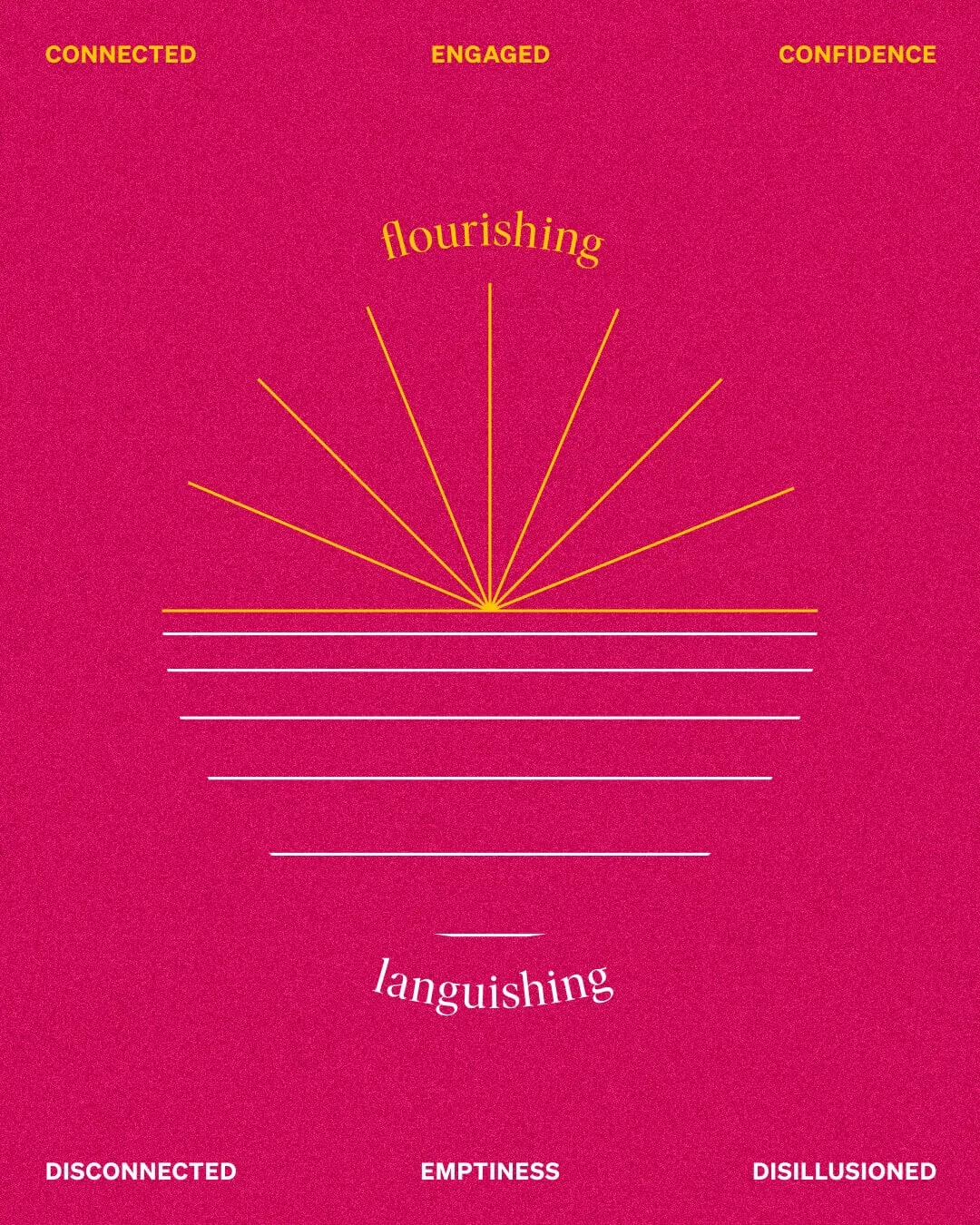 Graphic comparing languishing and flourishing mental states
Overcoming languishing is not about a sudden cure, but a practice of cultivating vitality. While professional support like coaching or therapy can be crucial, especially when underlying issues exist, engaging with practices that foster PERMA can shift the needle. For poetry lovers, this might mean:
- Increasing positive emotions: Finding joy in reading or writing poetry, focusing on poems that uplift or inspire gratitude.
- Increasing engagement: Dedicating focused time to reading or writing, analyzing a poem deeply, or getting lost in the rhythm and flow of verse. Engaging with famous poems can be a starting point.
- Improving relationships: Joining a poetry reading group, discussing poems with friends, or connecting with fellow enthusiasts online.
- Finding meaning: Exploring poems that delve into life’s purpose, grappling with existential questions through verse, or finding personal meaning in the themes a poem presents.
- Accomplishments: Finishing a challenging poem, writing a new piece, or simply setting aside dedicated time for poetry engagement and sticking to it.
Languish is Common, Yet Articulating It Through Poetry Offers Hope
Languishing, this pervasive state of ‘blah-ness’ and stagnation, is a common human experience, recently amplified by global circumstances. While psychological definitions and strategies like the PERMA model offer frameworks for understanding and addressing it, poetry provides an alternative, often more intuitive, path.
Through the ages, poets have given voice to the quiet disengagement, the dull ache, and the lack of vitality that define languishing. By exploring these themes in verse, we gain a deeper understanding of this complex state and feel less alone in experiencing it. Furthermore, the very act of engaging with poetry – reading it, analyzing it, writing it – involves positive emotions, engagement, potential relationships, the search for meaning, and small accomplishments. These are the building blocks that help shift us from a state of languishing towards one of flourishing.
Languishing may be common, but it doesn’t have to be a permanent state. Words have power – the power to name a feeling, the power to connect us to others who have felt similarly, and the power to re-engage us with the world. For those in the grip of languishing, turning to poetry might just be one way to start finding the words to bloom again.