
Poetry, at its heart, is an art form deeply connected to language, rhythm, and sound. While the 20th century saw a significant shift towards free verse, moving away from traditional structures, the enduring power and unique value of formal verse poems remain undeniable. Formal verse adheres to established patterns of meter, rhyme, and stanzaic form, creating a distinct kind of musicality and memorability that speaks to fundamental aspects of human experience and communication. This article explores why formal verse is not merely a historical curiosity but a vibrant and essential component of the poetic landscape.
Contents
- What Exactly Are Formal Verse Poems?
- Why Form Matters: Rhythm, Music, and Harmony
- The Innate Power of Rhythm
- Rhyme and its Resonances
- Crafting Memorability: Formal Verse as a Vessel for Memory
- Formal Verse Poems Across Eras and Cultures
- Formal Verse in the Modern Soundscape
- The Enduring Debate: Formal Verse vs. Free Verse
- Conclusion
What Exactly Are Formal Verse Poems?
Formal verse poems are characterized by their conscious use of structure. This structure typically involves a regular meter, which is the rhythmic pattern of stresses within a line of verse (like iambic pentameter, trochaic tetrameter, etc.). They also often employ a defined rhyme scheme, a pattern of rhymes at the end of lines (such as AABB, ABAB, ABBA). Furthermore, formal verse frequently utilizes specific stanzaic forms, recognized patterns of lines and rhymes that create the building blocks of the poem (like quatrains, sonnets, villanelles, haikus). Adhering to these formal constraints is not about limitation, but about channeling creative energy within a framework that can amplify meaning and emotional impact.
Why Form Matters: Rhythm, Music, and Harmony
The appeal of formal verse poems is deeply rooted in their sonic qualities – their rhythm, music, and harmony. As literary figures throughout history have noted, poetry has a unique connection to musicality.
Aristotle, in his Poetics, identified rhythm, language, and harmony as key elements of poetry, distinguishing it from other language-based forms through the use of harmony. Centuries later, Thomas Campion spoke of poetry as the “ioyning of words to harmony.” Ezra Pound famously updated Aristotle, stating, “Poetry is a composition of words set to music.” This inherent musicality is most pronounced in formal verse.
The Innate Power of Rhythm
The regular pulse of meter in formal verse resonates with fundamental human rhythms – the heartbeat, the breath, the natural cadences of speech. This creates an almost physical connection with the reader or listener, drawing them into the poem’s flow. A consistent rhythm can build anticipation, mimic movement, or create a sense of order or inevitability, adding layers of meaning beneath the semantic content of the words. It provides a foundational structure upon which the poet can build complex emotional and intellectual expressions.
Rhyme and its Resonances
Rhyme schemes create connections between lines and ideas through sound. Rhyme can provide a sense of closure, emphasize certain words or concepts, create unexpected juxtapositions, or simply delight the ear. The satisfaction of a well-executed rhyme reinforces the structure and contributes to the poem’s overall harmony. Beyond simple end-rhyme, techniques like internal rhyme, alliteration, and consonance further enhance the sonic texture, binding the language together in memorable ways. Exploring the works of famous women poet who masterfully employ these devices can illuminate their powerful effect.
Crafting Memorability: Formal Verse as a Vessel for Memory
One of the most practical and profound effects of formal elements is their contribution to memorability. The rhythm and rhyme in formal verse act as mnemonic devices, creating “hooks” on which the exact words of the poem can hang in our minds. Think of nursery rhymes, songs, or traditional ballads – their form makes them easily retained and passed down.
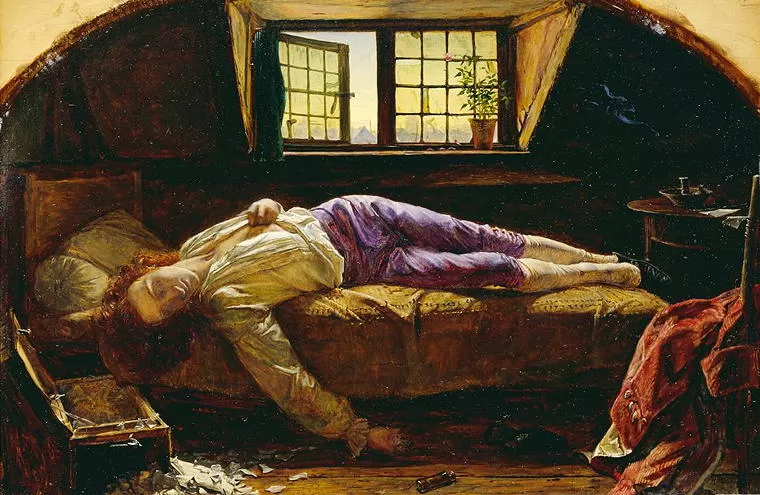 The Death of Chatterton
While modern life may rely less on oral tradition, this memorability is still crucial. It allows lines and phrases to echo in the mind long after reading, embedding the poem’s message or emotion more deeply. The resistance of formal verse to paraphrase, its insistence on the specific “best words in their best order” (as Coleridge put it), is reinforced by its structure, making it a uniquely durable form of communication. This contrasts sharply with the often less fixed linguistic patterns of free verse, which, while capable of great insight, are typically harder to recall word-for-word.
Formal Verse Poems Across Eras and Cultures
From ancient epics to Elizabethan sonnets, Romantic odes, and beyond, formal verse has been the dominant mode of poetic expression for much of literary history across diverse cultures. These forms evolved over centuries, proving their flexibility and power to convey a vast range of human experience. Poets like robert frost poems, writing in the 20th century, continued to utilize traditional forms, demonstrating their ongoing relevance and capacity for innovation. The forms themselves carry historical weight and resonance, connecting contemporary poets and readers to a rich literary heritage. Understanding how forms like the sonnet or ballad have been used and adapted throughout history provides valuable context for appreciating the art form’s evolution and its engagement with various themes, including complex societal issues. For example, historical analyses can sometimes touch upon how the language and themes within certain poetic eras intersected with dominant ideologies of the time.
Formal Verse in the Modern Soundscape
Although free verse gained prominence in the 20th century, the principles of formal verse never disappeared from popular culture. They live on vigorously in song lyrics across genres – rock, country, hip-hop, musicals – where rhythm, rhyme, and structure are fundamental. Rap, in particular, is a highly sophisticated form of contemporary formal verse, often employing intricate rhyme schemes, complex rhythms, and internal meter. The chants of protests, the rhythms of advertising jingles, and, of course, the lullabies sung to children all carry forward the ancient human impulse for patterned sound in language. Even outside of strict song, many modern performance poets utilize rhythm and repetition in ways that echo formal techniques. Poems written for specific traditional or cultural events, such as church easter poems, often adhere to formal patterns, showcasing the enduring link between structure, ritual, and shared experience.
The Enduring Debate: Formal Verse vs. Free Verse
The debate between formal verse and free verse is often framed as an opposition, but it might be more productive to see them as distinct tools in the poet’s arsenal, each with unique strengths. While free verse offers unparalleled flexibility and can capture the nuances of modern thought and speech with great fidelity, it sometimes risks losing the intense sonic focus and structural reinforcement that formal verse provides.
Formal verse, by embracing constraints, often forces poets into surprising and creative linguistic choices they might not otherwise make. The challenge of fitting meaning into meter and rhyme can lead to compression, unexpected turns of phrase, and a heightened sense of artistry. While some free verse can indeed feel like prose broken into arbitrary lines, formal verse, by definition, commits to a level of rhythmic and sonic organization that inherently distinguishes it from everyday language. This commitment to form is not merely decorative; it is integral to how the poem creates meaning and evokes emotion.
Conclusion
Formal verse poems, with their deliberate patterns of meter, rhyme, and structure, offer a powerful and enduring mode of poetic expression. They connect us to the inherent musicality of language, enhance memorability, link us to a rich literary history, and continue to thrive in both high art and popular culture. While free verse has expanded the possibilities of poetry, the unique strengths of formal verse – its harmony, rhythm, and structured beauty – ensure its continued relevance and its vital contribution to the vibrant art of poetry. They challenge both the poet and the reader to engage deeply with the sonic and structural dimensions of language, yielding rewards that are both intellectually stimulating and deeply emotionally resonant.