
Poetry offers a powerful lens through which to examine the most profound human experiences, and few themes are as universal or multifaceted as love. The phrase “love is poem” can be interpreted not just as a statement about love itself possessing poetic qualities, but also as a description of a specific poetic form used to explore this complex emotion: the “Love Is” poem. This structure, often a type of list poem, invites poets and readers alike to articulate the countless facets and feelings associated with love through a series of declarations beginning with the simple yet evocative phrase, “Love is.”
The accessibility and depth of the “Love Is” poem make it particularly effective, capable of capturing everything from grand gestures to subtle nuances. It encourages a free flow of ideas, allowing for diverse perspectives and personal interpretations. This form gained notable public attention when poet Kwame Alexander, inspired by the simplicity and profound insights of children, initiated a project asking students to complete the phrase “Love is…” The resulting collective poem, compiled from over 2,000 student responses, beautifully demonstrated the expansive nature of love as seen through young eyes. This initiative highlights how the “love is poem” structure can unlock surprising and heartfelt definitions, proving that complex emotions can be explored through seemingly simple means.
Understanding the ‘Love Is’ Form
The “Love Is” poem is a variation of the list poem, also known as a catalogue poem or a blazon (when describing a person’s physical attributes, though “Love Is” applies to abstract concepts). Its primary characteristic is the repetition of the phrase “Love is,” followed by varied definitions, comparisons, metaphors, or descriptions.
The power of this form lies in its cumulative effect. Each line, though distinct, builds upon the last, creating a mosaic of meaning. The juxtaposition of different images and ideas can be surprising, illuminating, and deeply moving. For instance, one line might offer a concrete, everyday example (“Love is hot dogs with ketchup”), while the next presents an abstract concept (“Love is justice”), revealing the many layers on which love operates in our lives. This structure makes poetry writing approachable, dismantling the notion that all poems must be complex riddles and demonstrating that profound expression can arise from structured simplicity, a technique also explored in some holocaust short poems or short holocaust poems to convey immense pain through stark, simple images.
This form is particularly effective in educational settings, where it empowers new writers to explore their feelings and observations without the pressure of complex rhyme schemes or meter. It encourages creative thinking, metaphor, and personal reflection, making the abstract concept of love tangible through individual experience.
Voices from the Classroom: Student ‘Love Is’ Poems
Inspired by Kwame Alexander’s project, educators often use the “Love Is” activity to engage students with poetry and explore emotional literacy. The resulting poems frequently offer definitions of love that are both unexpected and deeply insightful, reflecting the uninhibited perspectives of children.
Below are two collaborative “Love Is” poems compiled from the lines written by elementary school students. These poems serve as vivid examples of how the “love is poem” form can capture a wide spectrum of meanings and feelings associated with love:
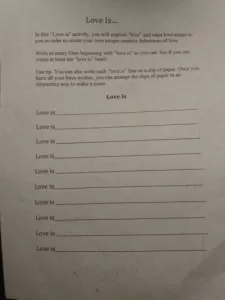 Student-created handout with the prompt "Love Is"
Love Is
By iclass students at Ponce de Leon Elementary and High Point Elementary
Love is loving my “me.”
Love is sunny days.
Love is what makes us human.
Love is hot dogs to eat with ketchup.
Love is coming to you.
Love is school.
Love is the center of your heart.
Love is my mom.
Love is right.
Love is learning.
Love is truth.
Love is my moon.
Love is life.
Love is caring for myself.
Love is for all.
Love is family.
Love is hard.
Love is beautiful.
Love is sharing things, and love.
Love is amazing.
This collection demonstrates the immediate, personal nature of love for young writers. Definitions range from self-love (“loving my me”) to simple pleasures (“sunny days,” “hot dogs”), core relationships (“my mom,” “family”), abstract concepts (“truth,” “right,” “life”), and universal feelings (“beautiful,” “amazing”). The inclusion of “Love is what makes us human” shows a remarkable grasp of love’s fundamental role in connection and existence. These lines, while simple in structure, collectively paint a rich picture of love rooted in experience and feeling.
Another group of students produced a similarly diverse and moving collection, expanding the scope to include societal observations and deeper emotional connections:
Love Is
By iclass students at Midtown Academy, Melrose Elementary, Campbell Park Elementary, and Fairmount Elementary
Love is smiling.
Love is a bond that two people share.
Love is hope—I hope my kids will love their skin color, whatever it is.
Love is taking care of my baby sister.
Love is the world that flows through the moon.
Love is the wave of the ocean.
Love is blue.
Love is coming home.
Love is Black Lives Matter.
Love is what made you.
Love is our family. Love is animals.
Love is giving someone the power to build you up.
Love is family. Love is my home.
Love is all colors.
Love is Krispy Kreme.
Love is warm and fuzzy.
Love is when two people touch each other’s soul.
Love is my mom. She is my heart.
Love is justice.
Love is my grandma.
Love is infinite.
Love is reaching our dreams, together.
Love is my lovely pit bull.
Love is me. Love is everything.
Love is red. Love is pink.
Love is ice cream in the sun.
Love is a jungle.
Love is to keep your masks on.
Love is you. Love is chocolate.
Love is the core of the earth that keeps us warm.
Love is us. Love is what you want it to be.
Love is the color of my heart.
Love is real. Love is perfect.
Love is obedience.
Love is when two people know each other’s secrets,
their deepest, darkest, most dreadful secrets.
Love is a soul.
Love is love.
This second poem delves into even more complex territories. Alongside personal connections (“my baby sister,” “my grandma,” “my lovely pit bull”) and sensory experiences (“Krispy Kreme,” “ice cream in the sun,” “warm and fuzzy”), we find reflections on social issues (“Black Lives Matter,” “justice,” “to keep your masks on”) and abstract concepts (“infinite,” “everything,” “a soul,” “what you want it to be”). The lines “Love is when two people know each other’s secrets, / their deepest, darkest, most dreadful secrets” show a surprising maturity in understanding vulnerability and trust within love, echoing themes sometimes found in more complex literary works among the best poems of 20th century or most iconic poems. The inclusion of “Love is love” serves as a simple yet powerful affirmation of its own existence.
Conclusion
The “love is poem” structure, particularly effective as a list poem exercise, provides a revealing pathway into understanding the multifaceted nature of love. As demonstrated by the poignant contributions of these young students, this simple form allows for profound expressions of personal, relational, societal, and abstract concepts of love. These poems remind us that love is not a single, easily defined entity, but a vast and varied experience, encompassing everything from the mundane to the infinite, the personal to the political. Exploring love through verse, whether in the form of a “Love Is” poem or other poetic structures, allows us to connect with our own feelings and appreciate the diverse ways this essential human experience manifests in the world.