
Love, in its myriad forms, has been the muse of poets across centuries and cultures. From the fervent declarations of romantic passion to the quiet understanding of companionship, the ache of loss, or the complex bonds of family and friendship, love permeates the human experience. Poetry, with its unique ability to distill vast emotions and ideas into concise, evocative language, serves as a perfect vessel for exploring the profound meaning of love poems. These verses don’t just describe love; they embody it, inviting readers to feel, question, and understand this universal force on a deeper level.
Delving into the meaning of love poems reveals not a single definition, but a rich tapestry woven from diverse perspectives, historical contexts, and poetic techniques. Each poem offers a window into a specific facet of love, illuminated by the poet’s individual voice and craft. Understanding these meanings involves more than just reading the words; it requires engaging with the imagery, rhythm, structure, and emotional landscape the poet creates.
 Exploring the meaning of love poems across diverse collections.
The Multifaceted Nature of Love in Verse
One of the most compelling aspects of love poetry is its capacity to capture the vast spectrum of human connection. Poets explore love in its many dimensions, moving beyond simple sentiment to probe its complexities, joys, and sorrows.
Romantic Passion and Devotion: At the heart of many love poems lies the portrayal of intense romantic feeling. Elizabeth Barrett Browning’s famous “How Do I Love Thee?” uses hyperbole to express a love that reaches the limits of the soul’s being, illustrating a profound devotion that transcends physical boundaries. William Shakespeare, in Sonnet 18, eternalizes his beloved’s beauty and essence by comparing her not just to a summer’s day, but to the enduring power of his own verse, imbuing his love with immortality through art. Similarly, the fervent lines of Rumi’s “Defeated by Love” or the consuming longing in Pablo Neruda’s “Love Sonnet XI” articulate a passion that feels overwhelming, life-altering, and utterly captivating. The meaning here isn’t just affection, but a complete surrender to the power of the beloved and the emotion itself.
Enduring Companionship: Not all love poems focus on soaring passion; many find beauty in the quiet, lasting bond of companionship. Margaret Atwood’s “Habitation” acknowledges the effort and challenges within marriage but celebrates the shared journey and the wonder of survival. Katherine Mansfield’s “Camomile Tea” captures a tranquil intimacy, finding deep satisfaction and wisdom in the simple, shared moments of domestic life. Maya Angelou’s “Come, And Be My Baby” speaks to the comfort and solace found in a lover’s presence amidst the chaos of the world, highlighting love as a refuge and a source of strength. These poems convey a meaning of love built on shared history, comfort, and mutual support.
 Poet Maya Angelou, whose work explores the comforting meaning found in love.
Loss and Heartbreak: The pain of lost love is as fertile a ground for poetry as love’s joy. W.H. Auden’s “The More Loving One” uses celestial metaphor to describe the pain of unreciprocated love and eventual loss, finding a somber beauty in acceptance. Christina Rossetti’s “Echo” is a poignant expression of yearning for a lost love, wishing for their return like an echo rebounding through memory. Audre Lorde’s “Movement Song” captures the sorrow at the end of a relationship but also the possibility of new beginnings, albeit separate. These works explore the profound meaning that absence gives to love, the lasting impact it leaves, and the difficult process of moving forward.
Non-Romantic Love: The concept of “love poem” can also encompass bonds beyond the romantic. Emily Brontë’s “Love and Friendship” contrasts the fleeting beauty of romantic love (like a rose) with the enduring strength of friendship (like a holly tree), highlighting the deep value and resilience of platonic affection. Pat Parker’s “My Lover Is a Woman” transcends typical romantic tropes to explore the meaning of love as a safe harbor and a source of strength within the context of identity and societal struggle, adding layers of social and personal significance to the emotion.
 Emily Brontë, known for exploring various meanings of love, including friendship.
Crafting Meaning: Poetic Techniques in Love Poetry
Poets employ a vast arsenal of literary devices to imbue their explorations of love with depth, emotion, and specific meaning. Understanding these techniques helps unlock the layers within the verse.
Imagery and Symbolism: Vivid imagery engages the senses and creates resonant symbols. Robert Burns’ “A Red, Red Rose” uses the iconic flower to symbolize passionate, fresh love, while Percy Bysshe Shelley’s “Love’s Philosophy” draws upon images of natural mingling (fountains with rivers, rivers with oceans) to argue for the naturalness and necessity of human connection. John Donne compares his love to the pure movement of angels in “Air and Angels,” elevating the emotion to something divine. Joy Harjo contrasts love with the enduring beauty of nature in “For Keeps,” suggesting a bond as fundamental and lasting as the natural world itself. These symbolic connections enrich the meaning of love poems, linking personal feeling to universal forces.
Metaphor and Simile: Comparisons are fundamental to explaining the ineffable nature of love. Craig Arnold’s “Bird-Understander” uses the metaphor of deeply understanding a bird’s unique way of being to represent a profound, non-judgmental acceptance of his partner’s true self. Daniel Hoffman’s “Yours” employs similes comparing the speaker’s belonging to his lover to the air possessed by scent or a snowcap by moonlight, illustrating a complete and essential connection. Langston Hughes uses the metaphor of a “high mountain” for love in “A Love Song for Lucinda,” conveying both its exhilarating heights and its potential dangers. Poets often employ vivid metaphor and simile to articulate these complex feelings. Exploring the use of these devices can offer deep insights, a skill valuable even when reading metaphor poems for kids.
Tone and Voice: The poet’s attitude and voice significantly shape the poem’s meaning. Margaret Atwood’s “Variations on the Word Love” adopts an analytical, almost clinical tone to dissect the different, sometimes uncomfortable, forms love can take. Rita Dove, in “Heart to Heart,” uses a direct, down-to-earth voice to reject clichés and assert a love that is real rather than idealized. Geoffrey Chaucer, in “Rondel of Merciless Beauty,” adopts a tone of piteous, yet devoted, heartbreak after being left. Matthew Yeager’s “Poem to First Love” uses a conversational, even humorous tone to try and quantify the immense feeling of first love, creating a unique, relatable perspective. The chosen tone guides the reader’s emotional response and understanding of the love being depicted.
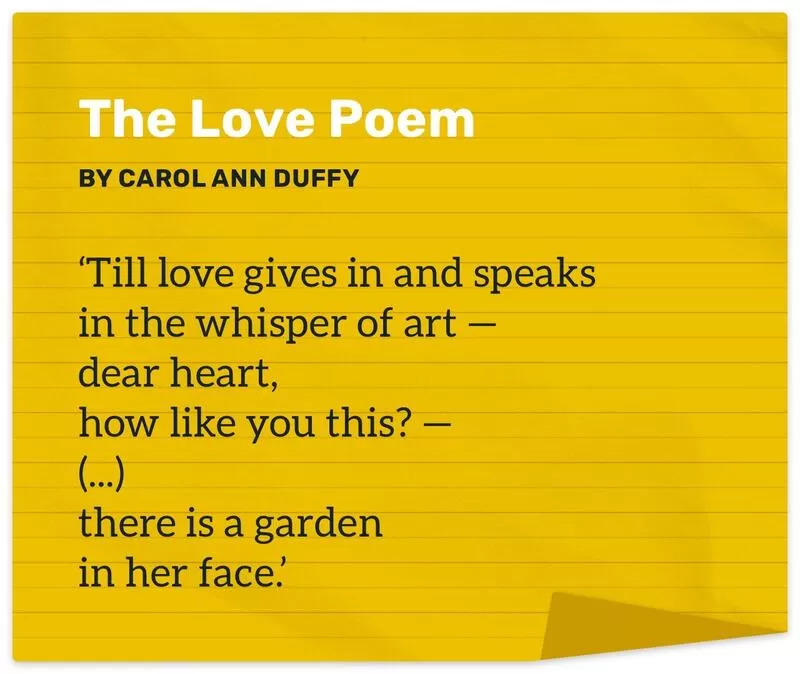 Carol Ann Duffy, poet laureate, capturing the vast and sometimes challenging meaning of love in verse.
Beyond the Surface: Deeper Meanings
The meaning of love poems often extends beyond simple expression, exploring love’s transformative power, its paradoxical nature, and its intersection with identity and reality.
Love as Transformation: Falling in love can fundamentally alter one’s perception of the world. Faiz Ahmed Faiz’s “Before You Came” describes how the world felt incomplete or distorted before his lover’s arrival, and only with her presence does reality become itself again. Gwendolyn Brooks’ “To Be In Love” speaks of touching “with a lighter hand” and feeling “well” within oneself, suggesting love brings healing and a new ease of being. These poems highlight love’s capacity to reshape one’s inner and outer world.
The Paradoxes of Love: Love is often a bundle of contradictions – pain and pleasure, absence and presence, madness and clarity. Luís Vaz de Camões describes love as “a wound that aches yet isn’t felt,” capturing its confusing blend of suffering and numbness. E.E. Cummings, in “[love is more thicker than forget],” plays with opposing concepts (“thicker than forget, more thinner than recall”) to show that love defies simple definition, residing in a complex, paradoxical space that is both rare and frequent, profound and modest. Understanding these paradoxes is key to grasping the intricate meaning of love poems.
Love and Identity/Context: A poet’s background and the context of their time can profoundly influence the meaning of love in their work. Janice Gould, as a Maidu lesbian, brings her specific identity and experience to her poems like “Six Sonnets: Crossing the West,” where love is intertwined with themes of separation and longing through a particular cultural lens. Cyrus Cassells’ collection Beautiful Signor, written against the backdrop of the AIDS epidemic, imbues romantic love with a poignant beauty and urgency, a testament to connection in challenging times. Pat Parker’s poem, mentioned earlier, similarly centers love within the context of marginalized identity, showing how love can be a source of resilience and validation.
The Mundane vs. The Ideal: Some poems deliberately ground love in reality, contrasting it with idealized notions. Rebecca Hazelton’s “You Are the Penultimate Love of My Life” is striking for its honesty, acknowledging that the love isn’t necessarily “the one,” but still holding value and presence in the speaker’s life, finding meaning in the imperfect reality. Lisa Olstein’s “Dear One Absent This Long While” focuses on the anxious, mundane act of waiting for a loved one’s return, giving emotional weight to the everyday reality of separation and longing. These poems find deep meaning not in grand declarations, but in the relatable experiences of real-life love. Poetry also captures shared, domestic moments, painting vivid pictures of connection, sometimes even referencing simple pleasures like those explored in drink poetry.
 William Shakespeare, whose sonnets profoundly explore the enduring meaning of love.
Conclusion
Exploring the meaning of love poems is an ongoing journey into the heart of human experience. These poems, spanning diverse styles and eras, collectively reveal that love is not a static concept but a dynamic, multifaceted force capable of inspiring intense joy, profound sorrow, quiet comfort, and transformative growth. Through careful use of imagery, metaphor, tone, and form, poets offer us unique ways to perceive and understand the complex meanings embedded within our deepest connections. Engaging with love poetry allows us to see our own experiences reflected and illuminated, enhancing our appreciation for both the art form and the enduring power of love itself.