
Love, in its myriad forms, has always been a central muse for poets. Yet, while romantic love often takes center stage, particularly around certain celebratory times, the ache and introspection that follow its absence – lost love poems – offer a uniquely fertile ground for verse. Far from being merely “un-Valentine” poetry, poems exploring lost love delve into the profound complexities of human emotion, revealing vulnerability, resilience, and the enduring power of memory.
Contents
When love is lost, the initial reaction is often a deep lament, a raw outpouring of grief. This first phase of heartache is a fertile source of powerful, resonant poetry that captures the immediate pain of separation. Poets across centuries have articulated this specific misery with striking honesty and vivid imagery.
The Raw Grief of Love Newly Lost
The immediate aftermath of lost love frequently manifests as overwhelming loneliness and a sense of desolate yearning. Poetry offers a powerful channel for this raw emotion. Many poignant verses capture this specific misery, making it relatable across time and experience.
 Silhouette of Man under tree shaped like heart with twilit background
Consider Alfred Tennyson’s “Mariana,” a poem that paints a vivid picture of a woman consumed by the absence of her lover. Drawing inspiration from Shakespeare’s Measure for Measure, Tennyson expands Mariana’s story, detailing her lonely existence in a decaying farmhouse, the “moated grange.” Her daily life is marked by gloom and decay, mirroring her inner state. The repetition of her lament underscores the depth of her despair.
She drew her casement-curtain by,
And glanced athwart the glooming flats.
She only said, “The night is dreary,
He cometh not,” she said;
She said, “I am aweary, aweary,
I would that I were dead!”—“Mariana” by Tennyson
These lines, repeated with variations throughout the poem, escalate the emotional impact. The description of the desolate setting – the “glooming flats,” the decay, the sounds of bats and mournful birds – enhances the sense of isolation. Tennyson’s musicality and vivid sensory details elevate Mariana’s sadness beyond mere pathos, making it a deeply affecting portrait of a soul in anguish over a lost connection.
Moving further back in time, Sir Thomas Wyatt’s elegant sonnet, “They Flee from Me,” explores the pain of desertion through a striking extended metaphor. The speaker compares his former lovers to wild creatures who once came to him freely but now shun his presence.
They flee from me that sometime did me seek
With naked foot, stalking in my chamber.
I have seen them gentle, tame, and meek,
That now are wild and do not remember
That sometime they put themself in danger
To take bread at my hand; and now they range,
Busily seeking with a continual change.–“They Flee From Me” by Sir Thomas Wyatt
The speaker’s pain stems not just from the physical absence but from the inexplicable change in affection, the sense of being forgotten or discarded. The contrast between their former “gentle, tame, and meek” approach and their current wild flight highlights his hurt. Wyatt’s portrayal suggests a world where relationships can be transactional, and emotional vulnerability is met with indifference or calculated withdrawal. The poem captures the sting of realizing that a deeply felt connection is no longer reciprocated.
The pain of a broken promise or a final, unmet rendezvous is captured poignantly in Thomas Hardy’s “A Broken Appointment.” The poem describes the speaker’s wait for a former lover who fails to show up for what was likely meant to be their last meeting.
You did not come,
And marching Time drew on, and wore me numb,—
While the speaker endures the direct disappointment of being stood up, the deeper wound is the revelation this absence provides about the character of the person he once loved.
You love not me,
And love alone can lend you loyalty; –I know and knew it. But, unto the store
Of human deeds divine in all but name,
Was it not worth a little hour or more
To add yet this: Once you, a woman, came
To soothe a time-torn man; even though it be
You love not me?–“A Broken Appointment” by Hardy
The speaker accepts the lack of love, but laments the absence of even simple kindness or courtesy. The broken appointment diminishes his former admiration for her, adding a layer of disillusionment to the sorrow of the lost relationship. This reveals a complex facet of heartbreak: the pain is not just the loss of the beloved, but potentially a loss of faith in who that person was.
Strategies for Coping with Lost Love
After the initial wave of grief, individuals often seek ways to cope with the lingering pain of love poems heartbreak. This can range from attempting to forget, to trying to manage the persistent emotions, to even finding a bittersweet solace in memory. Poets have explored these varied strategies with nuance and insight.
Emily Dickinson, with her characteristic brevity and intensity, captures the internal struggle to suppress feelings in “Heart, We Will Forget Him.” The speaker attempts to instruct her heart and mind to erase the memory of a lost love, assigning different aspects of the beloved – warmth and light – to each faculty.
XLVII
HEART, we will forget him!
You and I, to-night!
You may forget the warmth he gave,
I will forget the light.When you have done, pray tell me,
That I my thoughts may dim;
Haste! lest while you’re lagging,
I may remember him!–Emily Dickinson
The poem’s clever structure, with the speaker addressing her own heart, reveals the internal conflict. The final lines introduce a touch of wry humor and poignant honesty: the fear that the effort to forget is a race against time, and that memory is always ready to resurface if the heart’s “forgetting” lags behind. It highlights the difficulty, if not impossibility, of simply willing away deeply embedded feelings.
Carolyn Kizer’s modern poem “Bitch” offers a vivid, somewhat humorous, yet deeply insightful portrayal of managing unresolved emotions when encountering a former lover years later. The speaker personifies her lingering feelings as a dog, a “bitch,” inside her, reacting instinctually to the man she once loved.
Now, when he and I meet, after all these years,
I say to the bitch inside me, don’t start growling.
He isn’t a trespasser anymore,
Just an old acquaintance tipping his hat.
My voice says, “Nice to see you,”
As the bitch starts to bark hysterically.When the man speaks some kind words to her,
The bitch changes her tone; she begins to whimper.
She wants to snuggle up to him, to cringe.
Down, girl! Keep your distance
Or I’ll give you a taste of the choke-chain.
“Fine, I’m just fine,” I tell him.
She slobbers and grovels.–Carolyn Kizer
This extended metaphor brilliantly captures the struggle between the speaker’s outward composure and her turbulent inner world. The “bitch” represents primal, perhaps unwanted, feelings of anger, longing, and vulnerability. The speaker’s effort to control these emotions through commands and imagined threats (“choke-chain”) reveals the persistent power of the past, even as she maintains a polite facade.
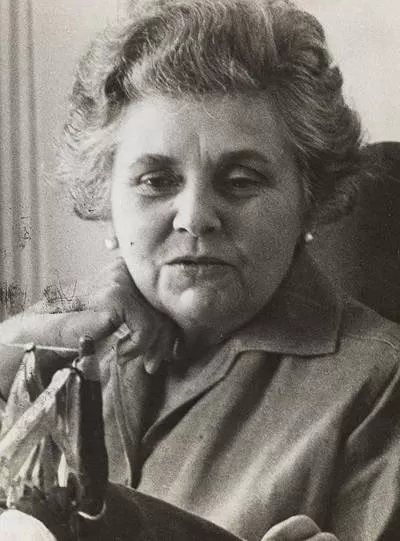 Elizabeth Bishop
Another coping mechanism is denial or minimizing the impact of loss. Elizabeth Bishop’s masterful villanelle “One Art” uses understated irony to explore the speaker’s attempt to convince herself, and the reader, that losing things, even significant ones like a beloved person, is a skill that can be mastered. The villanelle’s form, with its repeating lines, reinforces the speaker’s attempt to control the narrative of loss.
The art of losing isn’t hard to master;
so many things seem filled with the intent
to be lost that their loss is no disaster.
The poem escalates from losing trivial items like keys to losing places, heirlooms, and eventually, a person. The recurring lines, “the art of losing isn’t hard to master” and “their loss is no disaster,” build an ironic tension. By the final stanza, the facade begins to crack, and the parenthetical command to “Write it!” underscores the painful truth that this loss is, in fact, a profound disaster.
—Even losing you (the joking voice, a gesture
I love) isn’t impossible to live with.
Write it!
The poem brilliantly exposes the gap between the speaker’s intellectual assertion of control and the undeniable emotional impact of the loss.
Sometimes, the act of coping involves imagining a future where the lost lover regrets their decision. William Butler Yeats, long haunted by his unrequited love for Maude Gonne, transforms this sentiment into a beautiful and enduring poem, “When You Are Old.” He imagines his beloved in old age, reflecting on her youth and the many who admired her.
When you are old and grey and full of sleep,
. . . take down this book . . .
And dream of the soft look
Your eyes had once, and of their shadows deep;
How many loved your moments of glad grace,
And loved your beauty with love false or true,
He contrasts these transient admirers with his own enduring love, which saw beyond her physical beauty to “the pilgrim soul in you.” The final stanza offers a vision of the lost love not as a failure, but as a noble entity that departed.
And bending down beside the glowing bars,
Murmur, a little sadly, how Love fled
And paced upon the mountains overhead
And hid his face amid a crowd of stars.–“When You Are Old” by Yeats
This personification of Love elevates the experience, giving it a cosmic significance. The wistful “Murmur, a little sadly” suggests a gentle regret, a recognition that something precious was perhaps overlooked. It’s a powerful transformation of personal pain into universal, poetic beauty.
Finally, some poems grapple with the inability to cope, the feeling of being utterly consumed by the lost connection. Romantic poetry Shakespeare often delves into the darker sides of love. Sonnet 147, “My Love is as a fever, longing still,” presents the speaker’s obsession with a lost love as an uncontrollable illness.
My love is as a fever, longing still
For that which longer nurseth the disease,
Feeding on that which doth preserve the ill,
Th’ uncertain sickly appetite to please.
The speaker recognizes that his fixation is irrational and harmful, like a fever that craves what makes it worse. His “reason,” the physician meant to cure this ailment, has abandoned him because he refuses to follow its advice. His thoughts are like those of a “madman,” clinging unreasonably to someone he now sees as unworthy.
For I have sworn thee fair, and thought thee bright,
Who art as black as hell, as dark as night.–Sonnet 147 by Shakespeare
Despite this harsh realization, the speaker remains trapped by his “fever.” The sonnet captures the agonizing self-awareness of being ensnared by an unhealthy attachment, highlighting the difficulty of breaking free from a love that has turned toxic, even when reason dictates otherwise.
Questioning the Value of Love Itself
Given the immense pain that the loss of love can inflict, it is natural to question whether love is truly worth the suffering. This contemplation leads poets to reflect on the nature of love itself – its power, its risks, and its place in human existence.
Ancient voices, like that of Sappho (c. 630 BC), offer an early perspective on love’s potentially destructive force. Her fragment “With his venom” portrays Love not as a gentle or nurturing force, but as a potent, almost dangerous power.
With his venom
irresistible and bittersweet
that loosener of limbs, Love
reptile-like strikes me down
–Sappho
Sappho describes Love as having “venom,” implying harm, yet it is also “bittersweet” and “irresistible.” The imagery of a “reptile-like” strike suggests something sudden, involuntary, and incapacitating (“loosener of limbs”). This perspective views love as an overwhelming, perhaps harmful, force that strikes without warning, leaving one helpless.
The modern poem “palindrome” by Nate Marshall plays with the idea of undoing the events that led to a lost love, reflecting a desire to avoid the pain by erasing the past. A palindrome reads the same forwards and backward, mirroring the speaker’s wish to reverse time.
maybe we can go back to then. I unlearn her name, the way it is spelled the same backward.
–“palindrome” by Nate Marshall
The poem imagines peeling back the layers of shared history, hoping to reach a point where the connection never formed. However, the nature of a palindrome also suggests that going backward only leads you back to the beginning, implying that you cannot truly escape the sequence of events that shaped you. The attempt to “unlearn her name” that reads the same backward signifies the indelible mark the lost love has left; you can reverse the path, but the underlying structure remains, waiting to be read forward again.
Despite the pain and the temptation to wish love had never happened, many poets ultimately conclude that love, even lost love, is an essential part of the human experience. Edna St. Vincent Millay, known for her independent spirit and frankness about love, explores this in her Sonnet XXX, “Love Is Not All.” She begins by listing all the basic necessities that love cannot replace.
“Love is not all: it is not meat nor drink
Nor slumber nor a roof against the rain. . . .”
She posits a hypothetical situation where, under extreme duress, she might be forced to trade her love for survival or peace. However, the sonnet concludes with a powerful, understated affirmation.
I might be driven to sell your love for peace
Or trade the memory of this night for food.
It well may be. I do not think I would.–“Love is Not All” by St. Vincent Millay
This final line, a seemingly simple statement of doubt, carries immense weight. Despite acknowledging love’s limitations and the potential for pain, she concludes that she would likely choose to keep the experience, even the memory of a single night, over basic comfort or safety. This sentiment resonates deeply; the value of love lies not in its permanence or lack of pain, but in the richness, depth, and meaning it brings to life, however fleeting. For more on the nuances of such feelings, explore love poems for lost love.
The Enduring Power of Poetry on Lost Love
Poems on lost love traverse the full spectrum of human emotional response, from the initial shock and lament to the long, arduous process of coping, and the philosophical questioning of love’s ultimate worth. Through vivid imagery, compelling metaphors, and intricate structures, poets grant voice to the often-unspeakable pain of heartbreak, making individual suffering universal.
 Red heart-shaped balloon on floor
Whether capturing the desolate sorrow of Tennyson’s Mariana, the stinging betrayal felt by Wyatt, Hardy’s quiet disillusionment, Dickinson’s internal struggle, Kizer’s raw managing of emotion, Bishop’s ironic denial, Yeats’s elevated wistfulness, Sappho’s recognition of love’s fierce power, Marshall’s yearning for erasure, or Millay’s ultimate affirmation of love’s irreplaceable value, these poems remind us that lost love, while painful, is a profound part of the human condition. They offer solace, understanding, and a reminder that even in moments of deepest despair, the capacity to feel and to create beauty remains. Poetry on lost love validates our pain and helps us navigate the complex landscape of memory, grief, and eventual healing, cementing its place as a vital and enduring theme in literature. To explore different perspectives on affection, including those aimed at a specific person, see love poems her.
References
- Bishop, Elizabeth. “One Art.”
- Dickinson, Emily. “Heart, We Will Forget Him.”
- Hardy, Thomas. “A Broken Appointment.”
- Kizer, Carolyn. “Bitch.”
- Marshall, Nate. “palindrome.”
- Millay, Edna St. Vincent. “Love Is Not All” (Sonnet XXX).
- Sappho. “With his venom.”
- Shakespeare, William. Sonnet 147.
- Tennyson, Alfred Lord. “Mariana.”
- Wyatt, Sir Thomas. “They Flee from Me.”
- Yeats, William Butler. “When You Are Old.”