
Poetry has long been a cherished medium for capturing the ineffable qualities of beauty and grace. A Poem To A Beautiful Woman seeks to distill admiration, awe, and deep appreciation into carefully chosen words, painting a portrait not just of physical appearance, but of spirit, movement, and inner light. This collection delves into various facets often celebrated in such verses, from the radiant glow of presence to the subtle elegance of movement and the profound depths held within the eyes.
Contents
Analyzing poems dedicated to female beauty allows us to understand how poets use imagery, metaphor, and rhythm to convey powerful emotions. It highlights the diverse ways beauty is perceived and articulated across different styles and themes within poetry. These poems serve as testaments to the lasting power of inspiration that a single individual can hold, encouraging readers to reflect on the many forms of beauty that enrich our lives.
Celebrating Radiance and Inner Light
The presence of a beautiful woman often feels like an illumination, a radiant light that transforms the ordinary. Poets frequently use sun, star, or dawn imagery to describe this effect, suggesting that her beauty is not merely seen, but felt – a warmth, a promise of light in darkness. A poem capturing this aspect focuses on the aura, the glow that emanates from within, suggesting a connection between external beauty and internal vitality or spirit.
Consider how a poem might open, immediately establishing this theme:
In her presence, silence takes flight,
Replaced by wonder, pure and light.
She is a poem, a living verse,
A testament to the universe.
In the realms of beauty, she shines like a star,
Her radiance surpassing, near and far.
Her eyes, like pools of celestial light,
Draw hearts closer, igniting love’s might.
This verse uses celestial bodies – star, celestial light – to elevate the description beyond the mundane. The idea of her being a “living verse” or “poem” itself is a powerful metaphor, suggesting an inherent artistry and meaning in her very being. The shift from silence to wonder captures the captivating effect she has on those around her.
The Elegance of Movement
Beauty is not static; it is often dynamic, found in motion and gesture. The way a woman moves – with grace, confidence, or subtle expressiveness – can be as captivating as any static feature. Poems focusing on movement often employ metaphors related to dance, nature (like swans or flowing rivers), or music, emphasizing fluidity, harmony, and control.
Exploring this aspect allows poets to create vivid sensory experiences for the reader, making the beauty tangible and alive. It’s the rhythm of her step, the sway of her hair, the curve of her hand in gesture that builds a complete picture.
With each step, a dance of elegance,
Her movements are pure, a captivating trance.
Graceful as a swan on a moonlit lake,
Every motion a masterpiece she makes.
Her presence commands, a quiet power,
Like a blossom in the early hour.
She moves with the rhythm of the stars,
A dance that heals, a dance that scars.
Here, the comparison to a swan immediately evokes grace and poise. The idea of movement as a “masterpiece” or a “captivating trance” speaks to the mesmerizing quality. The phrase “rhythm of the stars” connects her movement to something cosmic and fundamental, suggesting a natural, almost inevitable grace.
The Depths Within: Eyes and Spirit
Often considered the windows to the soul, eyes are a frequent subject in poems about beauty. They are described as holding secrets, reflecting inner worlds, or possessing a unique light. Beyond the physical appearance of the eyes, poets explore the emotions they convey – mystery, kindness, strength, vulnerability.
Similarly, a woman’s spirit, her inner resilience, warmth, or passion, forms a crucial part of her overall beauty. Poems that touch upon the spirit connect the external form to the internal essence, creating a holistic appreciation. This moves beyond superficial admiration to a deeper respect for the individual.
Her eyes, two stars in the midnight sky,
Sparkle with secrets, soft and shy.
They hold a universe, vast and bright,
Guiding lost hearts through the darkest night.
Her smile, a dawn breaking through the gloom,
Fills every corner, every room.
With grace, she moves, a dance divine,
A timeless beauty, ever so fine.
This poem beautifully links the eyes to a “universe,” suggesting immense depth and complexity. The “secrets” and “guiding lost hearts” imply wisdom and compassion. The juxtaposition of eyes and smile (“dawn breaking through the gloom”) highlights how different features contribute to her overall radiant effect. This exploration resonates with the core of poetry that connects the visible world to deeper, often hidden, truths and emotions. For a wider perspective on the power of poetry across different themes and origins, one might explore the rich tradition of sudan poetry which, like all great poetry, finds beauty and meaning in unique cultural contexts.
Celebrating Diverse Beauty: Black Elegance and Resilience
It is crucial to acknowledge and celebrate beauty in all its forms, including those historically marginalized or overlooked. Poems dedicated to the beauty of Black women often emphasize not only physical features but also the profound strength, resilience, and cultural pride that are integral to their identity and beauty. This adds layers of depth and significance, recognizing beauty as intertwined with history, heritage, and lived experience.
These poems often highlight specific features like hair (described as a “crown of glory”), skin tone (“glows like the sun”), and curves (“masterpiece”), reclaiming and celebrating these attributes with pride. They also speak to the journey, the overcoming of adversity, and the inherent power held within.
Consider the themes in poems like “Black is Beautiful”:
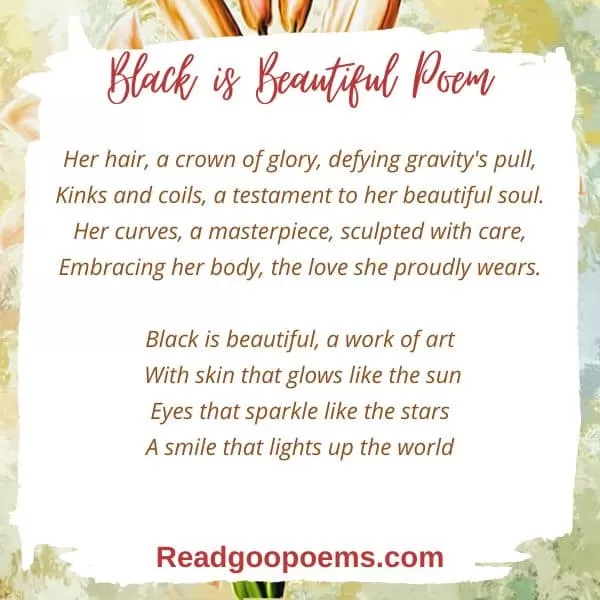 Her hair, a crown of glory, defying gravity’s pull,
Kinks and coils, a testament to her beautiful soul.
Her curves, a masterpiece, sculpted with care,
Embracing her body, the love she proudly wears.
Black is beautiful, a work of art
With skin that glows like the sun
Eyes that sparkle like the stars
A smile that lights up the world
Hair that defies gravity
And moves like the ocean waves
Hips that sway like a rhythm
Black is beautiful, an endless marvel
And verses exploring resilience:
Like a flame, she flickers with an inner glow,
Igniting hope and strength wherever she goes.
Each setback she faces, she turns into fuel,
Rising higher, bolder, with a spirit that’s uncool.
She’s a survivor, a conqueror of life’s storm,
With courage as her armor, she transforms.
In her scars, she finds beauty and grace,
A testament to her strength, her inner space.
 These poems move beyond simple aesthetic appreciation to celebrate identity, history, and inner fortitude. They use strong metaphors (“crown of glory,” “work of art,” “conqueror,” “flame”) to convey power and inherent value. Highlighting “scars” as a source of beauty and grace adds a profound dimension, acknowledging the struggles faced and overcome.
Conclusion
A poem to a beautiful woman, in its many forms, serves as a powerful expression of admiration and appreciation. Whether focusing on radiant presence, elegant movement, the depth of eyes, or the strength and beauty celebrated in diverse cultures, these poems remind us that beauty is multifaceted and deeply connected to identity and spirit. They invite us to look beyond the surface and find the poetry in the people who inspire us, recognizing the unique light and grace that each individual possesses. Reading and reflecting on such poems enriches our understanding of both the art of poetry and the diverse expressions of human beauty.