
The journey of love is a vast landscape in poetry, often chronicled from the first spark of attraction to the ache of separation or the quiet comfort of long-term companionship. Yet, there’s a specific, luminous terrain within this landscape: the state of being in love. It’s the feeling of a world transformed, the unique way another person’s presence reshapes reality, the profound sense of connection that settles into the everyday. Poetry offers us windows into this experience, articulating the ineffable joy, peace, wonder, and sometimes even delightful disorientation that comes with sharing life deeply with another.
Contents
- The Comfort and Shelter of Shared Space
- Which love poem are YOU?
- 1. “Come, And Be My Baby” by Maya Angelou
- 2. “Bird-Understander” by Craig Arnold
- 3. “Habitation” by Margaret Atwood
- 4. “Variations on the Word Love” by Margaret Atwood
- 5. “The More Loving One” by W.H. Auden
- Looking for something new to read?
- 6. “To My Dear and Loving Husband” by Anne Bradstreet
- 7. “Always For The First Time” by André Breton
- 8. “Love and Friendship” by Emily Brontë
- 9. “To Be In Love” by Gwendolyn Brooks
- 10. “How Do I Love Thee? (Sonnet 43)” by Elizabeth Barrett Browning
- 11. “A Red, Red Rose” by Robert Burns
- 12. “She Walks in Beauty” by Lord Byron
- 13. “Love is a fire that burns unseen” by Luís Vaz de Camões
- 14. “Beautiful Signor” by Cyrus Cassells
- 15. “Rondel of Merciless Beauty” by Geoffrey Chaucer
- 16. “Love Comes Quietly” by Robert Creeley
- 17. “[i carry your heart with me(i carry it in]” by E. E. Cummings
- 18. “[love is more thicker than forget]” by E.E. Cummings
- 19. “Sthandwa sami (my beloved, isiZulu)” by Yrsa Daley-Ward
- 20. “Married Love” by Guan Daosheng
- 21. “Heart, we will forget him!” by Emily Dickinson
- 22. “Air and Angels” by John Donne
- 23. “Flirtation” by Rita Dove
- 24. “Heart to Heart” by Rita Dove
- 25. “Love” by Carol Ann Duffy
- 26. “The Love Poem” by Carol Ann Duffy
- 27. “Before You Came” by Faiz Ahmed Faiz
- 28. “Lines Depicting Simple Happiness” by Peter Gizzi
- 29. “Six Sonnets: Crossing the West” by Janice Gould
- 30. “For Keeps” by Joy Harjo
- 31. “You Are the Penultimate Love of My Life” by Rebecca Hazelton
- 32. “Yours” by Daniel Hoffman
- 33. “A Love Song for Lucinda” by Langston Hughes
- 34. “Poem for My Love” by June Jordan
- 35. “for him” by Rupi Kaur
- 36. Untitled by Rupi Kaur
- 37. “Poem To An Unnameable Man” by Dorothea Lasky
- 38. “Movement Song” by Audre Lorde
- 39. “Camomile Tea” by Katherine Mansfield
- 40. “Love Elegy in the Chinese Garden, with Koi” by Nathan McClain
- 41. “I think I should have loved you presently (Sonnet IX)” by Edna St. Vincent Millay
- 42. “Love Sonnet XI” by Pablo Neruda
- 43. “Your Feet” by Pablo Neruda
- 44. “Dear One Absent This Long While” by Lisa Olstein
- 45. “My Lover Is a Woman” by Pat Parker
- 46. “It Is Here” by Harold Pinter
- 47. “Untitled” by Christopher Poindexter
- 48. “Love Is Not A Word” by Riyas Qurana
- 49. “[Again and again, even though we know love’s landscape]” by Rainer Maria Rilke
- 50. “Echo” by Christina Rossetti
- 51. “I loved you first: but afterwards your love” by Christina Rossetti
- 52. “Defeated by Love” by Rumi
- 53. “Shall I compare thee to a summer’s day? (Sonnet 18)” by William Shakespeare
- 54. “Let me not to the marriage of true minds (Sonnet 116)” by William Shakespeare
- 55. “My mistress’ eyes are nothing like the sun” (Sonnet 130) by William Shakespeare
- 56. “Love’s Philosophy” by Percy Bysshe Shelley
- 57. “One Day I Wrote her Name (Sonnet 75)” by Edmund Spenser
- 58. “I Am Not Yours” by Sara Teasdale
- 59. “Now Sleeps the Crimson Petal” by Alfred, Lord Tennyson
- 60. “poem I wrote sitting across the table from you” by Kevin Varrone
- 61. “On Earth We’re Briefly Gorgeous” by Ocean Vuong
- 62. “Love After Love” by Derek Walcott
- 63. “I Love You” by Ella Wheeler Wilcox
- 64. “We Have Not Long to Love” by Tennessee Williams
- 65. “Poem to First Love” by Matthew Yeager
- The Transformative Power of Being in Love
- Deep Understanding and Connection
- The Quiet Joys and Shared Reality
- Passion and Devotion
- Enduring Love and Commitment
- The Complexity and Paradoxes of Being in Love
- Conclusion
Unlike poems about falling in love (the initial rush) or love lost (the pain of absence), poems of being in love capture the ongoing reality – the shared space, the intertwined thoughts, the simple comfort of presence, the deep understanding that builds over time. These are the poems that resonate when love isn’t a quest or a memory, but the air you breathe. This exploration delves into poems that beautifully illuminate the state of being in love, revealing its multifaceted nature through diverse voices and styles.
The Comfort and Shelter of Shared Space
One of the most profound aspects of being in love is the sense of finding a haven, a place of safety and comfort in the presence of the other person. Life’s complexities and challenges seem less daunting when shared.
Maya Angelou, a celebrated voice in American letters, captures this beautifully in “Come, And Be My Baby.” Amidst the chaos of modern life, the poem finds solace in the simple invitation to connection:
There’s nothing quite so moving as beautiful love poems. Luckily for us romantics, they’ve been in abundant supply throughout history! From Rumi in the Islamic Golden Age, to iconic playwright William Shakespeare, to modern-day “Instapoets” like Rupi Kaur, love has been one of the most-explored themes among writers and poets for centuries.
In this post, we’ve put together the 65 most beautiful love poems ever written. Whether you’re looking for something to share with your partner, seeking solace after a breakup, or craving inspiration for how to write your own passionate prose, there’s bound to be a poem on this list which speaks to your heart.
Wondering which love poem you are? Take our 30-second quiz to find out.
📚
Which love poem are YOU?
Discover which poem best fits you in this quiz. Takes 30 seconds!
1. “Come, And Be My Baby” by Maya Angelou
Portrait of poet and civil rights activist Maya Angelou
Maya Angelou was one of America’s most acclaimed poets and storytellers, as well as a celebrated educator and civil rights activist. In ‘Come, And Be My Baby’, Angelou beautifully captures how overwhelming modern life can be and the comfort that love can provide during times of hardship — even if only for a moment.
2. “Bird-Understander” by Craig Arnold
These are your own words
your way of noticing
and saying plainly
of not turning away
from hurt
you have offered them
to me I am only
giving them back
if only I could show you
how very useless
they are not
The raw honesty of Craig Arnold’s poetry makes ‘Bird-Understander’ an easy pick for our list of the most beautiful love poems. In this piece, Arnold recounts a moment with his partner that makes his love grow even stronger. The language is simple yet evocative, putting a strong metaphor in the reader’s mind and facilitating a deeper understanding of Arnold’s feelings.
3. “Habitation” by Margaret Atwood
at the back where we squat
outside, eating popcorn
the edge of the receding glacier
where painfully and with wonder
at having survived even
this far
we are learning to make fire
Best known for her alarmingly realistic dystopian novel The Handmaid’s Tale, Margaret Atwood demonstrates similar strengths in this poem: ‘Habitation’ is strikingly real. For context, Atwood here admits to the challenges of marriage and acknowledges the work needed to overcome them. It is this candor which makes the poem so beautiful.
4. “Variations on the Word Love” by Margaret Atwood
Author Margaret Atwood
One of the most fascinating things about love is that it can come in so many different forms — platonic, passionate, or even patronizing. Margaret Atwood unflinchingly lays out some of these in her poem ‘Variations on the Word Love’.
5. “The More Loving One” by W.H. Auden
Were all stars to disappear or die,
I should learn to look at an empty sky
And feel its total dark sublime,
Though this might take me a little time.
Whilst poems about heartbreak might not be as uplifting as those about the joys of love, they can be equally as beautiful and meaningful. The celestial extended metaphor of W.H. Auden’s ‘The More Loving One’ demonstrates this — though ultimately he would rather be ‘the more loving one’ himself, Auden perfectly encapsulates the pain of loss when love ends.
Looking for something new to read?
Trust real people, not robots, to give you book recommendations.
Or sign up with an email address
6. “To My Dear and Loving Husband” by Anne Bradstreet
Thy love is such I can no way repay;
The heavens reward thee manifold, I pray.
Then while we live, in love let’s so persever,
That when we live no more, we may live ever.
Anne Bradstreet’s Puritan belief that marriage is a gift from God comes across strongly in ‘To My Dear and Loving Husband.’ Reading it through a modern lens, it’s easy to start the poem feeling a little skeptical; however, Bradstreet’s genuine gratitude and dedication to her husband soon manifests to make it a deeply moving assertion of true love.
7. “Always For The First Time” by André Breton
There is a silk ladder unrolled across the ivy
There is
That leaning over the precipice
Of the hopeless fusion of your presence and absence
I have found the secret
Of loving you
Always for the first time
‘Always For The First Time’ is André Breton’s ode to a woman he has not met, but is willing to wait every day for. Breton was the French founder of the surrealist movement, which aimed to blur the lines between dreams and reality in art — explaining the rather whimsical nature of this beautiful love poem.
8. “Love and Friendship” by Emily Brontë
Diverse hands holding a collection of love poems, symbolizing connection
Love doesn’t have to be confined to romance — love between friends can be just as strong and beautiful. In ‘Love and Friendship’, Emily Brontë compares romantic love to a rose — stunning but short-lived — and friendship to a holly tree which can endure all seasons.
9. “To Be In Love” by Gwendolyn Brooks
Next on our list of the most beautiful poems about love is ‘To Be in Love’ by Gwendolyn Brooks. Brooks was a poet, author, and teacher — and perhaps most notably, in 1950, was also the first African-American writer to receive a Pulitzer Prize. In this powerful poem, Brooks conveys the intense emotions which come with falling in love and how it can change your entire outlook on life.
To be in love
Is to touch with a lighter hand.
In yourself you stretch, you are well.
10. “How Do I Love Thee? (Sonnet 43)” by Elizabeth Barrett Browning
How do I love thee? Let me count the ways.
I love thee to the depth and breadth and height
My soul can reach, when feeling out of sight
For the ends of being and ideal grace.
Elizabeth Barrett Browning was a renowned Victorian poet who influenced the work of many later English-language poets, including Emily Dickinson. ‘How Do I Love Thee?’ is one of Browning’s most recognizable poems, and indeed one of the most famous love poems ever written — its ardent yet clear declaration of love has resonated with readers for over 150 years.
11. “A Red, Red Rose” by Robert Burns
Portrait of Scottish poet Robert Burns
Similar to Browning, Robert Burns’ profound love is evident in his poem ‘A Red, Red Rose’. Burns declares this love to be both passionate and refreshing — with each comparison, we see that even the loveliest language pales next to the depth of Burns’ ‘Luve’.
12. “She Walks in Beauty” by Lord Byron
She walks in beauty, like the night
Of cloudless climes and starry skies;
And all that’s best of dark and bright
Meet in her aspect and her eyes;
Thus mellowed to that tender light
Which heaven to gaudy day denies.
Though its author was known for a life of adventure and scandal, Lord Byron’s poem ‘She Walks in Beauty’ refers notably less to passionate or sexual love compared to his other works. That said, his astonishment at this woman’s beauty comes across instantly, making this a beautifully romantic poem.
13. “Love is a fire that burns unseen” by Luís Vaz de Camões
Love is a fire that burns unseen,
a wound that aches yet isn’t felt,
an always discontent contentment,
a pain that rages without hurting,
One of Portugal’s greatest poets, Luís Vaz de Camões is known for his lyrical poetry and dramatic epics. ‘Love is a fire that burns unseen’ is an example of the former, reflecting his numerous turbulent love affairs and how each brought a complex fusion of pleasure and pain.
14. “Beautiful Signor” by Cyrus Cassells
This is the endless wanderlust:
dervish,
yours is the April-upon-April love
that kept me spinning even beyond your eventful arms
toward the unsurpassed:
the one vast claiming heart,
the glimmering,
the beautiful and revealed Signor.
‘Beautiful Signor’ is an entry from Cyrus Cassells’ poetry collection of the same name, which he dedicated to ‘Lovers everywhere’. Culturally set against the backdrop of the AIDS epidemic, the collection aims to remind people of the potent beauty of romantic love.
15. “Rondel of Merciless Beauty” by Geoffrey Chaucer
Upon my word, I tell you faithfully
Through life and after death you are my queen;
For with my death the whole truth shall be seen.
Your two great eyes will slay me suddenly;
Their beauty shakes me who was once serene;
Straight through my heart the wound is quick and keen.
Widely regarded as the ‘Father of English poetry’, Geoffrey Chaucer wrote some of the most renowned works of the English language, including ‘The Canterbury Tales’ and ‘The Book of the Duchess’. The standalone poem ‘Rondel of Merciless Beauty’ (here translated from Middle English) recounts Chaucer’s heartbreak after being left by the love of his life, pledging his everlasting devotion to her even though it pains him.
16. “Love Comes Quietly” by Robert Creeley
Robert Creeley’s short but striking love poem aptly summarizes the feeling of never wanting to be apart from the person you love, almost making you forget what life was like before you met them.
17. “[i carry your heart with me(i carry it in]” by E. E. Cummings
i carry your heart with me(i carry it in
my heart)i am never without it(anywhere
i go you go,my dear;and whatever is done
by only me is your doing,my darling)
As one of America’s most prolific twentieth century poets, E.E. Cummings needs no introduction. Many of his poems centered around love and ‘[i carry your heart with me(i carry it in]’ is perhaps the best-known of them all. The rich imagery and intimate infatuation earns it a prominent spot on our list of the most beautiful love poems ever written.
18. “[love is more thicker than forget]” by E.E. Cummings
love is more thicker than forget
more thinner than recall
more seldom than a wave is wet
more frequent than to fail
Another brilliant example of Cummings’ love poetry is [love is more thicker than forget]. This poem explores the complexity of love, expressing that it cannot simply be defined as one thing or another — and indeed, painting love as a paradox of rarity and frequency, modesty and profundity, sanity and madness, and much more.
19. “Sthandwa sami (my beloved, isiZulu)” by Yrsa Daley-Ward
my thoughts about you are frightening but precise
I can see the house on the hill where we make our own vegetables out back
and drink warm wine out of jam jars
and sing songs in the kitchen until the sun comes up
wena you make me feel like myself again.
Yrsa Daley-Ward’s ‘Sthandwa sami (my beloved, isiZulu)’ is one of the most personal and revealing accounts of love on this list. The poem comes from her collection bone, which tackles some of the deepest aspects of humanity, including religion, desire, womanhood, race, and vulnerability.
20. “Married Love” by Guan Daosheng
You and I
Have so much love,
That it
Burns like a fire,
In which we bake a lump of clay
Molded into a figure of you
And a figure of me.
Guan Daosheng was a Chinese painter and poet of the early Yuan Dynasty (1271-1368). ‘Married Love’ uses the image of clay figurines to represent two lovers being united as one through the sacred act of marriage, just as clay solidifies in a kiln.
21. “Heart, we will forget him!” by Emily Dickinson
Heart, we will forget him!
You and I, to-night!
You may forget the warmth he gave,
I will forget the light.
‘Heart, we will forget him!’ aligns with the forceful nature of so many Emily Dickinson poems. It is a powerful reflection of the fallout after a passionate love affair and how she tried to move on, going so far as to command her heart to do so, even knowing it’s futile.
22. “Air and Angels” by John Donne
Portrait of the English poet John Donne
John Donne’s work is known for tackling faith and salvation, as well as both human and divine love. In ‘Angels and Air’, Donne compares his love to the movement of angels — pure and elegant. His conclusion that two lovers can come together and grow stronger adds another layer to this already quite romantic poem.
23. “Flirtation” by Rita Dove
Outside the sun
has rolled up her rugs
and night strewn salt
across the sky. My heart
is humming a tune
I haven’t heard in years!
The sparkling flirtation at the start of a new relationship is surely one of the most exciting parts of love. ‘Flirtation’ by Rita Dove eloquently captures this joy and anticipation, and is one of the most relatable poems about this aspect of love.
24. “Heart to Heart” by Rita Dove
It’s neither red
nor sweet.
It doesn’t melt
or turn over,
break or harden,
so it can’t feel
pain,
yearning,
regret.
In ‘Heart to Heart’, Rita Dove rejects the typical clichés that come with falling in love. With her down-to-earth approach to the topic, she assures the intended reader that although she may struggle to show her love, that doesn’t mean it’s not there.
25. “Love” by Carol Ann Duffy
you’re where I stand, hearing the sea, crazy
for the shore, seeing the moon ache and fret
for the earth. When morning comes, the sun, ardent,
covers the trees in gold, you walk
towards me,
out of the season, out of the light love reasons.
In 2009, Carol Ann Duffy made history when she was appointed the first female and openly lesbian British poet laureate. ‘Love’ is a perfect example of the monologue-style poems she is known for, fitting in with her usual sensory and emotional style of writing; here, she describes love as beautifully boundless, like the light of the sun or the crashing sound of waves.
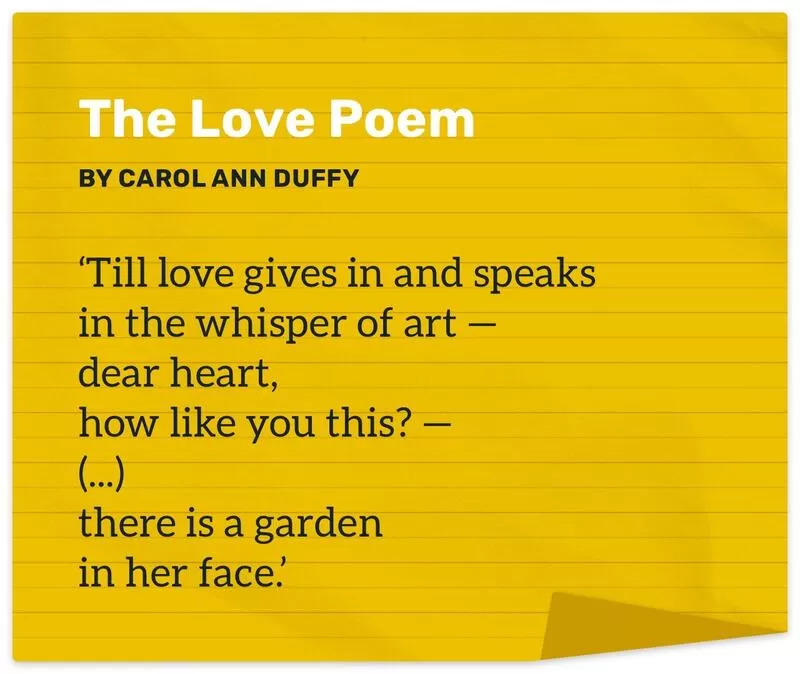
26. “The Love Poem” by Carol Ann Duffy
Former UK Poet Laureate Carol Ann Duffy
‘The Love Poem’ takes a different tack, depicting Duffy’s struggle to find the right words to describe her love. It comes from her 2005 collection Rapture, which charts the speaker’s journey through a love affair; at this stage, Duffy gets metafictional about love poetry, striving to explain the challenges of writing it (and invoking several other famous poems along the way).
27. “Before You Came” by Faiz Ahmed Faiz
Don’t leave now that you’re here—
Stay. So the world may become like itself again:
so the sky may by the sky,
the road a road,
and the glass of wine not a mirror, just a glass of wine.
Faiz Ahmed Faiz wrote of love, politics, and community throughout his tumultuous life, and has been especially acknowledged for his contributions to traditional Urdu poetry. In ‘Before You Came’, Faiz writes about how his perspective on life changed after falling in love and how he never wants to be without his lover, who helps him see things as they truly are.
28. “Lines Depicting Simple Happiness” by Peter Gizzi
It feels right to notice all the shiny things about you
About you there is nothing I wouldn’t want to know
With you nothing is simple yet nothing is simpler
About you many good things come into relation
The beauty in Peter Gizzi’s poetry stems from its simplicity. In ‘Lines Depicting Simple Happiness’, Gizzi’s adoration for his love is clear — however, he avoids overused clichés, meaning the poem is both more personal and less mawkish than other modern love poems.
29. “Six Sonnets: Crossing the West” by Janice Gould
In that communion of lovers, thick sobs
break from me as I think of my love
back home, all that I have done
and cannot say. This is the first time
I have left her so completely, so alone.
Janice Gould’s work homes in on themes of love and connection, with strong links to her identity as a Maidu lesbian. In ‘Six Sonnets: Crossing the West’, Gould equates her lover to a dream, never running short on ethereal ways to describe her… and mourning when she slips away, even temporarily.
30. “For Keeps” by Joy Harjo
Contrasting love with the beauty of nature helps to create an unbreakable bond between the two. This comparison helps illustrate Joy Harjo’s feelings for her lover in her marvelous poem, ‘For Keeps’.
31. “You Are the Penultimate Love of My Life” by Rebecca Hazelton
The garden you plant and I plant
is tunneled through by voles,
the vowels
we speak aren’t vows,
but there’s something
holding me here, for now,
like your eyes, which I suppose
are brown, after all.’
‘You Are the Penultimate Love of My Life’ is an unorthodox love poem, focusing on the realities rather than the fantasies of being in love. Rebecca Hazelton isn’t writing about her soulmate, and she’s aware of that — but that doesn’t make the love they share any less special.
32. “Yours” by Daniel Hoffman
I am yours as the summer air at evening is
Possessed by the scent of linden blossoms,
As the snowcap gleams with light
Lent it by the brimming moon.
Without you I’d be an unleaded tree
Blasted in a bleakness with no Spring.
Daniel Hoffman’s carefully chosen metaphors make ‘Yours’ a truly beautiful love poem. Hoffman’s complete dedication to his lover is obvious — in comparing her to everything from summer evenings to snow-capped mountains, it seems he cannot stop thinking about her throughout the changing seasons.
33. “A Love Song for Lucinda” by Langston Hughes
Love
Is a high mountain
Stark in a windy sky.
If you
Would never lose your breath
Do not climb too high.
Each stanza of Langston Hughes’ ‘A Love Song for Lucinda’ compares love to a specific feeling, all of which are linked to the natural world. This poem emphasizes the exhilaration of falling in love and the all-encompassing enchantment that comes with it.
34. “Poem for My Love” by June Jordan
Political activist, poet, and essayist June Jordan is one of the most widely-published Jamaican American writers of her generation. In her ‘Poem for My Love’, the speaker is in absolute spiritual awe of her partner and the way she feels about their transcendent love.
35. “for him” by Rupi Kaur
no,
it won’t
be love at
first sight when
we meet it’ll be love
at first remembrance
‘cause i’ve recognized you
in my mother’s eyes when she tells me,
marry the type of man you’d want to raise your son to be like.
At just 21 years old, Rupi Kaur wrote, illustrated, and self-published her first poetry collection, milk and honey. She describes her poetry as ‘simple and accessible’ — which has allowed it to reach millions of readers worldwide, particularly through Instagram presence. ‘for him’ is a perfect example of a beautiful, powerful love poem which doesn’t have to try too hard to pack a punch.
36. Untitled by Rupi Kaur
love will hurt you but
love will never mean to
love will play no games
cause love knows life
has been hard enough already
Another entry from milk and honey, this short, untitled poem takes a bittersweet and world weary, but ultimately generous look at love and its challenges.
37. “Poem To An Unnameable Man” by Dorothea Lasky
And I will not cry also
Although you will expect me to
I was wiser too than you had expected
For I knew all along you were mine
Prolific poet Dorothea Lasky has written multiple collections and currently directs the poetry programme at Columbia University. In ‘Poem To An Unnameable Man’, she uses celestial imagery to explore a romantic relationship, describing her power and strength to the lover who underestimates her.
38. “Movement Song” by Audre Lorde
Audre Lorde
‘Movement Song’ by Audre Lorde is about the end of a relationship. While the sorrow felt after the speaker’s heart has been broken is clear, the poem ultimately ends with hope that the pair can both have a new beginning — albeit apart.
39. “Camomile Tea” by Katherine Mansfield
We might be fifty, we might be five,
So snug, so compact, so wise are we!
Under the kitchen-table leg
My knee is pressing against his knee.
Our shutters are shut, the fire is low,
The tap is dripping peacefully;
The saucepan shadows on the wall
Are black and round and plain to see.
Katherine Mansfield has been praised for her ability to simplify complex emotions through short stories and poetry. One of the more tranquil poems on this list, ‘Camomile Tea’ paints a picture of a couple who are calm and quiet and happy with the life they’ve made for themselves, highlighting the underrated joy that peaceful familiarity and comfort bring in a relationship.
40. “Love Elegy in the Chinese Garden, with Koi” by Nathan McClain
Because who hasn’t done that —
loved so intently even after everything
has gone? Love something that has washed
its hands of you? I like to think I’m different now,
that I’m enlightened somehow,
but who am I kidding?
Nathan McClain’s inspiration for ‘Love Elegy in the Chinese Garden, with Koi’ was a date to the Huntington Botanical Gardens. In the poem, McClain aimed to ‘explore the sense of anxiety’ between two potential lovers, and the weighty emotional baggage that previous failed relationships can bestow upon you.
41. “I think I should have loved you presently (Sonnet IX)” by Edna St. Vincent Millay
I think I should have loved you presently,
And given in earnest words I flung in jest;
And lifted honest eyes for you to see,
And caught your hand against my cheek and breast;
And all my pretty follies flung aside
That won you to me, and beneath you gaze
Edna St. Vincent Millay’s ‘I think I should have loved you presently’ serves as a subversion of the traditional sonnet form. In the poem, the speaker laments their inability to reciprocate their lover’s earnest affection, instead choosing sweet nothings and superficial flirtation over genuine connection.
42. “Love Sonnet XI” by Pablo Neruda
I crave your mouth, your voice, your hair.
Silent and starving, I prowl through the streets.
Bread does not nourish me, dawn disrupts
me, all day
I hunt for the liquid measure of your steps.
There is a strong sense of longing in Pablo Neruda’s ‘Love Sonnet XI’, as our speaker confesses the thought of his love never leaves his mind, driving him to the point of distraction. Evocative and at times alarming, it’s a love poem which perfectly treads the blurred line between romance and obsession.
43. “Your Feet” by Pablo Neruda
Nobel laureate Pablo Neruda
In ‘Your Feet’, Neruda expresses a similar devotion to his love as he explains his love for her from head to toe, and gives thanks for the forces he feels brought them together inevitably.
44. “Dear One Absent This Long While” by Lisa Olstein
I expect you. I thought one night it was you
at the base of the drive, you at the foot of the stairs
you in a shiver of light, but each time
leaves in wind revealed themselves,
the retreating shadow of a fox, daybreak.
We expect you, cat and I, bluebirds and I, the stove.
The speaker in Lisa Olstein’s ‘Dear One Absent This Long While’ is anxiously waiting for her loved one to return home. The nervous buzz of anticipation as the speaker waits to return to a life of comfort and mundanity, a puzzle from which their lover is the only missing piece, gives this love poem a beautiful raw honesty.
45. “My Lover Is a Woman” by Pat Parker
my lover is a woman
& when i hold her
feel her warmth
i feel good
feel safe
Pat Parker was an American poet and activist who drew great inspiration from her life as an African-American lesbian feminist. ‘My Lover Is a Woman’ is about the struggles Parker faced as an openly queer woman of colour, and the safe harbour her lover represents in that storm.
46. “It Is Here” by Harold Pinter
What is this stance we take,
To turn away and then turn back?
What did we hear?
It was the breath we took when we first met.
Listen. It is here.
Relationships have a funny way of transcending time and space, and that transcendence isexpressed in Harold Pinter’s beautiful love poem ‘It Is Here’ as he asks his lover to think back to the beginning of their relationship, and in doing so brings the long-passed moment to life.
47. “Untitled” by Christopher Poindexter
I miss you even when you
are beside me.
I dream of your body
even when you are sleeping
in my arms.
The words I love you
could never be enough.
Christopher Poindexter here presents a deeply honest and relatable portrait of a love that goes beyond the limits of language, as he describes the overwhelming and paradoxical longing it’s possible to feel even when your lover is right by your side.
48. “Love Is Not A Word” by Riyas Qurana
Amidst all this
I keep a falling flower in the mid-air
Not to fall on the earth
Is it not up to you who search for it
To come and sit on it
And make love?
Don’t forget to bring the word
Darling
When you come.
Written from the point of view of a personified love, “Love Is Not A Word” is a rather ambiguous poem. Riyas Qurana explores the notion of love as a whole and relates the concept to nature to emphasize how elemental it is to the human experience.
49. “[Again and again, even though we know love’s landscape]” by Rainer Maria Rilke
Again and again, even though we know love’s landscape
and the little churchyard with its lamenting names
and the terrible reticent gorge in which the others
end: again and again the two of us walk out together
under the ancient trees, lay ourselves down again and
again
among the flowers, and look up into the sky.
Austrian poet Rainer Maria Rilke believed that it was ‘perhaps the most difficult of all our tasks’ for one human to love another (Letters to a Young Poet, 1929). In ‘[Again and again, even though we know love’s landscape]’, Rilke celebrates the continuous, everyday love that two people can share, and the strength that comes from making one vulnerable enough to love another, despite knowing the risk of heartbreak.
50. “Echo” by Christina Rossetti
In ‘Echo’, Christina Rossetti reflects on a lost love and how she wishes it would come back to her like an echo. Rossetti is in despair, longing for her ex-lover, and the resulting yearning creates an equally heartbreaking and beautiful love poem.
51. “I loved you first: but afterwards your love” by Christina Rossetti
I loved you first: but afterwards your love
Outsoaring mine, sang such a loftier song
As drowned the friendly cooings of my dove.
Which owes the other most? my love was long,
And yours one moment seemed to wax more strong
Despite a concern with reciprocity (or a lack thereof) in these opening lines, a feeling of ‘oneness’ in fact runs throughout ‘I loved you first: but afterwards your love’, also by Rossetti. This poem reflects the feeling of complete understanding between two people who love each other deeply, as Rossetti explains how their individual feelings combine to create one love, a whole greater than the sum of its parts.
52. “Defeated by Love” by Rumi
The sky was lit
by the splendor of the moon
So powerful
I fell to the ground
Your love
has made me sure
I am ready to forsake
this worldly life
and surrender
to the magnificence
of your Bering
The words of 13th-century Persian poet Rumi have transcended national, ethnic, and religious divides for centuries. The passion and dedication in ‘Defeated by Love’ is apparent in each line, making this enduring testament to the power of love one of the most beautiful love poems on our list.
53. “Shall I compare thee to a summer’s day? (Sonnet 18)” by William Shakespeare
The Bard, William Shakespeare
Although William Shakespeare may not have have written any romance novels, there are few more celebrated love poets and ‘Shall I compare thee to a summer’s day?’ is perhaps the most iconic and recognizable opening line of any love poem. Its simplicity compared to some of Shakespeare’s other sonnets makes it stand out against an incomparable library of work, but the hidden depths and layers of meaning in this densely packed mini-masterpiece have kept readers returning for centuries.
54. “Let me not to the marriage of true minds (Sonnet 116)” by William Shakespeare
Let me not to the marriage of true minds
Admit impediments. Love is not love
Which alters when it alteration finds,
Or bends with the remover to remove.
O no! it is an ever-fixed mark
In ‘Sonnet 116’, Shakespeare talks about the permanence of love — even if the people change as time goes on, the love between them will remain true and strong, or else it isn’t love at all.
55. “My mistress’ eyes are nothing like the sun” (Sonnet 130) by William Shakespeare
I grant I never saw a goddess go;
My mistress, when she walks, treads on the ground:
And yet, by heaven, I think my love as rare
As any she belied with false compare.
In Shakespeare’s final entry on our list, he challenges the traditional association of love with beauty. It doesn’t matter what his lover looks like — to him she is the most rare and valuable thing in the world.
56. “Love’s Philosophy” by Percy Bysshe Shelley
The fountains mingle with the river
And the rivers with the ocean,
The winds of heaven mix forever
With a sweet emotion;
Nothing in the world is single;
All things by a law divine
In one spirit meet and mingle
Why not I with thine?
‘Love’s Philosophy’, while a beautiful love poem, offers a much more logical take on romance than many of the other poems on our list. Percy Bysshe Shelley expresses to his lover that their love is as natural as a river meeting the ocean — but equally that all the beauties of nature are meaningless if he doesn’t have her.
57. “One Day I Wrote her Name (Sonnet 75)” by Edmund Spenser
One day I wrote her name upon the strand,
But came the waves and washed it away:
Again I wrote it with a second hand,
But came the tide, and made my pains his prey.
This beautiful love poem is part of Amoretti, a sonnet cycle about Edmund Spenser’s relationship with Elizabeth Boyle. Spenser explains in ‘Sonnet 75’ that — despite the seemingly portentous way his attempts to make a physical monument to his lover by writing her name in the sand is repeatedly foiled — his love for Boyle will never end, and he will do whatever it takes to make it last.
58. “I Am Not Yours” by Sara Teasdale
Sara Teasdale
A longing for genuine, passionate, all-encompassing love is the central theme of Sara Tesdale’s ‘I Am Not Yours’. The speaker doesn’t feel any sense of belonging in her current relationship, and wants to find a partner who makes her feel lost in their love.
59. “Now Sleeps the Crimson Petal” by Alfred, Lord Tennyson
Now sleeps the crimson petal, now the white;
Nor waves the cypress in the palace walk;
Nor winks the gold fin in the porphyry font.
The firefly wakens; waken thou with me.
Now drops the milk-white peacock like a ghost,
And like a ghost she glimmers on to me.
‘Now Sleeps the Crimson Petal’ is a song from The Princess, a longer, narrative poem by Alfred, Lord Tennyson. It was inspired by the ghazal, a Persian form of love poetry which focuses on unsustainable love, and is a classic masterclass in sensual description.
60. “poem I wrote sitting across the table from you” by Kevin Varrone
I would fold myself
into the hole in my pocket and disappear
into the pocket of myself, or at least my pants
but before I did
like some ancient star
I’d grab your hand
Kevin Varrone confesses how close he feels to his lover in ‘poem I wrote sitting across the table from you’. Written in a moment of procrastination as he worked on a longer verse in a coffee shop, the poem expresses how Varrone wants his lover to partake on all of his adventures, no matter how big or small.
61. “On Earth We’re Briefly Gorgeous” by Ocean Vuong
Tell me it was for the hunger
& nothing less. For hunger is to give
the body what it knows
it cannot keep. That this amber light
whittled down by another war
is all that pins my hand
to your chest.
While you’re probably familiar with Vuong’s 2019 novel by the same name, you may not be familiar with the poem that came first. Ocean Vuong’s writing invites the reader to slow down and understand every word, and ‘On Earth We’re Briefly Gorgeous’ explores themes of desire, impermanence, and craving when in love.
62. “Love After Love” by Derek Walcott
You will love again the stranger who was your self.
Give wine. Give bread. Give back your heart
to itself, to the stranger who has loved you
all your life, whom you ignored
for another, who knows you by heart.
Nobel Prize winning poet Derek Walcott offers advice and reassurance to anyone experiencing a breakup in his poem ‘Love After Love’. Encouraging the reader to return to themselves, the poem is a tonic in a world full of love poetry which expects us to hand ourselves over to lovers completely.
63. “I Love You” by Ella Wheeler Wilcox
I love your lips when they’re wet with wine
And red with a wild desire;
I love your eyes when the lovelight lies
Lit with a passionate fire.
I love your arms when the warm white flesh
Touches mine in a fond embrace;
I love your hair when the strands enmesh
Your kisses against my face.
In ‘I Love You’, Ella Wheeler Wilcox lays out the tiny moments that add up to why the speaker feels so passionately about her love, before going on to describe the colder attributes she’s not looking for in a relationship. This juxtaposition helps to make the initial love she describes all the more special.
64. “We Have Not Long to Love” by Tennessee Williams
Playwright and poet Tennessee Williams
Though better known for his plays than as a romance author, Tennessee Williams was also an accomplished poet. In ‘We Have Not Long to Love’ Williams stresses the importance of appreciating the time we do have and cherishing the love that comes with it, remembering that nothing will last forever.
65. “Poem to First Love” by Matthew Yeager
To have been told “I love you” by you could well be, for me,
the highlight of my life, the best feeling, the best peak
on my feeling graph, in the way that the Chrysler building
might not be the tallest building in the NY sky but is
the best, the most exquisitely spired
Matthew Yeager’s ‘Poem to First Love’ is a bittersweet young romance where, as the title suggests, the speaker is reminiscing about his relationship with his first love, and explores the different ways one might try to logically quantify the utterly illogical force of love.
***
Looking to dive a little deeper into the world of poetry? Check out our post on the 60+ best poetry books of all time!




The Transformative Power of Being in Love
Being in love often changes how we perceive the world and ourselves. Suddenly, the mundane takes on new significance, and the partner’s essence feels like a fundamental part of existence.
Gwendolyn Brooks, the first African-American Pulitzer Prize winner for poetry, speaks directly to this transformation in “To Be In Love”:
To be in love
Is to touch with a lighter hand.
In yourself you stretch, you are well.
This speaks not just to external changes, but an internal flourishing enabled by the love shared. Similarly, Faiz Ahmed Faiz, the acclaimed Urdu poet, describes a world regaining its true form because of his lover’s presence in “Before You Came”:
Don’t leave now that you’re here—
Stay. So the world may become like itself again:
so the sky may by the sky,
the road a road,
and the glass of wine not a mirror, just a glass of wine.
His world wasn’t wrong before, but it was seen through a distorting lens until love corrected his vision. In a more abstract vein, E.E. Cummings captures the overwhelming, ever-present nature of his beloved in “[i carry your heart with me(i carry it in]”:
i carry your heart with me(i carry it in
my heart)i am never without it(anywhere
i go you go,my dear;and whatever is done
by only me is your doing,my darling)
This isn’t just a sweet sentiment; it describes a state where the boundaries of self blur, and the partner’s influence is felt in every action and location. This intimate connection is a hallmark of deeply felt love, a connection that can feel both simple and profound.
Deep Understanding and Connection
Beyond comfort and transformation, being in love involves a unique depth of understanding that develops between two people. It’s a recognition of the other’s core, a resonance that feels both earned and inherent.
Craig Arnold’s “Bird-Understander” touches upon this quiet appreciation of a partner’s way of being:
These are your own words
your way of noticing
and saying plainly
of not turning away
from hurt
you have offered them
to me I am only
giving them back
if only I could show you
how very useless
they are not
The poem is a testament to valuing a partner’s inherent qualities, their unique perspective and resilience, which deepens the bond.
Christina Rossetti explores a similar sense of intertwined identity in “I loved you first: but afterwards your love,” where individual affections merge into a singular, powerful force:
I loved you first: but afterwards your love
Outsoaring mine, sang such a loftier song
As drowned the friendly cooings of my dove.
Which owes the other most? my love was long,
And yours one moment seemed to wax more strong
This isn’t about competition, but the miraculous way two loves combine to create something greater, a shared entity that transcends the individual parts. It’s the state of being in love where “yours” and “mine” become “ours.”
The Quiet Joys and Shared Reality
While grand declarations have their place, much of being in love resides in the quiet, everyday moments. The simple act of existing together, navigating the mundane, builds a powerful, understated beauty.
Katherine Mansfield’s “Camomile Tea” perfectly captures this domestic tranquility:
We might be fifty, we might be five,
So snug, so compact, so wise are we!
Under the kitchen-table leg
My knee is pressing against his knee.
Our shutters are shut, the fire is low,
The tap is dripping peacefully;
The saucepan shadows on the wall
Are black and round and plain to see.
This poem is a masterclass in finding the sacred within the ordinary. The comfort isn’t in grand gestures but in proximity, routine, and the shared space of a quiet evening. It highlights the often-overlooked beauty of peaceful familiarity that comes from being in love over time.
Margaret Atwood, known for exploring complex human relationships, also touches on the reality and effort of sustained love in “Habitation”:
at the back where we squat
outside, eating popcorn
the edge of the receding glacier
where painfully and with wonder
at having survived even
this far
we are learning to make fire
This isn’t a fairytale; it’s a depiction of love as a process of survival and effort, even “painful” at times. But the “wonder” of having endured and the ongoing act of “learning to make fire” together underscore the deep bond that forms through shared experience and perseverance – a key aspect of the state of being in love.
Passion and Devotion
Being in love certainly doesn’t exclude passion and deep devotion. These feelings are often intensified by the security and depth of an established connection.
Pablo Neruda’s “Love Sonnet XI” expresses an intense, almost consuming focus on the beloved:
I crave your mouth, your voice, your hair.
Silent and starving, I prowl through the streets.
Bread does not nourish me, dawn disrupts
me, all day
I hunt for the liquid measure of your steps.
While bordering on obsession, it captures the intensity of the lover’s presence dominating the speaker’s world – a powerful depiction of the state of being utterly captivated. Neruda’s “Your Feet” shows this devotion extending to every part of the beloved, expressing gratitude for the very forces that brought them together.
Ella Wheeler Wilcox’s “I Love You” is a more direct, almost catalog-like expression of the beloved’s physical presence and its effect:
I love your lips when they’re wet with wine
And red with a wild desire;
I love your eyes when the lovelight lies
Lit with a passionate fire.
I love your arms when the warm white flesh
Touches mine in a fond embrace;
I love your hair when the strands enmesh
Your kisses against my face.
This poem focuses on the tangible, sensory aspects of the person, detailing the specific things that fuel the passion and make the state of being in love so vivid and desirable.
Enduring Love and Commitment
The state of being in love implies a continuation, a sense of permanence that transcends fleeting moments. Poets have long sought to articulate the lasting nature of this bond.
Shakespeare’s Sonnet 116, “Let me not to the marriage of true minds,” famously defines a love that is steadfast:
Let me not to the marriage of true minds
Admit impediments. Love is not love
Which alters when it alteration finds,
Or bends with the remover to remove.
O no! it is an ever-fixed mark
This sonnet speaks to the ideal of love as an unshakeable constant, a fixed point in a changing world, which is a cornerstone of the feeling of secure, lasting love. Similarly, Edmund Spenser’s Sonnet 75, “One Day I Wrote her Name,” contrasts the ephemeral nature of the physical world with the immortalizing power of love and poetry:
One day I wrote her name upon the strand,
But came the waves and washed it away:
Again I wrote it with a second hand,
But came the tide, and made my pains his prey.
Despite the waves erasing the physical mark, the speaker’s commitment to making their love eternal through verse reflects the desire for the state of being in love to last forever.
The Complexity and Paradoxes of Being in Love
Being in love isn’t always simple bliss. It can involve vulnerability, effort, and even paradoxical feelings, such as longing for someone who is right beside you.
E.E. Cummings captures some of this complexity in “[love is more thicker than forget]”:
love is more thicker than forget
more thinner than recall
more seldom than a wave is wet
more frequent than to fail
By using paradoxes, Cummings suggests that the state of being in love defies easy definition, encompassing contradictions like rarity and frequency, depth and subtlety.
Christopher Poindexter’s untitled poem speaks to a specific, relatable paradox of being in love – the feeling of missing someone even in their presence:
I miss you even when you
are beside me.
I dream of your body
even when you are sleeping
in my arms.
The words I love you
could never be enough.
This isn’t about discontent but an overwhelming sense of the beloved’s importance, where even their proximity highlights the vastness of the feeling, the fear of ever being without it. It’s a powerful illustration of the depth of connection in the state of being in love.
Sometimes, the reality of being in love is acknowledged without romantic idealization. Rebecca Hazelton’s “You Are the Penultimate Love of My Life” takes an unconventional look:
The garden you plant and I plant
is tunneled through by voles,
the vowels
we speak aren’t vows,
but there’s something
holding me here, for now,
like your eyes, which I suppose
are brown, after all.’
This poem acknowledges imperfection (“tunneled through by voles”), lack of conventional commitment (“aren’t vows”), and even a touch of uncertainty (“for now,” “I suppose”). Yet, the underlying connection (“something holding me here”) is real and powerful, suggesting that the state of being in love can exist authentically outside of traditional narratives, in the acceptance of shared, imperfect reality. Exploring love poems for a man or a woman can reveal further nuances in how poets capture these complex dynamics.
Conclusion
Poems of being in love offer a rich tapestry woven from presence, comfort, transformation, understanding, passion, commitment, and complex realities. They move beyond the initial spark or the ache of loss to illuminate the ongoing, lived experience of sharing life with another person. From the quiet domesticity captured by Mansfield to the transcendent devotion expressed by Rumi or Neruda, these poems provide language for the multifaceted state that defines deep connection. They remind us that being in love is not a static condition but a dynamic space of shared existence, continuously shaped by presence, interaction, and the profound impact one soul has upon another. Just as poetry explores the highs and lows of existence, from the beauty of love to themes found in robert frost poems on death, the state of being in love remains one of its most enduring and resonant subjects.