
Robert Frost remains one of the most beloved American poets, his work resonating with readers for its accessibility, connection to nature, and deep human insight. Among his most cherished and frequently sought-after works is the short, seemingly simple poem, “The Pasture.” Searches for “robert frost the pasture lyrics” often lead readers to analyses and discussions of this introductory poem, which Frost chose to place at the beginning of several of his collected volumes. Far more than just a descriptive verse, “The Pasture” serves as an invitation, a philosophical statement, and a perfect encapsulation of Frost’s poetic craft and worldview. Let’s delve into the lyrics and explore the layers of meaning and technique within this memorable work.
Contents
Here are the lyrics to Robert Frost’s “The Pasture”:
I’m going out to clean the pasture spring;
I’ll only stop to rake the leaves away
(And wait to watch the water clear, I may);
I sha’n’t be gone long. You come too.
I’m going out to fetch the little calf
That’s standing by the mother. It’s so young,
It totters when she licks it with her tongue.
I sha’n’t be gone long. You come too.
At first glance, the poem presents a straightforward narrative: the speaker announces two simple tasks they plan to perform in a pasture and extends an invitation. However, its enduring appeal lies in the subtle artistry and profound implications embedded within these few lines.
 Robert Frost reading his poetry
Poet Robert Frost, whose work like “The Pasture” offers simple scenes with deep resonance.
More Than a Chore: The Poem as Invitation
Frost himself reportedly described “The Pasture” as “a poem about love that’s new in treatment and effect,” suggesting its core is relational, not merely descriptive. Its primary function, especially in its placement within collected works, is one of invitation. The speaker isn’t just talking to themselves or an unseen companion; the repeated “You come too” directly addresses the reader.
This invitation extends beyond a simple walk to a pasture. It’s an invitation into the world of Frost’s poetry itself – a world grounded in the everyday, in nature, in simple tasks, yet infused with contemplation and deeper meaning. It sets the tone for what the reader can expect: accessibility, genuine feeling, and a companionable voice that encourages participation rather than demanding intellectual deciphering. Frost was writing at a time when much poetry was moving towards greater complexity and obscurity. “The Pasture,” with its clear language and direct address, positioned him as a poet who remained comprehensible, offering an open hand to his audience. The promise “I sha’n’t be gone long” implies that his poetic explorations, while they may touch on serious themes, will always return to relatable ground, inviting the reader to join him on the journey.
The Sound of the Lyrics: Meter, Rhyme, and Musicality
The musicality of “The Pasture” is key to its memorability and charm. While analyzing sound can sometimes lead critics astray (a phenomenon sometimes termed the “Enactment Fallacy,” where meaning is perhaps overly attributed to technical sound features alone), it’s undeniable that Frost carefully crafted the aural experience of these lyrics.
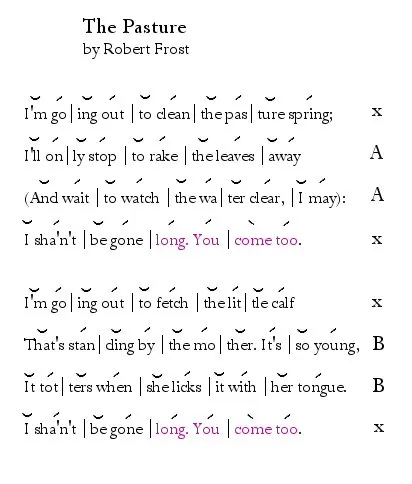
The first three lines of each stanza follow a pattern that closely resembles iambic pentameter (ten syllables per line, alternating unstressed/stressed). For example:
I'M GO | ing OUT | to CLEAN | the PAS | ture SPRING;
However, the fourth line drastically shifts to iambic tetrameter (eight syllables), I SHA'N'T | be GONE | long. YOU | come TOO. This metrical change has a significant effect. The shorter line feels more direct, more personal, like an aside or a whispered confidence. It breaks the slightly more formal rhythm of the preceding lines, highlighting the intimacy of the invitation. The caesura (the pause) in the middle of the third foot (“long. You”) further disrupts the regular flow, enhancing the conversational, almost spontaneous feel of the plea.
Beyond the meter, the internal rhyme and vowel sounds contribute significantly to the poem’s lyrical quality. In the first stanza:
- Line 2: Internal rhyme (“rake” / “away” / “wait” / “may”) uses the long ‘A’ sound.
- Line 3: The short ‘O’ in “(stop)” and the short ‘A’ in “(away)” contrast with the longer ‘A’ sounds. The short ‘O’ in “(watch)” and the short ‘A’ in “(water)” offer further internal echoes.
In the second stanza:
- Line 1: “little calf” – the short ‘I’ and short ‘A’ sounds.
- Lines 2 & 3: “young” and “tongue” offer a slant internal rhyme with the short ‘U’ sound. “standing” and “licks” contain short ‘A’ and short ‘I’ sounds.
While one must be cautious not to over-interpret every vowel sound, the deliberate play of these sounds creates a subtle, pleasing music. The recurring long ‘A’ in the first stanza feels open and expansive, perhaps mirroring the open pasture. The shorter sounds and slant rhymes in the second stanza feel grounded and perhaps slightly less formal, fitting the image of a wobbly calf. This attention to sound, combined with the shifting meter, makes the simple lyrics feel rich and carefully composed, contributing to their memorable quality. Frost was, as he put it, an “ear reader,” attuned to the music of words, and “The Pasture” exemplifies this.
 Historical image illustrating people discussing literary ideas
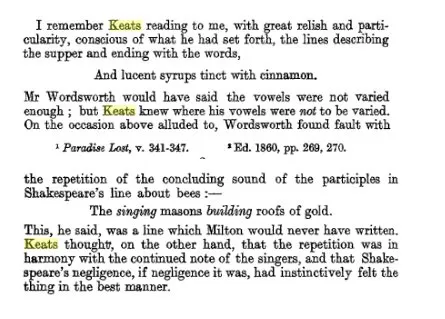
Literary discussions about the sounds of words, like the one referenced involving Keats and Wordsworth, highlight poetry’s musical dimension.
Frost’s Language: Colloquialisms and Clarity
Another characteristic feature of “The Pasture” and many of Frost’s lyrics is the incorporation of New England colloquialisms. Frost masterfully captured the speech patterns of rural New Englanders, infusing his poetry with an authentic, grounded voice.
One striking example is the use of anthimeria, the substitution of one part of speech for another. In the first line, “pasture spring,” the noun “pasture” is used as an adjective modifying “spring.” This grammatical short-cut, common in certain dialects, gives the line a distinctly regional and informal feel. It’s more concise and sounds more like natural speech than saying “the spring in the pasture.” Frost employs this technique often, adding vitality and a sense of place to his work.
Similarly, the contraction “sha’n’t” for “shall not” contributes to the colloquial intimacy. While less common today, it was part of the spoken language Frost aimed to capture. Using such contractions makes the speaker feel relatable, not distant or overly formal. It reinforces the idea that this is an ordinary person performing ordinary tasks, extending a genuine invitation.
The overall clarity and directness of the language, combined with these subtle colloquialisms, create a voice that feels both authentic and deeply personal. This is part of why readers feel a kinship with Frost; his poetic voice sounds like someone they could know, speaking about things they can understand, inviting them into a familiar, yet thoughtfully observed, world.
The Significance of Simple Tasks
The tasks themselves – cleaning a spring and fetching a calf – are not grand heroic gestures. They are part of the routine care of a farm or homestead. Yet, in Frost’s hands, they become significant. Cleaning a spring is about renewal, making something clear and clean. Fetching a calf is about nurturing new life, ensuring its safety under the mother’s care. These are acts of stewardship, connecting the speaker deeply to the land and its cycles.
The parenthetical line “(And wait to watch the water clear, I may)” adds a layer of contemplative patience. It’s not just about the work; it’s about the observation, the appreciation of natural processes. The willingness to pause and watch the water clear suggests a mindful presence, a connection to the quiet rhythms of the world. This observation, like the act of writing poetry, involves waiting, watching, and allowing clarity to emerge.
In the second stanza, the image of the wobbly calf highlights vulnerability and the protective bond between mother and young. It’s a small, specific detail that evokes tenderness and the simple beauty of life. These are the kinds of moments Frost captures – seemingly small, yet filled with emotional weight and universal resonance.
Conclusion: The Lasting Appeal of the Invitation
“The Pasture” endures because it is a perfect miniature of Robert Frost’s genius. In its brief lyrics, it offers a glimpse into his world – one of rural simplicity, careful observation, and profound connection to nature and the human condition. The blend of accessible language, subtle technical mastery in meter and sound, and the genuine warmth of the invitation create a poem that welcomes readers in.
By asking us to “come too,” Frost doesn’t just offer us a picture of a pasture; he offers us companionship on the journey of reading and experiencing poetry. He promises not to stray too far or for too long, assuring us that his work, however deep its currents, will always remain anchored in relatable human experience. Exploring the lyrics of “The Pasture” reveals why this short poem serves as such an effective gateway into the rich and rewarding landscape of Robert Frost’s collected works.
References
- Colvin, Sidney. John Keats: His Life and Poetry, His Friends, Critics and After-Fame. Charles Scribner’s Sons, 1917. (Cited for anecdote involving Keats and Wordsworth/Bailey).
- Fogle, Richard H. The Imagery of Keats and Shelley. The University of North Carolina Press, 1949. (Cited for Keats’s theory on vowels).
- Joseph, Sister Miriam. Shakespeare’s Use of the Arts of Language. Columbia University Press, 1947. (Cited for definition of anthimeria).
- Newman, Lea. Robert Frost: The People, Places, and Stories Behind His New England Poetry. Storey Publishing, 2203. (Cited for inspiration and Frost’s comments on “The Pasture”).
- Orr, David. “The Best of Yeats.” The New York Times, 11 May 2008. (Cited for definition of Enactment Fallacy).
- Vendler, Helen. Our Secret Discipline: Yeats and Lyric Form. Harvard University Press, 2007. (Cited in relation to Enactment Fallacy example).