
Poetry has long been the language of the heart, capable of articulating the deepest affections and most tender emotions we feel for our beloved partners. When we think of a “sweetheart,” we often picture someone cherished, a confidante, a source of comfort and profound joy. Finding the perfect words to express this unique bond can be a challenge, but thankfully, poets across centuries and cultures have explored the nuances of deep, enduring love that resonate perfectly with the idea of a sweetheart.
Contents
- Come, And Be My Baby by Maya Angelou
- Habitation by Margaret Atwood
- To My Dear and Loving Husband by Anne Bradstreet
- Love and Friendship by Emily Brontë
- To Be In Love by Gwendolyn Brooks
- How Do I Love Thee? (Sonnet 43) by Elizabeth Barrett Browning
- A Red, Red Rose by Robert Burns
- She Walks in Beauty by Lord Byron
- Married Love by Guan Daosheng
- Air and Angels by John Donne
- Heart to Heart by Rita Dove
- The Love Poem by Carol Ann Duffy
- Before You Came by Faiz Ahmed Faiz
- Lines Depicting Simple Happiness by Peter Gizzi
- For Keeps by Joy Harjo
- Yours by Daniel Hoffman
- Poem for My Love by June Jordan
- for him by Rupi Kaur
- Untitled by Rupi Kaur (from milk and honey)
- Camomile Tea by Katherine Mansfield
- Your Feet by Pablo Neruda
- Dear One Absent This Long While by Lisa Olstein
- My Lover Is a Woman by Pat Parker
- It Is Here by Harold Pinter
- Untitled by Christopher Poindexter
- Again and again, even though we know love’s landscape by Rainer Maria Rilke
- I loved you first: but afterwards your love by Christina Rossetti
- Defeated by Love by Rumi
- Shall I compare thee to a summer’s day? (Sonnet 18) by William Shakespeare
- Let me not to the marriage of true minds (Sonnet 116) by William Shakespeare
- My mistress’ eyes are nothing like the sun (Sonnet 130) by William Shakespeare
- One Day I Wrote her Name (Sonnet 75) by Edmund Spenser
- We Have Not Long to Love by Tennessee Williams
This collection brings together a selection of poems and excerpts that capture the essence of what it means to love and cherish a sweetheart. From declarations of unwavering devotion to quiet reflections on shared life, these verses offer beautiful ways to tell your special person how much they mean to you. Dive into these verses and find the lines that speak to your heart about the one who holds a special place in it. Discover love poems for your dearest one that perfectly express your feelings.
 Collection of beautiful sweetheart poems on a vintage background
Come, And Be My Baby by Maya Angelou
Maya Angelou, renowned for her powerful voice in American literature and civil rights, offers a poem that speaks to the solace and refuge found in a beloved’s presence. ‘Come, And Be My Baby’ beautifully portrays the simple yet profound comfort a sweetheart can provide amidst life’s complexities, offering a moment of peace and connection that feels like coming home.
The highway is alive tonight
But I am not going any place.
The clang of midnight
has fallen upon the city
But I am not going any place.Stay with me, sweetheart.
Stay with me, baby.See how the night
surrounds the day?
Come, and be my baby.
Habitation by Margaret Atwood
Margaret Atwood, celebrated author of The Handmaid’s Tale, shows her poetic strength in ‘Habitation’. This poem offers a strikingly real perspective on enduring love, acknowledging the work and challenges within a relationship. It beautifully captures the journey shared with a sweetheart, emphasizing survival, wonder, and the foundational process of building a life together, learning and growing side-by-side even through difficulties.
This is a photograph of me
taken in 1957.
I am standing
at the edge of a lake
about to go in.
The trees around me
are unfamiliar,
here is where I begin.At the back where we squat
outside, eating popcorn
the edge of the receding glacier
where painfully and with wonder
at having survived even
this far
we are learning to make fire
To My Dear and Loving Husband by Anne Bradstreet
Anne Bradstreet’s poem is a testament to the deep, appreciative love within a marriage, viewed through the lens of Puritan faith. While historical, its core message of profound gratitude and unwavering dedication to a beloved spouse resonates deeply. ‘To My Dear and Loving Husband’ expresses a bond so strong that earthly wealth pales in comparison, highlighting a mutual love that they pray will lead to eternal togetherness – a sentiment fitting for a lifelong sweetheart.
If ever two were one, then surely we.
If ever man were loved by wife, then thee;
If ever wife was happy in a man,
Compare with me ye women if you can.
I prize thy love more than whole mines of gold,
Or all the riches that the East doth hold.
My love is such that rivers cannot quench,
Nor ought but love from thee give recompense.
Thy love is such I can no way repay;
The heavens reward thee manifold, I pray.
Then while we live, in love let’s so persever,
That when we live no more, we may live ever.
Love and Friendship by Emily Brontë
Emily Brontë, known for her novel Wuthering Heights, contrasts different forms of affection in ‘Love and Friendship’. By comparing romantic love to a beautiful but ephemeral rose and friendship to the steadfast, enduring holly tree, she suggests the deep, reliable bond shared with a sweetheart often encompasses the lasting strength and comfort of true friendship, weathering all seasons together.
Love is like the wild rose-briar,
Friendship like the holly-tree—
The holly is dark when the rose-briar blooms
But which will bloom most constantly?The wild rose-briar is sweet in spring,
Its summer blossoms scent the air;
Yet wait till winter comes again
And who will meet the wild-briar there?But friendship is a holier thing,
I like the holly-tree it blooms
In winter bright.
 Rose and holly branch, symbolizing different kinds of love in sweetheart poetry
To Be In Love by Gwendolyn Brooks
Gwendolyn Brooks, a significant voice in 20th-century American poetry and the first African-American Pulitzer Prize winner, describes the transformative power of love in ‘To Be In Love’. This poem beautifully captures how being in love with a sweetheart can lighten one’s touch, stretch the self, and bring a sense of well-being. It’s about the profound shift in perspective and feeling that a deep connection brings.
To be in love
Is to touch with a lighter hand.
In yourself you stretch, you are well.To be in love
Is to tremble with happiness
When seaweed touches a cliff rock.
It is to tremble that a certain
Place has been prepared for you:
There is a beach on which you may stand.
How Do I Love Thee? (Sonnet 43) by Elizabeth Barrett Browning
One of the most iconic love poems in the English language, Elizabeth Barrett Browning’s Sonnet 43 offers a powerful and detailed enumeration of love’s depth. This poem is a perfect expression for a sweetheart, listing the countless ways the speaker’s soul reaches out in devotion, encompassing spiritual, daily, and enduring aspects of love that continue even beyond life.
How do I love thee? Let me count the ways.
I love thee to the depth and breadth and height
My soul can reach, when feeling out of sight
For the ends of being and ideal grace.
I love thee to the level of every day’s
Most quiet need, by sun and candle-light.
I love thee freely, as men strive for Right;
I love thee purely, as they turn from Praise.
I love thee with a passion put to use
In my old griefs, and with my childhood’s faith.
I love thee with a love I seemed to lose
With my lost saints. I love thee with the breath,
Smiles, tears, of all my life; and, if God choose,
I shall but love thee better after death.
A Red, Red Rose by Robert Burns
Robert Burns’s famous declaration, ‘A Red, Red Rose’, vividly portrays love using simple, powerful natural metaphors. Comparing his love to a beautiful rose and a sweet melody, Burns emphasizes both its passion and freshness. The pledges of enduring love, lasting as long as the seas and rocks, make this a timeless expression of deep, heartfelt affection suitable for a cherished sweetheart.
O my Luve’s like a red, red rose
That’s newly sprung in June;
O my Luve’s like the melody
That’s sweetly played in tune.So fair art thou, my bonnie lass,
So deep in luve am I:
And I will luve thee still, my dear,
Till a’ the seas gang dry.Till a’ the seas gang dry, my dear,
And the rocks melt wi’ the sun;
And I will luve thee still, my dear,
While the sands o’ life shall run.And fare thee weel, my only Luve,
And fare thee weel, a while!
And I will come again, my Luve,
Though it were ten thousand mile.
 Single red rose, symbolizing passionate love in sweetheart poems
She Walks in Beauty by Lord Byron
Lord Byron’s ‘She Walks in Beauty’ is an ode to the captivating charm and inner goodness of a woman. Unlike some of Byron’s more passionate works, this poem focuses on the harmonious blend of darkness and light in her appearance, reflecting a pure, serene beauty that comes from her peaceful mind and innocent heart. It’s an admiration that goes beyond the superficial, celebrating the intrinsic loveliness of a beloved sweetheart.
She walks in beauty, like the night
Of cloudless climes and starry skies;
And all that’s best of dark and bright
Meet in her aspect and her eyes;
Thus mellowed to that tender light
Which heaven to gaudy day denies.One shade the more, one ray the less,
Had half impaired the nameless grace
Which waves in every raven tress,
Or softly lightens o’er her face;
Where thoughts serenely sweet express,
How pure, how dear their dwelling-place.And on that cheek, and o’er that brow,
So soft, so calm, yet eloquent,
The smiles that win, the tints that glow,
But tell of days in goodness spent,
A mind at peace with all below,
A heart whose love is innocent!
Married Love by Guan Daosheng
Guan Daosheng, a notable Chinese artist and poet from the Yuan Dynasty, uses a simple yet powerful metaphor in ‘Married Love’. The image of molding two clay figures and baking them together in a kiln beautifully represents the union of two individuals through love, solidifying into one. It’s a tender depiction of partnership and shared identity, perfectly encapsulating the bond with a sweetheart in marriage.
You and I
Have so much love,
That it
Burns like a fire,
In which we bake a lump of clay
Molded into a figure of you
And a figure of me.We smash them to pieces
And mix the bits with water,
Then mold a figure of you
And a figure of me.I pour you into my inkwell
You pour me into your teacup
We will never be separated again.
Air and Angels by John Donne
John Donne, known for his complex and deeply felt poetry exploring themes of faith and love, compares his love in ‘Air and Angels’ to the pure, elegant movement of angels. The poem progresses to the idea that two lovers combine to become something greater and stronger together. This concept of love elevating and strengthening individuals through union is a sophisticated expression of the deep connection shared with a sweetheart.
Twice or thrice had I lov’d thee,
Before I knew thy face or name;
So in a voice, so in a shapeless flame,
Angels affect us oft, and worshipped be.True, I am now come to know
By Accidents, which passion sports,
That this body is not all, between,
Nor can our souls know here, what Angels do.
 Angelic figures, symbolizing the purity and elevation of love in sweetheart poems
Heart to Heart by Rita Dove
Rita Dove takes a grounded approach to love in ‘Heart to Heart’, deliberately moving away from common romantic clichés. She describes the physical heart not as a fragile, emotional organ, but as a reliable, functional one. Yet, in doing so, she assures her beloved that her love is real and constant, perhaps not always overtly sentimental but deeply present and true – a subtle, trustworthy love for a sweetheart.
It’s neither red
nor sweet.
It doesn’t melt
or turn over,
break or harden,
so it can’t feel
pain,
yearning,
regret.It isn’t an arrow,
nor an X on a treasure map.It’s not a thump
or a throb
but a hush,
slightPause,
then a push.It is, they say,
a fist.
It is, I say,
the seat of faithI do not believe
in the body’s
intelligence
beyond
the日至
a fluttering
of nerves.Still,
when I place my head
upon your chest,
I can feel the húsh
slightPause
push
in its insistence,
as if it were
whispering
a name,
whispering
sweetheart sweetheart sweetheart.
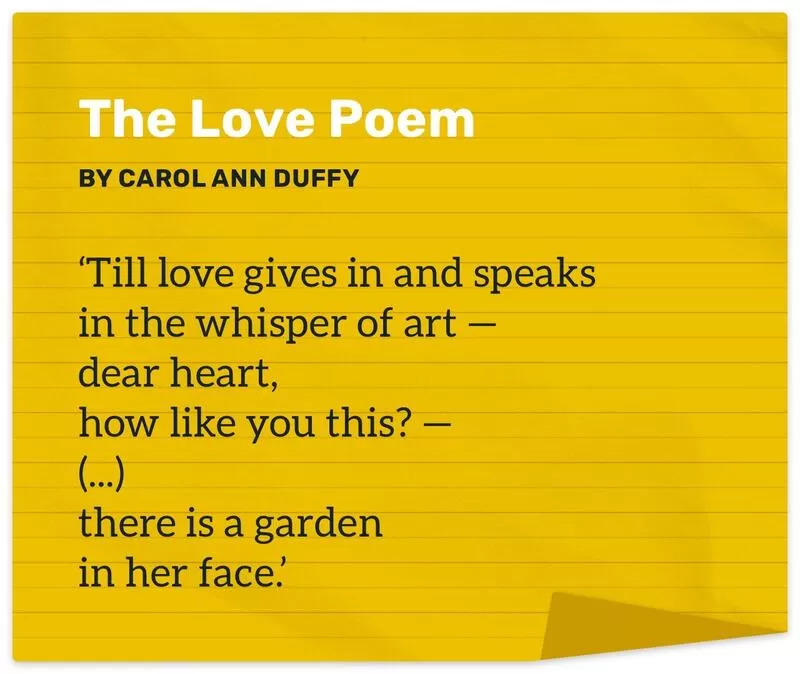
The Love Poem by Carol Ann Duffy
Carol Ann Duffy, the first female and openly lesbian British Poet Laureate, explores the challenge of articulating deep love in ‘The Love Poem’. Coming from a collection that charts a love affair, this poem becomes meta, reflecting on the difficulty of finding words that truly capture the boundless, elemental nature of love. It speaks to the ineffable feeling for a sweetheart that often leaves one searching for adequate expression.
The room was vast, or seemed to be,
because you were not there.
The house was heavy, holding its breath.
I heard the clock tick.
I sat on the stairs, not waiting, not thinking,
but, as it were, hearing
you not arrive.I looked through poems,
through the ages,
blank verse,
a haiku,
a sonnet,
free verse,
anything.
Nothing worked.I tried words like:
Sun. Moon. Stars. Sea.
I tried words like:
Heart. Soul. Mind. Body.I tried saying your name
and watched the air
go blank.There is no love poem
that can say
what you are.
 Hand writing, representing the act of composing love poems for a sweetheart
Before You Came by Faiz Ahmed Faiz
Faiz Ahmed Faiz, a renowned Pakistani poet, beautifully describes how his perspective on life was fundamentally altered by the arrival of his beloved in ‘Before You Came’. The poem expresses a deep reliance on the lover’s presence to see the world authentically. This dependence and the idea that the sweetheart brings clarity and meaning to existence is a powerful expression of their essential role in the speaker’s life.
Before you came,
things were what they were:
the sky a sky,
the road a road,
the glass of wine not a mirror,
just a glass of wine.Before you came,
the heart was a heart
and the sea was a sea.Now
things are not what they were:
the sky is you,
the road is you,
the glass of wine
is a mirror of you.Now
the heart is you,
and the sea is you.Don’t leave now that you’re here—
Stay. So the world may become like itself again:
so the sky may by the sky,
the road a road,
and the glass of wine not a mirror, just a glass of wine.
Lines Depicting Simple Happiness by Peter Gizzi
Peter Gizzi’s poem finds beauty in the simplicity of shared life and admiration. ‘Lines Depicting Simple Happiness’ avoids grand gestures, focusing instead on the quiet joy of noticing and wanting to know everything about the beloved. This appreciation for the ordinary, coupled with a clear adoration, makes it a wonderful expression of simple, profound happiness found with a sweetheart. For inspiration on sharing such tender feelings, explore best love poems for her that capture similar sentiment.
The orange peels are glistening on the sill.
The shadows are long and purple now.
The day is ending and it is beautiful.
It feels right to notice all the shiny things about you
About you there is nothing I wouldn’t want to know
With you nothing is simple yet nothing is simpler
About you many good things come into relationThe rain is soft and steady now.
The dog is dreaming at your feet.
The light is gone and it is beautiful.
It feels right to be quiet beside you.
For Keeps by Joy Harjo
Joy Harjo, a celebrated Mvskoke poet and the first Native American Poet Laureate, often intertwines human emotion with the natural world. In ‘For Keeps’, she draws parallels between her love and the enduring beauty and strength of nature, creating an image of an unbreakable bond. This comparison emphasizes the lasting, essential nature of the feelings she holds for her sweetheart.
We are walking the edge of an island
that flows into the sun.
The sea is on our left, the cliffs
are on our right.You are talking about the way the land
has changed, about the houses that have been built
since you were a child.I am listening to you, but I am also
listening to the sea,
the way it talks to the cliffs,
the way it talks to the sand.Your voice is like the sea,
deep and constant,
and I could listen to it forever.This is for keeps,
this moment,
this island,
this sun,
this sea,
this conversation,
this love.
 Intertwined tree roots, symbolizing enduring connection in sweetheart poems
Yours by Daniel Hoffman
Daniel Hoffman uses carefully chosen metaphors from the natural world to express complete dedication in ‘Yours’. Comparing his connection to his lover to how summer air is possessed by scent or snowcaps gleam with moonlight, he highlights her essential presence that brings life and beauty to his world. The concluding lines emphasize that without her, he would be desolate, making this a powerful testament to the vital role of a sweetheart.
I am yours as the summer air at evening is
Possessed by the scent of linden blossoms,
As the snowcap gleams with light
Lent it by the brimming moon.
Without you I’d be an unleaded tree
Blasted in a bleakness with no Spring.As the water in the river is yours
From the mountains to the sea,
As the moon in the night is yours,
The stars in the sky,
So I am yours.
Poem for My Love by June Jordan
June Jordan, a significant poet and activist, conveys a sense of spiritual awe and transcendence in ‘Poem for My Love’. The speaker is profoundly impacted by their partner, feeling a connection that goes beyond the physical to the spiritual. This poem expresses the deep reverence and transformative power a sweetheart can have on one’s being.
If you would come with me
we could live upon the Atlantic
Oceanwe could seriously engage
the question of Sharkor if you would come with me
we could live inside the
pineconeor we could be
the moonlightor we could be
the statue in the garden
at midnightor we could be
the bench in the park
where the lovers areor we could be
the loversor we could be
the question mark
at the end of the sentenceor we could be
the silence that followsIf you would come with me
we could live inside the
wordif you would come with me
we could live inside the
dreamif you would come with me
we could be
the miracleif you would come with me
we could be
the starsif you would come with me
we could be
the sea.
for him by Rupi Kaur
Rupi Kaur, a leading voice in contemporary poetry, is known for her accessible style. In ‘for him’, she presents a poignant idea: love isn’t just a new discovery but a recognition, a feeling of having known the beloved before, perhaps through the wisdom of a parent. This sense of deep, almost fated familiarity makes it a touching tribute to finding the right person, your sweetheart.
no,
it won’t
be love at
first sight when
we meet it’ll be love
at first remembrance
‘cause i’ve recognized you
in my mother’s eyes when she tells me,
marry the type of man you’d want to raise your son to be like.i’ve waited my whole life for you.
the kind of wait that makes you
understand the patience of a seed.
Untitled by Rupi Kaur (from milk and honey)
Another brief but impactful piece from milk and honey, this untitled poem reflects on love’s nature with a touch of bittersweet wisdom. It suggests that while love can sometimes cause pain, it is not malicious or intentionally hurtful. Love is presented as a force that understands life’s inherent difficulties and therefore strives to be gentle – a generous and understanding perspective fitting for the complex reality of loving a sweetheart.
love will hurt you but
love will never mean to
love will play no games
cause love knows life
has been hard enough already
Camomile Tea by Katherine Mansfield
Katherine Mansfield, celebrated for her insightful short stories and poetry, captures the quiet, underrated joy of peaceful familiarity in ‘Camomile Tea’. The poem paints an intimate scene of a couple finding simple happiness and contentment in each other’s presence, highlighting the deep comfort and understanding shared in the mundane moments – a beautiful depiction of the calm, settled love for a sweetheart.
We might be fifty, we might be five,
So snug, so compact, so wise are we!
Under the kitchen-table leg
My knee is pressing against his knee.Our shutters are shut, the fire is low,
The tap is dripping peacefully;
The saucepan shadows on the wall
Are black and round and plain to see.‘When she comes back,’ I softly say,
‘We’ll give her of our camomile tea.’
You smile at me; I smile at you;
And ‘Yes,’ you murmur, ‘yes,’ agree.
Your Feet by Pablo Neruda
Pablo Neruda, the Nobel Prize-winning Chilean poet, is known for his passionate declarations. In ‘Your Feet’, he takes an unconventional approach, focusing his adoration on a seemingly small detail – the beloved’s feet. Yet, this specific focus expands into a profound expression of loving every part of the person, celebrating their journey and presence in his life. It’s a unique and deeply personal way of expressing devotion to a sweetheart.
When I am working, shut up in my study,
I see your feet, two bowls of compact gold,
or two alabaster boats, to carry me.When I am working, planting my verses,
I come and go through your feet, bare,
walking and walking, knowing that I cannot live
without first going through the light, the earth,
the wind, and the water, through your feet.There are many feet, but only yours
understand me when I walk in the street.
That is why I kiss your feet,
knowing that I walk with you,
and I do not walk alone, not with the wind
nor with the water, nor with the light,
nor with the earth, but with you.
Dear One Absent This Long While by Lisa Olstein
Lisa Olstein’s poem captures the anxious anticipation and deep longing for a beloved’s return. ‘Dear One Absent This Long While’ portrays how the speaker sees glimpses of their loved one everywhere, finding their presence essential to restoring the world to its proper state. This intense sense of missing and the reliance on the sweetheart for completion makes this a moving portrayal of their importance.
I know you are not coming back
but I expect you. I thought one night it was you
at the base of the drive, you at the foot of the stairs
you in a shiver of light, but each time
leaves in wind revealed themselves,
the retreating shadow of a fox, daybreak.We expect you, cat and I, bluebirds and I, the stove.
The bluebirds come back to the birdhouse each spring.
The cat waits by the door.
The stove waits to be lit.I wait for you.
My Lover Is a Woman by Pat Parker
Pat Parker, an influential African-American lesbian feminist poet and activist, speaks of finding safety and refuge in love amidst external struggles. ‘My Lover Is a Woman’ highlights the sweetheart as a safe harbor, a place of warmth and security in a challenging world. This poem powerfully articulates the comfort and sense of belonging a beloved partner provides. Consider these verses among deep love melt love poems for her for their profound emotional impact.
my lover is a woman
& when i hold her
feel her warmth
i feel good
feel safeshe is the storm
she is the calm
she is the moon
she is the sunshe is the lover
she is the friend
she is the beginning
she is the end.
It Is Here by Harold Pinter
Harold Pinter, the Nobel Laureate playwright, explores the enduring presence of love that transcends time and space in his poem ‘It Is Here’. By reflecting on the moment of first meeting, Pinter suggests that the initial spark and connection remain accessible, existing in the shared consciousness of the lovers. This idea of love being ever-present and reachable makes it a tender reflection on the lasting bond with a sweetheart.
What is this stance we take,
To turn away and then turn back?
What did we hear?
It was the breath we took when we first met.
Listen. It is here.It is the silence that follows the first sound.
It is the sound that shatters the first silence.
It is the question that follows the first answer.
It is the answer that silences the first question.
It is here.
Untitled by Christopher Poindexter
Christopher Poindexter offers a deeply honest and relatable portrayal of love that pushes against the limits of language. This untitled poem expresses a paradoxical longing – missing the beloved even when they are near, dreaming of them even in their arms. It speaks to the overwhelming nature of deep affection for a sweetheart, suggesting that even the words “I love you” feel inadequate to fully convey the feeling.
I miss you even when you
are beside me.
I dream of your body
even when you are sleeping
in my arms.The words I love you
could never be enough.The universe is not big enough
to hold my love for you.You are my universe.
Again and again, even though we know love’s landscape by Rainer Maria Rilke
Rainer Maria Rilke believed that loving another was perhaps humanity’s most difficult task. In this poem, he celebrates the continuous, everyday act of choosing love, walking out together despite knowing the potential for pain. It highlights the strength and vulnerability in committing to deep connection with a sweetheart, finding beauty in the repeated choice to love and look up at the sky together. This resonates with poems about love and the moon in its use of celestial or landscape imagery to describe profound feeling.
Again and again, even though we know love’s landscape
and the little churchyard with its lamenting names
and the terrible reticent gorge in which the others
end: again and again the two of us walk out together
under the ancient trees, lay ourselves down again and
again
among the flowers, and look up into the sky.
I loved you first: but afterwards your love by Christina Rossetti
Christina Rossetti explores the reciprocity and merging of love in this sonnet. Despite initially questioning who loved more, the poem moves towards a feeling of ‘oneness’, where individual affections combine to create a unified love greater than its parts. This theme of deep understanding and merging identities speaks to the profound connection shared with a sweetheart, where two lives intertwine and enhance one another.
I loved you first: but afterwards your love
Outsoaring mine, sang such a loftier song
As drowned the friendly cooings of my dove.
Which owes the other most? my love was long,
And yours one moment seemed to wax more strong;
I loved you first: but afterwards your love
Was greater, and the rest all came thereof.In me you loved the river, in you I loved the sea.
In me you loved the flower, in you I loved the tree.Your life is mine, and my life is yours.
We are one.
Defeated by Love by Rumi
The enduring words of Rumi, the 13th-century Persian poet, often speak of intense spiritual and earthly devotion. ‘Defeated by Love’ portrays a love so powerful it overwhelms the self, leading to surrender to the beloved’s magnificence. While grand in its passion, this poem’s core message of being utterly transformed and consumed by love is a powerful way to express the profound impact a sweetheart can have.
The sky was lit
by the splendor of the moon
So powerful
I fell to the ground
Your love
has made me sure
I am ready to forsake
this worldly life
and surrender
to the magnificence
of your BeringYour love has made me
a wild bird
flying in the skyYour love has made me
a fish in the sea
swimmingYour love has made me
a star
shining in the night.
Shall I compare thee to a summer’s day? (Sonnet 18) by William Shakespeare
Perhaps the most famous sonnet ever written, Shakespeare’s Sonnet 18 is a timeless comparison of the beloved to a summer’s day. While acknowledging summer’s fleeting nature, the poem asserts that the beloved’s beauty and essence are eternal, preserved forever in the lines of the verse. This theme of immortalizing the beloved makes it a classic, enduring tribute perfect for a cherished sweetheart.
Shall I compare thee to a summer’s day?
Thou art more lovely and more temperate:
Rough winds do shake the darling buds of May,
And summer’s lease hath all too short a date:
Sometime too hot the eye of heaven shines,
And often is his gold complexion dimm’d;
And every fair from fair sometime declines,
By chance or nature’s changing course untrimm’d;
But thy eternal summer shall not fade,
Nor lose possession of that fair thou owest;
Nor shall Death brag thou wander’st in his shade,
When in eternal lines to time thou growest:
So long as men can breathe or eyes can see,
So long lives this, and this gives life to thee.
 Bust of William Shakespeare, author of famous sonnets often used as sweetheart poems
Let me not to the marriage of true minds (Sonnet 116) by William Shakespeare
Shakespeare’s Sonnet 116 offers a definition of true love as a constant, unwavering force. It asserts that love is not subject to change or external pressures; it is a fixed guide, like the North Star to lost ships. This poem’s depiction of love as an enduring, steadfast commitment makes it an incredibly fitting expression for the deep, reliable bond shared with a sweetheart.
Let me not to the marriage of true minds
Admit impediments. Love is not love
Which alters when it alteration finds,
Or bends with the remover to remove.
O no! it is an ever-fixed mark
That looks on tempests and is never shaken;
It is the star to every wandering bark,
Whose worth’s unknown, although his height be taken.
Love’s not Time’s fool, though rosy lips and cheeks
Within his bending sickle’s compass come;
Love alters not with his brief hours and weeks,
But bears it out even to the edge of doom.
If this be error and upon me proved,
I never writ, nor no man ever loved.
My mistress’ eyes are nothing like the sun (Sonnet 130) by William Shakespeare
In Sonnet 130, Shakespeare playfully subverts the traditional Petrarchan comparisons of the beloved to idealized natural beauty. He frankly lists his mistress’s imperfections – her eyes are not like the sun, her lips not as red as coral. Yet, the poem concludes with a powerful assertion: his love is just as rare and valuable as any idealized love, precisely because he loves her realistically, flaws and all. This honest, accepting love is a beautiful sentiment for a cherished sweetheart.
My mistress’ eyes are nothing like the sun;
Coral is far more red than her lips’ red;
If snow be white, why then her breasts are dun;
If hairs be wires, black wires grow on her head.
I have seen roses damask’d, red and white,
But no such roses see I in her cheeks;
And in some perfumes is there more delight
Than in the breath that from my mistress reeks.
I love to hear her speak, yet well I know
That music hath a far more pleasing sound;
I grant I never saw a goddess go;
My mistress, when she walks, treads on the ground:
And yet, by heaven, I think my love as rare
As any she belied with false compare.
One Day I Wrote her Name (Sonnet 75) by Edmund Spenser
Part of Edmund Spenser’s Amoretti sonnet sequence dedicated to his beloved Elizabeth Boyle, Sonnet 75 addresses the desire to immortalize love despite the transient nature of earthly things. Although waves repeatedly wash away the name written in the sand, the speaker vows to make their love eternal through verse, ensuring her name and their love live forever in fame. This dedication to preserving the memory and value of love speaks to the lasting significance of a sweetheart.
One day I wrote her name upon the strand,
But came the waves and washed it away:
Again I wrote it with a second hand,
But came the tide, and made my pains his prey.
Vain man, said she, that dost in vain assay
A mortal thing so to immortalize,
For I myself shall like to this decay,
And eke my name be wiped out likewise.
Not so, quoth I, let baser things devise
To die in dust, but you shall live by fame:
My verse your virtues rare shall eternize,
And in the heavens write your glorious name:
Where whenas Death shall all the world subdue,
Our love shall live, and later life renew.
We Have Not Long to Love by Tennessee Williams
Though renowned for his plays, Tennessee Williams also wrote poignant poetry. In ‘We Have Not Long to Love’, he offers a gentle reminder to cherish the present moment and the love shared within it. Recognizing the fleeting nature of time and life, the poem encourages deep appreciation for the love we have now, making it a tender call to value the time spent with a sweetheart.
We have not long to love.
Light
and the heart
break even.We have not long to love.
The world
is an island
in an ocean of shadow.We have not long to love.
The light
is leaving.We have not long to love.
Hold
on
to each other.
 Vintage streetcar, evoking a sense of nostalgia and fleeting time in love poems
These poems, whether classic or contemporary, share a common thread: they attempt to capture the ineffable feeling of cherishing another person. A sweetheart is more than just a partner; they are a light, a home, a constant in a changing world. Poetry provides a unique lens through which to view and express this profound bond, offering words that resonate with the depth and tenderness of true affection. Reading and sharing these sweetheart poems can deepen your connection and remind you both of the beautiful language that love inspires. Choose your favorites and let the words speak for you.