
Analyzing poetry allows us to unearth hidden meanings and derive intellectual satisfaction from discovering the poet’s artistry. While all poems offer something to the reader, some possess exceptional depth, inviting exploration and interpretation. This selection of ten analytically rich poems, spanning various eras and styles, exemplifies the power of poetic language and the diverse ways it can resonate with us. These poems, written in English and primarily lyric or short narrative, adhere to classical forms and meters, showcasing how analytical depth can be achieved within formal constraints.
Contents
- 1. Sonnet 142: A Study in Contrasts (William Shakespeare, 1609)
- 2. A Valediction: Forbidding Mourning: Metaphysical Love (John Donne, 1633)
- 3. The Sick Rose: Enigmatic Symbolism (William Blake, 1789)
- 4. Ode: Intimations of Immortality: Wordsworth’s Platonic Vision (William Wordsworth, 1815)
- 5. Ozymandias: The Futility of Power (Percy Bysshe Shelley, 1818)
- 6. My Last Duchess: A Psychological Portrait (Robert Browning, 1842)
- 7. The Raven: Confronting Nihilism (Edgar Allan Poe, 1845)
- 8. Dover Beach: Loss of Faith (Matthew Arnold, 1867)
- 9. Stopping by Woods on a Snowy Evening: A Moment of Reflection (Robert Frost, 1923)
- 10. We Real Cool: A Stark Warning (Gwendolyn Brooks, 1959)
 William Shakespeare, from the First Folio (1623).
1. Sonnet 142: A Study in Contrasts (William Shakespeare, 1609)
Love is my sin, and thy dear virtue hate,
Hate of my sin, grounded on sinful loving:
O, but with mine compare thou thine own state,
And thou shalt find it merits not reproving;
Or, if it do, not from those lips of thine,
That have profan’d their scarlet ornaments
And seal’d false bonds of love as oft as mine,
Robb’d others’ beds’ revenues of their rents.
Be it lawful I love thee, as thou lov’st those
Whom thine eyes woo as mine importune thee:
Root pity in thy heart, that when it grows,
Thy pity may deserve to pitied be.
If thou dost seek to have what thou dost hide,
By self-example mayst thou be denied!
Among Shakespeare’s trove of sonnets, Sonnet 142 stands out for its striking use of contrast. Love becomes sin, and hate transforms into virtue. Beneath the surface lies a plea for pity, adding another layer of complexity. While adhering to the Shakespearean rhyme scheme, the solution presented at the beginning of the third quatrain echoes the Italian sonnet form, creating an intriguing structural interplay.
 John Donne (after miniature by Isaac Oliver, ca. 1616)
2. A Valediction: Forbidding Mourning: Metaphysical Love (John Donne, 1633)
As virtuous men pass mildly away,
And whisper to their souls to go,
Whilst some of their sad friends do say,
“Now his breath goes,” and some say, “No.”
(…)
Such wilt thou be to me, who must,
Like th’ other foot, obliquely run;
Thy firmness makes my circle just
And makes me end where I begun.
Donne’s metaphysical style shines in this valediction, a poem that transcends a simple farewell to a lover. Through extended metaphors, or conceits, Donne compares the union of souls to a compass, each soul tracing an infinite circle. He delves into metaphysical concepts, referencing astronomy and the nature of the soul, transforming a love poem into a profound philosophical exploration.
 William Blake by Thomas Phillips.
3. The Sick Rose: Enigmatic Symbolism (William Blake, 1789)
O Rose thou art sick,
The invisible worm
That flies in the night,
In the howling storm,
(…)
And his dark secret love
Does thy life destroy.
From Blake’s Songs of Innocence and Experience, “The Sick Rose” presents a potent, yet ambiguous image. Its brevity and open metaphors allow for a multitude of interpretations, ranging from the societal ills of Blake’s time to the corrosive effects of experience on innocence. The poem’s enigmatic nature invites continuous analysis and discussion.
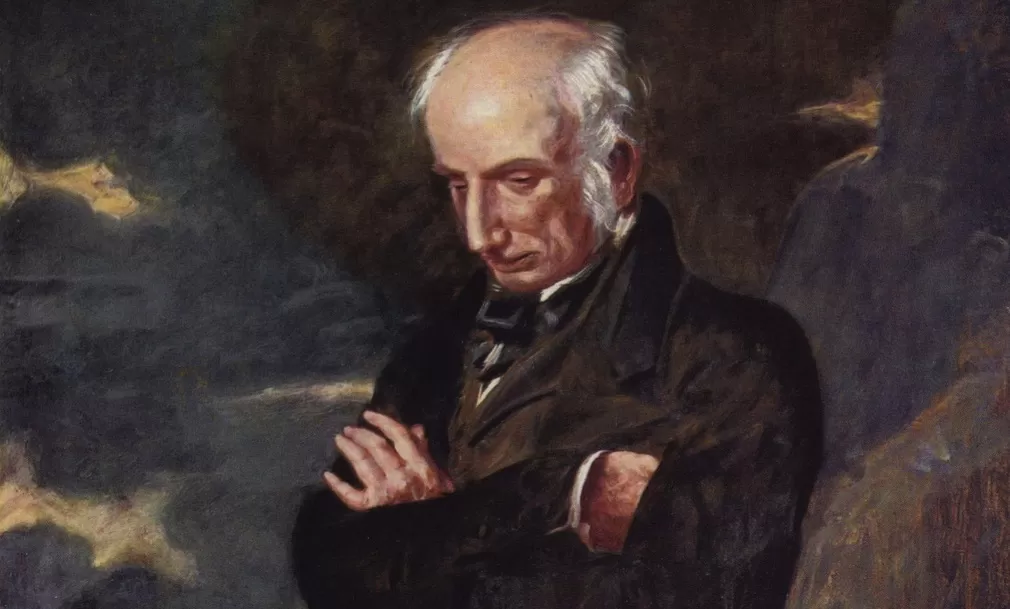 William Wordsworth by Benjamin Robert Haydon.
4. Ode: Intimations of Immortality: Wordsworth’s Platonic Vision (William Wordsworth, 1815)
There was a time when meadow, grove, and stream,
The earth, and every common sight,
To me did seem
Apparelled in celestial light,
(…)
To me the meanest flower that blows can give
Thoughts that do often lie too deep for tears.
Unlike Wordsworth’s typically straightforward style, this ode delves into philosophical depths, exploring the Platonic concept of the soul’s origin in an ideal realm. The poem traces the journey of the human spirit, grappling with the loss of this ideal as the world imprints itself upon the developing mind. Its length and intricate imagery provide ample material for in-depth analysis.
5. Ozymandias: The Futility of Power (Percy Bysshe Shelley, 1818)
I met a traveller from an antique land
Who said: Two vast and trunkless legs of stone
Stand in the desert. Near them, on the sand,
Half sunk, a shattered visage lies, whose frown,
(…)
Nothing beside remains. Round the decay
Of that colossal wreck, boundless and bare
The lone and level sands stretch far away.
Shelley’s sonnet encapsulates layers of meaning within its concise form. While the poem’s surface explores the transient nature of human power, closer examination reveals commentary on art, perception, and the power of artistic representation to shape reality. Historical allusions and a complex narrative structure further enrich its analytical depth.
 The Duke and Duchess by Ford Madox Brown
6. My Last Duchess: A Psychological Portrait (Robert Browning, 1842)
That’s my last Duchess painted on the wall,
Looking as if she were alive. I call
That piece a wonder, now; Fra Pandolf’s hands
(…)
Which Claus of Innsbruck cast in bronze for me!
Browning’s dramatic monologue offers a chilling glimpse into the mind of the Duke of Ferrara. Through his seemingly casual remarks about his deceased wife, the Duke reveals a disturbing psychological profile marked by paranoia and narcissism. The context of his speech, addressed to an ambassador negotiating a future marriage, adds another layer to the poem’s complexity, making it a prime example of psychological analysis in literature.
 The Raven illustration by Gustave Doré
7. The Raven: Confronting Nihilism (Edgar Allan Poe, 1845)
Once upon a midnight dreary, while I pondered, weak and weary,
Over many a quaint and curious volume of forgotten lore —
(…)
And my soul from out that shadow that lies floating on the floor
Shall be lifted — nevermore!
Poe’s “The Raven” transcends a simple ghost story, offering a profound exploration of nihilism. The raven, a masterful personification of despair, embodies the speaker’s internal struggle. As the speaker confronts the raven’s relentless “nevermore,” the poem delves into the psychological turmoil of grappling with existential dread.
 Matthew Arnold
8. Dover Beach: Loss of Faith (Matthew Arnold, 1867)
The sea is calm tonight.
The tide is full, the moon lies fair
(…)
Where ignorant armies clash by night.
“Dover Beach” presents a monologue confronting the loss of faith and the ensuing uncertainty. The speaker’s contemplation of the sea’s ebb and flow becomes a metaphor for the receding “Sea of Faith.” The poem’s complex metaphors, classical allusions, and seemingly inadequate resolution in love offer rich material for analysis.
 Robert Frost
9. Stopping by Woods on a Snowy Evening: A Moment of Reflection (Robert Frost, 1923)
Whose woods these are I think I know.
His house is in the village though;
(…)
And miles to go before I sleep,
And miles to go before I sleep.
Frost’s seemingly simple language belies a deeper metaphorical richness. The captivating winter scene becomes a space for contemplation. The speaker’s pause, mirrored by the horse’s bewilderment, suggests a confrontation with the unknown, similar to the existential questioning in “Dover Beach.”
 Gwendolyn Brooks
10. We Real Cool: A Stark Warning (Gwendolyn Brooks, 1959)
The Pool Players.
Seven at the Golden Shovel.
(…)
We
Die soon.
Brooks’ concise poem, with its striking use of rhyme, alliteration, and anaphora, delivers a powerful message. The boasts of the pool players, subtly alluding to the Seven Deadly Sins, culminate in a chilling premonition of their fate. This stark portrayal of youthful bravado and its consequences invites reflection on contemporary societal issues and the timeless relevance of moral choices.