
Dante Alighieri is universally acclaimed for the monumental Divine Comedy, his epic descent into the realms of the afterlife. Yet, before embarking on that cosmic journey, Dante chronicled a profoundly personal voyage through the landscape of longing, devotion, and sorrow in his earlier work, the Vita Nuova. This lesser-known masterpiece offers a unique glimpse into the poet’s soul, his philosophy of love, and, crucially, his own process of poetic creation, making it a foundational text not only of medieval Italian literature but also a vital guide for understanding the art of poetry itself.
The Vita Nuova, meaning “New Life,” centers on Dante’s transcendent love for Beatrice Portinari, a woman he admired from a distance and whose presence evoked in him overwhelming emotion and spiritual aspiration. More than just a collection of verses, the book intertwines poems – sonnets, canzoni, and a ballata – with prose narrative and commentary written by Dante years after the initial compositions. This structure is groundbreaking, as Dante uses the prose sections to explain the circumstances under which each poem was written, analyze its structure, and clarify its meaning. It’s an early form of autobiography, literary criticism, and poetic manifesto combined.
Dante’s relationship with Beatrice, largely one of distant admiration, evolves through various stages in the Vita Nuova. Initially, he experiences the classic physical symptoms of courtly love – trembling, pallor, inability to speak in her presence. However, a pivotal moment arrives when he is questioned about the nature of his love. This prompts Dante to reflect deeply on how love poetry can ascend from mere physical desire to a purer, more spiritual veneration of the beloved. This introspection leads to a transformation in his poetic focus, shifting from seeking Beatrice’s ‘salute’ (both greeting and salvation) to praising her virtues for their own sake, regardless of any return from her.
This journey of spiritual transfiguration is at the heart of the Vita Nuova. Dante portrays his love for Beatrice as a pathway to divine understanding and grace. Following a vision, he receives guidance on how to compose poetry that truly honors love by focusing on praise of the lady. This concept of love as a means to spiritual growth, culminating in Beatrice’s death and subsequent elevation to heaven, becomes the foundation for his later theological exploration in the Divine Comedy.
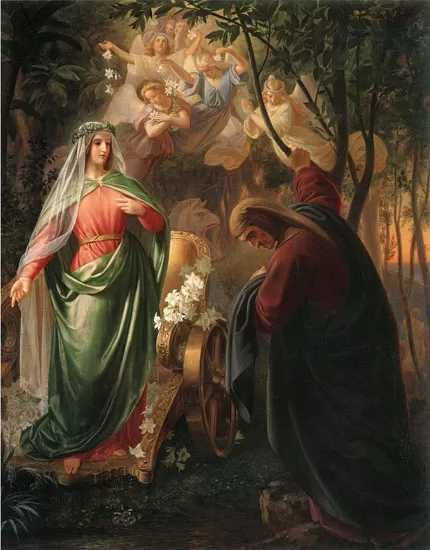 Painting depicting Dante Alighieri and Beatrice Portinari by Carl Wilhelm Friederich Oesterly
For readers approaching the Vita Nuova today, the experience is shaped significantly by the translation chosen. Translating poetry is inherently challenging, requiring a delicate balance between preserving the original meaning, rhythm, rhyme, and emotional tone. Different translators make different choices, resulting in varied interpretations that can highlight distinct facets of Dante’s work.
Comparing translations offers valuable insights into Dante’s original Italian and the translator’s craft. Consider, for example, a passage from Canto XLI (often numbered XL as in some editions), describing a sigh that ascends to heaven to see Beatrice.
Here is Mark Musa’s 1992 translation:
Beyond the sphere that makes the widest round,
passes the sigh which issues from my heart;
a strange, new understanding that sad Love
imparts to its keeps urging it on high.
When it has reached the place of its desiring,
it sees a lady held in reverence,
splendid in light, and through her radiance
the pilgrim spirit gazes at her being.
But when it tries to tell me what it saw,
I cannot understand the subtle words
it speaks to the sad heart that makes it speak.
I know it talks of that most gracious one,
because it often mentions Beatrice;
this much is very clear to me, dear ladies.
And here is Dante Gabriel Rossetti’s 1846 translation of the same poem:
Beyond the sphere which spreads to widest space
Now soars the sigh that my heart sends above:
A new perception born of grieving Love
Guideth it upward the untrodden ways.
When it hath reached unto the end, and stays,
It sees a lady round whom splendors move
In homage; till, by the great light thereof
Abashed, the pilgrim spirit stands at gaze.
It sees her such, that when it tells me this
Which it hath seen, I understand it not,
It hath a speech so subtle and so fine.
And yet I know its voice within my thought
Often remembereth me of Beatrice:
So that I understand it, ladies mine.
Musa’s translation often prioritizes a more direct, literal rendering of the Italian, allowing the reader (especially with a facing-page edition) to see the original structure and vocabulary. Rossetti, writing in a different era with a keen poetic sensibility himself, seeks to recreate the poem’s form and musicality in English, sometimes employing language that feels more archaic but captures a certain poetic elevation. Both versions offer unique strengths; Musa might provide a clearer window into the original’s mechanics, while Rossetti might offer a more immediate experience of its aesthetic power as a translated English poem.
Consider another comparison, describing the impact of Beatrice’s death:
From Rossetti (1846):
…
For ever, among all my sighs which burn,
There is a piteous speech
That clamors upon death continually:
Yea, unto him doth my whole spirit turn
Since first his hand did reach
My lady’s life with most foul cruelty.
But from the height of woman’s fairness, she,
Going up from us with the joy we had,
Grew perfectly and spiritually fair;
That so she spreads even there
A light of Love which makes the Angels glad,
And even unto their subtle minds can bring
A certain awe of profound marveling.
And from Musa (1992):
…
And there is blended out of all my sighs
a chorus of beseeching
that constantly keeps calling upon Death.
Towards this has turned each one of my desires
since that day when my lady
was taken from me by Death’s cruelty.
This is because the pleasure of her beauty,
having removed itself from mortal sight,
was transformed into beauty of the soul
spreading throughout the heavens
a light of love that greets the angels there,
and moves their keen and lofty intellects
to marvel at such graciousness as hers.
Here, Rossetti’s language (“piteous speech,” “most foul cruelty,” “profound marveling”) carries a distinct Victorian resonance, aiming for poetic grandeur. Musa’s (“chorus of beseeching,” “Death’s cruelty,” “keen and lofty intellects”) feels more modern and perhaps more directly descriptive of the internal state and theological consequence. The choice between them often depends on the reader’s preference for historical sound versus contemporary clarity.
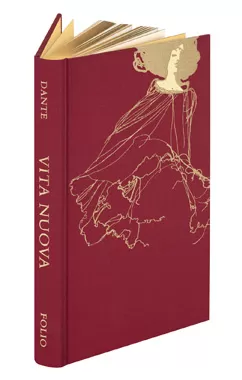 Cover of the Folio Society edition of Dante Alighieri's Vita Nuova, Musa translation
Beyond its narrative of love and loss, the Vita Nuova stands out as a unique resource for aspiring poets and readers interested in the craft. Dante’s detailed prose explanations accompanying each poem offer invaluable insights into his compositional process, his response to external requests for verses, and his intentional choices regarding form and content. He explicitly discusses how he approached expressing certain ideas or emotions, almost acting as a teacher guiding the reader through the construction of traditional poetry.
Furthermore, the Vita Nuova articulates a profound truth about the power of poetry: its ability to capture and convey experiences and emotions that prose often struggles to articulate. Dante demonstrates how poetic language, through imagery, metaphor, and rhythm, can penetrate deeper than surface meaning, accessing and expressing the ineffable inner feeling of human experience and spiritual revelation. This aspect alone makes the Vita Nuova a timeless and highly relevant text for anyone seeking to understand the enduring value and unique capabilities of the poetic art form.
In conclusion, Dante Alighieri’s Vita Nuova is far more than just a collection of love poems. It is a deeply personal narrative of spiritual growth through love, an innovative blend of verse and prose commentary, and a remarkable early treatise on the art and purpose of poetry. By exploring Dante’s journey with Beatrice, readers gain not only an appreciation for medieval lyricism but also a foundational understanding of the thought process behind traditional poetic composition and the unique capacity of poetry to express the most profound aspects of the human and spiritual condition.