
Choosing the right poem for a funeral or memorial service is a deeply personal act, offering a voice to the complex emotions of grief, remembrance, and acceptance. Poetry can provide solace, celebrate a life lived, or simply offer a moment of quiet reflection amidst sorrow. Finding a poem that resonates with the spirit of the departed and brings comfort to those gathered is a meaningful part of the farewell process. This collection presents ten diverse poems, each offering a unique perspective on death, loss, and the enduring nature of connection, providing options that range from poignant expressions of grief to messages of hope and peaceful transition.
Contents
- Loss by Winifred M. Letts
- Crossing the Bar by Alfred Lord Tennyson
- Nothing Gold Can Stay by Robert Frost
- Epitaph on My Own Friend by Robert Burns
- The Departed by John Banister Tabb
- Miss Me, but Let Me Go by Unknown
- Consolation by Robert Louis Stevenson
- Happy the Man by John Dryden
- Funeral Blues by W.H. Auden
- Music When Soft Voices Die by Percy Bysshe Shelley
Loss by Winifred M. Letts
Winifred M. Letts (1882-1972) was an English-born writer who found success as a playwright and novelist before publishing her first poetry collection at 31. Her poem “Loss” is a powerful evocation of the tangible void left by the absence of a loved one. It doesn’t shy away from the profound sense of deprivation that grief brings, enumerating the simple, vital elements of life – the sun, moon, seasons, dreams, hope – that seem to vanish when a significant person is gone. The poem’s strength lies in its vivid imagery and its raw, relatable portrayal of a world fundamentally altered by sorrow, making it a fitting expression for deep, personal grief at a funeral.
In losing you I lost my sun and moon
And all the stars that blessed my lonely night.
I lost the hope of Spring, the joy of June,
The Autumn’s peace, the Winter’s firelight.
I lost the zest of living, the sweet sense
Expectant of your step, your smile, your kiss;
I lost all hope and fear and keen suspense
For this cold calm, sans agony, sans bliss.
I lost the rainbow’s gold, the silver key
That gave me freedom of my town of dreams;
I lost the path that leads to Faërie
By beechen glades and heron-haunted streams.
I lost the master word, dear love, the clue
That threads the maze of life when I lost you.
Crossing the Bar by Alfred Lord Tennyson
Alfred Lord Tennyson (1809-1892), the Poet Laureate of England for much of Queen Victoria’s reign, wrote “Crossing the Bar” as a metaphorical contemplation of his own approaching death. The poem frames death as a peaceful sea journey, crossing the sandbar from a sheltered harbor into the vast, open ocean. It speaks of a “clear call” and hopes for a calm, gentle transition (“no moaning of the bar”) and a tide so still it seems asleep. This perspective offers a sense of tranquility and faith in the face of mortality, suggesting a return to a boundless origin. The final stanza expresses a hopeful anticipation of meeting the “Pilot face to face” after the journey, a comforting image for those with faith. This poem is a classic choice for funeral services, offering a sense of serenity and acceptance regarding death as a natural, if profound, transition.
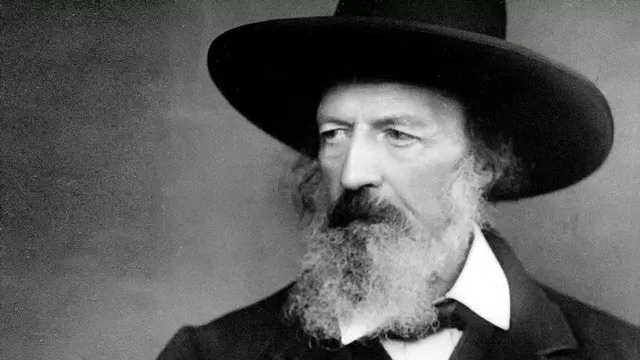 Portrait of Alfred Lord Tennyson, author of the funeral poem 'Crossing the Bar'
Sunset and evening star,
And one clear call for me!
And may there be no moaning of the bar,
When I put out to sea,
But such a tide as moving seems asleep,
Too full for sound and foam,
When that which drew from out the boundless deep
Turns again home.
Twilight and evening bell,
And after that the dark!
And may there be no sadness of farewell,
When I embark;
For tho’ from out our bourne of Time and Place
The flood may bear me far,
I hope to see my Pilot face to face
When I have cross’d the bar.
Nothing Gold Can Stay by Robert Frost
Robert Frost (1874-1963) was a celebrated American poet known for his depictions of rural New England life and his exploration of complex philosophical themes through accessible language. “Nothing Gold Can Stay” is a short, poignant reflection on the transient nature of beauty, youth, and fleeting moments of perfection. Using the metaphor of spring’s first green leaves turning gold before fading to ordinary green, Frost connects this natural cycle to larger ideas of impermanence, referencing the fall from Eden and the inevitable progression from dawn to day. For a funeral, this poem offers a somber but beautiful acknowledgment of the brevity of life and the preciousness of the moments that are, like gold, hard to hold onto. It can be particularly resonant when mourning someone who died young or “before their time,” encouraging reflection on the intense beauty and value of the life that was lived, however brief.
Nature’s first green is gold,
Her hardest hue to hold.
Her early leaf’s a flower;
But only so an hour.
Then leaf subsides to leaf.
So Eden sank to grief,
So dawn goes down to day.
Nothing gold can stay.
Epitaph on My Own Friend by Robert Burns
Robert Burns (1759-1796), the national poet of Scotland, is beloved for his lyrical poems and songs. While titled an “Epitaph,” this poem is a heartfelt tribute to his friend, William Muir. It celebrates the qualities of a truly good person: honesty, friendship (to humanity, truth, age, and youth), virtue, and knowledge. The final lines offer a pragmatic and hopeful view of a life well-lived: if there is an afterlife, such a person finds bliss; if not, they have nonetheless made the absolute best of their time on Earth. This poem is an excellent choice for honoring a cherished friend at a funeral, focusing on the positive impact and the virtuous character of the deceased rather than solely on grief. It serves as a powerful testament to the value of friendship and a life lived with integrity.
 Portrait of Scottish poet Robert Burns, known for 'Epitaph on My Own Friend'
An honest man here lies at rest,
As e’er God with His image blest:
The friend of man, the friend of truth;
The friend of age, and guide of youth:
Few hearts like his, with virtue warm’d,
Few heads with knowledge so inform’d:
If there’s another world, he lives in bliss;
If there is none, he made the best of this.
The Departed by John Banister Tabb
John Banister Tabb (1845-1909) was a priest and poet whose work appeared in prominent magazines of his time. His poem “The Departed” is a brief yet profound meditation on the enduring connection between the living and those who have passed on. It suggests that the departed do not entirely leave us (“cannot wholly pass away”), just as we, the living, remain connected to them. The beautiful metaphor of spirits reaching “backward into Time, as we, Like lifted clouds, reach on” suggests a continuous link, like shadows stretching or clouds moving across the sky. This short, graceful poem offers a comforting thought: that the bond of love transcends the physical separation of death, implying that those we love are still accessible to us in some meaningful way.
They cannot wholly pass away
How far soe’er above;
Nor we, the lingerers, wholly stay
Apart from those we love:
For spirits in eternity,
As shadows in the sun,
Reach backward into Time, as we,
Like lifted clouds, reach on.
Miss Me, but Let Me Go by Unknown
“Miss Me, but Let Me Go” is a widely popular funeral poem whose authorship is uncertain, though it’s often attributed to figures like Christina Rossetti, Henry Scott Holland, or Edgar A. Guest. Regardless of origin, its message is clear and comforting: the speaker, from beyond the grave, asks loved ones not to mourn excessively but to find peace in their release. It frames death not as an end, but as a “journey we all must take,” a “step on the road to home.” The poem encourages remembrance (“Remember the love that we once shared”) but also urges the living to move forward, find solace in shared memories and community, and continue living purposeful lives (“bury your sorrows in doing good deeds”). This poem is particularly well-suited for someone who planned their own service or wished to offer words of consolation and encouragement to those left behind. Its tone is one of acceptance, love, and gentle release.
 Image of a grave headstone, symbolizing loss and the unknown authorship of the funeral poem 'Miss Me, but Let Me Go'
When I come to the end of the road
And the sun has set for me,
I want no rites in a gloom-filled room,
Why cry for a soul set free!
Miss me a little—but not for long
And not with your head bowed low.
Remember the love that we once shared,
Miss me, but let me go.
For this is a journey we all must take
And each must go alone;
It’s all a part of the Master’s plan
A step on the road to home.
When you are lonely and sick at heart
Go to the friends we know,
And bury your sorrows in doing good deeds.
Miss me, but let me go.
Consolation by Robert Louis Stevenson
Robert Louis Stevenson (1850-1894), the renowned Scottish writer of novels like Treasure Island and poetry like A Child’s Garden of Verses, offers a comforting perspective on loss in his poem “Consolation.” Addressed to someone grieving a friend, the poem uses the metaphor of two people walking the same path together. When one person dies (“Be gone a while before”), they have simply “turned the corner” or gotten “some few, trifling steps ahead” on the same journey that the living are still traveling. The poem encourages the one left behind to “Push gaily on,” suggesting that the friend is not truly gone but merely waiting further up the path (“He loiters with a backward smile”). This imagery provides reassurance, suggesting that separation is temporary and a reunion is inevitable on the shared path of life and beyond. It offers a hopeful and less final view of death, portraying it as merely a bend in the road.
Though he, that ever kind and true,
Kept stoutly step by step with you,
Your whole long, gusty lifetime through,
Be gone a while before,
Be now a moment gone before,
Yet, doubt not, soon the seasons shall restore
Your friend to you.
He has but turned the corner—still
He pushes on with right good will,
Through mire and marsh, by heugh and hill,
That self-same arduous way—
That self-same upland, hopeful way,
That you and he through many a doubtful day
Attempted still.
He is not dead, this friend—not dead,
But in the path we mortals tread
Got some few, trifling steps ahead
And nearer to the end;
So that you too, once past the bend,
Shall meet again, as face to face, this friend
You fancy dead.
Push gaily on, strong heart! The while
You travel forward mile by mile,
He loiters with a backward smile
Till you can overtake,
And strains his eyes to search his wake,
Or whistling, as he sees you through the brake,
Waits on a stile.
Happy the Man by John Dryden
John Dryden (1631–1700), England’s first Poet Laureate, penned “Happy the Man” as a celebration of living fully in the present moment and facing the future without regret. The poem asserts that true happiness belongs to the one who can claim “today his own,” feeling secure and content with the present. The speaker defiantly addresses tomorrow (“Tomorrow do thy worst”), confident that the joys and experiences of the past are secure and cannot be taken away, even by fate or time. The powerful closing line, “But what has been, has been, and I have had my hour,” is a declaration of fulfillment and acceptance. Reading this poem at a funeral can be a tribute to someone who lived their life with purpose, embraced its joys, and approached death with a sense of completion rather than fear. It’s a poem of empowerment and contentment derived from a life well-lived.
 Historical portrait of John Dryden, the first English Poet Laureate
Happy the man, and happy he alone,
He who can call today his own:
He who, secure within, can say,
Tomorrow do thy worst, for I have lived today.
Be fair or foul or rain or shine
The joys I have possessed, in spite of fate, are mine.
Not Heaven itself upon the past has power,
But what has been, has been, and I have had my hour.
Funeral Blues by W.H. Auden
W.H. Auden (1907-1973) was a British-American poet known for his technical skill and engagement with social and political themes, alongside deeply personal ones. “Funeral Blues” (also known by its opening line, “Stop all the clocks”) gained widespread popularity after its poignant reading in the film Four Weddings and a Funeral. This poem is a raw, exaggerated expression of overwhelming grief upon the death of a beloved partner. It uses hyperbole – demanding the cessation of all life’s activities, the dismantling of the cosmos itself – to convey the absolute devastation felt by the speaker. The lines “He was my North, my South, my East and West… I thought that love would last forever: I was wrong” perfectly capture the sense that the deceased was the very center of the speaker’s world, and their loss has rendered everything else meaningless. For those experiencing acute, world-shattering grief at a funeral, this poem offers a powerful, validating articulation of that intense pain.
Stop all the clocks, cut off the telephone,
Prevent the dog from barking with a juicy bone,
Silence the pianos and with muffled drum
Bring out the coffin, let the mourners come.
Let aeroplanes circle moaning overhead
Scribbling on the sky the message ‘He is Dead’.
Put crepe bows round the white necks of the public doves,
Let the traffic policemen wear black cotton gloves.
He was my North, my South, my East and West,
My working week and my Sunday rest,
My noon, my midnight, my talk, my song;
I thought that love would last forever: I was wrong.
The stars are not wanted now; put out every one,
Pack up the moon and dismantle the sun,
Pour away the ocean and sweep up the wood;
For nothing now can ever come to any good.
Music When Soft Voices Die by Percy Bysshe Shelley
Percy Bysshe Shelley (1792-1822), a major English Romantic poet, wrote “Music When Soft Voices Die” (also known as “To Constantia”). Though brief, this lyric captures the enduring nature of sensory and emotional impressions, even after their source is gone. It uses beautiful analogies: music lingers in memory after it fades, the scent of violets remains after they wither, and rose leaves gathered after the bloom are saved for a beloved. The poem’s core message is in the final lines: “And so thy thoughts, when thou art gone, Love itself shall slumber on.” It suggests that the essence of a loved one, the feelings and memories associated with them, do not disappear but continue to exist, preserved within love itself, perhaps lying dormant but still present. This poem offers a delicate and lyrical way to express that the love and memory of the departed person will persist, a comforting thought at a funeral service. Its musical quality also makes it particularly lovely to read aloud.
 Portrait of Romantic poet Percy Bysshe Shelley, author of 'Music When Soft Voices Die'
Music, when soft voices die,
Vibrates in the memory—
Odours, when sweet violets sicken,
Live within the sense they quicken.
Rose leaves, when the rose is dead,
Are heaped for the belovèd’s bed;
And so thy thoughts, when thou art gone,
Love itself shall slumber on.
Finding the right words during a time of loss can be challenging, and poetry offers a powerful way to articulate feelings that are often difficult to express. This selection provides a starting point, exploring different facets of grief, memory, and the transition of death. Whether seeking solace, celebrating a life, or reflecting on enduring love, the perfect poem can add a layer of depth, beauty, and emotional resonance to a funeral service, helping to honor the departed and support those who mourn.