
Pablo Neruda’s Twenty Love Poems and a Song of Despair is a landmark collection, renowned globally for its raw passion and evocative imagery. As we explore the landscape of 1st love poems, Neruda’s early work, penned at just 19, offers a compelling, albeit complex, example of how young poets capture the turbulent intensity of burgeoning romance. “Poem 1,” the opening piece of this celebrated series, sets a striking, and at times challenging, tone, presenting a powerful, one-sided perspective on love and desire.
Contents
Unlike many simple, innocent portrayals of early affection, “Poem 1” dives headfirst into audacious metaphors, depicting the beloved not just as a person, but as a vast, almost mineral, landscape to be explored and claimed. This intense focus on the physical, viewed through the male speaker’s gaze, immediately distinguishes it from other poetry about initial romantic experiences. While perhaps not a typical “first love” in the sense of innocent affection, it vividly portrays the overwhelming physical and emotional world as experienced by a young poet encountering intense desire for the first time, making it a significant entry point into understanding complex early love poems.
Neruda’s approach in Twenty Love Poems is notable for the relative absence of the beloved’s voice or inner world. Throughout the collection, and strikingly in “Poem 1,” the focus remains squarely on the speaker’s feelings, perceptions, and struggles. This self-centeredness, while perhaps a hallmark of a young poet’s perspective, raises questions about the dynamics of the relationships depicted, a theme often explored in more mature reflections on 1st love poems and relationships.
Decoding the Audacious Imagery in “Poem 1”
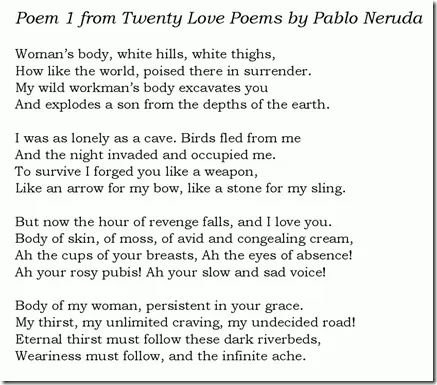
The opening stanza of “Poem 1” immediately confronts the reader with a bold, physical metaphor: the beloved as a “body of a woman,” likened to a “white mountain” or a “silent country.” This isn’t the delicate imagery often associated with romantic poetry; it’s stark, almost geological.
Neruda’s speaker portrays himself as the explorer or miner of this landscape. This imagery, particularly the translation choices involved, reveals the poet’s raw, almost possessive, engagement with the beloved. Translating this poem requires careful consideration of the Spanish nuances, balancing fidelity to the original’s striking rawness with creating compelling English verse. The act of “mining” the lover’s body, the suggestion of conceiving a son through this process, can be interpreted as both an extravagant declaration of potency and a potentially problematic claim of ownership, elements that distinguish this from more conventional portrayals found in many good morning love poems for her or gentle verses.
 Poem 1
The second stanza shifts focus, turning inward to describe the speaker’s own experience within this physical landscape. Phrases like “my rough peasant body that digs in you” offer a vivid, visceral image of the speaker’s presence and action. This section showcases Neruda’s ability to create mysterious and evocative descriptions, even when describing his own state. The challenge for a translator lies in capturing the specific feel and sound of words like “túnel,” where choosing between “tunnel” or “cave” impacts the subtext and musicality of the verse.
The third stanza introduces more complex, and arguably problematic, imagery. Descriptions of the beloved’s body parts mingle with abstract or possessive phrasing. Lines that could suggest an acknowledgment of the beloved’s inner life (“Oh the cup of sorrow for breasts!”) quickly revert to physical descriptions and the speaker’s perspective. The struggle in translation is evident here, particularly with phrases open to multiple interpretations, including idiomatic or even crude readings in the original Spanish. This tension between evocative language and potentially uncomfortable dynamics is a defining characteristic of Neruda’s first love poems in this collection.
The Male Gaze and Early Poetic Expression
A recurring critique of Neruda’s Twenty Love Poems is its pervasive “Male Gaze.” The beloved exists primarily as the object of the speaker’s desire, projection, and suffering. She is described, explored, and lamented, but rarely, if ever, speaks or expresses her own emotions directly within the poems.
This perspective is starkly present in “Poem 1.” The powerful, often violent or possessive, imagery reflects the speaker’s internal world and his tumultuous experience of love and desire. While this can be seen as a limitation – particularly from a modern perspective valuing mutual expression – it is also precisely what the poem is: a raw, unfiltered outpouring of a young man’s feelings. When considering the nature of 1st love poems, this intensity and self-focus might unfortunately reflect the immaturity and limited perspective common in early romantic experiences.
The final stanza returns to a broader reflection on the beloved’s body and the speaker’s relationship to it. The use of phrases like “my woman” underscores the possessive tone that runs through the poem. The ending lines emphasize the speaker’s transient nature, his inability to be satisfied, and a certain resignation or world-weariness that feels perhaps premature for a 19-year-old, yet aligns with the “Song of Despair” that concludes the collection. It paints a picture of love not as a lasting union, but a temporary, intense exploration from which the speaker must eventually move on. This complex portrayal contrasts sharply with the hopeful visions found in verses about true love good morning love poems.
The Enduring Power and Problematic Aspects
Despite the critical lens applied to the male gaze and possessive elements, “Poem 1” and the entire Twenty Love Poems collection have resonated deeply with readers for decades. This enduring popularity suggests that while the dynamics depicted may be debated, the sheer power of Neruda’s language, the vividness of his imagery, and the intensity of his emotional expression connect with universal experiences of passion, desire, and loss.
Perhaps the appeal lies in its authenticity as an expression of overwhelming, perhaps immature, feeling – a state often characteristic of 1st love poems or early intense relationships. It’s poetry as raw experience, prioritizing emotional truth (from the speaker’s perspective) over social commentary or equitable representation.
As readers in the 21st century, we can appreciate the artistic merit of Neruda’s youthful work while also critically examining the perspectives it embodies. “Poem 1” stands as a powerful, if challenging, example of early love poetry – a testament to the intense, self-absorbed world of a young poet grappling with the force of love and desire. It invites us to consider not just the beauty of language, but the complex human dynamics that poetry can capture. For those exploring different poetic voices, contrasting Neruda’s intense approach with the structured beauty of robert frost poems can offer a fascinating study in style and theme.
By engaging with poems like this, we gain a deeper understanding of how the art form captures the multifaceted, sometimes problematic, nature of human emotion, especially in the formative experiences of first love.
References:
- The original Spanish text and another English translation of “Poem 1” can often be found in literary archives and online resources dedicated to Pablo Neruda’s work, such as this one.