
Poetry and music have long been intertwined, two languages of emotion that speak to the soul. The rhythm and meter of verse can mimic a melody, while carefully chosen words can evoke feelings as powerful as a musical phrase. Within the realm of love poetry, this connection is particularly potent. Love, with its highs and lows, its tender whispers and passionate declarations, finds natural expression in both lyrical poetry and heartfelt song. The concept of “love poem music” speaks to this inherent harmony – the way poems about love possess an internal melody or how they inspire external musical interpretation.
One poet whose work often touches upon this intrinsic musicality, even amidst complex emotional landscapes, is Pablo Neruda. His Twenty Love Poems and a Song of Despair, written in his youth, is a collection where intense feeling is conveyed through striking, often unconventional, imagery. While not explicitly written as songs, the poems in this collection carry a distinct rhythm and sonic quality that hints at their potential for musical expression.
love at first sight poems often capture instantaneous passion, much like a sudden swell of orchestral music. Neruda’s poems, while sometimes depicting moments of intimacy, frequently explore the echoes of love, its absence, and its lingering effects, offering a different kind of “love poem music” – one perhaps more melancholic or introspective.
The opening poem in the collection, “Poem 1,” offers a fascinating starting point for exploring this connection. The poem immediately presents the beloved not just as a person, but as an expansive, almost geological landscape. This initial image sets a unique tone, using tactile and visual descriptions that nonetheless carry a certain weight and internal rhythm when read aloud.
The speaker describes “Body of woman, white hills, white thighs.” Even in translation, the repetition of “white” creates a simple, almost hypnotic beat. The subsequent lines, “you look like a world in surrender,” introduce a broader scope, shifting from specific physical details to a vast, metaphorical yielding. This movement between the intimate and the immense gives the poem a dynamic quality, much like varying tempos within a musical piece.
Body of woman, white hills, white thighs,
you look like a world in surrender.
My rough peasant’s body digs in you
and makes a son leap from the earth’s inside.
The first stanza, as analyzed in the original commentary, uses bold, even audacious imagery, portraying the lover as a mineral landscape being “mined.” While the critique points out potential issues with this perspective, from a purely sonic and rhythmic standpoint, the language (“white hills, white thighs,” “peasant’s body digs,” “son leap from the earth’s inside”) contains strong consonants and varied vowel sounds that create a rugged, almost percussive feel. The rhythm isn’t strictly metrical, but flows with a raw, earthy energy.
The second stanza shifts focus to the speaker’s internal landscape. “I was alone like a tunnel.” This line introduces a solitary, echoing sound – the sound of being enclosed and perhaps empty. The choice of “tunnel” or, as the original analysis notes a preference for, “cave,” significantly impacts the poem’s soundscape. “Tunnel” might suggest a straight, perhaps echoing passage, while “cave” evokes a more resonant, enclosed, and mysterious space.
I was alone like a tunnel. The birds fled from me,
and night flooded me with its powerful invasion.
To survive I forged you like a weapon,
like an arrow in my bow, a stone in my sling.
The imagery here – fleeing birds, invading night, forging a weapon – introduces a sense of struggle and defense. The rhythm becomes perhaps more urgent, driven by active verbs like “fled,” “flooded,” “forged.” This stanza showcases how even seemingly abstract or emotional states are rendered through concrete, almost physical actions, giving the lines a grounded, impactful feel. The sounds themselves contribute to this feeling of resilience and raw determination.
The third stanza returns to describing the beloved, but also highlights the speaker’s interaction with her.
Body of woman, I will persist in your grace.
My thirst, my boundless desire, my wavering road!
Dark riverbeds where the thirst eternal flows
and weariness follows, and the infinite ache.
The opening line, “Body of woman, I will persist in your grace,” repeats the initial address, creating a returning motif, like a recurring theme in music. The subsequent lines use evocative, almost overwhelming language to describe internal states (“thirst,” “desire,” “ache”) but frame them within physical metaphors (“riverbeds,” “road”). This blend creates a sense of flow and intensity. The sound of words like “boundless desire,” “wavering road,” and “infinite ache” carry a weight that resonates emotionally, contributing to the overall “love poem music” of the piece – a melody perhaps marked by longing and melancholy.
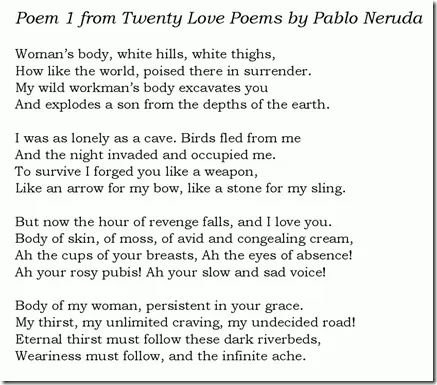 Neruda Poem 1
The final stanza brings a complex blend of possessiveness and transient recognition.
In the shore of your arms
the little birds of thirst and the infinite ache rested.
Your moist mouth, your grapes of silence,
your naked body, quiet, still.
The image of “little birds of thirst and the infinite ache resting” in the beloved’s arms is a moment of poignant, albeit perhaps fleeting, solace. The description of the mouth as “grapes of silence” is a striking synesthetic image that links the tactile (grapes) with the auditory/lack thereof (silence), creating a unique sonic texture in the reader’s mind. The final lines describing the body as “naked, quiet, still” emphasize the lack of movement and sound, a stillness that the poet has noted as a recurring characteristic he attributes to his beloved throughout the collection. This quiet ending provides a contrasting note to the earlier, more dynamic imagery, much like a piece of music ending on a hushed, reflective chord.
The original commentary highlights the author’s choice to perform this poem not romantically, but as a dramatic monologue with astringent pianos and a tender cello. This demonstrates how the inherent “love poem music” within the text – its rhythms, sounds, and emotional shifts – can be interpreted musically in various ways. The contrast between the “rough peasant’s body” and the quiet stillness, the shift from vast landscapes to intimate details, and the movement between desire and ache all provide material for musical interpretation. A composer or performer could choose to emphasize the percussive nature of the early lines, the echoing solitude of the tunnel/cave, the sweeping flow of desire, or the hushed stillness of the conclusion.
Exploring the connection between love poetry and music allows for a deeper appreciation of both art forms. It highlights how poets use sound devices, rhythm, and evocative imagery to create an auditory experience for the reader, an internal music that complements the poem’s meaning. It also shows how musicians can draw inspiration from the emotional depth and narrative implicit in love poems to create new soundscapes.
Whether analyzing classical works or contemporary verses, understanding the musicality inherent in best poems for recitation helps us appreciate why some poems resonate so strongly when read aloud or set to music. Neruda’s “Poem 1,” despite its analytical complexities and critiques, offers a rich example of how even poems dealing with challenging perspectives can possess a compelling internal rhythm and sound structure, contributing to the vast tradition of “love poem music.” It reminds us that love, in all its forms, has a sound, a rhythm, and a melody that poets and musicians have sought to capture across generations. Discussing poems to my man or 4th of july poems from this perspective of inherent musicality can reveal surprising depths and connections between seemingly disparate themes and styles.
In conclusion, the analysis of Neruda’s “Poem 1” through the lens of “love poem music” reveals how sonic elements, rhythm, and imagery contribute to the overall emotional impact and potential for musical interpretation. The raw energy of the opening, the echoing solitude, the flowing desire, and the final stillness all create a unique soundscape within the poem. This exploration underscores the deep, often subtle, connection between love poetry and music, inviting readers to listen not just with their minds, but with their ears, for the inherent melody within the verse.