
Sir Gawain and the Green Knight, the celebrated Middle English chivalric romance, continues to fascinate readers and scholars alike with its compelling narrative of virtue, temptation, and knightly duty. Set against the backdrop of King Arthur’s court and the wild landscapes of medieval England, the poem stands as a masterpiece of alliterative verse. Yet, despite its prominence, the identity of its creator remains one of literature’s enduring mysteries. Traditionally known as the “Gawain Poet” or the “Pearl Poet,” due to the inclusion of Sir Gawain and the Green Knight alongside the poems Pearl, Cleanness, and Patience in the single surviving manuscript, Cotton Nero A. x, this anonymous author’s brilliance is undeniable. For centuries, scholars have debated who this poet might have been, proposing various candidates based on linguistic, historical, and contextual evidence.
The search for the author of Sir Gawain and the Green Knight has seen numerous theories put forth, attempting to match the poet’s evident learning, sophisticated style, and specific regional dialect to historical figures. While definitive proof has remained elusive, new research continues to shed light on potential candidates. The enduring mystery only adds to the poem’s allure, prompting deeper dives into the world from which it emerged. Understanding who wrote this gawain and the green knight poem could unlock further insights into its meaning and context.
In recent years, scholar Andrew Breeze has revisited this persistent question, presenting a compelling case for the identification of the Gawain Poet in his book, The Historical Arthur and The Gawain Poet: Studies on Arthurian and Other Traditions. Breeze proposes Sir John Stanley (c. 1350–1414) as the likely author. While Stanley has been considered by previous scholars, often as a potential patron rather than the poet himself, Breeze’s work offers a detailed exposition of the arguments supporting Stanley’s authorship.
Sir John Stanley’s life and background appear to align remarkably well with the world depicted in Sir Gawain and the Green Knight and the known characteristics of the poet. Stanley was a prominent figure of his time, a soldier, a shrewd administrator, and eventually Lord Lieutenant of Ireland under Richard II. His career was not without controversy; records show early charges of violent behavior and even a pardon for murder in 1378, indicating a man deeply embedded in the sometimes-brutal realities of medieval life.
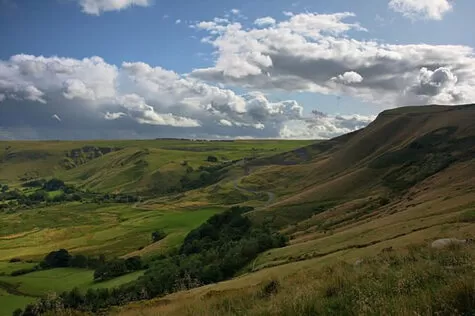 Rolling hills of the Peak District, evoking the wild setting of Sir Gawain and the Green Knight.
Crucially, Stanley hailed from Cheshire in Northwestern England, an area whose dialect is strongly reflected in the poem’s language. His family seat was Storeton Hall in the Wirral, a region specifically mentioned in the poem as Gawain’s point of entry into the challenging landscape he must traverse. The poem’s detailed and accurate portrayal of the geography and the rugged nature of the Pennine foothills suggests an author intimately familiar with this specific locale. A reader interested in the original language might explore a middle english sir gawain and the green knight version to appreciate the linguistic nuances.
Furthermore, Stanley’s life as a nobleman involved in courtly circles, military campaigns in France, and the administration of lands would have provided him with extensive knowledge of the themes central to the poem: chivalry, heraldry, hunting, feasting, and the intricate customs of the late medieval court. The poet’s sophisticated understanding of these elements points towards someone with firsthand experience of such a world. The blend of Arthurian legend with elements of French chivalric romance and local folklore aligns perfectly with the likely cultural exposures of a figure like Stanley.
Perhaps one of the most compelling pieces of evidence highlighted by Breeze is the poem’s concluding motto: “Hony Soyt qui mal pence” (“Shame be to him who thinks evil of it”). This is the motto of the prestigious Order of the Garter. Sir John Stanley was the only member of this illustrious order who originated from the Northwest of England, the region associated with the poem’s dialect and setting. This specific detail provides a strong potential link between the poet’s identity and a significant historical figure.
In conclusion, while the anonymity of the Gawain Poet has long shrouded the origins of this magnificent work, Andrew Breeze’s research presents a robust case for identifying Sir John Stanley as the probable author of Sir Gawain and the Green Knight. By correlating the biographical details of Stanley’s life – his regional ties, his social standing, his experiences, and his connection to the Order of the Garter – with the internal evidence from the poem, Breeze offers a compelling solution to one of literary history’s great puzzles. This theory not only suggests a name for the anonymous master but also enriches our understanding of the potential context and influences behind this enduring Arthurian romance. For those wishing to delve deeper into the scholarly arguments, exploring the details presented in Breeze’s gawain and the green knight book is highly recommended.
Illustration of Sir Gawain from the Cotton Nero A.x manuscript, the sole surviving copy of the poem.
References
Breeze, Andrew. The Historical Arthur and The Gawain Poet: Studies on Arthurian and Other Traditions. Lexington Books, 2021.