
William Shakespeare is universally celebrated as arguably the greatest playwright in the English language. His towering dramas like Hamlet, Romeo and Juliet, and Macbeth dominate literary discourse and stage productions worldwide. Yet, focusing solely on his plays overlooks a significant portion of his creative output and fails to fully answer the question: is Shakespeare poetry? The emphatic answer is yes, and exploring his extensive collection of poems reveals a master craftsman whose contributions to poetic form and expression are as profound and enduring as his theatrical achievements.
Contents
 Portrait of William Shakespeare, a renowned English poet and playwright
While his 37 plays are central to his fame, Shakespeare also penned over 150 poems. These works, primarily sonnets and two longer narrative poems, demonstrate his versatility, linguistic genius, and deep understanding of human emotion and form. To appreciate Shakespeare fully, one must delve into his poetic side, which often serves as a foundation and complement to his dramatic verse.
More Than Just Plays: Shakespeare as a Poet
Before establishing himself as a successful playwright, Shakespeare first sought recognition as a poet. In the Elizabethan era, poetry, particularly lengthy narrative poems and carefully crafted sonnet sequences, was often seen as a more prestigious and lasting art form compared to plays, which were considered ephemeral entertainment. Shakespeare’s earliest published works were poems, not plays, signaling his initial aspirations and demonstrating his mastery of poetic techniques from the outset of his career.
His prolific output in various poetic forms cemented his status among his contemporaries as a poet of considerable skill. While his plays often feature elevated language and verse, it is in his dedicated poems that his exploration of poetic structure, rhyme, meter, and theme is most concentrated and deliberate.
The Iconic Shakespearean Sonnet
Perhaps Shakespeare’s most famous contribution to poetry is his sequence of 154 sonnets. These poems popularized and perfected a specific structure that now bears his name: the Shakespearean, or English, sonnet. This form consists of 14 lines, typically written in iambic pentameter, and follows a specific rhyme scheme: ABAB CDCD EFEF GG. This structure comprises three quatrains (four-line stanzas) and a concluding couplet (two rhyming lines).
The first quatrain often introduces a theme or argument, which is then developed in the second and third quatrains. A turning point, or volta, frequently occurs around the beginning of the third quatrain or the final couplet, shifting the perspective or introducing a resolution. The concluding couplet typically provides a summary, a twist, or a powerful final statement.
Consider the opening lines of Sonnet 1, a quintessential example:
From fairest creatures we desire increase, (A)
That thereby beauty’s rose might never die, (B)
But as the riper should by time decease, (A)
His tender heir might bear his memory: (B)
But thou contracted to thine own bright eyes, (C)
Feed’st thy light’s flame with self-substantial fuel, (D)
Making a famine where abundance lies, (C)
Thy self thy foe, to thy sweet self too cruel: (D)
Thou that art now the world’s fresh ornament, (E)
And only herald to the gaudy spring, (F)
Within thine own bud buriest thy content, (E)
And, tender churl, mak’st waste in niggarding: (F)
Pity the world, or else this glutton be, (G)
To eat the world’s due, by the grave and thee. (G)
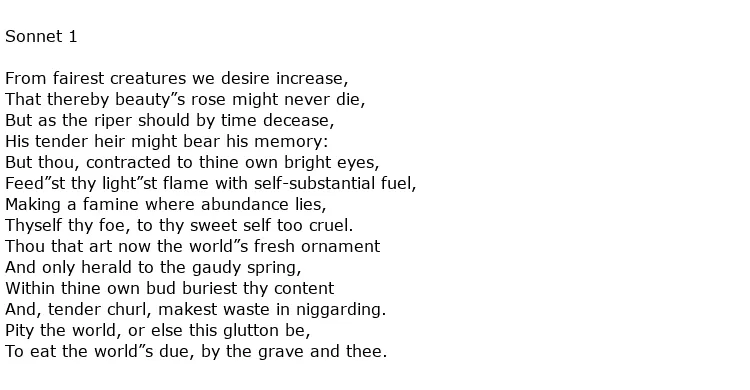 Original text of Shakespeare's Sonnet 1 displaying its structure
The consistent use of iambic pentameter – a line with ten syllables, alternating unstressed and stressed sounds (da-DUM da-DUM da-DUM da-DUM da-DUM) – gives the sonnets a natural, rhythmic flow, akin to spoken English yet elevated and musical. This meter, combined with the intricate rhyme scheme and thematic development, is a hallmark of Shakespeare’s poetic artistry.
Themes in Shakespeare’s Sonnets
While the original article notes the prevalence of love as a theme, Shakespeare’s sonnets explore a rich tapestry of human experience. The sequence is broadly divided into two sections: the first 126 sonnets addressed to a young man, often called the “Fair Youth,” dealing with themes of beauty, time, mortality, friendship, and procreation; and sonnets 127-154 addressed to a mysterious “Dark Lady,” exploring themes of passionate, often tumultuous, love and desire.
Across the collection, Shakespeare masterfully navigates the complexities of love in its various forms – idealized love, physical desire, manipulative affection, and enduring devotion. Beyond love, he grapples with the destructive power of time, the ephemeral nature of beauty, the immortality offered by verse, jealousy, infidelity, and the paradoxes of human relationships. These universal themes, explored with unparalleled linguistic depth and emotional nuance, are why his sonnets continue to resonate centuries later.
Shakespeare’s Narrative Poems: Epic Storytelling
Beyond the sonnet sequence, Shakespeare also wrote two significant narrative poems: Venus and Adonis (published 1593) and The Rape of Lucrece (published 1594). These much longer works demonstrate his ability to sustain poetic intensity and storytelling over extended form, providing further evidence that Shakespeare is indeed a poet of remarkable range.
Venus and Adonis, dedicated to the Earl of Southampton, is an Ovidian-style mythological poem relating the unrequited love of the goddess Venus for the beautiful youth Adonis. Written in six-line stanzas rhyming ABABCC (sestain), the poem is celebrated for its vivid descriptions, sensory language, and exploration of desire versus chastity, nature, and death. It was immensely popular in its time, running through numerous editions. For anyone seeking an example of narrative poetry, this work offers a compelling case study in using poetic form to tell a dramatic story.
The Rape of Lucrece, also dedicated to Southampton, is a darker, more psychologically complex poem written in rhyme royal (seven-line stanzas rhyming ABABBCC). It recounts the story of the virtuous Roman noblewoman Lucrece, her violation by Tarquin, and her subsequent suicide, leading to the expulsion of the kings and the establishment of the Roman Republic. This poem delves deeply into themes of honor, shame, tyranny, and justice. Its intense focus on internal monologue and the psychological aftermath of trauma reveals a narrative skill that foreshadows the character depth found in his later tragedies, such as Hamlet or King Lear. Comparing it to other significant long poems in English literature, such as the themes of duty and chivalry explored in works like the story chronicled in the gawain and the green knight book, highlights Shakespeare’s place within a tradition of using poetry for complex storytelling and moral exploration.
These narrative poems, though less read today than the sonnets or plays, were crucial in establishing Shakespeare’s literary reputation early in his career and solidify his status as a significant poet beyond the dramatic stage.
The Enduring Influence of The Bard’s Poetry
So, is Shakespeare poetry? Absolutely. His work encompasses some of the most influential and technically brilliant poems in the English language. His sonnets alone redefined the form and provided a template and inspiration for countless poets who followed. His narrative poems demonstrated the power of sustained poetic storytelling.
Shakespeare’s understanding and manipulation of meter, rhyme, imagery, and figurative language are evident throughout his work, whether in a sonnet, a narrative poem, or the blank verse of his plays. Studying his poetry offers invaluable insights into the craft and artistry that define him as “The Bard” – a term that recognizes his unparalleled skill not just with dramatic dialogue, but with the very essence of poetic expression. To truly grasp Shakespeare’s genius, one must engage with his poems, which stand as masterpieces in their own right.
In conclusion, Shakespeare is not merely a playwright who wrote in verse; he is a poet whose command of language and form shaped the trajectory of English literature. His poems are essential reading for anyone seeking to understand the depth and breadth of his artistic legacy and the enduring power of poetry itself.