
Poetry, in its essence, seeks to capture the ineffable, translate emotion, and illuminate the human condition. But what elevates poetry to the realm of the ‘great’? The works of classical poets, those enduring voices from various eras, offer profound answers. This article delves into a curated selection of exceptional poems written by significant classical poets, focusing on pieces originally composed in English and limited to fifty lines or fewer. By exploring these concise yet powerful works, we aim to illuminate the artistry and lasting relevance that define the contributions of classical poets to the literary landscape.
Contents
- 10. “The Road Not Taken” by Robert Frost (1874-1963)
- Analysis of the Poem
- 9. “The New Colossus” by Emma Lazarus (1849-1887)
- Analysis of the Poem
- 8. “Ozymandias” by Percy Bysshe Shelley (1792-1822)
- Analysis of the Poem
- 7. “Ode on a Grecian Urn” by John Keats (1795-1821)
- Analysis of the Poem
- 6. “The Tiger” by William Blake (1757-1827)
- Analysis of the Poem
- 5. “On His Blindness” by John Milton (1608-1674)
- Analysis of the Poem
- 4. “A Psalm of Life” by Henry Wadsworth Longfellow (1807-1882)
- Analysis of the Poem
- 3. “Daffodils” by William Wordsworth (1770-1850)
- Analysis of the Poem
- 2. “Holy Sonnet 10: Death, Be Not Proud” by John Donne (1572-1631)
- Analysis of the Poem
- 1. “Sonnet 18” by William Shakespeare (1564-1616)
- Analysis of the Poem
The poems featured here, ranging from the Renaissance to the early 20th century, represent diverse styles and themes, yet all share a timeless quality that resonates with readers across generations. They are masterpieces from famous poets of all time whose verses continue to bloom in the gardens of literature.
10. “The Road Not Taken” by Robert Frost (1874-1963)
Two roads diverged in a yellow wood, Portrait of celebrated classical poet Robert FrostAnd sorry I could not travel both
And be one traveler, long I stood
And looked down one as far as I could
To where it bent in the undergrowth;
Then took the other, as just as fair,
And having perhaps the better claim,
Because it was grassy and wanted wear;
Though as for that the passing there
Had worn them really about the same,
And both that morning equally lay
In leaves no step had trodden black.
Oh, I kept the first for another day!
Yet knowing how way leads on to way,
I doubted if I should ever come back.
I shall be telling this with a sigh
Somewhere ages and ages hence:
Two roads diverged in a wood, and I—
I took the one less traveled by,
And that has made all the difference.
Analysis of the Poem
Robert Frost, a poet whose work often embodies the spirit and themes found in the tradition of classical poetry through its accessible language and focus on universal human experiences, presents a seemingly straightforward narrative of choice. “The Road Not Taken” explores the moment of decision at a fork in a path, a common metaphor for choices in life. The speaker reflects on the roads, noting they are remarkably similar, yet the choice feels significant.
The poem’s true depth emerges in the final stanza, where the speaker imagines recounting the story “ages and ages hence.” The tone here shifts, suggesting a retrospective framing that perhaps exaggerates the difference made by the chosen path. The famous line, “I took the one less traveled by, / And that has made all the difference,” often interpreted as an anthem for individualism and non-conformity, is complicated by the earlier description that the roads “Had worn them really about the same.” This ambiguity invites readers to ponder the nature of choice itself – how much do our decisions truly shape our destiny, and how much is the narrative of significance constructed in hindsight? Frost, a master craftsman like the classical poets before him, uses simple language and imagery to pose a profound philosophical question about identity, memory, and the stories we tell ourselves.
9. “The New Colossus” by Emma Lazarus (1849-1887)
Not like the brazen giant of Greek fame,
With conquering limbs astride from land to land;
Here at our sea-washed, sunset gates shall stand
A mighty woman with a torch, whose flame
Is the imprisoned lightning, and her name
Mother of Exiles. From her beacon-hand
Glows world-wide welcome; her mild eyes command
The air-bridged harbor that twin cities frame.
“Keep, ancient lands, your storied pomp!” cries she
With silent lips. “Give me your tired, your poor,
Your huddled masses yearning to breathe free,
The wretched refuse of your teeming shore.
Send these, the homeless, tempest-tossed to me,
I lift my lamp beside the golden door!”
Analysis of the Poem
Emma Lazarus’s sonnet, “The New Colossus,” holds a unique place in history, etched onto a bronze plaque within the pedestal of the Statue of Liberty. This poem is a powerful testament to America’s identity as a haven for immigrants, directly invoking and contrasting with the classical world by referencing the Colossus of Rhodes. The ancient Colossus symbolized military might and territorial conquest, standing astride harbors with “conquering limbs.”
In stark contrast, Lazarus presents the Statue of Liberty as a “mighty woman with a torch,” whose purpose is not to dominate but to welcome. Her torch, holding the “imprisoned lightning,” is a beacon of hope, and her “mild eyes command / The air-bridged harbor” with compassion. The statue speaks, not of conquest, but of invitation, issuing the famous call to “Give me your tired, your poor, / Your huddled masses yearning to breathe free.” This poem encapsulates a foundational American ideal – the promise of opportunity and freedom for those fleeing oppression or hardship. By drawing a parallel to the classical era’s monumental symbols while redefining their purpose, Lazarus highlights a distinctly modern, humanitarian vision, contributing to the body of influential works that resonate like classical poems.
8. “Ozymandias” by Percy Bysshe Shelley (1792-1822)
I met a traveler from an antique land
Who said: “Two vast and trunkless legs of stone
Stand in the desert . . . Near them, on the sand,
Half sunk, a shattered visage lies, whose frown,
And wrinkled lip, and sneer of cold command,
Tell that its sculptor well those passions read
Which yet survive, stamped on these lifeless things,
The hand that mocked them, and the heart that fed:
And on the pedestal these words appear:
‘My name is Ozymandias, king of kings:
Look on my works, ye Mighty, and despair!’
Nothing beside remains. Round the decay
Of that colossal wreck, boundless and bare
The lone and level sands stretch far away.”
Analysis of the Poem
Percy Bysshe Shelley, a prominent voice among the Romantic poets who drew heavily on classical themes and forms, delivers a potent meditation on the transience of power and the inevitable triumph of time. “Ozymandias” recounts a traveler’s description of the ruins of a statue in the desert. The statue belonged to Ozymandias, a king whose self-proclaimed might (“king of kings”) and demand for awe (“Look on my works, ye Mighty, and despair!”) are rendered tragically ironic by the state of his monument. All that remains are colossal, “trunkless legs,” a “shattered visage” bearing a “sneer of cold command,” and the boastful inscription on the ruined pedestal.
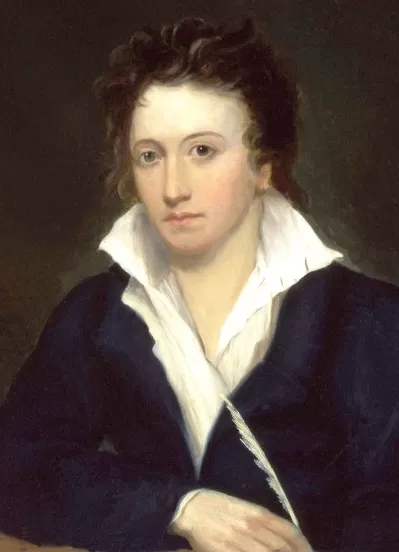 Oil painting portrait of Romantic and classical poet Percy Bysshe Shelley
Shelley masterfully uses the decay of this ancient artifact (referencing Ramesses II of Egypt, a figure from a distant, classical-adjacent civilization) to illustrate the futility of earthly ambition and tyranny in the face of eternity. The sculptor’s art, which captured the king’s tyrannical nature, has outlasted the king and his empire. The “lone and level sands” symbolize the vast, impersonal force of nature and time that eventually erases all human constructs. Beyond a simple critique of power, the poem suggests that only art and ideas possess a form of immortality. This powerful, concise narrative structure is a hallmark of effective poetry, a skill honed by the classical poets who understood economy of language.
7. “Ode on a Grecian Urn” by John Keats (1795-1821)
Thou still unravish’d bride of quietness,
Thou foster-child of silence and slow time,
Sylvan historian, who canst thus express
A flowery tale more sweetly than our rhyme:
What leaf-fring’d legend haunts about thy shape
Of deities or mortals, or of both,
In Tempe or the dales of Arcady?
What men or gods are these? What maidens loth?
What mad pursuit? What struggle to escape?
What pipes and timbrels? What wild ecstasy?
Heard melodies are sweet, but those unheard
Are sweeter; therefore, ye soft pipes, play on;
Not to the sensual ear, but, more endear’d,
Pipe to the spirit ditties of no tone:
Fair youth, beneath the trees, thou canst not leave
Thy song, nor ever can those trees be bare;
Bold Lover, never, never canst thou kiss,
Though winning near the goal yet, do not grieve;
She cannot fade, though thou hast not thy bliss,
For ever wilt thou love, and she be fair!
 Sketch by John Keats depicting a Grecian Urn, subject of his famous ode
Ah, happy, happy boughs! that cannot shed
Your leaves, nor ever bid the Spring adieu;
And, happy melodist, unwearied,
For ever piping songs for ever new;
More happy love! more happy, happy love!
For ever warm and still to be enjoy’d,
For ever panting, and for ever young;
All breathing human passion far above,
That leaves a heart high-sorrowful and cloy’d,
A burning forehead, and a parching tongue.
Who are these coming to the sacrifice?
To what green altar, O mysterious priest,
Lead’st thou that heifer lowing at the skies,
And all her silken flanks with garlands drest?
What little town by river or sea shore,
Or mountain-built with peaceful citadel,
Is emptied of this folk, this pious morn?
And, little town, thy streets for evermore
Will silent be; and not a soul to tell
Why thou art desolate, can e’er return.
O Attic shape! Fair attitude! with brede
Of marble men and maidens overwrought,
With forest branches and the trodden weed;
Thou, silent form, dost tease us out of thought
As doth eternity: Cold Pastoral!
When old age shall this generation waste,
Thou shalt remain, in midst of other woe
Than ours, a friend to man, to whom thou say’st,
“Beauty is truth, truth beauty,—that is all
Ye know on earth, and all ye need to know.”
Analysis of the Poem
John Keats, another titan of the Romantic era deeply influenced by classical literature and mythology, explores the relationship between art, eternity, and human experience in “Ode on a Grecian Urn.” The speaker contemplates scenes depicted on an ancient Greek urn, contrasting the frozen perfection of the art with the fleeting reality of life. The figures on the urn – musicians, lovers, participants in a sacrifice – are forever caught in a moment. The musicians play melodies that are “unheard” yet “sweeter” because they exist purely in the imagination. The lovers are eternally close to a kiss but will never experience the bittersweet completion of desire; conversely, their love will never fade or cool.
This state of perpetual near-fulfillment is presented as a form of happiness superior to human passion, which is subject to sorrow and weariness. The urn itself is a “Sylvan historian,” telling stories more sweetly than human verse, and a “Cold Pastoral,” a static scene of rural life. Yet, it is also a “friend to man,” offering solace as generations pass. The famous concluding lines, “Beauty is truth, truth beauty,—that is all / Ye know on earth, and all ye need to know,” spoken by the urn, suggest that the enduring beauty of art contains a fundamental truth about existence, offering a form of consolation or understanding beyond the limitations of human life and time – a theme often pondered by the great classical poets.
6. “The Tiger” by William Blake (1757-1827)
Tiger Tiger, burning bright,
In the forests of the night;
What immortal hand or eye,
Could frame thy fearful symmetry?
In what distant deeps or skies.
Burnt the fire of thine eyes?
On what wings dare he aspire?
What the hand, dare seize the fire?
And what shoulder, and what art,
Could twist the sinews of thy heart?
And when thy heart began to beat,
What dread hand? and what dread feet?
What the hammer? what the chain,
In what furnace was thy brain?
What the anvil? what dread grasp,
Dare its deadly terrors clasp!
When the stars threw down their spears
And water’d heaven with their tears:
Did he smile his work to see?
Did he who made the Lamb make thee?
Tiger Tiger burning bright,
In the forests of the night:
What immortal hand or eye,
Dare frame thy fearful symmetry?
Analysis of the Poem
William Blake, a visionary poet and artist whose work transcends simple categorization but shares with classical poets a deep engagement with fundamental questions of existence and morality, presents a series of powerful questions in “The Tiger.” The poem is a companion to “The Lamb” from his Songs of Innocence, and together they explore the “contrary states of the human soul.” “The Tiger,” from Songs of Experience, confronts the existence of fearsome, powerful, and potentially destructive forces in the world, embodied by the terrifying beauty of the tiger.
 Portrait of visionary classical poet and artist William Blake
Blake’s questions probe the nature of the Creator. The speaker imagines a divine blacksmith forging the tiger, using powerful, almost terrifying tools (“hammer,” “furnace,” “anvil”). The central question arises in the penultimate stanza: “Did he who made the Lamb make thee?” This directly addresses the problem of evil and the paradox of a benevolent creator fashioning a creature of “fearful symmetry.” The poem offers no easy answers but forces the reader to confront the mystery of creation and the coexistence of innocence and experience, good and evil, in the world. Blake’s intense imagery and rhythmic questioning create a sense of awe and terror, reflecting the sublime power he attributes to both the tiger and its maker. Like many classical poets grappling with the divine and the human, Blake uses potent symbolism to explore complex theological and philosophical issues.
5. “On His Blindness” by John Milton (1608-1674)
When I consider how my light is spent,
Ere half my days in this dark world and wide,
And that one talent which is death to hide
Lodg’d with me useless, though my soul more bent
To serve therewith my Maker, and present
My true account, lest he returning chide,
“Doth God exact day-labour, light denied?”
I fondly ask. But Patience, to prevent
That murmur, soon replies: “God doth not need
Either man’s work or his own gifts; who best
Bear his mild yoke, they serve him best. His state
Is kingly; thousands at his bidding speed
And post o’er land and ocean without rest:
They also serve who only stand and wait.”
Analysis of the Poem
John Milton, a towering figure among English classical poets known for his epic scale and profound theological depth, penned this sonnet reflecting on his gradual loss of sight, which rendered his literary talents seemingly “useless” for serving God. The poem opens with the speaker’s contemplation of his blindness, feeling frustrated that his “one talent” (a reference to the Parable of the Talents in the Bible, signifying his poetic ability) is now “Lodg’d with me useless.” He questions God, wondering if divine service requires active “day-labour” even when the “light” (eyesight) is denied.
 Historical portrait of epic and classical poet John Milton
The turning point comes with the personification of Patience, who provides the crucial answer. Patience explains that God’s power is absolute and does not depend on human efforts or gifts. True service lies not necessarily in active work but in patiently enduring the burdens (“mild yoke”) that life imposes. The concluding line, “They also serve who only stand and wait,” offers a powerful message of acceptance and faith, suggesting that even in states of apparent helplessness or limitation, one can fulfill a divine purpose simply by trusting in God’s plan and waiting with patience. This sonnet embodies the stoic resilience and deep faith often explored by classical poets confronting personal hardship within a larger cosmic order.
4. “A Psalm of Life” by Henry Wadsworth Longfellow (1807-1882)
What the heart of the young man said to the Psalmist
Tell me not, in mournful numbers,
Life is but an empty dream!
For the soul is dead that slumbers,
And things are not what they seem.
Life is real! Life is earnest!
And the grave is not its goal;
Dust thou art, to dust returnest,
Was not spoken of the soul.
Not enjoyment, and not sorrow,
Is our destined end or way;
But to act, that each tomorrow
Find us farther than today.
Art is long, and Time is fleeting,
And our hearts, though stout and brave,
Still, like muffled drums, are beating
Funeral marches to the grave.
In the world’s broad field of battle,
In the bivouac of Life,
Be not like dumb, driven cattle!
Be a hero in the strife!
 Manuscript illustration or depiction related to Longfellow's classical poem "A Psalm of Life"
Trust no Future, howe’er pleasant!
Let the dead Past bury its dead!
Act,—act in the living Present!
Heart within, and God o’erhead!
Lives of great men all remind us
We can make our lives sublime,
And, departing, leave behind us
Footprints on the sands of time;—
Footprints, that perhaps another,
Sailing o’er life’s solemn main,
A forlorn and shipwrecked brother,
Seeing, shall take heart again.
Let us, then, be up and doing,
With a heart for any fate;
Still achieving, still pursuing,
Learn to labor and to wait.
Analysis of the Poem
Henry Wadsworth Longfellow, an American poet whose popularity in the 19th century rivaled that of many European classical poets, offers an uplifting and motivational message in “A Psalm of Life.” Presented as the words of a “young man” to a “Psalmist” (implying a response to somber reflection), the poem rejects a view of life as meaningless or merely a prelude to death. It asserts forcefully, “Life is real! Life is earnest!” and that the famous biblical phrase “Dust thou art, to dust returnest” applies only to the body, not the immortal soul.
The poem advocates for purposeful action in the present (“Act,—act in the living Present!”), emphasizing continuous progress (“that each tomorrow / Find us farther than today”). It uses vivid metaphors like “the world’s broad field of battle” to encourage readers to be active participants (“Be a hero in the strife!”) rather than passive observers (“dumb, driven cattle!”). The idea of leaving “Footprints on the sands of time” suggests that individual efforts, inspired by the examples of “great men,” can have a lasting impact and serve as an inspiration to future generations facing their own struggles. While perhaps less complex formally than some earlier classical poems, Longfellow’s clear, earnest message and memorable phrases resonated deeply with his audience and continue to inspire, demonstrating the enduring power of motivational verse.
3. “Daffodils” by William Wordsworth (1770-1850)
I wandered lonely as a cloud
That floats on high o’er vales and hills,
When all at once I saw a crowd,
A host, of golden daffodils;
Beside the lake, beneath the trees,
Fluttering and dancing in the breeze.
Continuous as the stars that shine
And twinkle on the milky way,
They stretched in never-ending line
Along the margin of a bay:
Ten thousand saw I at a glance,
Tossing their heads in sprightly dance.
The waves beside them danced; but they
Out-did the sparkling waves in glee:
A poet could not but be gay,
In such a jocund company:
I gazed—and gazed—but little thought
What wealth the show to me had brought:
For oft, when on my couch I lie
In vacant or in pensive mood,
They flash upon that inward eye
Which is the bliss of solitude;
And then my heart with pleasure fills,
And dances with the daffodils.
Analysis of the Poem
William Wordsworth, a foundational figure of English Romanticism whose focus on nature and emotion revitalized poetry much like the classical poets revitalized earlier forms, captures a moment of profound connection with the natural world in “Daffodils” (also known as “I Wandered Lonely as a Cloud”). The poem describes the speaker’s encounter with a large field of daffodils while wandering alone. Initially feeling disconnected (“lonely as a cloud”), he is suddenly struck by the vibrant, joyful sight of the flowers, described as a “crowd, / A host,” dancing in the breeze.
 Portrait of influential Romantic and classical poet William Wordsworth at age 28
The encounter is not just a pleasant visual experience but one that brings immediate joy (“A poet could not but be gay”). The true significance, however, is revealed in the final stanza. The memory of the daffodils becomes a source of internal happiness and solace during moments of loneliness or reflection. They “flash upon that inward eye,” bringing a “bliss of solitude,” and causing the speaker’s heart to feel pleasure and “dance with the daffodils.” Wordsworth suggests that the beauty and joy experienced in nature are not confined to the moment of observation but can be stored in memory, offering spiritual and emotional richness long after the physical encounter. This emphasis on the subjective experience and the restorative power of nature marked a departure from Neoclassical trends but contributed to the rich tradition of profound observation found in the lineage of classical poets.
2. “Holy Sonnet 10: Death, Be Not Proud” by John Donne (1572-1631)
Death, be not proud, though some have called thee
Mighty and dreadful, for thou art not so;
For those whom thou think’st thou dost overthrow
Die not, poor Death, nor yet canst thou kill me.
From rest and sleep, which but thy pictures be,
Much pleasure; then from thee much more must flow,
And soonest our best men with thee do go,
Rest of their bones, and soul’s delivery.
Thou art slave to fate, chance, kings, and desperate men,
And dost with poison, war, and sickness dwell,
And poppy or charms can make us sleep as well
And better than thy stroke; why swell’st thou then?
One short sleep past, we wake eternally
And death shall be no more; Death, thou shalt die.
Analysis of the Poem
John Donne, a leading figure among the Metaphysical poets and a powerful voice in the classical tradition of English poetry through his intellectual rigor and profound thematic exploration, directly confronts and challenges Death in this famous Holy Sonnet. Instead of treating Death as an unstoppable, fearsome entity, the speaker addresses Death directly, belittling its power. The opening line, “Death, be not proud,” sets a defiant tone.
Donne argues that Death’s reputation is unearned. He contends that those Death claims to conquer do not truly die because their souls achieve immortality (“Die not, poor Death, nor yet canst thou kill me”). Sleep and rest, which resemble death, are pleasurable, suggesting that death itself might bring greater pleasure. Furthermore, Death is presented not as a master but as a “slave” to external forces like “fate, chance, kings, and desperate men” (who might commit suicide or murder). Death is also associated with unpleasant company: “poison, war, and sickness.” Even mundane things like “poppy or charms” (opium or other sedatives) can induce sleep, performing Death’s primary function just as well, if not better. The sonnet culminates in a triumphant assertion of Christian belief: physical death is merely a “short sleep,” after which the soul wakes eternally, and in that ultimate reality, “death shall be no more; Death, thou shalt die.” Donne’s bold, argumentative style and profound faith offer a powerful intellectual and spiritual antidote to the fear of mortality, a theme explored with varying perspectives by classical poets throughout history.
1. “Sonnet 18” by William Shakespeare (1564-1616)
Shall I compare thee to a summer’s day?
Thou art more lovely and more temperate:
Rough winds do shake the darling buds of May,
And summer’s lease hath all too short a date:
Sometime too hot the eye of heaven shines,
And often is his gold complexion dimm’d;
And every fair from fair sometime declines,
By chance, or nature’s changing course, untrimm’d;
But thy eternal summer shall not fade
Nor lose possession of that fair thou ow’st;
Nor shall Death brag thou wander’st in his shade,
When in eternal lines to time thou grow’st;
So long as men can breathe or eyes can see,
So long lives this, and this gives life to thee.
Analysis of the Poem
William Shakespeare, universally acknowledged as the greatest of English classical poets, perfects the sonnet form in this immortal work. “Sonnet 18” begins with a seemingly simple question: Should the beloved (whose identity remains ambiguous) be compared to a summer’s day? The speaker immediately answers that the beloved is “more lovely and more temperate.” The rest of the first twelve lines detail the imperfections and fleeting nature of summer: it’s subject to rough winds, it’s too short, the sun can be too hot or obscured, and its beauty inevitably fades due to chance or nature’s course.
 The Cobbe portrait, believed to be of William Shakespeare, the greatest classical poet
In contrast, the beloved’s “eternal summer shall not fade.” How is this immortality achieved? Not through inherent physical permanence, but through the power of the speaker’s verse. The beloved will not be claimed by Death’s “shade” because they will live on, integrated “in eternal lines to time.” The concluding couplet delivers the poem’s central assertion: “So long as men can breathe or eyes can see, / So long lives this, and this gives life to thee.” The poem itself is the vessel of immortality. As long as people read this sonnet, the beauty and essence of the beloved are preserved, defying the decay of time and the finality of death. This audacious claim for the power of poetry, a theme subtly present in other classical poets but stated here with unparalleled clarity and confidence, makes “Sonnet 18” not only a perfect example of the English sonnet but a definitive statement on the enduring legacy that great art confers. It stands as a testament to the lasting impact achievable through the mastery of language, a legacy defined by classical poets across centuries.
These ten poems, drawn from different periods but united by their lasting impact and artistry, offer a glimpse into the wealth of wisdom, emotion, and beauty captured by classical poets writing in English. Their ability to condense complex ideas and deep feelings into memorable, often brief, forms continues to enrich our understanding of ourselves and the world. Engaging with these works provides not just literary appreciation but a connection to the enduring human spirit articulated across centuries by these master wordsmiths.
If you found inspiration in this exploration of poems by classical poets, we encourage you to delve deeper into the art form. Share your thoughts on these poems or suggest others by influential classical poets in the comments below. Your engagement helps foster a vibrant community dedicated to the appreciation of poetry.