
Clerihew poems offer a delightful detour into the world of light verse, providing a unique lens through which to view famous, infamous, or simply interesting individuals. Named after their inventor, Edmund Clerihew Bentley, who devised the form at the tender age of sixteen, clerihews are short, witty biographical poems that adhere to a specific, simple structure. They stand apart from many other poetry formats by prioritizing humor and a direct, often whimsical, focus on a person.
Contents
The charm of the clerihew lies in its accessibility and its inherent capacity for playful observation. Unlike forms requiring complex meter or rhyme schemes, the clerihew invites creativity within straightforward boundaries, making it an engaging challenge for both seasoned poets and newcomers. Mastering the structure allows for surprising twists and clever insights into the subject’s character or deeds.
The Simple Structure of Clerihew Poems
Writing a clerihew poem requires adherence to just a few core principles, making the form remarkably easy to grasp:
- Four Lines: Each clerihew consists of precisely four lines.
- AABB Rhyme Scheme: The first two lines rhyme with each other, and the third and fourth lines rhyme with each other. This simple scheme contributes to the form’s lighthearted feel.
- Subject Naming: The first line must introduce the subject, ending with their name.
- Rhyming Name: The second line must end with a word or phrase that rhymes with the name in the first line.
- Biographical & Humorous Content: The subsequent two lines (the AABB rhyming pair) should offer some commentary or observation about the person, ideally with a humorous or witty slant.
There are no strict rules regarding syllable count or meter, providing significant freedom in rhythm and phrasing, as long as the rhymes land correctly and the content relates humorously to the person named in the first line.
Crafting Witty Clerihew Poems
The process of writing a clerihew typically begins with choosing a person – this could be a historical figure, a celebrity, a character from fiction, or even someone known within a specific circle. The key is to pick someone whose name you can readily rhyme and about whom you have a potentially amusing observation.
Let’s consider an example focusing on a famous historical figure. Suppose we choose Leonardo da Vinci.
- Line 1 (Name): Leonardo da Vinci
- Line 2 (Rhyme for Vinci): convinci (Italian for “convince”), princely, wince he… let’s try “princely”.
- Start:
Leonardo da Vinci,
Was really quite princely.
Now, we need two more lines that rhyme and offer a witty remark about Leonardo. What was he known for? Art, inventions, perhaps slow work?
- Line 3 (Rhyme): something ending in -ing or similar sound.
- Line 4 (Rhyme): rhymes with line 3.
- Observation: Maybe about his Mona Lisa or his many unfinished projects.
Combining these elements might lead to:
Leonardo da Vinci,
Was really quite princely.
He spent years applying
That Mona Lisa smiling.
This fits the criteria: four lines, AABB rhyme, names the person in line 1, rhymes with the name in line 2, and offers a humorous observation in lines 3 and 4.
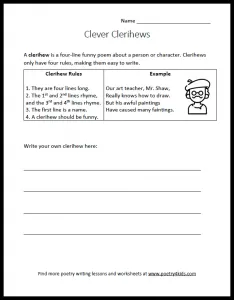 Visual guide illustrating the structure of clerihew poems
Another example, perhaps about a figure from literature or myth:
Young Icarus’s father,
Made his flying a bother.
He said, “Don’t fly too high!”
Which proved to be useful advice by and by.
Here, the name (implied: Daedalus, but the subject is clearly Icarus’s father) is introduced in line 1. “Father” rhymes with “bother” in line 2. Lines 3 and 4 rhyme and comment humorously on the classic myth’s outcome.
The Appeal of the Clerihew
The lasting appeal of the clerihew lies in its blend of biographical reference and playful wit. It encourages close, albeit lighthearted, observation of individuals and the crafting of concise, impactful rhymes. While often associated with children’s verse due to its simplicity, clerihews can be incredibly sophisticated in their humor and choice of subject matter, appealing to a wide audience of poetry lovers.
Exploring forms like the clerihew broadens one’s appreciation for the diverse landscape of poetry, from structured humor to deeply emotional narratives, like those found in soulmate poems for husband or profound analyses of classic works. The clerihew stands as a testament to the fact that poetry can be both formally inventive and genuinely fun.
In conclusion, clerihew poems offer a unique, accessible, and highly entertaining form of biographical poetry. Their simple rules belie the potential for sharp wit and memorable observations about the people who populate our world, both real and imagined. They invite us to look at subjects with a discerning, humorous eye, proving that sometimes, the simplest structures yield the most delightful results. Learning to write a clerihew is not just about mastering a form; it’s about cultivating a playful perspective on personality and life.