
Dive into the charming and often hilarious world of clerihews! These short, simple poems are a fantastic way to explore the lighter side of poetry and are surprisingly easy to write. Invented by Edmund Clerihew Bentley when he was just a teenager, the clerihew is a testament to the fact that creating new forms of expression isn’t limited by age or experience. They are perfect for poking gentle fun at people – whether they are famous figures, fictional characters, or even your own pet. If you’re looking for a poetic form that prioritizes wit and rhyme over meter and complexity, exploring clerihew examples is a great place to start. You might find yourself quickly inspired to write your own!
Contents
Understanding the Clerihew Rules
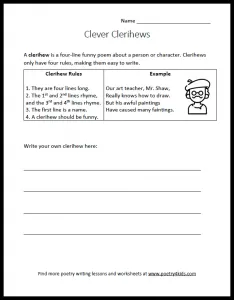
Before we jump into more clerihew examples, let’s quickly recap the simple guidelines that define this unique form. There are only four key rules:
- Four Lines Long: Every clerihew consists of exactly four lines.
- Rhyming Pairs: The first two lines rhyme with each other, and the third and fourth lines rhyme with each other (AABB rhyme scheme).
- The Subject’s Name: The first line must name a person. The second line must end with something that rhymes with that person’s name.
- It Should Be Funny: The aim of a clerihew is generally to be humorous or witty, often revealing an observation or quirk about the named person.
That’s all there is to it! No need to count syllables, stress patterns, or worry about a consistent rhythm. The freedom from strict meter makes them particularly accessible.
Clerihew Examples: Seeing the Form in Action
The best way to understand a clerihew is to see several clerihew examples. They showcase how poets can use the simple structure to deliver a humorous punchline or observation.
Let’s look at a classic type, often used when first learning:
A Simple Clerihew
Consider someone you know, maybe a teacher or friend.
Our art teacher, Mr. Shaw,
Really knows how to draw.
But his awful paintings
Have caused many faintings.
Notice how the first line introduces “Mr. Shaw,” and the second line rhymes with his name (“draw”). The following two lines rhyme (“paintings” / “faintings”) and provide a humorous observation about his actual artistic output compared to his teaching skill.
Clerihews About Famous People
Part of the fun of clerihews is writing about well-known figures, as the audience likely has some existing knowledge to appreciate the humor.
Here’s one about two popular musicians:
The music of Katy Perry
Is kind of scary.
I heard it and sniffed,
“I much prefer Taylor Swift.”
This clerihew plays on personal preference and uses rhymes (“Perry” / “scary”, “sniffed” / “Swift”) to deliver a subjective, humorous take.
Let’s try another original example about a historical figure:
Julius Caesar
Was a keen pleaser.
He liked crossing the Rubicon,
Then found his life gone.
(This clerihew was created for this article.)
Clerihews About Fictional Characters
You don’t have to limit yourself to real people. Fictional characters from books, movies, or shows also make excellent subjects for clerihews.
Here’s an example about a famous wizarding antagonist:
The enemy of Harry Potter
Was a scheming plotter.
I can’t tell you what he’s called;
I’d be ashamed
To name “he who must not be named.”
This one plays on a known characteristic of the Harry Potter series. The humor comes from the narrator’s feigned embarrassment.
Here’s an original example about a character from classic literature:
Miss Elizabeth Bennet
Couldn't quite get it.
Why Darcy was proud,
Until she saw him from the crowd.
(This clerihew was created for this article.) This clerihew summarizes a key plot point with a playful tone.
Clerihews About Everyday Subjects
While the rule states the first line names a person, the form is often adapted loosely to include animals or even anthropomorphized objects for fun. This expands the possibilities for more clerihew examples.
An example about a pet:
Our dog, Rover,
Likes rolling over.
But only for a treat,
Otherwise, he won't move his feet.
(This clerihew was created for this article.)
 Clever Clerihews Worksheet
love poems short for him from the heart
Tips for Writing Your Own Clerihew
Inspired by these clerihew examples? Ready to try writing one yourself? Here are a few tips:
- Pick Your Subject: Choose a person (or character, or pet) you know well, or a famous figure with some easily recognizable traits.
- Find the First Rhyme: Write the first line, ending with the person’s name. Then, brainstorm words that rhyme with that name for the second line. This is often the trickiest part!
- Find the Second Rhyme: Once you have your first two lines, think about a humorous or insightful observation about your subject. Write two lines that capture this idea, making sure they rhyme with each other.
- Keep it Concise and Witty: The humor should ideally come from a quick, clever observation delivered within the four lines.
i love you short poems for him
Conclusion
Clerihew examples demonstrate just how much fun can be packed into a simple four-line structure. They prove that poetry doesn’t always have to be serious or complex to be engaging and enjoyable. With easy rules and a focus on wit and rhyme, writing clerihews is an accessible way for anyone to start creating poetry. Whether you’re writing about historical figures, fictional favorites, or the people around you, the clerihew offers a playful framework for capturing personality in verse. So grab a pen, pick a person, and start rhyming – you might find your next clerihew flowing easily!