
La poesía ha sido durante mucho tiempo el lenguaje del corazón, capaz de articular los afectos más profundos y las emociones más tiernas que sentimos por nuestras parejas amadas. Cuando pensamos en un “ser querido”, a menudo imaginamos a alguien apreciado, un confidente, una fuente de consuelo y profunda alegría. Encontrar las palabras perfectas para expresar este vínculo único puede ser un desafío, pero afortunadamente, poetas a lo largo de siglos y culturas han explorado los matices del amor profundo y duradero que resuenan perfectamente con la idea de un ser querido.
Contents
- Come, And Be My Baby por Maya Angelou
- Habitation por Margaret Atwood
- To My Dear and Loving Husband por Anne Bradstreet
- Love and Friendship por Emily Brontë
- To Be In Love por Gwendolyn Brooks
- How Do I Love Thee? (Sonnet 43) por Elizabeth Barrett Browning
- A Red, Red Rose por Robert Burns
- She Walks in Beauty por Lord Byron
- Married Love por Guan Daosheng
- Air and Angels por John Donne
- Heart to Heart por Rita Dove
- The Love Poem por Carol Ann Duffy
- Before You Came por Faiz Ahmed Faiz
- Lines Depicting Simple Happiness por Peter Gizzi
- For Keeps por Joy Harjo
- Yours por Daniel Hoffman
- Poem for My Love por June Jordan
- for him por Rupi Kaur
- Untitled por Rupi Kaur (de milk and honey)
- Camomile Tea por Katherine Mansfield
- Your Feet por Pablo Neruda
- Dear One Absent This Long While por Lisa Olstein
- My Lover Is a Woman por Pat Parker
- It Is Here por Harold Pinter
- Untitled por Christopher Poindexter
- Again and again, even though we know love’s landscape por Rainer Maria Rilke
- I loved you first: but afterwards your love por Christina Rossetti
- Defeated by Love por Rumi
- Shall I compare thee to a summer’s day? (Sonnet 18) por William Shakespeare
- Let me not to the marriage of true minds (Sonnet 116) por William Shakespeare
- My mistress’ eyes are nothing like the sun (Sonnet 130) por William Shakespeare
- One Day I Wrote her Name (Sonnet 75) por Edmund Spenser
- We Have Not Long to Love por Tennessee Williams
Esta colección reúne una selección de poemas y extractos que capturan la esencia de lo que significa amar y apreciar a un ser querido. Desde declaraciones de devoción inquebrantable hasta reflexiones tranquilas sobre la vida compartida, estos versos ofrecen formas hermosas de decirle a esa persona especial cuánto significa para ti. Sumérgete en estos versos y encuentra las líneas que hablan a tu corazón sobre quien ocupa un lugar especial en él. Descubre poemas de amor para tu ser más querido que expresan perfectamente tus sentimientos.
 Colección de hermosos poemas para seres queridos sobre un fondo vintage
Come, And Be My Baby por Maya Angelou
Maya Angelou, reconocida por su poderosa voz en la literatura estadounidense y los derechos civiles, ofrece un poema que habla del consuelo y refugio que se encuentran en la presencia de un ser amado. ‘Come, And Be My Baby’ retrata hermosamente el consuelo simple pero profundo que un ser querido puede brindar en medio de las complejidades de la vida, ofreciendo un momento de paz y conexión que se siente como volver a casa.
The highway is alive tonight But I am not going any place. The clang of midnight has fallen upon the city But I am not going any place.
Stay with me, cariño. Stay with me, baby.
See how the night surrounds the day? Come, and be my baby.
Habitation por Margaret Atwood
Margaret Atwood, célebre autora de El Cuento de la Criada, muestra su fuerza poética en ‘Habitation’. Este poema ofrece una perspectiva sorprendentemente real sobre el amor duradero, reconociendo el trabajo y los desafíos dentro de una relación. Captura hermosamente el viaje compartido con un ser querido, enfatizando la supervivencia, el asombro y el proceso fundamental de construir una vida juntos, aprendiendo y creciendo uno al lado del otro incluso a través de las dificultades.
This is a photograph of me taken in 1957. I am standing at the edge of a lake about to go in. The trees around me are unfamiliar, here is where I begin.
At the back where we squat outside, eating popcorn the edge of the receding glacier where painfully and with wonder at having survived even this far we are learning to make fire
To My Dear and Loving Husband por Anne Bradstreet
El poema de Anne Bradstreet es un testamento del amor profundo y agradecido dentro de un matrimonio, visto a través de la lente de la fe puritana. Aunque histórico, su mensaje central de profunda gratitud y dedicación inquebrantable a un cónyuge amado resuena profundamente. ‘To My Dear and Loving Husband’ expresa un vínculo tan fuerte que la riqueza terrenal palidece en comparación, destacando un amor mutuo que ruegan que los lleve a la unión eterna, un sentimiento apropiado para un ser querido de toda la vida.
If ever two were one, then surely we. If ever man were loved by wife, then thee; If ever wife was happy in a man, Compare with me ye women if you can. I prize thy love more than whole mines of gold, Or all the riches that the East doth hold. My love is such that rivers cannot quench, Nor ought but love from thee give recompense. Thy love is such I can no way repay; The heavens reward thee manifold, I pray. Then while we live, in love let’s so persever, That when we live no more, we may live ever.
Love and Friendship por Emily Brontë
Emily Brontë, conocida por su novela Cumbres Borrascosas, contrasta diferentes formas de afecto en ‘Love and Friendship’. Al comparar el amor romántico con una hermosa pero efímera rosa y la amistad con el firme y duradero árbol de acebo, sugiere que el vínculo profundo y confiable compartido con un ser querido a menudo abarca la fuerza duradera y el consuelo de la verdadera amistad, resistiendo todas las estaciones juntos.
Love is like the wild rose-briar, Friendship like the holly-tree— The holly is dark when the rose-briar blooms But which will bloom most constantly?
The wild rose-briar is sweet in spring, Its summer blossoms scent the air; Yet wait till winter comes again And who will meet the wild-briar there?
But friendship is a holier thing, I like the holly-tree it blooms In winter bright.
 Rama de rosa y acebo, simbolizando diferentes tipos de amor en la poesía para seres queridos
To Be In Love por Gwendolyn Brooks
Gwendolyn Brooks, una voz significativa en la poesía estadounidense del siglo XX y la primera afroamericana ganadora del Premio Pulitzer, describe el poder transformador del amor en ‘To Be In Love’. Este poema captura hermosamente cómo estar enamorado de un ser querido puede aligerar el tacto, expandir el ser y traer una sensación de bienestar. Se trata del cambio profundo en la perspectiva y el sentimiento que una conexión profunda trae consigo.
To be in love Is to touch with a lighter hand. In yourself you stretch, you are well.
To be in love Is to tremble with happiness When seaweed touches a cliff rock. It is to tremble that a certain Place has been prepared for you: There is a beach on which you may stand.
How Do I Love Thee? (Sonnet 43) por Elizabeth Barrett Browning
Uno de los poemas de amor más icónicos en el idioma inglés, el Soneto 43 de Elizabeth Barrett Browning ofrece una enumeración poderosa y detallada de la profundidad del amor. Este poema es una expresión perfecta para un ser querido, enumerando las innumerables formas en que el alma del hablante se extiende en devoción, abarcando aspectos espirituales, cotidianos y duraderos del amor que continúan incluso más allá de la vida.
How do I love thee? Let me count the ways. I love thee to the depth and breadth and height My soul can reach, when feeling out of sight For the ends of being and ideal grace. I love thee to the level of every day’s Most quiet need, by sun and candle-light. I love thee freely, as men strive for Right; I love thee purely, as they turn from Praise. I love thee with a passion put to use In my old griefs, and with my childhood’s faith. I love thee with a love I seemed to lose With my lost saints. I love thee with the breath, Smiles, tears, of all my life; and, if God choose, I shall but love thee better after death.
A Red, Red Rose por Robert Burns
La famosa declaración de Robert Burns, ‘A Red, Red Rose’, retrata vívidamente el amor usando metáforas naturales simples y poderosas. Comparando su amor con una hermosa rosa y una dulce melodía, Burns enfatiza tanto su pasión como su frescura. Las promesas de amor duradero, tan largas como los mares y las rocas, hacen de esta una expresión atemporal de afecto profundo y sincero, adecuada para un ser querido apreciado.
O my Luve’s like a red, red rose That’s newly sprung in June; O my Luve’s like the melody That’s sweetly played in tune.
So fair art thou, my bonnie lass, So deep in luve am I: And I will luve thee still, my dear, Till a’ the seas gang dry.
Till a’ the seas gang dry, my dear, And the rocks melt wi’ the sun; And I will luve thee still, my dear, While the sands o’ life shall run.
And fare thee weel, my only Luve, And fare thee weel, a while! And I will come again, my Luve, Though it were ten thousand mile.
 Rosa roja única, simbolizando el amor apasionado en la poesía para seres queridos
She Walks in Beauty por Lord Byron
‘She Walks in Beauty’ de Lord Byron es una oda al encanto cautivador y la bondad interior de una mujer. A diferencia de algunas de las obras más apasionadas de Byron, este poema se centra en la mezcla armoniosa de oscuridad y luz en su apariencia, reflejando una belleza pura y serena que proviene de su mente pacífica y su corazón inocente. Es una admiración que va más allá de lo superficial, celebrando la belleza intrínseca de un ser querido.
She walks in beauty, like the night Of cloudless climes and starry skies; And all that’s best of dark and bright Meet in her aspect and her eyes; Thus mellowed to that tender light Which heaven to gaudy day denies.
One shade the more, one ray the less, Had half impaired the nameless grace Which waves in every raven tress, Or softly lightens o’er her face; Where thoughts serenely sweet express, How pure, how dear their dwelling-place.
And on that cheek, and o’er that brow, So soft, so calm, yet eloquent, The smiles that win, the tints that glow, But tell of days in goodness spent, A mind at peace with all below, A heart whose love is innocent!
Married Love por Guan Daosheng
Guan Daosheng, una notable artista y poeta china de la Dinastía Yuan, utiliza una metáfora simple pero poderosa en ‘Married Love’. La imagen de moldear dos figuras de arcilla y hornearlas juntas en un horno representa hermosamente la unión de dos individuos a través del amor, solidificándose en uno solo. Es una tierna representación de la sociedad y la identidad compartida, encapsulando perfectamente el vínculo con un ser querido en el matrimonio.
You and I Have so much love, That it Burns like a fire, In which we bake a lump of clay Molded into a figure of you And a figure of me.
We smash them to pieces And mix the bits with water, Then mold a figure of you And a figure of me.
I pour you into my inkwell You pour me into your teacup We will never be separated again.
Air and Angels por John Donne
John Donne, conocido por su poesía compleja y profundamente sentida que explora temas de fe y amor, compara su amor en ‘Air and Angels’ con el movimiento puro y elegante de los ángeles. El poema avanza hacia la idea de que dos amantes se combinan para convertirse en algo más grande y fuerte juntos. Este concepto de que el amor eleva y fortalece a los individuos a través de la unión es una expresión sofisticada de la profunda conexión compartida con un ser querido.
Twice or thrice had I lov’d thee, Before I knew thy face or name; So in a voice, so in a shapeless flame, Angels affect us oft, and worshipped be.
True, I am now come to know By Accidents, which passion sports, That this body is not all, between, Nor can our souls know here, what Angels do.
 Figuras angelicales, simbolizando la pureza y elevación del amor en la poesía para seres queridos
Heart to Heart por Rita Dove
Rita Dove adopta un enfoque realista del amor en ‘Heart to Heart’, alejándose deliberadamente de los clichés románticos comunes. Describe el corazón físico no como un órgano frágil y emocional, sino como uno confiable y funcional. Sin embargo, al hacerlo, asegura a su amado que su amor es real y constante, quizás no siempre abiertamente sentimental, pero profundamente presente y verdadero, un amor sutil y digno de confianza para un ser querido.
It’s neither red nor sweet. It doesn’t melt or turn over, break or harden, so it can’t feel pain, yearning, regret.
It isn’t an arrow, nor an X on a treasure map.
It’s not a thump or a throb but a hush, slightPause, then a push.
It is, they say, a fist. It is, I say, the seat of faith
I do not believe in the body’s intelligence beyond the日至 a fluttering of nerves.
Still, when I place my head upon your chest, I can feel the húsh slightPause push in its insistence, as if it were whispering a name, whispering cariño cariño cariño.
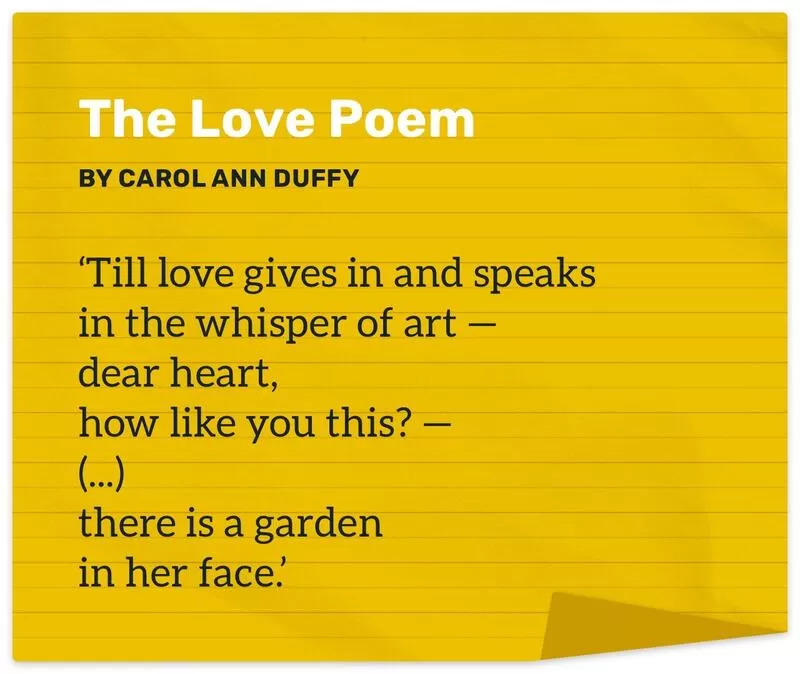
The Love Poem por Carol Ann Duffy
Carol Ann Duffy, la primera poeta laureada británica mujer y abiertamente lesbiana, explora el desafío de articular el amor profundo en ‘The Love Poem’. Proveniente de una colección que relata una aventura amorosa, este poema se vuelve meta, reflexionando sobre la dificultad de encontrar palabras que realmente capturen la naturaleza ilimitada y elemental del amor. Habla del sentimiento inefable por un ser querido que a menudo deja a uno buscando la expresión adecuada.
The room was vast, or seemed to be, because you were not there. The house was heavy, holding its breath. I heard the clock tick. I sat on the stairs, not waiting, not thinking, but, as it were, hearing you not arrive.
I looked through poems, through the ages, blank verse, a haiku, a sonnet, free verse, anything. Nothing worked.
I tried words like: Sun. Moon. Stars. Sea. I tried words like: Heart. Soul. Mind. Body.
I tried saying your name and watched the air go blank.
There is no love poem that can say what you are.
 Mano escribiendo, representando el acto de componer poemas de amor para un ser querido
Before You Came por Faiz Ahmed Faiz
Faiz Ahmed Faiz, un renombrado poeta pakistaní, describe hermosamente cómo su perspectiva de la vida fue alterada fundamentalmente por la llegada de su amado/a en ‘Before You Came’. El poema expresa una profunda dependencia de la presencia del amante para ver el mundo auténticamente. Esta dependencia y la idea de que el ser querido aporta claridad y significado a la existencia es una poderosa expresión de su papel esencial en la vida del hablante.
Before you came, things were what they were: the sky a sky, the road a road, the glass of wine not a mirror, just a glass of wine.
Before you came, the heart was a heart and the sea was a sea.
Now things are not what they were: the sky is you, the road is you, the glass of wine is a mirror of you.
Now the heart is you, and the sea is you.
Don’t leave now that you’re here— Stay. So the world may become like itself again: so the sky may by the sky, the road a road, and the glass of wine not a mirror, just a glass of wine.
Lines Depicting Simple Happiness por Peter Gizzi
El poema de Peter Gizzi encuentra belleza en la simplicidad de la vida compartida y la admiración. ‘Lines Depicting Simple Happiness’ evita los grandes gestos, centrándose en la alegría tranquila de notar y querer saber todo sobre el ser amado. Este aprecio por lo ordinario, junto con una clara adoración, lo convierte en una maravillosa expresión de la felicidad simple y profunda que se encuentra con un ser querido. Para inspirarte en compartir sentimientos tan tiernos, explora los mejores poemas de amor para ella que capturan un sentimiento similar.
The orange peels are glistening on the sill. The shadows are long and purple now. The day is ending and it is beautiful. It feels right to notice all the shiny things about you About you there is nothing I wouldn’t want to know With you nothing is simple yet nothing is simpler About you many good things come into relation
The rain is soft and steady now. The dog is dreaming at your feet. The light is gone and it is beautiful. It feels right to be quiet beside you.
For Keeps por Joy Harjo
Joy Harjo, una célebre poeta Mvskoke y la primera poeta laureada nativa americana, a menudo entrelaza la emoción humana con el mundo natural. En ‘For Keeps’, establece paralelismos entre su amor y la belleza y fuerza duraderas de la naturaleza, creando una imagen de un vínculo inquebrantable. Esta comparación enfatiza la naturaleza duradera y esencial de los sentimientos que tiene por su ser querido.
We are walking the edge of an island that flows into the sun. The sea is on our left, the cliffs are on our right.
You are talking about the way the land has changed, about the houses that have been built since you were a child.
I am listening to you, but I am also listening to the sea, the way it talks to the cliffs, the way it talks to the sand.
Your voice is like the sea, deep and constant, and I could listen to it forever.
This is for keeps, this moment, this island, this sun, this sea, this conversation, this love.
 Raíces de árboles entrelazadas, simbolizando la conexión duradera en la poesía para seres queridos
Yours por Daniel Hoffman
Daniel Hoffman utiliza metáforas cuidadosamente elegidas del mundo natural para expresar una dedicación completa en ‘Yours’. Comparando su conexión con su amante con la forma en que el aire de verano es poseído por el aroma o las cumbres nevadas brillan con la luz de la luna, destaca la presencia esencial de ella que trae vida y belleza a su mundo. Las líneas finales enfatizan que sin ella, estaría desolado, lo que hace de este un poderoso testamento del papel vital de un ser querido.
I am yours as the summer air at evening is Possessed by the scent of linden blossoms, As the snowcap gleams with light Lent it by the brimming moon. Without you I’d be an unleaded tree Blasted in a bleakness with no Spring.
As the water in the river is yours From the mountains to the sea, As the moon in the night is yours, The stars in the sky, So I am yours.
Poem for My Love por June Jordan
June Jordan, una poeta y activista significativa, transmite una sensación de asombro espiritual y trascendencia en ‘Poem for My Love’. La hablante se ve profundamente impactada por su pareja, sintiendo una conexión que va más allá de lo físico hacia lo espiritual. Este poema expresa la profunda reverencia y el poder transformador que un ser querido puede tener en el ser de uno.
If you would come with me we could live upon the Atlantic Ocean
we could seriously engage the question of Shark
or if you would come with me we could live inside the pinecone
or we could be the moonlight
or we could be the statue in the garden at midnight
or we could be the bench in the park where the lovers are
or we could be the lovers
or we could be the question mark at the end of the sentence
or we could be the silence that follows
If you would come with me we could live inside the word
if you would come with me we could live inside the dream
if you would come with me we could be the miracle
if you would come with me we could be the stars
if you would come with me we could be the sea.
for him por Rupi Kaur
Rupi Kaur, una voz destacada en la poesía contemporánea, es conocida por su estilo accesible. En ‘for him’, presenta una idea conmovedora: el amor no es solo un nuevo descubrimiento, sino un reconocimiento, una sensación de haber conocido al amado antes, quizás a través de la sabiduría de un padre. Este sentido de familiaridad profunda, casi predestinada, lo convierte en un conmovedor tributo a encontrar a la persona adecuada, tu ser querido.
no, it won’t be love at first sight when we meet it’ll be love at first remembrance ‘cause i’ve recognized you in my mother’s eyes when she tells me, marry the type of man you’d want to raise your son to be like.
i’ve waited my whole life for you. the kind of wait that makes you understand the patience of a seed.
Untitled por Rupi Kaur (de milk and honey)
Otra pieza breve pero impactante de milk and honey, este poema sin título reflexiona sobre la naturaleza del amor con un toque de sabiduría agridulce. Sugiere que, si bien el amor a veces puede causar dolor, no es malicioso ni intencionalmente hiriente. El amor se presenta como una fuerza que comprende las dificultades inherentes de la vida y, por lo tanto, se esfuerza por ser gentil, una perspectiva generosa y comprensiva que encaja con la compleja realidad de amar a un ser querido.
love will hurt you but love will never mean to love will play no games cause love knows life has been hard enough already
Camomile Tea por Katherine Mansfield
Katherine Mansfield, célebre por sus perspicaces cuentos y poesía, captura la alegría tranquila y subestimada de la familiaridad pacífica en ‘Camomile Tea’. El poema pinta una escena íntima de una pareja que encuentra felicidad simple y satisfacción en la presencia del otro, destacando el profundo consuelo y comprensión compartidos en los momentos cotidianos, una hermosa representación del amor tranquilo y asentado por un ser querido.
We might be fifty, we might be five, So snug, so compact, so wise are we! Under the kitchen-table leg My knee is pressing against his knee.
Our shutters are shut, the fire is low, The tap is dripping peacefully; The saucepan shadows on the wall Are black and round and plain to see.
‘When she comes back,’ I softly say, ‘We’ll give her of our camomile tea.’ You smile at me; I smile at you; And ‘Yes,’ you murmur, ‘yes,’ agree.
Your Feet por Pablo Neruda
Pablo Neruda, el poeta chileno ganador del Premio Nobel, es conocido por sus apasionadas declaraciones. En ‘Tus Pies’, adopta un enfoque poco convencional, centrando su adoración en un detalle aparentemente pequeño: los pies del amado/a. Sin embargo, este enfoque específico se expande en una expresión profunda de amar cada parte de la persona, celebrando su viaje y presencia en su vida. Es una forma única y profundamente personal de expresar devoción a un ser querido.
Cuando estoy trabajando, encerrado en mi estudio, veo tus pies, dos copas de oro compacto, o dos barcos de alabastro, para llevarme.
Cuando estoy trabajando, plantando mis versos, vengo y voy a través de tus pies, desnudos, andando y andando, sabiendo que no puedo vivir sin pasar primero por la luz, la tierra, el viento, y el agua, por tus pies.
Hay muchos pies, pero sólo los tuyos me entienden cuando ando en la calle. Por eso beso tus pies, sabiendo que ando contigo, y no ando solo, no con el viento ni con el agua, ni con la luz, ni con la tierra, sino contigo.
Dear One Absent This Long While por Lisa Olstein
El poema de Lisa Olstein captura la ansiosa anticipación y el profundo anhelo por el regreso de un ser amado. ‘Dear One Absent This Long While’ retrata cómo la hablante ve destellos de su ser querido en todas partes, encontrando su presencia esencial para restaurar el mundo a su estado correcto. Este intenso sentimiento de ausencia y la dependencia del ser querido para la plenitud lo convierten en una conmovedora representación de su importancia.
I know you are not coming back but I expect you. I thought one night it was you at the base of the drive, you at the foot of the stairs you in a shiver of light, but each time leaves in wind revealed themselves, the retreating shadow of a fox, daybreak.
We expect you, cat and I, bluebirds and I, the stove.
The bluebirds come back to the birdhouse each spring. The cat waits by the door. The stove waits to be lit.
I wait for you.
My Lover Is a Woman por Pat Parker
Pat Parker, una influyente poeta y activista feminista lesbiana afroamericana, habla de encontrar seguridad y refugio en el amor en medio de luchas externas. ‘My Lover Is a Woman’ destaca al ser querido como un puerto seguro, un lugar de calidez y seguridad en un mundo desafiante. Este poema articula poderosamente el consuelo y el sentido de pertenencia que una pareja amada proporciona. Considera estos versos entre los poemas de amor profundo para ella por su profundo impacto emocional.
my lover is a woman & when i hold her feel her warmth i feel good feel safe
she is the storm she is the calm she is the moon she is the sun
she is the lover she is the friend she is the beginning she is the end.
It Is Here por Harold Pinter
Harold Pinter, el dramaturgo ganador del Premio Nobel, explora la presencia duradera del amor que trasciende el tiempo y el espacio en su poema ‘It Is Here’. Al reflexionar sobre el momento del primer encuentro, Pinter sugiere que la chispa y conexión iniciales permanecen accesibles, existiendo en la conciencia compartida de los amantes. Esta idea de que el amor está siempre presente y es alcanzable lo convierte en una tierna reflexión sobre el vínculo duradero con un ser querido.
What is this stance we take, To turn away and then turn back? What did we hear? It was the breath we took when we first met. Listen. It is here.
It is the silence that follows the first sound. It is the sound that shatters the first silence. It is the question that follows the first answer. It is the answer that silences the first question. It is here.
Untitled por Christopher Poindexter
Christopher Poindexter ofrece un retrato profundamente honesto y fácil de identificar del amor que empuja contra los límites del lenguaje. Este poema sin título expresa un anhelo paradójico: extrañar al amado/a incluso cuando está cerca, soñar con ellos incluso en sus brazos. Habla de la naturaleza abrumadora del afecto profundo por un ser querido, sugiriendo que incluso las palabras “Te amo” se sienten inadecuadas para transmitir completamente el sentimiento.
I miss you even when you are beside me. I dream of your body even when you are sleeping in my arms.
The words I love you could never be enough.
The universe is not big enough to hold my love for you.
You are my universe.
Again and again, even though we know love’s landscape por Rainer Maria Rilke
Rainer Maria Rilke creía que amar a otro era quizás la tarea más difícil de la humanidad. En este poema, celebra el acto continuo y cotidiano de elegir el amor, saliendo juntos a pesar de conocer el potencial de dolor. Destaca la fuerza y la vulnerabilidad al comprometerse con una conexión profunda con un ser querido, encontrando belleza en la elección repetida de amar y mirar juntos al cielo. Esto resuena con poemas sobre el amor y la luna en su uso de imágenes celestiales o de paisajes para describir sentimientos profundos.
Again and again, even though we know love’s landscape and the little churchyard with its lamenting names and the terrible reticent gorge in which the others end: again and again the two of us walk out together under the ancient trees, lay ourselves down again and again among the flowers, and look up into the sky.
I loved you first: but afterwards your love por Christina Rossetti
Christina Rossetti explora la reciprocidad y la fusión del amor en este soneto. A pesar de cuestionar inicialmente quién amó más, el poema se mueve hacia un sentimiento de “unidad”, donde los afectos individuales se combinan para crear un amor unificado más grande que sus partes. Este tema de profunda comprensión e identidades que se fusionan habla de la profunda conexión compartida con un ser querido, donde dos vidas se entrelazan y se mejoran mutuamente.
I loved you first: but afterwards your love Outsoaring mine, sang such a loftier song As drowned the friendly cooings of my dove. Which owes the other most? my love was long, And yours one moment seemed to wax more strong; I loved you first: but afterwards your love Was greater, and the rest all came thereof.
In me you loved the river, in you I loved the sea. In me you loved the flower, in you I loved the tree.
Your life is mine, and my life is yours. We are one.
Defeated by Love por Rumi
Las palabras perdurables de Rumi, el poeta persa del siglo XIII, a menudo hablan de intensa devoción espiritual y terrenal. ‘Defeated by Love’ retrata un amor tan poderoso que abruma el yo, llevando a la rendición a la magnificencia del amado/a. Aunque grandioso en su pasión, el mensaje central de este poema de ser completamente transformado y consumido por el amor es una forma poderosa de expresar el profundo impacto que un ser querido puede tener.
The sky was lit by the splendor of the moon So powerful I fell to the ground Your love has made me sure I am ready to forsake this worldly life and surrender to the magnificence of your Bering
Your love has made me a wild bird flying in the sky
Your love has made me a fish in the sea swimming
Your love has made me a star shining in the night.
Shall I compare thee to a summer’s day? (Sonnet 18) por William Shakespeare
Quizás el soneto más famoso jamás escrito, el Soneto 18 de Shakespeare es una comparación atemporal del amado/a con un día de verano. Si bien reconoce la naturaleza efímera del verano, el poema afirma que la belleza y la esencia del amado/a son eternas, preservadas para siempre en las líneas del verso. Este tema de inmortalizar al amado/a lo convierte en un tributo clásico y duradero, perfecto para un ser querido apreciado.
Shall I compare thee to a summer’s day? Thou art more lovely and more temperate: Rough winds do shake the darling buds of May, And summer’s lease hath all too short a date: Sometime too hot the eye of heaven shines, And often is his gold complexion dimm’d; And every fair from fair sometime declines, By chance or nature’s changing course untrimm’d; But thy eternal summer shall not fade, Nor lose possession of that fair thou owest; Nor shall Death brag thou wander’st in his shade, When in eternal lines to time thou growest: So long as men can breathe or eyes can see, So long lives this, and this gives life to thee.
 Busto de William Shakespeare, autor de famosos sonetos a menudo usados como poemas para seres queridos
Let me not to the marriage of true minds (Sonnet 116) por William Shakespeare
El Soneto 116 de Shakespeare ofrece una definición del amor verdadero como una fuerza constante e inquebrantable. Afirma que el amor no está sujeto a cambios o presiones externas; es una guía fija, como la Estrella Polar para los barcos perdidos. La representación que hace este poema del amor como un compromiso duradero y firme lo convierte en una expresión increíblemente adecuada para el vínculo profundo y confiable compartido con un ser querido.
Let me not to the marriage of true minds Admit impediments. Love is not love Which alters when it alteration finds, Or bends with the remover to remove. O no! it is an ever-fixed mark That looks on tempests and is never shaken; It is the star to every wandering bark, Whose worth’s unknown, although his height be taken. Love’s not Time’s fool, though rosy lips and cheeks Within his bending sickle’s compass come; Love alters not with his brief hours and weeks, But bears it out even to the edge of doom. If this be error and upon me proved, I never writ, nor no man ever loved.
My mistress’ eyes are nothing like the sun (Sonnet 130) por William Shakespeare
En el Soneto 130, Shakespeare subvierte juguetonamente las comparaciones petrarquistas tradicionales del amado/a con la belleza natural idealizada. Enumera francamente las imperfecciones de su amante: sus ojos no son como el sol, sus labios no son tan rojos como el coral. Sin embargo, el poema concluye con una poderosa afirmación: su amor es tan raro y valioso como cualquier amor idealizado, precisamente porque la ama de manera realista, con defectos y todo. Este amor honesto y aceptador es un sentimiento hermoso para un ser querido apreciado.
My mistress’ eyes are nothing like the sun; Coral is far more red than her lips’ red; If snow be white, why then her breasts are dun; If hairs be wires, black wires grow on her head. I have seen roses damask’d, red and white, But no such roses see I in her cheeks; And in some perfumes is there more delight Than in the breath that from my mistress reeks. I love to hear her speak, yet well I know That music hath a far more pleasing sound; I grant I never saw a goddess go; My mistress, when she walks, treads on the ground: And yet, by heaven, I think my love as rare As any she belied with false compare.
One Day I Wrote her Name (Sonnet 75) por Edmund Spenser
Parte de la secuencia de sonetos Amoretti de Edmund Spenser, dedicada a su amada Elizabeth Boyle, el Soneto 75 aborda el deseo de inmortalizar el amor a pesar de la naturaleza transitoria de las cosas terrenales. Aunque las olas lavan repetidamente el nombre escrito en la arena, el hablante jura hacer su amor eterno a través del verso, asegurando que su nombre y su amor vivan para siempre en la fama. Esta dedicación a preservar la memoria y el valor del amor habla del significado duradero de un ser querido.
One day I wrote her name upon the strand, But came the waves and washed it away: Again I wrote it with a second hand, But came the tide, and made my pains his prey. Vain man, said she, that dost in vain assay A mortal thing so to immortalize, For I myself shall like to this decay, And eke my name be wiped out likewise. Not so, quoth I, let baser things devise To die in dust, but you shall live by fame: My verse your virtues rare shall eternize, And in the heavens write your glorious name: Where whenas Death shall all the world subdue, Our love shall live, and later life renew.
We Have Not Long to Love por Tennessee Williams
Aunque reconocido por sus obras de teatro, Tennessee Williams también escribió poesía conmovedora. En ‘We Have Not Long to Love’, ofrece un recordatorio suave para apreciar el momento presente y el amor compartido en él. Reconociendo la naturaleza fugaz del tiempo y la vida, el poema fomenta una profunda apreciación por el amor que tenemos ahora, convirtiéndolo en una tierna llamada a valorar el tiempo pasado con un ser querido.
We have not long to love. Light and the heart break even.
We have not long to love. The world is an island in an ocean of shadow.
We have not long to love. The light is leaving.
We have not long to love. Hold on to each other.
 Tranvía vintage, evocando una sensación de nostalgia y tiempo efímero en los poemas de amor
Estos poemas, ya sean clásicos o contemporáneos, comparten un hilo conductor: intentan capturar el sentimiento inefable de apreciar a otra persona. Un ser querido es más que una pareja; es una luz, un hogar, una constante en un mundo cambiante. La poesía proporciona una lente única a través de la cual ver y expresar este vínculo profundo, ofreciendo palabras que resuenan con la profundidad y ternura del afecto verdadero. Leer y compartir estos poemas para tu cariño puede profundizar tu conexión y recordarles a ambos el hermoso lenguaje que el amor inspira. Elige tus favoritos y deja que las palabras hablen por ti.