
Haiku poetry, originating in ancient Japan, is a form renowned for its brevity, structure, and ability to capture poignant moments, often connected to nature and the changing seasons. These short, evocative verses, traditionally following a 5-7-5 syllable pattern, invite readers to pause, observe, and find deep meaning in simple imagery. For anyone looking to delve into this fascinating poetic form, studying diverse examples haiku poems is an essential step. From the timeless works of the great masters to innovative modern interpretations, haiku offers a unique window into the world and the human experience. This collection presents 40 notable haiku examples, showcasing the form’s enduring power and versatility.
Contents
- Classic Japanese Haiku Masters
- 1. “The Old Pond” by Matsuo Bashō
- 2. “The light of a candle” by Yosa Buson
- 3. “A World of Dew” by Kobayashi Issa
- 4. “I want to sleep” by Masaoka Shiki
- 5. “O snail” by Kobayashi Issa
- 6. “In the moonlight” by Yosa Buson
- 7. “After Killing a Spider” by Masaoka Shiki
- 8. “[cherry blossoms]” by Kobayashi Issa
- 9. “[The crow has flown away:]” by Natsume Soseki
- 10. “[Plum flower temple:]” by Natsume Soseki
- 11. “[The first soft snow:]” by Matsuo Bashō
- 12. “[A caterpillar,]” by Matsuo Bashō
- 13. “[On the one-ton temple bell]” by Taniguchi Buson
- 14. “Childless woman” by Hattori Ransetsu
- 15. “[The snow of yesterday]” by Gozan
- 16. “[First autumn morning]” by Murakami Kijo
- Modern & English Haiku Examples
- 17. “Haiku Ambulance” by Richard Brautigan
- 18. “In a Station of the Metro” by Ezra Pound
- 19. “The Taste of Rain” by Jack Kerouac
- 20. “Haiku [for you]” by Sonia Sanchez
- 21. “Lines on a Skull” by Ravi Shankar
- 22. “[snowmelt— ]” by Penny Harter
- 23. [meteor shower] by Michael Dylan Welch
- 24. “[The west wind whispered]” by R.M. Hansard
- 25. “[I kill an ant]” by Kato Shuson
- 26. “[Just friends:]” by Alexis Rotella
- 27. “[The neighing horses]” by Richard Wright
- 28. “[Lily:]” by Nick Virgilio
- 29. “[A raindrop from]” by Jack Kerouac
- 30. “[I was in that fire]” by Andrew Mancinelli
- 31. “[Everything I touch]” by Kobayashi Issa
- Haiku on Diverse Themes
- 32. “A Poppy Blooms” by Katsushika Hokusai
- 33. “The earth shakes” by Steve Sanfield
- 34. “JANUARY” by Paul Holmes
- 35. “[Even in Kyoto,]” by Kobayashi Issa
- 36. “[What is it but a dream?]” by Hakuen Ekaku
- 37. “[Grasses wilt:]” by Yamaguchi Seishi
- 38. “[losing its name]” by John Sandbach
- 39. “Over The Wintry” by Natsume Sōse
- 40. “[The lamp once out]” by Natsume Soseki
- Conclusion
Dive into the world of haiku and discover the profound artistry contained within these compact poems. We’ll explore classic examples alongside contemporary pieces, highlighting how poets use precise language and vivid imagery to create powerful effects. Whether you are a seasoned poetry enthusiast or new to the form, these haiku poems examples offer a rich source of inspiration and insight. Understanding different haiku styles and themes can deepen your appreciation for this ancient yet ever-relevant art form. To explore more about the form, consider looking into english haiku poems examples which showcase its adaptation across languages and cultures.
Classic Japanese Haiku Masters
The foundation of modern haiku is built upon the work of four great Japanese masters: Matsuo Bashō, Yosa Buson, Kobayashi Issa, and Masaoka Shiki. Their poems, often rooted in observations of nature, set the standard for conciseness, imagery, and emotional resonance. These are some of the most famous haiku in history.
1. “The Old Pond” by Matsuo Bashō
an old silent pond…
A frog jumps into the pond,
splash! Silence again.
Bashō’s most celebrated haiku perfectly embodies the form’s essence. It captures a fleeting moment – the sound disrupting the quiet, followed by a return to stillness. This juxtaposition of movement and tranquility, the natural imagery, and the implied depth of the “old pond” offer layers of interpretation, reflecting on the nature of reality and consciousness.
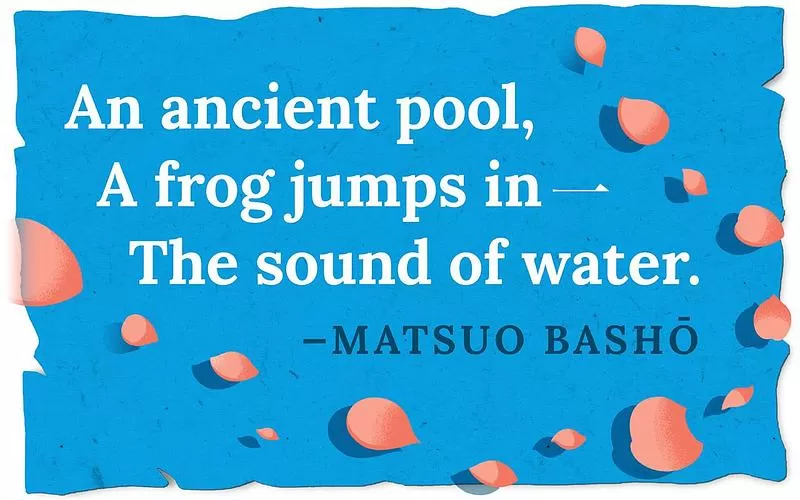 Illustration depicting a frog jumping into an old pond, referencing Basho's famous haiku
2. “The light of a candle” by Yosa Buson
The light of a candle
Is transferred to another candle —
spring twilight.
Buson, known for his painterly sensibility, presents a delicate scene of shared light. The image evokes connection and continuity – how light, knowledge, or spirit can be passed on without diminishing the source. Set against the backdrop of “spring twilight,” the poem adds a layer of gentle beauty and subtle transition, characteristic of the season.
3. “A World of Dew” by Kobayashi Issa
This world of dew
is a world of dew,
and yet, and yet.
Written shortly after the death of his daughter, Issa’s poignant haiku confronts the ephemeral nature of life. The repetition emphasizes the fleetingness, the dew-like fragility of existence. Yet, the concluding “and yet, and yet” introduces a profound emotional complexity – a sense of lingering sorrow, a questioning acceptance, or an ineffable continuation despite loss.
4. “I want to sleep” by Masaoka Shiki
I want to sleep
Swat the flies
Softly, please.
Masaoka Shiki, who suffered from tuberculosis, often wrote from the perspective of his sickbed. This haiku captures a moment of weariness and vulnerability. The speaker’s desire for rest is interrupted by a trivial disturbance (flies), but the request to swat them “softly” reveals a deep tenderness or perhaps a heightened sensitivity brought on by illness.
5. “O snail” by Kobayashi Issa
O snail
Climb Mount Fuji,
But slowly, slowly!
Issa often showed empathy for small creatures. Addressing the snail directly, he playfully encourages its monumental task. The repetition of “slowly, slowly” underscores the snail’s nature and offers a gentle reminder about perseverance and patience, suggesting that grand goals can be achieved one small step at a time.
6. “In the moonlight” by Yosa Buson
In pale moonlight
the wisteria’s scent
comes from far away.
Buson masterfully employs sensory details. The visual image of “pale moonlight” sets a serene, perhaps nostalgic mood. The unexpected arrival of the “wisteria’s scent” from “far away” adds a layer of mystery and evokes the power of scent to transport the mind to distant places or memories.
7. “After Killing a Spider” by Masaoka Shiki
After killing
a spider, how lonely I feel
in the cold of night!
Shiki reveals a moment of unexpected remorse and isolation after a seemingly insignificant act. The “cold of night” mirrors the speaker’s internal state of loneliness. It’s a powerful example of how haiku can explore the human psyche and emotional consequence, even in the simplest of actions.
8. “[cherry blossoms]” by Kobayashi Issa
cherry blossoms
fall! fall!
enough to fill my belly
This haiku is filled with exuberant, almost childlike delight. Issa’s speaker is overwhelmed by the abundance of falling cherry blossoms, expressing a desire to consume their beauty completely. It captures the joyous, fleeting intensity of spring’s peak.
9. “[The crow has flown away:]” by Natsume Soseki
The crow has flown away:
Swaying in the evening sun,
A leafless tree
Natsume Soseki presents a scene of transition, likely from autumn to winter. The departure of the crow marks the change. The remaining image of the “leafless tree” swaying in the “evening sun” evokes a sense of solitude, stark beauty, and the quiet resignation of nature preparing for the cold season.
10. “[Plum flower temple:]” by Natsume Soseki
Plum flower temple:
Voices rise
From the foothills
Soseki creates a sense of mystery and spiritual presence. The image of the “Plum flower temple” suggests beauty and tranquility, while the rising “Voices… From the foothills” adds an element of the unseen, perhaps monks chanting or the sounds of nature echoing, hinting at a connection between the sacred and the natural world.
11. “[The first soft snow:]” by Matsuo Bashō
The first soft snow:
leaves of the awed jonquil
bow low
Bashō personifies the jonquil leaves, showing them reacting with reverence to the arrival of snow. The word “awed” attributes a sense of wonder and respect to nature itself, highlighting the quiet power and beauty of the changing seasons and nature’s submission to its forces.
12. “[A caterpillar,]” by Matsuo Bashō
A caterpillar,
this deep in fall –
still not a butterfly.
Bashō observes a caterpillar late in the season, noting its unfinished transformation. The haiku captures a feeling of anticipation, perhaps mixed with melancholy, as fall progresses while the caterpillar remains in its current state. It can be read as a reflection on potential, delay, or the timing of natural processes.
13. “[On the one-ton temple bell]” by Taniguchi Buson
On the one-ton temple bell
A moonmoth, folded into sleep,
Sits still.
Buson creates a striking contrast between the massive, potentially loud bell and the small, delicate, silent moonmoth resting upon it. The image evokes vulnerability and stillness against the backdrop of immense potential sound, highlighting a moment of peaceful unawareness or calm fragility.
14. “Childless woman” by Hattori Ransetsu
The childless woman,
how tenderly she caresses
homeless dolls …
Hattori Ransetsu offers a poignant portrait of a woman finding an outlet for maternal tenderness. The image of her caring for “homeless dolls” is both sad and touching, speaking to universal human needs for connection, care, and expression of love, even in the absence of biological children.
15. “[The snow of yesterday]” by Gozan
The snow of yesterday
That fell like cherry blossoms
Is water once again
Gozan reflects on impermanence. He compares falling snow to cherry blossoms, two fleeting beauties. The transformation of snow back into water serves as a simple, natural reminder of the cycle of change and the transient nature of all things, echoing themes often found in Japanese aesthetics.
16. “[First autumn morning]” by Murakami Kijo
First autumn morning
the mirror I stare into
shows my father’s face.
Murakami Kijo captures a moment of self-reflection and the realization of aging and lineage. Looking in the mirror on a crisp autumn morning, the speaker sees not just themselves but the face of their father emerging, a powerful image of connection across generations and the passage of time.
Modern & English Haiku Examples
Haiku has been adapted and evolved in English and other languages, often experimenting with the strict syllable count while retaining the spirit of conciseness, imagery, and the “aha” moment (kire or cut). These examples demonstrate the form’s adaptability.
17. “Haiku Ambulance” by Richard Brautigan
A piece of green pepper
fell
off the wooden salad bowl:
so what?
Richard Brautigan offers a playful, anti-establishment take on haiku. He deliberately breaks the traditional form (syllable count, line breaks) and subject matter. The conclusion “so what?” is a cheeky rejection of finding deep meaning in the mundane, or perhaps a commentary on the arbitrary nature of poetic rules.
18. “In a Station of the Metro” by Ezra Pound
The apparition of these faces
in the crowd;
Petals on a wet, black bough.
Though considered an Imagist poem, Pound’s work is often cited for its haiku-like qualities. It features two distinct images juxtaposed (“faces in the crowd” and “Petals on a wet, black bough”) connected by a simile (implied by the semicolon or dash in some versions). It captures a fleeting urban moment with striking visual clarity and surprising comparison.
19. “The Taste of Rain” by Jack Kerouac
The taste
of rain
— Why kneel?
Beat generation writer Jack Kerouac brings a philosophical edge to the haiku form. This piece connects the simple sensory experience of tasting rain with a deeper, questioning thought about reverence or prayer. It’s concise, unexpected, and prompts reflection on nature, spirituality, and personal experience.
20. “Haiku [for you]” by Sonia Sanchez
love between us is
speech and breath. loving you is
a long river running.
Sonia Sanchez’s haiku (often presented in non-traditional lines) is a warm, declarative statement of love. She uses natural, essential elements (“speech and breath”) and a powerful, continuous image (“a long river running”) to describe the effortless and enduring nature of the connection. This is a beautiful example of haiku poems about love.
21. “Lines on a Skull” by Ravi Shankar
life’s little, our heads
sad. Redeemed and wasting clay
this chance. Be of use.
Ravi Shankar presents a contemporary haiku with a direct, almost urgent tone. Reflecting on mortality (“wasting clay”), he contrasts the brevity of life (“life’s little”) with the potential for meaning (“this chance”). The final imperative “Be of use” turns the observation into a call to action, giving the poem a philosophical weight.
22. “[snowmelt— ]” by Penny Harter
snowmelt—
on the banks of the torrent
small flowers
Penny Harter creates a dynamic image of contrasting forces in nature. The powerful “torrent” of snowmelt exists alongside the delicate emergence of “small flowers.” The haiku captures the simultaneous presence of strength and fragility, decay and new life, characteristic of spring.
23. [meteor shower] by Michael Dylan Welch
meteor shower
a gentle wave
wets our sandals
Michael Dylan Welch’s haiku shifts perspective dramatically. It moves from the grand cosmic event of a “meteor shower” to the intimate, sensory detail of “a gentle wave / wets our sandals.” This movement from the universal to the personal, from the distant to the immediate, creates a sense of grounded connection within a vast universe.
24. “[The west wind whispered]” by R.M. Hansard
The west wind whispered,
And touched the eyelids of spring:
Her eyes, Primroses.
R.M. Hansard uses personification to depict the arrival of spring. The “west wind” is a gentle messenger, awakening spring itself, whose eyes open as primroses bloom. It’s a lyrical and charming image of nature’s reawakening.
25. “[I kill an ant]” by Kato Shuson
I kill an ant
and realize my three children
have been watching.
Kato Shuson’s haiku moves from a simple, almost thoughtless act to a moment of parental self-awareness. The speaker’s killing of an ant is framed by the sudden realization of being observed by their children. It highlights the weight of parental example and the potential impact of small actions witnessed by young eyes.
26. “[Just friends:]” by Alexis Rotella
Just friends:
he watches my gauze dress
blowing on the line.
Alexis Rotella captures a moment charged with unspoken tension and desire. The simple statement “Just friends:” is immediately undercut by the visual image that follows – the “gauze dress / blowing on the line” observed by “he.” The fragile, revealing nature of the dress and the act of watching suggest a relationship constrained by definition, hinting at longing beneath the surface. For more a lovers poems short that capture complex emotions concisely, exploring modern haiku is fruitful.
27. “[The neighing horses]” by Richard Wright
The neighing horses
are causing echoing neighs
in neighboring barns
Richard Wright uses repetition and sound to create a sense of widespread connection or reaction. The sound of “neighing horses” doesn’t just happen in one place; it spreads, causing echoes in other barns. It can be read simply as an observation of sound propagation or metaphorically about the ripple effect of communication or emotion. Wright sometimes used a technique called the “haiku round,” where the last line leads back to the first, creating a loop, which can be felt here.
28. “[Lily:]” by Nick Virgilio
Lily:
out of the water
out of itself
Nick Virgilio’s concise haiku about a lily is often cited as an example of the “cutting word” effect (kireji) achieved with the colon. The poem moves from the specific subject (“Lily:”) to its emergence from its environment (“out of the water”) and then to a more abstract, almost spiritual idea of transcending its own limitations (“out of itself”). It’s a powerful image of growth and transformation.
29. “[A raindrop from]” by Jack Kerouac
A raindrop from
the roof
Fell in my beer
Kerouac again places a natural element into a mundane, human context. The simple observation of a raindrop falling from the roof takes an unexpected turn by landing “in my beer.” It’s slightly disruptive, perhaps humorous, and contrasts the vastness of nature with a small, everyday human pleasure.
30. “[I was in that fire]” by Andrew Mancinelli
I was in that fire,
The room was dark and somber.
I sleep peacefully.
Andrew Mancinelli presents a haiku that hints at past trauma or difficulty. The “fire” could be literal or metaphorical (a hardship, a conflict). The middle line describes the difficult state (“dark and somber”). The final line provides a resolution or present state of peace, suggesting survival and healing after adversity.
31. “[Everything I touch]” by Kobayashi Issa
Everything I touch
with tenderness, alas,
pricks like a bramble
Issa expresses a deep sense of vulnerability and repeated disappointment in connection. Despite approaching things “with tenderness,” his attempts result in pain, like being pricked by a “bramble.” It’s a heartfelt cry of someone whose efforts to connect or love are met with hurt, conveying a profound sense of world-weariness or personal suffering.
Haiku on Diverse Themes
Haiku, while often associated with nature, can explore a wide range of themes, from human relationships and emotions to everyday observations and philosophical reflections.
32. “A Poppy Blooms” by Katsushika Hokusai
I write, erase, rewrite
Erase again, and then
A poppy blooms.
Artist Katsushika Hokusai compares the creative process to the blooming of a flower. The repeated actions of writing and erasing reflect the effort, revision, and struggle involved in creation. The sudden appearance of “A poppy blooms” is the reward – the beautiful, seemingly effortless result that emerges from diligent work.
33. “The earth shakes” by Steve Sanfield
The earth shakes
just enough
to remind us.
Steve Sanfield’s haiku uses the natural event of an earthquake as a subtle, yet powerful reminder. The shaking is not catastrophic, but merely “just enough.” This gentle jolt serves as a reminder of nature’s power, perhaps our own fragility, or the importance of appreciating the present moment.
34. “JANUARY” by Paul Holmes
Delightful display
Snowdrops bow their pure white heads
To the sun’s glory.
Paul Holmes captures a specific moment in the seasonal transition from winter to spring. The snowdrops, symbols of hope and new life, acknowledge the growing power of the sun. The image is one of gentle emergence and natural reverence for the returning light and warmth.
35. “[Even in Kyoto,]” by Kobayashi Issa
Even in Kyoto,
Hearing the cuckoo’s cry,
I long for Kyoto
Issa expresses a paradoxical longing. Even while physically present in Kyoto, hearing the cuckoo’s cry (a sound associated with rural life and nostalgia) triggers a desire for a different, perhaps idealized or past, experience of the city or elsewhere. It speaks to the complex nature of memory and belonging.
36. “[What is it but a dream?]” by Hakuen Ekaku
What is it but a dream?
The blooming as well
Lasts only seven cycles
Hakuen Ekaku, a Zen monk, reflects on the illusory nature of reality and the impermanence of beauty. Comparing life to a “dream,” he notes that even the beautiful act of “blooming” (like cherry blossoms) is transient, lasting only a short time (“seven cycles” – often interpreted as seven days, aligning with the short life of a cherry blossom).
37. “[Grasses wilt:]” by Yamaguchi Seishi
Grasses wilt:
the braking locomotive
grinds to a halt.
Yamaguchi Seishi juxtaposes natural decay (“Grasses wilt:”) with mechanical force and cessation (“the braking locomotive / grinds to a halt”). This contrast highlights the different ways things come to an end – the slow, natural wilting versus the powerful, engineered stop. It’s an image reflecting the intersection of nature and industry.
38. “[losing its name]” by John Sandbach
losing its name
a river
enters the sea
John Sandbach uses the natural image of a river flowing into the sea as a metaphor for dissolution, integration, or selflessness. The river “loses its name” as it becomes part of the larger ocean, suggesting a merging where individual identity is subsumed into a greater whole.
39. “Over The Wintry” by Natsume Sōse
Over the wintry
forest, winds howl in rage
with no leaves to blow.
Soseki paints a stark, powerful image of a winter forest. The “winds howl in rage,” but their fury is rendered somewhat futile by the absence of leaves. The poem evokes a sense of raw, perhaps frustrated, power in nature, or could be a metaphor for strong emotions lacking an outlet or impact.
40. “[The lamp once out]” by Natsume Soseki
The lamp once out
Cool stars enter
The window frame.
Soseki creates a beautiful image of what happens when artificial light is removed. The darkness allows the natural light of the “Cool stars” to become visible, framed by the window. It can be read literally as an observation of the night sky or metaphorically as gaining a wider perspective or experiencing a different kind of illumination when conventional sources of light or understanding are gone.
Conclusion
These examples haiku poems demonstrate the enduring appeal and artistic depth of the haiku form. From capturing the subtle changes in nature observed by the Japanese masters to exploring complex human emotions and modern life in English, haiku proves its ability to resonate across cultures and centuries. Each poem, in its concise structure, offers a moment of intense observation, a flash of insight, or a deep emotional connection. By exploring these and other haiku, readers can gain a deeper appreciation for the power held within brevity and the simple beauty found in the world around us. Continue your journey into short poetic forms by exploring senryu poem, a related form focusing on human nature, or revisit the beauty of haiku poems about love.