
Haiku, a traditional Japanese poetic form, encapsulates a world of meaning within its concise structure. Characterized by its three-line, 5-7-5 syllable count, haiku often draws inspiration from nature and fleeting moments. This article explores the essence of haiku through examples, demonstrating its power and beauty.
Classic Haiku Examples
Here are a few examples of classic haiku, highlighting the form’s traditional themes and structure:
- Matsuo Bashō’s “The Old Pond”:
An old silent pond…
A frog jumps into the pond—
Splash! Silence again.
This haiku masterfully uses imagery to evoke a sense of tranquility and the interconnectedness of nature.
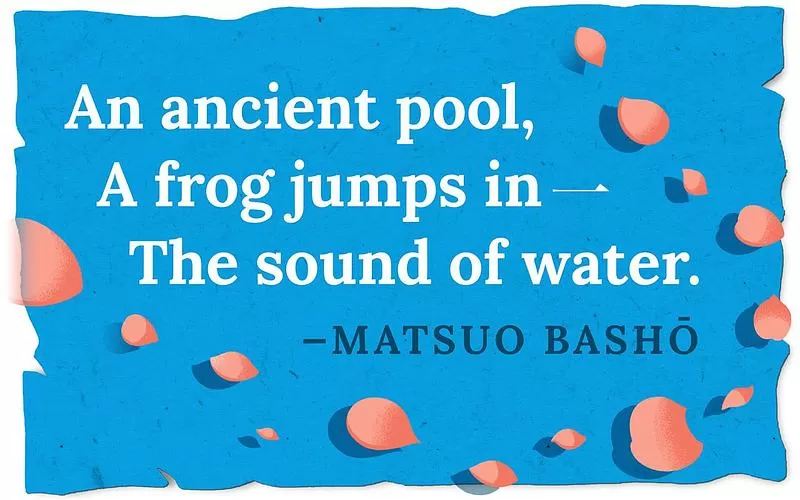 An old pond with a frog.
- Yosa Buson’s “The light of a candle”:
The light of a candle
Is transferred to another candle—
Spring twilight.
Buson’s haiku beautifully captures a moment of transition and the cyclical nature of life.
- Kobayashi Issa’s “A World of Dew”:
This world of dew
Is a world of dew,
And yet, and yet.
This poignant haiku reflects on the ephemeral nature of existence, hinting at deeper philosophical musings.
Modern Haiku Examples
Modern haiku often deviate from the strict 5-7-5 syllable rule while still retaining the essence of the form:
- Richard Brautigan’s “Haiku Ambulance”:
A piece of green pepper
fell
off the wooden salad bowl:
so what?
Brautigan’s playful haiku challenges traditional conventions and explores themes of absurdity.
- Ezra Pound’s “In a Station of the Metro”:
The apparition of these faces
in the crowd;
Petals on a wet, black bough.
Pound’s evocative haiku juxtaposes human experience with natural imagery, highlighting the fleeting nature of both.
 Faces in a crowd like petals on a wet bough.
Writing Your Own Haiku
Inspired to try your hand at haiku? Here’s a simple guide:
- Observe: Find a moment or scene in nature that resonates with you.
- Count Syllables: Craft three lines with a 5-7-5 syllable structure (or experiment with variations).
- Use Imagery: Employ vivid language to paint a picture with your words.
- Embrace Simplicity: Capture the essence of the moment without unnecessary embellishments.
- Kireji (Cutting Word): Consider using a word or phrase to create a pause or break between two parts of the haiku, adding depth and contrast.
The Power of Haiku
Haiku, despite its brevity, holds immense power. It allows us to connect with nature, reflect on life’s fleeting moments, and express complex emotions in a concise and evocative way. Through its simple structure, haiku encourages mindfulness and appreciation for the world around us.