
Understanding meter in poetry is like finding the right prescription for your eyes: it brings the words into sharp focus, allowing you to truly appreciate the rhythm and flow of the language. Just as a blurred image obscures details, an incorrect reading of meter can distort the poem’s intended sound and meaning. This article explores several examples of meters in poetry, demonstrating how these rhythmic patterns shape the overall effect of a poem.
Contents
Common Metrical Feet
English poetry relies on the arrangement of stressed and unstressed syllables to create repeating sonic units called “feet.” These feet form the building blocks of meter. Let’s examine some of the most common types:
Iambic Pentameter
Shakespeare’s Sonnet 18, “Shall I compare thee to a summer’s day?,” exemplifies iambic pentameter. An iamb consists of an unstressed syllable followed by a stressed syllable (da DUM). Pentameter signifies five feet per line. The rhythmic pattern of this line is: shall I | _com_PARE | thee TO | a SUM | mer’s DAY?
 Iambic Pentameter
The gentle rise and fall of the iambic rhythm create a sense of natural speech, making it a popular choice for poets.
Trochaic Octameter
Edgar Allan Poe’s “The Raven” opens with a line in trochaic octameter: “Once upon a midnight dreary, while I pondered, weak and weary.” A trochee is the opposite of an iamb: a stressed syllable followed by an unstressed syllable (DA dum). Octameter indicates eight feet per line. The rhythmic emphasis at the beginning of each foot creates a more forceful and dramatic effect compared to the iamb.
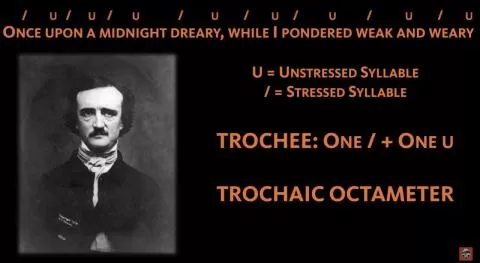 trochaic octameter
Anapestic Tetrameter
Clement Clarke Moore’s “A Visit from St. Nicholas” employs anapestic tetrameter: “‘Twas the night before Christmas when all through the house, not a creature was stirring, not even a mouse.” An anapest comprises two unstressed syllables followed by a stressed syllable (da da DUM). Tetrameter signifies four feet per line. This meter creates a light, quick rhythm, often associated with storytelling and narrative verse.
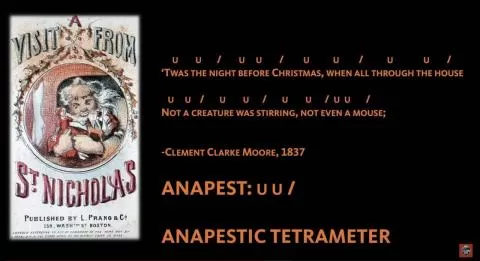 anapestic tetrameter
Dactylic Hexameter
A dactyl, consisting of a stressed syllable followed by two unstressed syllables (DUM da da), is less common in English poetry but appears in epic poems like Henry Wadsworth Longfellow’s “Evangeline”: “This is the forest primeval, the murmuring pines and the hemlocks.” Hexameter indicates six feet per line. The dactylic rhythm can create a sense of grandeur and flowing movement.
 dactylic hexameter
Interestingly, dactylic hexameter also appears in contemporary music, like the Migos song “Versace”: “Drownin’ in compliments, pool in the backyard that look like Metropolis.” While the subject matter differs drastically from Longfellow’s, the underlying meter remains the same.
 Dactyl Meter 2
Breaking the Meter
Once you identify the dominant meter in a poem, look for deviations from the established pattern. These breaks can offer crucial insights into the poem’s meaning. For example, John Milton’s “Paradise Lost,” written primarily in iambic pentameter, contains deliberate metrical variations:
 Paradise Lost opening Lines
“Of Man’s First Disobedience, and the Fruit
Of that Forbidden Tree, whose mortal taste
Brought Death into the World, and all our woe”
Analyzing why Milton disrupts the meter at specific points can enrich our understanding of the poem’s themes and emotional impact.
Conclusion
By recognizing and understanding these examples of meters in poetry, we gain a deeper appreciation for the artistry and complexity of poetic language. Meter is not simply a technical element; it contributes significantly to the poem’s overall effect, shaping its rhythm, tone, and meaning. Learning to identify and analyze metrical patterns empowers us to read poetry with a more discerning ear and a more profound understanding.