
Poetry, in its myriad forms, captivates us with its rhythm and rhyme, painting vivid images with words. One crucial element that shapes a poem’s sonic landscape is its meter. Metrical poetry, utilizing structured patterns of stressed and unstressed syllables, creates a rhythmic pulse that enhances the poem’s meaning and emotional impact. This guide delves into the intricacies of metrical poetry, exploring various metrical feet and their effects.
Contents
What is Meter in Poetry?
Meter, in poetry, refers to the rhythmic structure of a line, created by the arrangement of stressed and unstressed syllables. These rhythmic units are known as “feet.” Just as a musician uses time signatures, a poet uses meter to establish a rhythmic pattern, adding a layer of musicality to the verse. Recognizing and understanding meter allows us to appreciate the poem’s artistry on a deeper level, enhancing our reading experience.
Common Metrical Feet
Several types of metrical feet form the foundation of metrical poetry. Familiarizing yourself with these common feet will significantly enhance your understanding and analysis of poetry:
Iamb (da DUM)
An iamb consists of an unstressed syllable followed by a stressed syllable. This is the most common metrical foot in English poetry. Shakespeare’s sonnets, for example, are predominantly written in iambic pentameter (five iambs per line).
 Iambic Pentameter
Consider the line: “Shall I compare thee to a summer’s day?” The rhythmic pattern of unstressed and stressed syllables creates a gentle, flowing rhythm.
Trochee (DA dum)
A trochee is the reverse of an iamb – a stressed syllable followed by an unstressed syllable. Edgar Allan Poe frequently used trochees to create a more dramatic and urgent rhythm.
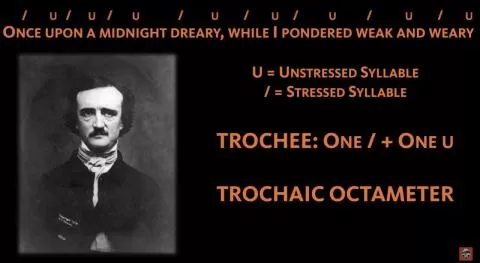 trochaic octameter
The opening line of “The Raven”—”Once upon a midnight dreary”—demonstrates the trochaic rhythm. This pattern contributes to the poem’s haunting atmosphere.
Anapest (da da DUM)
An anapest consists of two unstressed syllables followed by a stressed syllable. This foot creates a faster, more lively rhythm.
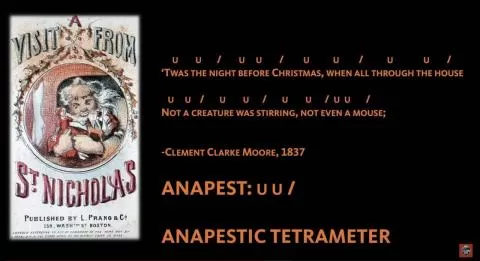 anapestic tetrameter
Clement Clarke Moore’s “A Visit from St. Nicholas” (“Twas the NIGHT before CHRISTmas”) uses anapestic tetrameter (four anapests per line), adding to the poem’s playful and energetic feel.
Dactyl (DUM da da)
A dactyl is the opposite of an anapest – a stressed syllable followed by two unstressed syllables. While less common in English poetry, dactyls appear in classical Greek poetry and some English works influenced by it.
 dactylic hexameter
Henry Wadsworth Longfellow’s “Evangeline” (“This is the FORest priMEval”) demonstrates dactylic hexameter. Interestingly, this meter has also found its way into modern music, particularly in certain rap verses.
 Dactyl Meter 2
Metrical Variations and Interpretations
While poems often adhere to a dominant meter, variations can occur. These deviations from the established pattern are not accidental. Poets often use metrical variations to emphasize specific words or phrases, create dramatic effect, or signal a shift in tone or meaning.
 Paradise Lost opening Lines
Identifying these variations and analyzing their potential significance adds another layer to our understanding of the poem. For instance, a sudden shift from iambic pentameter to a trochaic foot might highlight a moment of emotional intensity or a crucial turning point in the narrative.
Conclusion
Understanding metrical poetry allows us to appreciate the artistry and craftsmanship behind the words. By recognizing different metrical feet and observing how poets utilize them, we can gain a deeper understanding of a poem’s rhythm, flow, and ultimately, its meaning. Metrical analysis allows us to move beyond simply reading the words on the page and experience the full sonic and emotional depth that poetry offers.