
Falling in love can be a messy, complicated, and often illogical experience. Diane Seuss’s poem “Romantic Poet” captures this beautifully, using the unlikely figure of John Keats to explore the contradictions inherent in romantic love. This analysis delves into the poem’s layered meaning, examining its clever use of language, imagery, and allusion to illuminate the enduring power of poetry and the often-conflicted nature of love itself.
Contents
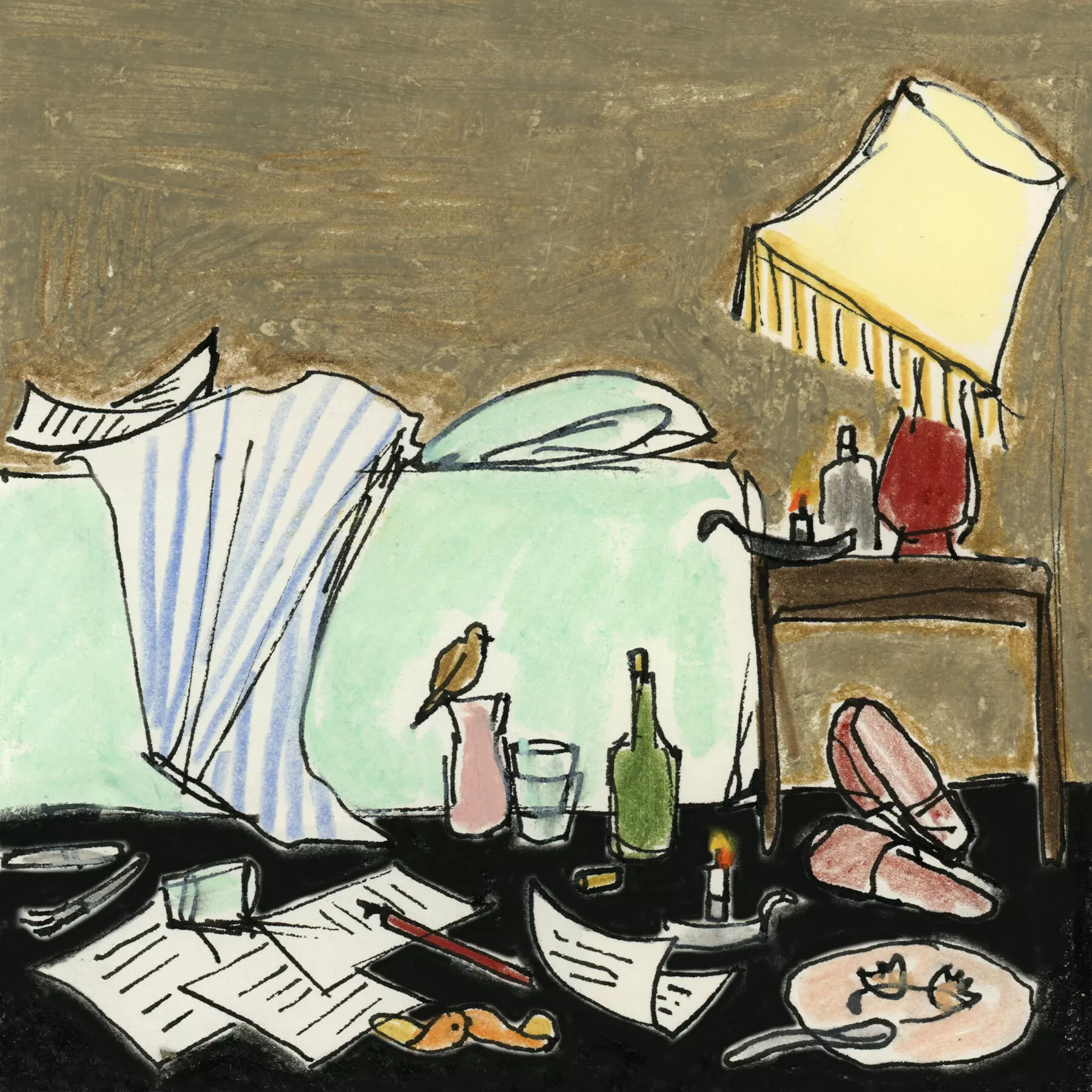 An illustration depicting an unmade bed, surrounded by empty bottles, upturned glasses and lit candles. A small brown bird perches on a vase in the foreground.
Seuss’s poem begins with a conversation, a debate between the speaker and a scholar about the romantic appeal of a certain “Romantic Poet.” The scholar presents a compelling case against romantic interest, citing the poet’s less-than-desirable hygiene habits and, oh yes, the fact that he’s deceased.
Romantic Poet by Diane Seuss

You would not have loved him,
my friend the scholar
decried. He brushed his teeth,
if at all, with salt. He lied,
and rarely washed
his hair. Wiped his ass
with leaves or with his hand.
The top of his head would have barely
reached your tits. His pits
reeked, as did his deathbed.

But the nightingale, I said.
The scholar’s argument is grounded in the mundane realities of human existence. This juxtaposition of the idealized Romantic poet with the gritty details of his life creates a humorous and thought-provoking tension. The poem’s language mirrors this contrast, shifting from the scholar’s blunt, almost crude descriptions to the speaker’s evocative final line: “But the nightingale, I said.” This single line, referencing Keats’s famous “Ode to a Nightingale,” acts as a powerful counterpoint.
The Nightingale’s Song: Transcending the Mundane
The allusion to the nightingale is crucial to understanding the poem’s deeper meaning. It represents the transformative power of art, the ability of poetry to transcend the messy realities of life and create something beautiful and enduring. The nightingale’s song, both in Keats’s poem and in Seuss’s, becomes a symbol of this transcendent power. It represents the beauty and truth that Keats sought in his work, a beauty that persists even after the poet himself is gone.
 Black-and-white image of a young man’s head, as he reclines, eyes closed.
Seuss isn’t simply defending Keats’s poetic genius; she’s exploring the complex nature of love itself. The love for a poet, or for any artist, is often intertwined with a love for their work. We fall in love with the art, with the emotions it evokes, with the worlds it creates. This love can be just as powerful, just as messy, and just as illogical as any other kind of love.
The Romance of Poetry: Finding Beauty in Imperfection
Seuss’s “Romantic Poet” is itself a testament to the romantic power of poetry. The poem’s seemingly unromantic language, with its blunt descriptions and colloquialisms, ultimately creates a unique and compelling rhythm. The scattered rhymes and near-rhymes, like spilled jewels, create a sense of controlled chaos that mirrors the emotional turmoil of love.
Seuss’s poem reminds us that love, in all its forms, is rarely neat and tidy. It can be messy, contradictory, and often illogical. But it is in these imperfections that we often find the most profound beauty and truth. Just as Keats found beauty in the song of the nightingale, Seuss finds beauty in the flawed, human reality of Keats himself, and in the enduring power of his poetry. And through her own poetry, she invites us to do the same. To embrace the messy, the imperfect, and the illogical, and to find within them the seeds of true romance.