
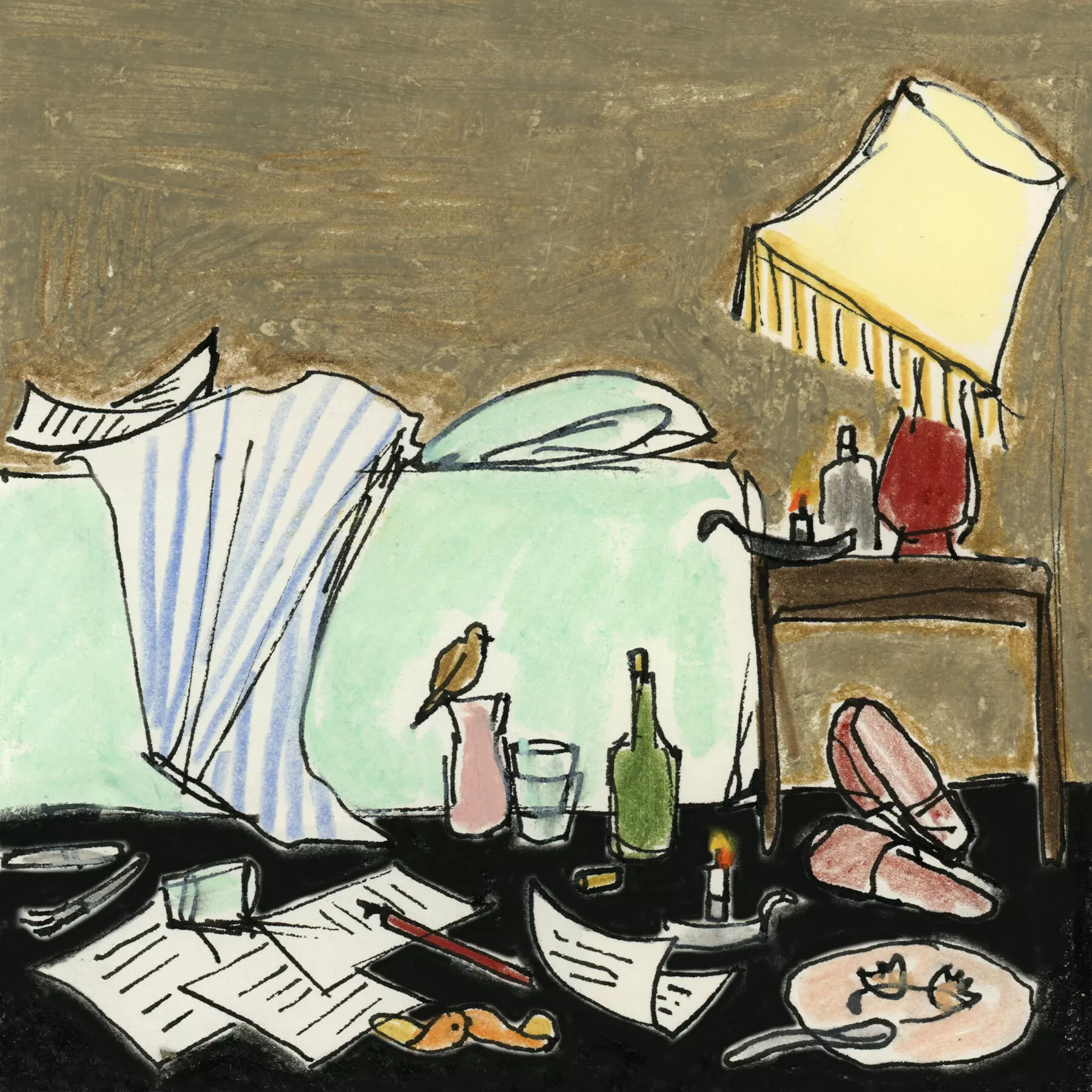
 An illustration depicting an unmade bed, surrounded by empty bottles, upturned glasses and lit candles. A small brown bird perches on a vase in the foreground.
Contents
Love in a poem can take many forms. It can be a celebration of beauty, a lament for loss, or an exploration of the complex emotions that bind us together. In Diane Seuss’s “Romantic Poet,” love becomes a fascinating interplay between idealized romanticism and the messy realities of human existence. This poem, through its witty dialogue and clever allusions, invites us to examine how we perceive love, both in poetry and in life.
The Scholar’s Argument: Debunking Romantic Ideals
Seuss’s poem begins with a conversation between the speaker and a scholar, who decries the speaker’s apparent infatuation with a “Romantic Poet.” The scholar presents a decidedly unromantic portrait of this poet:
You would not have loved him,
my friend the scholar
decried. He brushed his teeth,
if at all, with salt. He lied,
and rarely washed
his hair. Wiped his ass
with leaves or with his hand.
The top of his head would have barely
reached your tits. His pits
reeked, as did his deathbed.
This unflattering depiction, filled with mundane details of poor hygiene and physical shortcomings, serves to challenge the romanticized image of the poet. The scholar’s argument highlights the disconnect between the idealized image of a beloved figure and the often-unpleasant realities of their human existence. The scholar’s blunt language, starkly contrasting with the lyrical language typically associated with romantic poetry, emphasizes the absurdity of romanticizing flawed individuals.
The Nightingale Sings: A Love for the Art, Not the Artist?
The speaker’s response to the scholar’s critique is a simple, yet powerful, allusion:
But the nightingale, I said.This single line evokes John Keats’s “Ode to a Nightingale,” immediately identifying the “Romantic Poet” as Keats himself. The nightingale, a symbol of beauty and artistic inspiration, becomes the speaker’s defense of their love for Keats. This seemingly dismissive reply suggests that the love being discussed is not a romantic love for Keats the man, but rather an appreciation for his artistic genius.
 Black-and-white image of a young man’s head, as he reclines, eyes closed.
A Deeper Look at Love in a Poem: Beyond Idealization
Seuss’s “Romantic Poet” doesn’t simply offer a witty commentary on the contrast between artistic ideals and biographical realities. The poem’s subtle wordplay and lack of capitalization and quotation marks around “the nightingale” suggest a more nuanced interpretation. The nightingale becomes not just a reference to Keats’s poem, but also a symbol of the enduring power of art to transcend the flaws of its creator. The poem compels us to question whether love in a poem, and in life, can truly exist separate from the object of affection. Is it possible to love the art without considering the artist? Seuss implies that the two are inextricably linked, even if the connection is complex and sometimes uncomfortable.
The Romantic Power of Language
Seuss’s own poetic skill is evident in the construction of “Romantic Poet.” The seemingly prosaic language of the scholar’s critique is infused with subtle rhymes and rhythms, revealing the romantic potential even within mundane details. This deliberate crafting of language demonstrates how poetry can transform the ordinary into something extraordinary. The poem’s final, succinct line acts as both a punchline and a profound statement about the enduring power of art and the complexities of love. “Romantic Poet” is a testament to the ability of poetry to explore the multifaceted nature of love, offering a perspective that goes beyond simple idealization and embraces the messy realities of human experience.