
Charles Baudelaire’s Les Fleurs du Mal (The Flowers of Evil), first published in 1857, remains one of the most pivotal and controversial works in literary history. Beyond its infamous trial for obscenity, the collection’s enduring power lies in its title and the complex tapestry of meaning it weaves. To truly grasp the “fleur du mal meaning,” one must delve into Baudelaire’s revolutionary approach to poetry and his unflinching gaze upon the human condition and the modern world.
The very phrase “Fleurs du Mal” presents a stark paradox. Flowers are traditionally symbols of beauty, nature, love, and purity. “Evil” (mal) evokes corruption, sin, suffering, and decay. Juxtaposing these terms immediately signals Baudelaire’s intent: to find and express beauty, art, and perhaps even a twisted form of salvation or transcendence, not in the idealized realms of nature or traditional romance, but within the depths of depravity, urban squalor, moral corruption, and existential despair. It suggests that beauty can bloom from the most unlikely, even repulsive, soil.
This challenging title set Baudelaire apart from his Romantic predecessors, who often sought solace and inspiration in nature. Baudelaire instead found his muse in the burgeoning, often ugly, reality of 19th-century Paris – its crowds, its artificiality, its poverty, its fleeting moments of intense sensation. The “flowers” he cultivates are not plucked from idyllic gardens but are strange, potent, and sometimes poisonous blossoms grown in the hothouse of urban alienation and spiritual struggle.
The book’s structure is not merely a random assortment of poems but a deliberate journey charting the poet’s tumultuous inner life and his exploration of the modern world. It opens with a prologue, “Au Lecteur” (To the Reader), which immediately implicates the reader in the poet’s struggle, ending with the provocative line, “– Hypocrite lecteur, – mon semblable, – mon frère!” (“– Hypocrite reader, – kindred spirit, – brother!”). This sets the stage for a shared exploration of the darker aspects of existence, suggesting that the “evil” he depicts is not just his own but resides within all of us.
The longest and most central section, “Spleen et Idéal” (Spleen and the Ideal), perfectly embodies the collection’s core “fleur du mal meaning.” It documents the poet’s oscillation between moments of ecstatic vision, spiritual aspiration (the “Ideal”), and crushing despair, ennui, and existential nausea (the “Spleen”). Poems in this section range from soaring hymns to beauty to suffocating depictions of melancholy and paralysis. This duality is fundamental to Baudelaire’s vision: the constant tension between the pull upwards towards the sublime and the drag downwards into the abyss of modern life and inner torment.
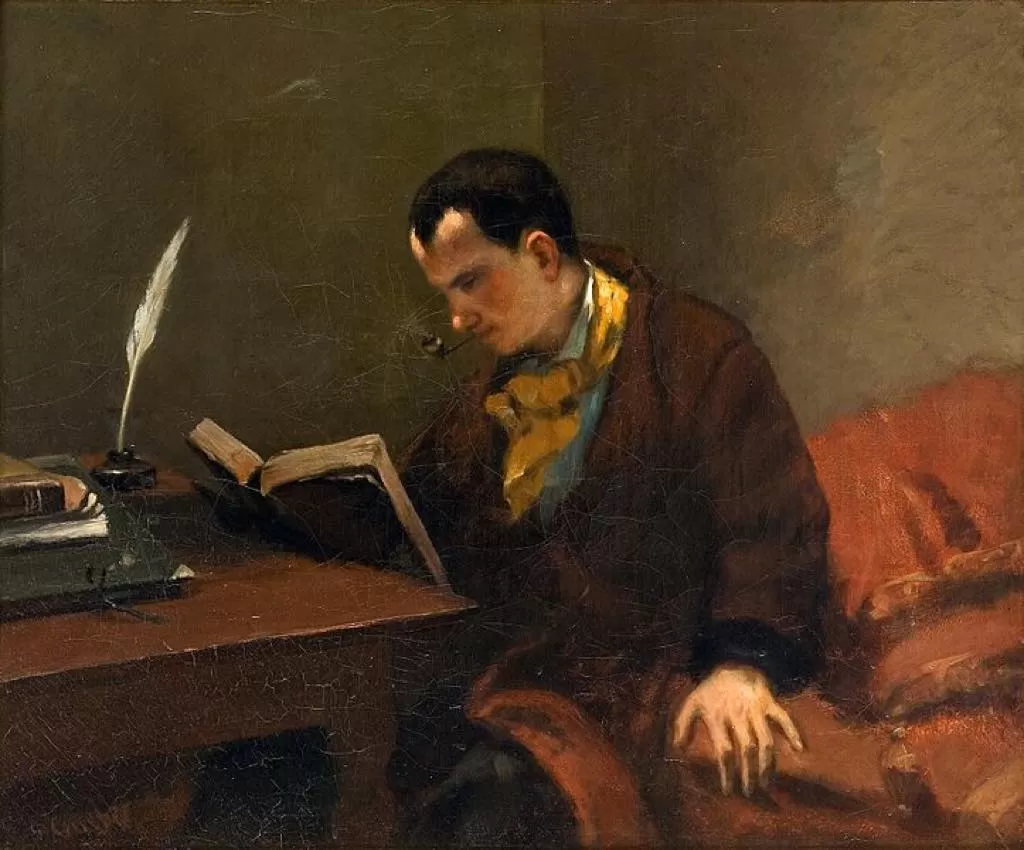
Gustave Courbet’s portrait of Charles Baudelaire, reflecting the intense gaze of the poet behind Les Fleurs du Mal.
Following this internal battle, the “Tableaux Parisiens” (Parisian Scenes) section grounds the struggle in the external reality of the city. Here, the “flowers of evil” bloom amidst the transformation and grime of Paris undergoing Haussmann’s renovations. Baudelaire finds poetic potential in the anonymity of the crowd, the fleeting encounters, the beggars, the old women, and even the animals displaced by urban change. The poem “Le Cygne” (The Swan) is a powerful example, depicting a swan struggling awkwardly on dry pavement – a symbol of exile, loss, and incongruous beauty within the urban sprawl. Baudelaire elevates these mundane or even ugly scenes to the level of high art, fulfilling the promise of his title.
The remaining sections, “Le Vin” (Wine), “Fleurs du Mal” (Flowers of Evil – a smaller section within the larger volume), “Révolte” (Revolt), and “La Mort” (Death), explore different facets of escaping or confronting the “Spleen” – through artificial paradises (wine, drugs), transgressive loves that defy societal norms (captured in the section also titled “Fleurs du Mal,” focusing on forbidden desires), rebellion against God and convention, and finally, the ultimate unknown of death.
A particularly stark example of the collection’s exploration of evil and decay comes from the “Fleurs du Mal” section (the smaller one): “Un Voyage à Cythère” (A Voyage to Cythera). What begins as a hopeful journey to the mythical island of love transforms into a horrific vision of a decaying corpse, mirroring the poet’s own internal corruption and self-disgust. The concluding lines:
– Ah! Seigneur! donnez-moi la force et le courage
De contempler mon cœur et mon corps sans dégoût !
(Oh Lord! give me the strength and the courage
To contemplate my body and my soul without disgust!)
reveal the spiritual anguish and the search for strength even in the face of utter despair. The meaning here is that evil and decay are not just external forces but are deeply intertwined with the self.
Ultimately, the “fleur du mal meaning” encapsulates Baudelaire’s revolutionary aesthetic: the assertion that poetry must engage with the totality of modern experience, including its most degraded and painful aspects. He sought a new kind of beauty, one that acknowledged suffering, sin, and the artificiality of the city. The flowers blooming from evil are the poems themselves – works of art that transform the base, the ugly, and the morally questionable into something potent, significant, and strangely beautiful.
Baudelaire’s work had a profound impact on subsequent literature, influencing poets like Arthur Rimbaud and Stéphane Mallarmé. His exploration of the city, consciousness, and the darker side of human nature paved the way for modern poetry. Understanding Les Fleurs du Mal means accepting Baudelaire’s invitation to confront the contradictions of existence and to recognize the strange, compelling beauty that can indeed bloom from the soil of evil and decay. Just as Victor Hugo poems often grapple with societal issues and the human spirit, Baudelaire turns his piercing gaze inward and onto the modern urban landscape, finding a new, unsettling form of poetic truth. The collection concludes not with salvation or damnation, but with a leap into the unknown, embracing novelty regardless of the outcome, echoing the spirit of audacious exploration that defines the entire work.
The title page of Charles Baudelaire’s controversial poetry collection, Les Fleurs du Mal.
In essence, the “fleur du mal meaning” is Baudelaire’s declaration that art can, and must, confront the totality of life, finding transformative beauty and profound meaning even in the places we least expect – in the shadows, the suffering, and the moral complexity of the modern soul and the modern city. It is a testament to the power of poetry to distill something potent and lasting from the transient and the terrible. Like many influential poets, including the author of celebrated poems Victor Hugo, Baudelaire used verse to dissect the world around him and the turbulent world within. Through his challenging title and the poems it contains, he cultivated a garden of dark, mesmerizing flowers that continue to fascinate and provoke readers today. His legacy, much like the lasting appeal of Victor Hugo poems, lies in his fearless engagement with the human condition in all its messy, contradictory glory.