
Haiku, a form rooted in 17th-century Japanese poetry, stands as a testament to the power of brevity and imagery. Renowned for its concise structure, traditionally consisting of three lines with a 5, 7, 5 syllable count, haiku aims to capture a fleeting moment, often drawing inspiration from the natural world. Yet, beyond this classic form lies a vibrant evolution, with modern poets exploring new structures and themes while retaining the essence of sharp observation and emotional resonance. Understanding haiku is not just about counting syllables; it’s about learning to see the world through a poet’s minimalist lens, finding profound depth in simple juxtapositions and evocative images. In this article, we delve into the rich world of haiku by examining some examples of classic and modern poems, offering insights into their structure, imagery, and enduring appeal. We’ll look at foundational works by the Japanese masters and explore how the form has been adapted and reinterpreted across cultures and centuries, providing a window into the diverse ways poets have used this miniature canvas. For those exploring various forms of poetry, haiku offers a unique perspective, demonstrating how constraints can foster creativity and how a few carefully chosen words can paint a vast emotional landscape. You can find more examples of poetry forms on Latrespace.
Contents
- The Foundations: Masters of Japanese Haiku
- Matsuo Bashō: The Quiet Profundity
- Yosa Buson: Lyrical Imagery
- Kobayashi Issa: Empathy and the Everyday
- Masaoka Shiki: Directness and Realism
- Haiku in English: Modern Adaptations
- Ezra Pound: Imagism
- Richard Brautigan: Playful Subversion
- Contemporary Voices
- Thematic Depths in Haiku
- Nature’s Mirror
- The Human Condition
- The Power of the Moment
- Conclusion
The Foundations: Masters of Japanese Haiku
The bedrock of haiku tradition lies with four undisputed masters: Matsuo Bashō, Yosa Buson, Kobayashi Issa, and Masaoka Shiki. Their works established the form’s connection to nature (kigo – season word) and its focus on a moment of insight or juxtaposition (kiru – cutting word).
Matsuo Bashō: The Quiet Profundity
Matsuo Bashō (1644–1694) is arguably the most famous haiku poet. His work embodies sabi (loneliness, rustic simplicity) and wabi (refined solitude). His poems often create a sense of profound quietude and connection with the natural world.
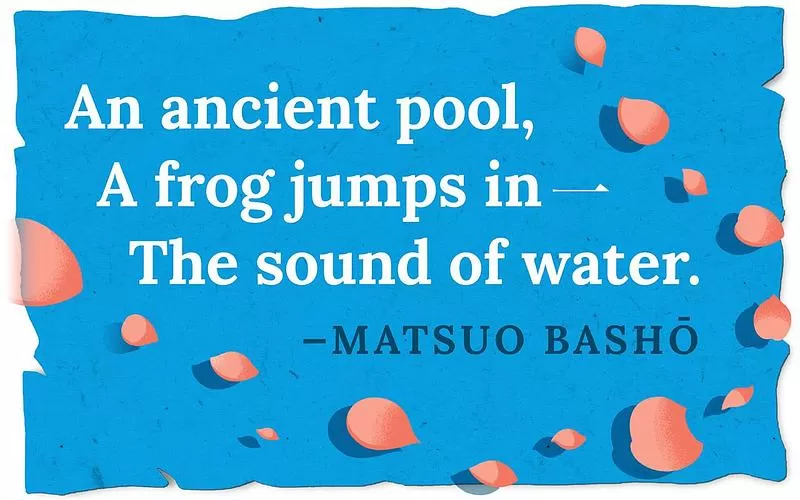
“The Old Pond”
An old silent pond…
A frog jumps into the pond,
splash! Silence again.
This is perhaps the most famous haiku globally. Bashō captures a moment of sudden sound (the frog jumping) disrupting and then returning to an ancient silence. The juxtaposition of the eternal stillness of the pond with the momentary action of the frog evokes a feeling of timelessness within a fleeting event. The sound itself (kawazu tobikomu mizu no oto – frog jumps in, water’s sound) acts as the cutting word, creating the turn or shift in perspective.
 An old silent pond with a frog jumping into the water.An old silent pond with a frog jumping into the water, illustrating Basho’s famous haiku.
“The first soft snow:”
The first soft snow:
leaves of the awed jonquil
bow low
Here, Bashō personifies the jonquil leaves, portraying them as “awed” by the arrival of the first snow. Their bowing is a gesture of reverence or surrender to the power and beauty of nature’s transformation. It’s a delicate image, capturing the subtle shift in a winter landscape and the quiet respect it inspires in the smallest elements.
“A caterpillar,”
A caterpillar,
this deep in fall –
still not a butterfly.
This haiku captures a feeling of anticipation or unrealized potential. Observing a caterpillar late in the season, Bashō notes its state of arrested development. The “deep in fall” context adds a layer of melancholy, suggesting time is running out for transformation, mirroring perhaps human struggles with growth or delay.
Yosa Buson: Lyrical Imagery
Yosa Buson (1716–1784) was also a renowned painter, and his haiku often display a painterly quality, rich in visual and sensory detail. His style is considered more lyrical and sensuous than Bashō’s.
“The light of a candle”
The light of a candle
Is transferred to another candle —
spring twilight.
Buson presents a beautiful image of light propagation, subtly linking it to the softness of spring twilight. The act of lighting one candle from another without diminishing the source can be interpreted in various ways – perhaps as sharing knowledge, love, or simply depicting a common, quiet evening scene illuminated gently. The “spring twilight” adds a specific seasonal and temporal mood.
“In the moonlight”
In pale moonlight
the wisteria’s scent
comes from far away.
This haiku masterfully blends visual (pale moonlight) and olfactory (wisteria’s scent) senses. The fact that the scent comes “from far away” adds a layer of mystery and longing, inviting the reader to imagine an unseen source and perhaps evoking memories or a sense of distance and beauty.
Kobayashi Issa: Empathy and the Everyday
Kobayashi Issa (1763–1828) often wrote from a perspective of empathy for the small and the less fortunate, perhaps stemming from his own difficult life. His haiku often feature insects, animals, and the struggles of common people, imbued with a personal and often poignant tone.
“A World of Dew”
This world of dew
is a world of dew,
and yet, and yet.
Written shortly after the death of his daughter, this deeply emotional haiku reflects on the ephemeral nature of life (likened to dew, which quickly vanishes). The repetition “world of dew is a world of dew” emphasizes this fragility and reality. The “and yet, and yet” introduces a powerful, unresolved yearning – a lament, a questioning, a refusal to fully accept the transient sorrow.
“O snail”
O snail
Climb Mount Fuji,
But slowly, slowly!
Issa addresses a snail directly, offering gentle encouragement for an immense task (climbing Japan’s tallest mountain). The repetition “slowly, slowly!” highlights the snail’s natural pace, creating a sense of tender patience and perhaps offering a metaphor for tackling life’s challenges one step at a time, without rushing. It’s a moment of quiet observation filled with warmth for a small creature.
“Even in Kyoto,”
Even in Kyoto,
Hearing the cuckoo’s cry,
I long for Kyoto
This haiku expresses a feeling of nostalgic longing, even while being in the place one supposedly longs for. The cuckoo’s cry, often associated with spring and home, triggers a memory or feeling for a past experience of Kyoto, showing how places can hold multiple layers of meaning and how the present can evoke a longing for a past within the same location. It’s a poignant reflection on memory and presence. While not typically focused on romantic themes, this sense of longing can resonate with emotions explored in short romantic poems.
Masaoka Shiki: Directness and Realism
Masaoka Shiki (1867–1902), the last of the four masters, advocated for realism and objectivity in haiku, moving away from some of the philosophical or deeply personal tones of his predecessors. Suffering from tuberculosis for years, his poems often capture details of his confined life and observations of the natural world with clarity and directness.
“I want to sleep”
I want to sleep
Swat the flies
Softly, please.
This haiku vividly portrays the weary state of the speaker (likely Shiki himself during his illness). The simple desire for sleep is interrupted by the mundane annoyance of flies. The plea “Softly, please” adds a layer of vulnerability and gentleness, highlighting his fatigue and perhaps his sensitivity to the world around him, even in his weakened state.
“After Killing a Spider”
After killing
a spider, how lonely I feel
in the cold of night!
Shiki captures a moment of unexpected remorse. The act of killing a small creature leads to a feeling of profound loneliness. The “cold of night” amplifies this isolation, suggesting that even minor actions can have significant emotional repercussions, particularly when one is already in a state of solitude. The break after “killing” emphasizes the weight of the act.
Haiku in English: Modern Adaptations
While the 5-7-5 syllable structure is a common guideline, many modern English-language haiku poets prioritize the form’s spirit – its focus on a specific moment, sensory imagery, and juxtaposition – over strict adherence to syllable count, which doesn’t translate perfectly across languages.
Ezra Pound: Imagism
Ezra Pound’s (1885–1972) famous poem, though slightly longer than a traditional haiku, is a key example of Imagism, heavily influenced by haiku’s conciseness and focus on vivid images.
“In a Station of the Metro”
The apparition of these faces
in the crowd;
Petals on a wet, black bough.
Pound presents two stark images: faces appearing in a subway crowd and petals clinging to a dark branch. The semi-colon acts as the cutting device, juxtaposing these two seemingly disparate visuals. The comparison suggests the fleeting, delicate beauty of human faces glimpsed in a transient urban setting, likening them to fragile petals on a bough, highlighting their momentary appearance against a darker, more enduring background.
Richard Brautigan: Playful Subversion
Richard Brautigan (1935–1984) often played with traditional forms, injecting humor and postmodern sensibilities.
“Haiku Ambulance”
A piece of green pepper
fell
off the wooden salad bowl:
so what?
Brautigan deliberately breaks the traditional haiku structure (both syllable count and lines) and tone. He captures a trivial, ordinary event and then dismisses its significance with a deadpan “so what?”. It’s a humorous subversion of the form’s typical search for profundity in the small, suggesting perhaps a deliberate anti-poetic stance or a comment on finding meaning (or lack thereof) in everyday occurrences. For those who enjoy witty or unexpected verse, this might appeal alongside short poems that are funny.
Contemporary Voices
Many contemporary poets continue to write haiku in English, exploring diverse themes and styles while keeping the core principles of the form alive.
“Just friends:” by Alexis Rotella
Just friends:
he watches my gauze dress
blowing on the line.
This haiku by Alexis Rotella captures a moment of unspoken tension and desire within a friendship. The opening “Just friends:” sets the context, immediately creating a sense of limitation. The image of the dress “blowing on the line” is ordinary yet carries sensual undertones (gauze, blowing, hinting at form). The juxtaposition creates a poignant feeling of potential longing or unexpressed emotion observed from a distance, confined within the boundary of “just friends.”
“losing its name” by John Sandbach
losing its name
a river
enters the sea
This simple yet profound haiku uses a natural image to explore themes of identity, merging, and loss. As a river flows into the vast sea, it ceases to be a distinct river, “losing its name.” It becomes part of something much larger. This can be interpreted as a metaphor for joining a collective, achieving spiritual unity, or perhaps even the process of death and merging back into the elements.
These are just some examples of haiku poems that demonstrate the form’s versatility and enduring appeal. From capturing the quiet dignity of nature to reflecting on the complexities of human emotion and existence, haiku continues to offer poets a powerful means of expression through economy and evocative imagery. Exploring these poems reveals that haiku is much more than a strict syllable count; it is a way of perceiving and articulating the world in crystalline moments. You can explore more popular haiku poems to deepen your understanding.
Thematic Depths in Haiku
While nature is a dominant theme, haiku also explores a wide range of human experiences.
Nature’s Mirror
Nature in haiku is rarely just descriptive; it often serves as a mirror for human emotion or a backdrop for philosophical reflection. The changing seasons, animals, landscapes – all become symbols or participants in the fleeting moments captured by the poet. Basho’s pond and frog, Buson’s wisteria, Issa’s snail and cherry blossoms, Shiki’s spider and flies – all highlight how the external natural world interacts with internal human perception and feeling.
The Human Condition
Many haiku, especially modern ones, touch upon the human condition – loneliness, longing, regret, observation of social dynamics, or existential thoughts. Issa’s poem on loss, Shiki’s on loneliness after killing a spider, Rotella’s on unexpressed desire, and Sandbach’s on merging identity show that haiku can be a vehicle for deep personal and philosophical inquiry, using the brevity of the form to deliver a powerful emotional punch.
The Power of the Moment
Ultimately, haiku excels at capturing a specific, often everyday, moment and imbuing it with significance. Whether it’s the splash in a pond, the scent on the wind, the sight of snow on leaves, or a glance at one’s reflection, haiku trains the reader to find the extraordinary within the ordinary, encouraging mindfulness and appreciation for the present.
Conclusion
Through these some examples of haiku poems, we’ve seen how this deceptively simple form can encapsulate vast worlds of meaning and emotion. From the classic observations of Japanese masters rooted in nature and spiritual reflection to the diverse and often experimental explorations by modern poets writing in English, haiku remains a vibrant and relevant poetic form. Its power lies in its conciseness, its reliance on vivid imagery, and its ability to create a resonant moment for the reader. Whether you are new to poetry or a seasoned enthusiast, exploring haiku offers a unique path to appreciating the beauty and depth that can be conveyed with just a few carefully chosen words. We encourage you to read more haiku, perhaps even try writing your own, and discover the profound insights that can bloom from this miniature art form.