
Love, in its myriad forms, has been an inexhaustible wellspring for poets across centuries and cultures. From the first blush of attraction to the quiet comfort of enduring companionship, the experience of loving and being loved finds its most resonant expression in verse. Poems for love capture the ineffable – the flutter of a heart, the ache of longing, the deep connection that binds two souls. They offer us language when our own fails, solace in heartbreak, and celebration in union.
Contents
- A Tapestry of Love’s Expressions: 65 Poems for Love
- 1. “Come, And Be My Baby” by Maya Angelou
- 2. “Bird-Understander” by Craig Arnold
- 3. “Habitation” by Margaret Atwood
- 4. “Variations on the Word Love” by Margaret Atwood
- 5. “The More Loving One” by W.H. Auden
- 6. “To My Dear and Loving Husband” by Anne Bradstreet
- 7. “Always For The First Time” by André Breton
- 8. “Love and Friendship” by Emily Brontë
- 9. “To Be In Love” by Gwendolyn Brooks
- 10. “How Do I Love Thee? (Sonnet 43)” by Elizabeth Barrett Browning
- 11. “A Red, Red Rose” by Robert Burns
- 12. “She Walks in Beauty” by Lord Byron
- 13. “Love is a fire that burns unseen” by Luís Vaz de Camões
- 14. “Beautiful Signor” by Cyrus Cassells
- 15. “Rondel of Merciless Beauty” by Geoffrey Chaucer
- 16. “Love Comes Quietly” by Robert Creeley
- 17. “[i carry your heart with me(i carry it in]” by E. E. Cummings
- 18. “[love is more thicker than forget]” by E.E. Cummings
- 19. “Sthandwa sami (my beloved, isiZulu)” by Yrsa Daley-Ward
- 20. “Married Love” by Guan Daosheng
- 21. “Heart, we will forget him!” by Emily Dickinson
- 22. “Air and Angels” by John Donne
- 23. “Flirtation” by Rita Dove
- 24. “Heart to Heart” by Rita Dove
- 25. “Love” by Carol Ann Duffy
- 26. “The Love Poem” by Carol Ann Duffy
- 27. “Before You Came” by Faiz Ahmed Faiz
- 28. “Lines Depicting Simple Happiness” by Peter Gizzi
- 29. “Six Sonnets: Crossing the West” by Janice Gould
- 30. “For Keeps” by Joy Harjo
- 31. “You Are the Penultimate Love of My Life” by Rebecca Hazelton
- 32. “Yours” by Daniel Hoffman
- 33. “A Love Song for Lucinda” by Langston Hughes
- 34. “Poem for My Love” by June Jordan
- 35. “for him” by Rupi Kaur
- 36. Untitled by Rupi Kaur
- 37. “Poem To An Unnameable Man” by Dorothea Lasky
- 38. “Movement Song” by Audre Lorde
- 39. “Camomile Tea” by Katherine Mansfield
- 40. “Love Elegy in the Chinese Garden, with Koi” by Nathan McClain
- 41. “I think I should have loved you presently (Sonnet IX)” by Edna St. Vincent Millay
- 42. “Love Sonnet XI” by Pablo Neruda
- 43. “Your Feet” by Pablo Neruda
- 44. “Dear One Absent This Long While” by Lisa Olstein
- 45. “My Lover Is a Woman” by Pat Parker
- 46. “It Is Here” by Harold Pinter
- 47. “Untitled” by Christopher Poindexter
- 48. “Love Is Not A Word” by Riyas Qurana
- 49. “[Again and again, even though we know love’s landscape]” by Rainer Maria Rilke
- 50. “Echo” by Christina Rossetti
- 51. “I loved you first: but afterwards your love” by Christina Rossetti
- 52. “Defeated by Love” by Rumi
- 53. “Shall I compare thee to a summer’s day? (Sonnet 18)” by William Shakespeare
- 54. “Let me not to the marriage of true minds (Sonnet 116)” by William Shakespeare
- 55. “My mistress’ eyes are nothing like the sun” (Sonnet 130) by William Shakespeare
- 56. “Love’s Philosophy” by Percy Bysshe Shelley
- 57. “One Day I Wrote her Name (Sonnet 75)” by Edmund Spenser
- 58. “I Am Not Yours” by Sara Teasdale
- 59. “Now Sleeps the Crimson Petal” by Alfred, Lord Tennyson
- 60. “poem I wrote sitting across the table from you” by Kevin Varrone
- 61. “On Earth We’re Briefly Gorgeous” by Ocean Vuong
- 62. “Love After Love” by Derek Walcott
- 63. “I Love You” by Ella Wheeler Wilcox
- 64. “We Have Not Long to Love” by Tennessee Williams
- 65. “Poem to First Love” by Matthew Yeager
- The Lasting Power of Poems for Love
At Latrespace, where words bloom into poetry, we understand the power of these verses. We’ve curated a collection of 65 profound poems for love, exploring the diverse ways poets have attempted to articulate this most fundamental human emotion. From classical sonnets to modern free verse, these works delve into the passion, vulnerability, joy, and sometimes, pain, inherent in love, offering readers deep insights and emotional connection.
A Tapestry of Love’s Expressions: 65 Poems for Love
Poetry provides a unique lens through which to view the complexity of love. It allows for abstraction, intense emotion, and vivid imagery, often revealing truths that prose might miss. Here, we explore a selection of these timeless and compelling poems for love.
1. “Come, And Be My Baby” by Maya Angelou
Maya Angelou, a voice of immense power and grace, offers in “Come, And Be My Baby” a simple yet profound portrayal of love as a refuge. Amidst the chaos and overwhelming nature of modern existence, the poem suggests that love offers a sanctuary, a place of quiet intimacy and comfort. Angelou uses accessible language to capture the feeling of finding peace and grounding in another person’s presence, even if just for a fleeting moment. It highlights love not as grand gesture, but as a necessary respite from the world’s clamor.
 Woman reading a book in a sunlit room, symbolizing finding comfort in words and poetry
2. “Bird-Understander” by Craig Arnold
Craig Arnold’s “Bird-Understander” is a testament to the transformative power of vulnerability and shared experience within a relationship. The poem recounts a moment where the speaker witnesses their partner’s unique way of perceiving and articulating hurt, offering their own words back as confirmation of their value. The act of “giving them back” emphasizes validation and understanding. The concluding lines powerfully assert the significance of these seemingly simple observations, highlighting how a partner’s way of seeing the world, even its pain, can deepen love and reveal profound worth, countering any sense of uselessness.
3. “Habitation” by Margaret Atwood
Known for her sharp observations, Margaret Atwood’s “Habitation” tackles the realities of long-term love, specifically marriage, with striking candor. Set against the stark image of a receding glacier’s edge, the poem acknowledges that relationships require work and endurance. The act of “squat[ting] outside, eating popcorn” suggests simple, shared moments, while the painful wonder of “having survived even / this far” underscores the challenges overcome. The closing line, “we are learning to make fire,” serves as a powerful metaphor for the ongoing effort required to generate warmth, intimacy, and survival in a relationship, making this one of the more realistic and beautiful poems for love’s long haul.
4. “Variations on the Word Love” by Margaret Atwood
Margaret Atwood’s “Variations on the Word Love” is a compelling exploration of the multifaceted nature of love itself. Instead of offering a single definition, Atwood dissects the word, revealing its capacity for expressing not just passion and tenderness, but also less romantic forms like obsession or manipulation. By laying bare these different “variations,” the poem prompts readers to consider the complex and sometimes contradictory meanings we assign to love, demonstrating poetry’s ability to analyze and reveal the nuances within even a single word, making it a fascinating piece among poems for love.
5. “The More Loving One” by W.H. Auden
W.H. Auden’s “The More Loving One” is a poignant exploration of unrequited or disproportionate love and the dignity found in being the one who loves more. Using the celestial metaphor of stars disappearing, Auden contemplates facing an “empty sky” – the absence of the beloved. Despite the inherent pain and the time it would take to adjust (“Though this might take me a little time”), the speaker asserts a preference for being the one who loves more, suggesting a certain strength or richness in the capacity to love deeply, even when that love isn’t fully returned. This poem offers a sophisticated perspective on love’s challenges.
Were all stars to disappear or die,
I should learn to look at an empty sky
And feel its total dark sublime,
Though this might take me a little time.
For those seeking verses that delve into the depth of personal connection, exploring themes of care and affection for a partner, consider exploring some care poems for her.
6. “To My Dear and Loving Husband” by Anne Bradstreet
Anne Bradstreet’s “To My Dear and Loving Husband” is a powerful declaration of marital love from a Puritan perspective. While rooted in her faith, viewing marriage as a divine gift, the poem transcends its historical context through the sheer force of genuine emotion. Bradstreet expresses profound gratitude and unwavering dedication to her husband, highlighting the richness and fulfillment their love brings. The desire to “so persever” in love during life, hoping to “live ever” together in the afterlife, showcases a deep, abiding connection that feels authentic and moving even centuries later, making it a classic among poems for love.
Thy love is such I can no way repay;
The heavens reward thee manifold, I pray.
Then while we live, in love let’s so persever,
That when we live no more, we may live ever.
7. “Always For The First Time” by André Breton
André Breton, a key figure in the surrealist movement, brings a dreamlike quality to “Always For The First Time.” This poem is an ode to an anticipated lover, someone not yet met but waited for with fervent hope. The imagery, like a “silk ladder unrolled across the ivy” or leaning over a “precipice,” blurs the lines between reality and imagination, characteristic of surrealism. The “secret / Of loving you / Always for the first time” captures the surrealist ideal of perpetual wonder and renewed perception, suggesting a love that defies routine and remains perpetually fresh, even before it fully exists.
8. “Love and Friendship” by Emily Brontë
Emily Brontë, known for the intense passions of Wuthering Heights, offers a comparative study of romantic love and friendship in “Love and Friendship.” She uses natural metaphors – the romantic love as a fleeting, beautiful rose and friendship as the resilient, evergreen holly tree. This comparison highlights the transient nature often associated with passionate romance versus the steadfast, enduring quality of true friendship that can withstand the “seasons” of life. It’s a reminder that love is not solely romantic and that the deep bonds of friendship are equally valuable and worthy of poetic celebration.
 Drawing of two trees, one blooming with roses and the other an evergreen holly, symbolizing different kinds of love
9. “To Be In Love” by Gwendolyn Brooks
Gwendolyn Brooks, the first African-American Pulitzer Prize winner, brings her characteristic insight into human experience to “To Be In Love.” The poem explores the subtle yet profound ways that love transforms an individual and their perception of the world. Phrases like “to touch with a lighter hand” and stretching “in yourself” suggest a newfound ease, expansion, and well-being that accompanies being loved. Brooks captures the feeling of being made whole and revitalized by love, emphasizing its power to change one’s internal state and external interactions, making it a deeply personal addition to poems for love.
To be in love
Is to touch with a lighter hand.
In yourself you stretch, you are well.
10. “How Do I Love Thee? (Sonnet 43)” by Elizabeth Barrett Browning
Elizabeth Barrett Browning’s “How Do I Love Thee? (Sonnet 43)” is arguably one of the most famous and direct declarations of love in the English language. Part of her Sonnets from the Portuguese, addressed to her husband Robert Browning, this sonnet attempts to quantify the boundless nature of her affection. The speaker lists the ways she loves, reaching into the “depth and breadth and height” of her soul and linking her love to fundamental aspects of her being and purpose. Its enduring popularity lies in its ardent sincerity and comprehensive portrayal of a love that permeates every aspect of life and transcends even death.
How do I love thee? Let me count the ways.
I love thee to the depth and breadth and height
My soul can reach, when feeling out of sight
For the ends of being and ideal grace.
11. “A Red, Red Rose” by Robert Burns
Robert Burns’ “A Red, Red Rose” is a classic example of using simple, natural imagery to convey profound love. Comparing his “Luve” first to a blooming rose, then to a melody, Burns establishes a sensory connection to beauty and joy. The poem then extends the duration of his love through hyperbolic comparisons to geological and cosmological timescales (“till a’ the seas gang dry,” “till the rocks melt wi’ the sun”), culminating in a vow of love that will last “While the sands o’ life shall run.” The poem’s blend of simple comparison and grand declaration makes it a powerful and accessible poem for love.
 Illustration of a single red rose, wet with dew drops, symbolizing passionate and fresh love
12. “She Walks in Beauty” by Lord Byron
Lord Byron’s “She Walks in Beauty” diverges from his more typical themes of passionate, tumultuous romance. Instead, it focuses on the serene, inner beauty of a woman. Byron compares her beauty not just to light (“cloudless climes and starry skies”) but also to darkness (“all that’s best of dark and bright”), finding a harmonious balance in her appearance that physical perfection alone cannot achieve. The poem emphasizes the link between outer beauty and inner goodness (“A mind at peace… / A heart whose love is innocent”), suggesting that true beauty emanates from a virtuous and tranquil soul.
She walks in beauty, like the night
Of cloudless climes and starry skies;
And all that’s best of dark and bright
Meet in her aspect and her eyes;
Thus mellowed to that tender light
Which heaven to gaudy day denies.
13. “Love is a fire that burns unseen” by Luís Vaz de Camões
Luís Vaz de Camões, one of Portugal’s literary giants, offers a paradoxical and insightful definition of love in “Love is a fire that burns unseen.” Through a series of contradictions – a hidden fire, an unfelt wound, a discontent contentment, a painless rage – Camões captures the confusing, complex, and often contradictory nature of love. He presents it as a force that simultaneously brings pleasure and pain, satisfaction and longing, closeness and distance. This poem resonates because it acknowledges love’s illogical and overwhelming aspects, portraying it as a powerful, almost mystical state of being that defies simple categorization.
Love is a fire that burns unseen,
a wound that aches yet isn’t felt,
an always discontent contentment,
a pain that rages without hurting,
14. “Beautiful Signor” by Cyrus Cassells
Cyrus Cassells’ “Beautiful Signor” is a contemporary ode to a beloved, found within a collection dedicated to lovers amidst challenging times. The poem speaks of an “April-upon-April love” that persists and propels the speaker towards something “unsurpassed.” The term “dervish” and the idea of being kept “spinning” evoke a sense of ecstatic, almost spiritual motion induced by love. This love doesn’t confine but rather expands the self, guiding the speaker towards a vast, “claiming heart.” The poem finds transcendent beauty in a love that is both deeply personal and universally resonant, connecting individual passion to a larger, perhaps divine, force.
15. “Rondel of Merciless Beauty” by Geoffrey Chaucer
Geoffrey Chaucer’s “Rondel of Merciless Beauty,” translated from Middle English, expresses the exquisite pain of unrequited or lost love caused by the beloved’s overwhelming beauty. The speaker declares unwavering faithfulness (“Through life and after death you are my queen”) despite the suffering inflicted by the beloved’s indifference or departure. The intense impact of her “two great eyes” is described as a sudden, keen wound. This poem captures the medieval concept of courtly love, where the lover is often tormented by the beloved’s unattainable perfection or cruelty, making their devotion a form of beautiful martyrdom.
Upon my word, I tell you faithfully
Through life and after death you are my queen;
For with my death the whole truth shall be seen.
Your two great eyes will slay me suddenly;
Their beauty shakes me who was once serene;
Straight through my heart the wound is quick and keen.
16. “Love Comes Quietly” by Robert Creeley
Robert Creeley’s “Love Comes Quietly” is a remarkably concise poem that captures the subtle, almost imperceptible arrival of love and its profound, lasting impact. Unlike dramatic portrayals, Creeley suggests love doesn’t announce itself with fanfare but arrives gently, like a natural process (“as the light on the leaves”). Yet, its effect is absolute and all-consuming, leaving the speaker unable to recall a time without the beloved (“I have no recollection / of anywhere but here”). This brief poem beautifully articulates the feeling that once love arrives, it becomes the defining present, erasing the memory of solitude.
17. “[i carry your heart with me(i carry it in]” by E. E. Cummings
E. E. Cummings’ iconic poem “[i carry your heart with me(i carry it in]” is a testament to the complete integration of two selves in love. Characteristic of Cummings’ style, the unconventional punctuation and syntax visually merge the speaker and the beloved. The core message is that the beloved’s presence is internal, carried within the speaker’s heart, making them inseparable (“anywhere / i go you go,my dear”). The poem suggests that the beloved’s influence is so profound that the speaker’s actions are, in essence, the beloved’s doing. It’s a powerful and structurally innovative declaration of total, internal union, making it one of the most celebrated poems for love.
i carry your heart with me(i carry it in
my heart)i am never without it(anywhere
i go you go,my dear;and whatever is done
by only me is your doing,my darling)
18. “[love is more thicker than forget]” by E.E. Cummings
Another insightful piece by E.E. Cummings, “[love is more thicker than forget]” explores the elusive and paradoxical nature of love through a series of abstract comparisons. Love is described using comparative adjectives that highlight its resistance to time and memory (“more thicker than forget, more thinner than recall”). It’s presented as both rare and frequent, modest yet profound, logical yet bordering on madness. Cummings uses these contradictions to suggest that love defies simple definition or understanding, existing as a complex, multifaceted force that is both elusive and omnipresent in human experience.
19. “Sthandwa sami (my beloved, isiZulu)” by Yrsa Daley-Ward
Yrsa Daley-Ward’s “Sthandwa sami (my beloved, isiZulu)” is a deeply personal and emotionally raw portrayal of love as a force that restores and brings one back to their true self. The poem opens with intense, almost overwhelming thoughts about the beloved, quickly shifting to vivid, grounded imagery of a shared future – “the house on the hill,” “make our own vegetables,” “drink warm wine out of jam jars,” “sing songs in the kitchen.” This blend of intense emotion and simple, domestic detail makes the love feel tangible and real. The powerful closing line, “wena you make me feel like myself again,” encapsulates the poem’s core message: love as a journey of rediscovery and wholeness.
20. “Married Love” by Guan Daosheng
Guan Daosheng, a notable female poet and painter from the Yuan Dynasty, uses a striking metaphor in “Married Love” to depict the union of marriage. The image of molding clay figurines of the two lovers and baking them together in a fire is central. The fire, often a symbol of passion, here serves as a transformative force, solidifying the clay and merging the figures into one unbreakable entity. This act symbolizes the way marriage unites two individuals, making them stronger and forever changed by the shared experience, much like clay is hardened and made permanent in a kiln. It is a beautiful representation of enduring union among poems for love.
You and I
Have so much love,
That it
Burns like a fire,
In which we bake a lump of clay
Molded into a figure of you
And a figure of me.
21. “Heart, we will forget him!” by Emily Dickinson
In “Heart, we will forget him!”, Emily Dickinson confronts the painful aftermath of a broken heart with her characteristic forceful and internal dialogue. The speaker addresses her own heart, issuing a command to forget the former lover. She attempts to divide the task – the heart forgetting the “warmth,” the speaker forgetting the “light” – acknowledging the multifaceted nature of the loss. Despite the assertive tone, the poem carries an underlying sense of futility, recognizing the near impossibility of truly erasing such a profound emotional connection. It’s a vivid portrayal of the struggle to heal and move on from lost love.
22. “Air and Angels” by John Donne
John Donne, a master of metaphysical poetry, explores the nature and purity of love in “Air and Angels.” Donne compares his love to the movement of angels – a pure, incorporeal essence. He ponders how something so spiritual can manifest in the physical world. The poem concludes that just as angels take on bodies of air to interact with the physical realm, love, initially a pure, possibly abstract feeling towards an ideal, becomes fully realized and strengthened when it resides within a specific person. The union of two lovers, then, is like the perfect embodiment of this pure love, adding a layer of physical reality and making it stronger.
 Illustration of an angel in the sky, with light rays symbolizing purity and love
23. “Flirtation” by Rita Dove
Rita Dove’s “Flirtation” perfectly captures the electric excitement and anticipation at the very beginning of a new romantic connection. The poem uses sensory details (“sun has rolled up her rugs,” “night strewn salt across the sky”) to set a vivid scene, suggesting a moment of transition and quiet potential. The speaker’s internal state is revealed through a simple yet powerful image: her heart is “humming a tune / I haven’t heard in years!” This suggests a reawakening, a joy that has been dormant. The poem celebrates the lighthearted, hopeful energy of mutual interest and the thrill of what might develop, a relatable take on nascent love among poems for love.
24. “Heart to Heart” by Rita Dove
In “Heart to Heart,” Rita Dove consciously rejects common, often clichéd metaphors for the heart and love. She states plainly that the heart is “neither red / nor sweet” and doesn’t behave like the metaphorical heart – it doesn’t melt, break, or harden in the literal sense. By stripping away these romanticized notions, Dove gets to a more grounded, perhaps more authentic, expression of love. The implied message is that her love, while perhaps not outwardly demonstrative or conforming to poetic conventions, is nonetheless real and deeply felt. It’s an honest acknowledgment that love can exist and be strong even without grand gestures or flowery language.
25. “Love” by Carol Ann Duffy
Carol Ann Duffy, the first female and openly lesbian British Poet Laureate, crafts a monologue-style poem simply titled “Love.” True to her sensory and emotional style, she describes love through vivid natural comparisons. The speaker grounds her existence in the beloved’s presence (“you’re where I stand”). Love is likened to the sea’s ceaseless longing for the shore and the moon’s ache for the earth, suggesting an irresistible, elemental pull. The image of the sun covering trees in gold when the beloved walks towards the speaker implies a radiant, transformative power. The love transcends reason and season, portrayed as a boundless, essential force.
you’re where I stand, hearing the sea, crazy
for the shore, seeing the moon ache and fret
for the earth. When morning comes, the sun, ardent,
covers the trees in gold, you walk
towards me,
out of the season, out of the light love reasons.
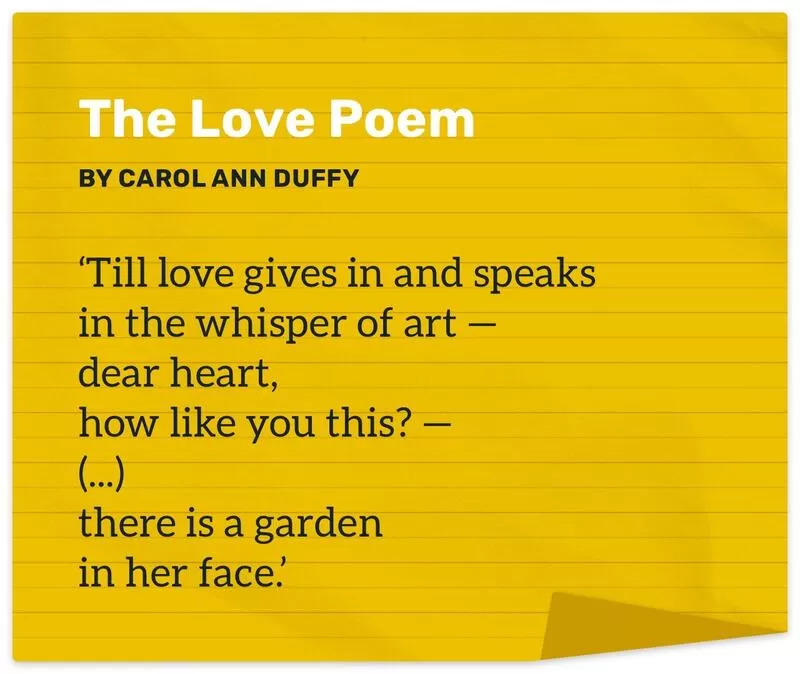
26. “The Love Poem” by Carol Ann Duffy
Taking a meta-poetic approach, Carol Ann Duffy’s “The Love Poem” explores the challenge and inadequacy of language itself when trying to capture the essence of love. Part of a collection charting a love affair, this poem finds the speaker grappling with the difficulty of writing a “love poem” that feels true and sufficient. By referencing other famous poems implicitly or explicitly, Duffy highlights the long tradition of poets attempting this task and the potential for cliché. The poem becomes an honest reflection on the struggle to find unique, authentic words for an experience that feels both deeply personal and universally explored, offering a poet’s perspective on poems for love.
 Hand writing in a notebook surrounded by crumpled paper, symbolizing the struggle and process of writing a love poem
27. “Before You Came” by Faiz Ahmed Faiz
Faiz Ahmed Faiz, a renowned Urdu poet, beautifully articulates the transformative impact of love in “Before You Came.” The poem describes a world that was somehow incomplete or perceived incorrectly before the beloved’s arrival. The speaker implores the beloved to “Stay,” so that “the world may become like itself again.” This suggests that the beloved’s presence restores clarity, authenticity, and proper perspective to existence. Simple things, like the sky or a glass of wine, are seen truly for what they are, rather than distorted by longing or absence. Love, in this poem, is depicted as the essential element that makes reality itself coherent and beautiful.
Don’t leave now that you’re here—
Stay. So the world may become like itself again:
so the sky may by the sky,
the road a road,
and the glass of wine not a mirror, just a glass of wine.
28. “Lines Depicting Simple Happiness” by Peter Gizzi
Peter Gizzi’s “Lines Depicting Simple Happiness” finds beauty in the straightforward appreciation of a loved one. The poem avoids elaborate metaphors, opting for direct statements that feel both personal and resonant. The speaker’s desire to “notice all the shiny things” and know “nothing I wouldn’t want to know” about the beloved conveys deep affection and interest. The paradoxical line, “With you nothing is simple yet nothing is simpler,” captures the complex ease and profound simplicity that a deep connection can bring. It celebrates the quiet joy and inherent goodness discovered in the beloved’s presence.
It feels right to notice all the shiny things about you
About you there is nothing I wouldn’t want to know
With you nothing is simple yet nothing is simpler
About you many good things come into relation
29. “Six Sonnets: Crossing the West” by Janice Gould
Janice Gould’s “Six Sonnets: Crossing the West” draws upon her identity as a Maidu lesbian to explore themes of love, distance, and longing. In the quoted lines, the physical separation from her beloved leads to intense emotional pain (“thick sobs”) and a sense of unspoken burdens (“all that I have done / and cannot say”). The speaker’s awareness of leaving her partner “so completely, so alone” highlights the vulnerability inherent in love and the ache of absence. While rooted in a specific cultural and personal context, the poem’s portrayal of separation and longing speaks to the universal experience of missing a loved one.
30. “For Keeps” by Joy Harjo
Joy Harjo, a Mvskoke poet and former U.S. Poet Laureate, often weaves themes of nature, ancestry, and spirit into her work. In “For Keeps,” she creates a powerful connection between the enduring beauty of the natural world and the strength of her love. By contrasting the beloved with elements of nature, Harjo suggests that this love possesses the same fundamental, resilient, and life-affirming qualities found in the earth itself. The title “For Keeps” implies a permanence and unwavering commitment, reinforcing the idea that this love is as constant and vital as the natural forces she references, making it a grounded and beautiful piece among poems for love.
 Nature scene with trees, sky, and sun, symbolizing the enduring beauty of love mirrored in the natural world
31. “You Are the Penultimate Love of My Life” by Rebecca Hazelton
Rebecca Hazelton’s provocatively titled “You Are the Penultimate Love of My Life” offers a refreshingly honest and unconventional perspective on love. This isn’t a poem about a soulmate or a destined, everlasting love, but rather a love acknowledged as potentially temporary (“for now”). Yet, the poem finds beauty and meaning within this reality. The speaker notes imperfections (“garden… tunneled through by voles”) and the lack of formal vows, but affirms that “there’s something / holding me here.” The mundane detail of the beloved’s “brown” eyes anchors the poem in reality, suggesting that love’s value doesn’t always lie in grand pronouncements but in the genuine connection of the present moment.
The garden you plant and I plant
is tunneled through by voles,
the vowels
we speak aren’t vows,
but there’s something
holding me here, for now,
like your eyes, which I suppose
are brown, after all.’
For individuals expressing their deep affection and devotion, exploring verses specifically crafted for a male partner might be helpful. Find inspiration with these poems to my man.
32. “Yours” by Daniel Hoffman
Daniel Hoffman’s “Yours” is a poem of complete dedication and dependence, using rich natural metaphors to illustrate the speaker’s belonging to the beloved. The speaker is “yours as the summer air… is / Possessed by the scent of linden blossoms,” suggesting a pervasive, delightful presence. The beloved is also likened to the moon lending light to a snowcap, highlighting their essential role in illuminating the speaker’s world. The concluding lines powerfully state the consequence of absence: “Without you I’d be an unleaded tree / Blasted in a bleakness with no Spring.” This conveys a sense of vital reliance and the fear of barrenness without the beloved’s presence, making it a profound poem about connection.
I am yours as the summer air at evening is
Possessed by the scent of linden blossoms,
As the snowcap gleams with light
Lent it by the brimming moon.
Without you I’d be an unleaded tree
Blasted in a bleakness with no Spring.
33. “A Love Song for Lucinda” by Langston Hughes
Langston Hughes, a central figure of the Harlem Renaissance, offers a series of evocative comparisons for love in “A Love Song for Lucinda.” Each stanza uses a different natural image – a “high mountain,” a “red star,” a “large sea.” These comparisons emphasize the intense, sometimes perilous, and all-encompassing nature of love. The mountain suggests aspiration and potential danger (“Do not climb too high”). The star represents distant beauty and perhaps a guiding light. The sea implies depth and vastness. Hughes distills love into these powerful, concise images, capturing its exhilaration and potential risks.
Love
Is a high mountain
Stark in a windy sky.
If you
Would never lose your breath
Do not climb too high.
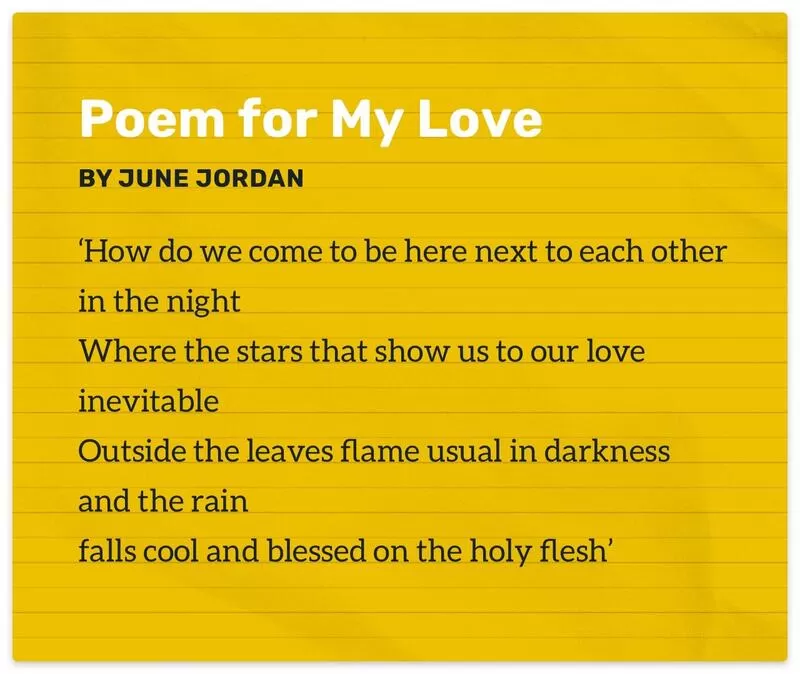
34. “Poem for My Love” by June Jordan
June Jordan, a prolific activist and writer, expresses profound spiritual and emotional awe for her beloved in “Poem for My Love.” The poem conveys a sense of transcendence and deep connection that elevates the relationship beyond the ordinary. The speaker is in awe of their partner’s being and the transformative nature of their shared love. Jordan’s work often connects the personal with the political, and while this poem is deeply intimate, it carries the weight of a love that feels revolutionary or inherently powerful, a force that aligns with her broader themes of identity and liberation.
 Woman sitting with her eyes closed, hands near her chest, symbolizing deep inner peace and spiritual connection from love
Life itself is a complex tapestry, woven with threads of love, loss, joy, and challenge. For more reflections on the human experience, explore some beautiful poems on life.
35. “for him” by Rupi Kaur
Rupi Kaur, known for her accessible and emotionally direct style often shared on social media, offers a modern perspective on destiny and recognition in “for him.” The poem suggests that their meeting won’t be “love at first sight” but “love at first remembrance,” implying a deep, pre-existing connection. This feeling of recognition is linked back to maternal wisdom, specifically the speaker’s mother’s advice about choosing a partner with qualities one would want to instill in a son. It’s a simple yet resonant poem that connects personal destiny with inherited wisdom and the feeling of recognizing a soulmate.
no,
it won’t
be love at
first sight when
we meet it’ll be love
at first remembrance
‘cause i’ve recognized you
in my mother’s eyes when she tells me,
marry the type of man you’d want to raise your son to be like.
36. Untitled by Rupi Kaur
Another short, impactful poem from Rupi Kaur’s milk and honey, this untitled piece offers a perspective on love that acknowledges its potential for pain while ultimately asserting its benevolent nature. The lines “love will hurt you but / love will never mean to” capture the bittersweet reality that love, despite bringing joy, can also cause suffering, often unintentionally. The conclusion, “love knows life / has been hard enough already,” presents love as a force that, at its core, is not malicious or cruel, but understands and seeks to alleviate the difficulties of life. It’s a world-weary but ultimately gentle take on love.
love will hurt you but
love will never mean to
love will play no games
cause love knows life
has been hard enough already
37. “Poem To An Unnameable Man” by Dorothea Lasky
Dorothea Lasky’s “Poem To An Unnameable Man” is characterized by her distinctive, often confrontational and surreal style. The speaker asserts unexpected strength and knowledge in the face of being underestimated by a lover. The refusal to cry (“And I will not cry also / Although you will expect me to”) defies traditional expectations of feminine vulnerability. The declaration “I knew all along you were mine” is powerful and perhaps possessive, suggesting a deep, internal certainty about the relationship. The poem, while addressing a specific person, explores themes of power dynamics, perception, and the speaker’s self-assuredness in love, using celestial imagery (though not quoted here) elsewhere to add a cosmic dimension.
38. “Movement Song” by Audre Lorde
Audre Lorde, a pivotal figure in feminist and civil rights movements, pens “Movement Song” about the difficult process of a relationship ending. While acknowledging the sorrow and breakage that occurs when hearts are wounded (“sorrow felt after the speaker’s heart has been broken is clear”), the poem doesn’t end in despair. The focus shifts to the possibility of moving forward, for both individuals. The title itself suggests transition and progress. The poem holds onto hope that despite the pain of separation, both parties can find a “new beginning,” albeit on separate paths, reflecting Lorde’s emphasis on resilience and self-preservation.
 Two abstract figures moving apart, symbolizing the end of a relationship and the start of new paths
39. “Camomile Tea” by Katherine Mansfield
Katherine Mansfield, celebrated for her ability to capture subtle emotions, presents a tranquil scene of domestic intimacy in “Camomile Tea.” The poem paints a picture of quiet contentment shared between a couple in the comfort of their home. Details like “Under the kitchen-table leg / My knee is pressing against his knee” and the “tap is dripping peacefully” create a sense of gentle closeness and shared mundane reality. This poem highlights an often overlooked aspect of love: the deep, quiet joy and comfort found in familiar presence and shared, peaceful moments, suggesting that not all poems for love need to be grand or dramatic.
We might be fifty, we might be five,
So snug, so compact, so wise are we!
Under the kitchen-table leg
My knee is pressing against his knee.
Our shutters are shut, the fire is low,
The tap is dripping peacefully;
The saucepan shadows on the wall
Are black and round and plain to see.
40. “Love Elegy in the Chinese Garden, with Koi” by Nathan McClain
Nathan McClain’s “Love Elegy in the Chinese Garden, with Koi” delves into the complexities of love when navigating past hurts and anxieties. Set in a beautiful garden, the poem contrasts the serene environment with internal turmoil. The speaker reflects on the common human experience of clinging to love even after it’s gone or unreturned (“loved so intently even after everything / has gone? Love something that has washed / its hands of you?”). Despite a desire for enlightenment or change, the speaker admits to still being affected by past baggage (“but who am I kidding?”). It’s an honest exploration of the emotional weight that previous relationships can impose on potential new ones.
Because who hasn’t done that —
loved so intently even after everything
has gone? Love something that has washed
its hands of you? I like to think I’m different now,
that I’m enlightened somehow,
but who am I kidding?
41. “I think I should have loved you presently (Sonnet IX)” by Edna St. Vincent Millay
Edna St. Vincent Millay subverts the traditional expectations of a love sonnet in “I think I should have loved you presently (Sonnet IX).” The speaker reflects on a potential, deeper love that was missed or avoided. Instead of offering genuine affection (“earnest words”), the speaker chose superficial “jest” and “pretty follies” that attracted the lover but prevented true connection. The regret is palpable – the speaker feels she should have loved more sincerely and allowed herself to be vulnerable (“lifted honest eyes,” “caught your hand”). It’s a poem about the paths not taken in love and the melancholy realization of valuing fleeting attraction over lasting depth.
I think I should have loved you presently,
And given in earnest words I flung in jest;
And lifted honest eyes for you to see,
And caught your hand against my cheek and breast;
And all my pretty follies flung aside
That won you to me, and beneath you gaze
42. “Love Sonnet XI” by Pablo Neruda
Pablo Neruda, whose work is synonymous with passionate love poetry, expresses intense longing and near-obsessive desire in “Love Sonnet XI.” The speaker’s need for the beloved is presented as a primal hunger (“I crave your mouth, your voice, your hair”), so profound that even basic sustenance like bread fails to nourish. The beloved’s absence or presence dictates the speaker’s entire world, driving them to ceaseless searching (“I prowl through the streets,” “all day / I hunt for the liquid measure of your steps”). The poem vividly captures the overwhelming, consuming nature of passionate love, where the beloved becomes the sole focus of existence.
I crave your mouth, your voice, your hair.
Silent and starving, I prowl through the streets.
Bread does not nourish me, dawn disrupts
me, all day
I hunt for the liquid measure of your steps.
43. “Your Feet” by Pablo Neruda
In “Your Feet,” Pablo Neruda offers a unique and tender perspective on loving someone completely. Instead of focusing on the conventionally beautiful aspects of the beloved, Neruda begins with her feet, following them through her day and life. This unconventional focus signifies a love that embraces every part of the person, even the mundane or less-celebrated aspects. The poem moves upwards, celebrating the beloved from toe to head, culminating in a feeling of deep gratitude for the forces that brought them together. It is a powerful illustration of holistic love that cherishes the entire being of the beloved.
 Close-up image of bare feet walking on a stone path, symbolizing cherishing every part of the beloved
44. “Dear One Absent This Long While” by Lisa Olstein
Lisa Olstein’s “Dear One Absent This Long While” captures the palpable feeling of anxiously awaiting a loved one’s return. The speaker is hyper-aware of every sight and sound, mistaking natural phenomena (“leaves in wind,” “retreating shadow of a fox,” “daybreak”) for the beloved’s arrival. This heightened state of anticipation is shared even with the domestic environment (“We expect you, cat and I, bluebirds and I, the stove”), personifying the home’s longing. The poem beautifully conveys how the absence of a loved one creates a void that makes ordinary life feel incomplete, portraying love as the essential missing piece that brings the world back into focus.
I expect you. I thought one night it was you
at the base of the drive, you at the foot of the stairs
you in a shiver of light, but each time
leaves in wind revealed themselves,
the retreating shadow of a fox, daybreak.
We expect you, cat and I, bluebirds and I, the stove.
45. “My Lover Is a Woman” by Pat Parker
Pat Parker, a Black lesbian feminist poet and activist, writes directly and powerfully in “My Lover Is a Woman.” For Parker, declaring her love for a woman is not just a personal statement but a political one, given the societal challenges she faced. The poem finds profound comfort and safety in the beloved’s presence (“when i hold her / feel her warmth / i feel good / feel safe”). In a world that presented obstacles and dangers, the lover represents a haven, a place of acceptance and security. It’s a testament to the power of love to provide solace and strength in the face of external adversity, making it a significant entry among poems for love and identity.
my lover is a woman
& when i hold her
feel her warmth
i feel good
feel safe
Some moments in life, even the simplest ones, hold a special significance. The feeling captured in Norman Rockwell’s painting “No Swimming” evokes a specific time and mood; similarly, some poems transport us to particular places or feelings. While not directly related to love, exploring diverse artistic expressions like no swimming norman rockwell can broaden appreciation for how art captures emotion and human experience, much like poems for love do.
46. “It Is Here” by Harold Pinter
Harold Pinter, primarily known as a Nobel-winning playwright, also wrote poetry. In “It Is Here,” he contemplates the enduring presence of a relationship’s beginning. The “stance we take, / To turn away and then turn back” suggests a dynamic of engagement and reflection. The crucial moment isn’t some grand event, but the simple act of breathing together at their first meeting (“It was the breath we took when we first met”). Pinter suggests that the essence of that initial connection, that shared breath, remains accessible (“Listen. It is here.”). The poem implies that the fundamental feeling of falling in love persists, a constant underlying current throughout the relationship’s history.
What is this stance we take,
To turn away and then turn back?
What did we hear?
It was the breath we took when we first met.
Listen. It is here.
47. “Untitled” by Christopher Poindexter
Christopher Poindexter, known for his concise and emotionally direct free verse often shared online, offers an untitled poem that captures a sense of overwhelming, paradoxical longing within love. The speaker admits to missing the beloved “even when you / are beside me” and dreaming of their body “even when you are sleeping / in my arms.” This intense desire transcends physical presence, suggesting a depth of connection that defies logic. The concluding lines, “The words I love you / could never be enough,” highlight the inadequacy of language to fully express the magnitude of this feeling, a common theme in poems for love.
I miss you even when you
are beside me.
I dream of your body
even when you are sleeping
in my arms.
The words I love you
could never be enough.
48. “Love Is Not A Word” by Riyas Qurana
Riyas Qurana’s “Love Is Not A Word” is a philosophical exploration of love, suggesting it exists beyond mere definition or articulation. Written from a personified perspective of love, the poem uses the image of a “falling flower” held “in the mid-air.” This suspended flower represents the intangible, ethereal nature of love itself – something waiting to be fully experienced rather than just named or understood intellectually. The invitation for the one who seeks love to “come and sit on it / And make love?” implies that love is an action, an experience, a shared creation. The final request, “Don’t forget to bring the word / Darling / When you come,” acknowledges that while love isn’t just a word, affectionate terms like “Darling” are essential markers of its presence and intimacy.
Amidst all this
I keep a falling flower in the mid-air
Not to fall on the earth
Is it not up to you who search for it
To come and sit on it
And make love?
Don’t forget to bring the word
Darling
When you come.
49. “[Again and again, even though we know love’s landscape]” by Rainer Maria Rilke
Rainer Maria Rilke’s poem acknowledges the inherent vulnerability and potential for pain (“lamenting names,” “terrible reticent gorge”) within the “landscape” of love. Yet, despite this awareness, the speaker emphasizes the recurring, deliberate choice to engage in love (“again and again the two of us walk out together”). Simple acts like laying “among the flowers” and looking “up into the sky” become profound reaffirmations of their connection. The poem suggests that true strength in love comes not from avoiding risk, but from choosing to be vulnerable and share life’s simple beauties together, fully aware of love’s potential costs.
Again and again, even though we know love’s landscape
and the little churchyard with its lamenting names
and the terrible reticent gorge in which the others
end: again and again the two of us walk out together
under the ancient trees, lay ourselves down again and
again
among the flowers, and look up into the sky.
50. “Echo” by Christina Rossetti
Christina Rossetti’s “Echo” is a haunting poem of grief and longing for a lost love. The speaker pleads for the beloved’s return, even if only as an “echo,” a faint reflection or memory. The desire is intense, wanting to meet “in the twilight,” “in the dreamland” – places where boundaries blur and the lost can momentarily reappear. The repetition of “Come back” underscores the depth of despair and yearning. It’s a beautiful, melancholic portrayal of how the memory of a past love can linger, creating a powerful echo that the heart desperately tries to recapture.
 Abstract image of sound waves echoing or rippling, symbolizing the lingering memory of a lost love
51. “I loved you first: but afterwards your love” by Christina Rossetti
In this sonnet, Christina Rossetti explores the dynamic of reciprocal love and how it evolves. The poem begins with a potential conflict or imbalance – the speaker loved first, but the beloved’s love “Outsoaring mine, sang such a loftier song.” This comparison suggests the beloved’s love became more powerful or expressive, potentially overshadowing the speaker’s initial affection. However, the sonnet moves towards a resolution of unity. It concludes by emphasizing how their individual loves combine to create something greater, a singular “love” that is a “whole” exceeding the sum of its parts, highlighting the beauty of a love that is shared and mutually amplifying.
I loved you first: but afterwards your love
Outsoaring mine, sang such a loftier song
As drowned the friendly cooings of my dove.
Which owes the other most? my love was long,
And yours one moment seemed to wax more strong
52. “Defeated by Love” by Rumi
Rumi, the 13th-century Persian mystic and poet, expresses a love that is all-consuming and transcendent in “Defeated by Love.” His poems often describe love as a force that overwhelms the ego and leads to a spiritual surrender. The image of being struck down by the “splendor of the moon” (symbolizing the divine or beloved) emphasizes the immense power of this love. The speaker is made “sure” by the beloved’s love and ready to “forsake / this worldly life” and “surrender / to the magnificence / of your Being.” This is not just human romantic love, but a love that leads to spiritual transformation and union with the beloved/Divine, a key theme in Rumi’s influential work.
The sky was lit
by the splendor of the moon
So powerful
I fell to the ground
Your love
has made me sure
I am ready to forsake
this worldly life
and surrender
to the magnificence
of your Bering
53. “Shall I compare thee to a summer’s day? (Sonnet 18)” by William Shakespeare
William Shakespeare’s “Sonnet 18” is arguably the most famous love poem in the English language, and a quintessential example of poems for love. Addressed to the Fair Youth, the sonnet begins with a rhetorical question comparing the beloved to a summer’s day, only to find the beloved “more lovely and more temperate.” Shakespeare lists the imperfections of summer (too short, too hot, sometimes dim) to emphasize the beloved’s superior, unchanging beauty. The turning point (volta) in the third quatrain asserts the enduring power of the speaker’s verse. The beloved’s eternal summer (“Thy eternal summer shall not fade”) is granted immortality not by nature, but by being preserved within the lines of the poem (“So long as men can breathe or eyes can see, / So long lives this, and this gives life to thee.”). It’s a poem about the power of poetry to immortalize love and beauty.
 Illustration of a quill pen writing on parchment with a subtle image of roses and sunshine, symbolizing immortalizing love through poetry
The vibrant celebration of freedom and community captured in 4th of july poems might seem distant from the intimacy of personal love poems, yet both genres speak to deep human connections and shared values, albeit on different scales.
54. “Let me not to the marriage of true minds (Sonnet 116)” by William Shakespeare
Shakespeare’s “Sonnet 116” offers a definition of true love that is unwavering and immutable. It rejects the idea that love can be altered by external circumstances or the beloved’s changeability (“Which alters when it alteration finds, / Or bends with the remover to remove”). Instead, love is presented as an “ever-fixed mark,” like a guiding star (or “star to every wand’ring bark”) that is constant and provides direction, even through life’s storms (“tempests”). The sonnet asserts that genuine love is timeless and endures until the very end of existence, a powerful declaration of love’s permanence.
Let me not to the marriage of true minds
Admit impediments. Love is not love
Which alters when it alteration finds,
Or bends with the remover to remove.
O no! it is an ever-fixed mark
55. “My mistress’ eyes are nothing like the sun” (Sonnet 130) by William Shakespeare
In “Sonnet 130,” Shakespeare playfully satirizes the hyperbolic comparisons often found in traditional love poetry (including, perhaps, his own “Sonnet 18”). The speaker lists his mistress’s features and deliberately contrasts them with idealized, often celestial, standards – her eyes are “nothing like the sun,” her lips less red than coral, her breasts are not white as snow. However, the poem is not a rejection of his mistress but a rejection of unrealistic poetic conventions. The concluding couplet affirms that his love is “as rare / As any she belied with false compare.” By presenting her realistically, the speaker implies that his love is based on genuine affection for the person, not on unattainable ideals, making it a remarkably modern take among poems for love.
I grant I never saw a goddess go;
My mistress, when she walks, treads on the ground:
And yet, by heaven, I think my love as rare
As any she belied with false compare.
56. “Love’s Philosophy” by Percy Bysshe Shelley
Percy Bysshe Shelley’s “Love’s Philosophy” uses observations from the natural world to create a persuasive argument for the inevitability and desirability of union in love. He points to how elements in nature mingle and merge – fountains with rivers, rivers with the ocean, winds with emotion. He posits this as a “law divine” where “Nothing in the world is single.” Having established this pattern of natural union, the speaker directly asks his beloved, “Why not I with thine?” The poem’s structure is a logical, albeit emotionally driven, plea for reciprocity, suggesting that their union is as natural and necessary as the merging of rivers and oceans.
The fountains mingle with the river
And the rivers with the ocean,
The winds of heaven mix forever
With a sweet emotion;
Nothing in the world is single;
All things by a law divine
In one spirit meet and mingle
Why not I with thine?
57. “One Day I Wrote her Name (Sonnet 75)” by Edmund Spenser
Part of Edmund Spenser’s Amoretti, a sonnet sequence detailing his courtship of Elizabeth Boyle, “Sonnet 75” reflects on the attempt to make love eternal. The speaker repeatedly writes his beloved’s name on the beach (“upon the strand”), only for the waves and tide to wash it away, symbolizing the ephemeral nature of physical existence and perhaps fame. The beloved argues against the futility of this, noting that she too will fade. However, the speaker counters this pessimism in the final lines (not fully quoted here) by asserting that his verse will immortalize her name and their love, making them live forever “in your fairest fame, / And in my verse eternallized shalbe.” Like Shakespeare’s Sonnet 18, it is a poem about the power of poetry to grant immortality to love.
One day I wrote her name upon the strand,
But came the waves and washed it away:
Again I wrote it with a second hand,
But came the tide, and made my pains his prey.
58. “I Am Not Yours” by Sara Teasdale
Sara Teasdale’s “I Am Not Yours” expresses a deep yearning for a love that is consuming and transformative, a love that would make the speaker feel utterly possessed and belonging to another. The opening line establishes a state of restless independence (“I Am Not Yours”). The speaker desires a love so powerful it would make her lose her sense of self and be absorbed into the beloved’s being, like the sea absorbing a river (“until you drown me, / Drown me with your dark river”). This intense longing isn’t for just any love, but a specific, overwhelming connection that would provide a sense of true belonging and loss of self in the other, highlighting the desire for complete surrender in love.
 Abstract image of swirling water or a dark river merging into a vast sea, symbolizing the desire for complete absorption in love
59. “Now Sleeps the Crimson Petal” by Alfred, Lord Tennyson
From Tennyson’s longer narrative poem The Princess, “Now Sleeps the Crimson Petal” is a sensuous and evocative song inspired by the Persian ghazal form. It sets a scene of nighttime tranquility, where nature seems hushed (“crimson petal,” “white petal,” “cypress”). This quiet atmosphere builds anticipation for the beloved’s presence. The imagery then shifts to the awakening firefly and peacock, signalling a call for the beloved to “waken thou with me.” The poem uses lush, visual details to create a mood of hushed expectation and subtle desire, culminating in an intimate invitation, illustrating love through sensory experience and atmosphere.
Now sleeps the crimson petal, now the white;
Nor waves the cypress in the palace walk;
Nor winks the gold fin in the porphyry font.
The firefly wakens; waken thou with me.
Now drops the milk-white peacock like a ghost,
And like a ghost she glimmers on to me.
60. “poem I wrote sitting across the table from you” by Kevin Varrone
Kevin Varrone’s poem captures a moment of intimate connection during a seemingly mundane activity – sitting across a table. The speaker contemplates retreating into himself (“fold myself / into the hole in my pocket and disappear”) but is drawn back by the beloved’s presence. The comparison to an “ancient star” before disappearing adds a touch of cosmic perspective to the intimate moment. Ultimately, the simple act of wanting to “grab your hand” before withdrawing signifies the pull of connection and the desire to share even internal journeys with the beloved. It’s a modern, relatable poem about finding the profound in the ordinary shared spaces of love.
I would fold myself
into the hole in my pocket and disappear
into the pocket of myself, or at least my pants
but before I did
like some ancient star
I’d grab your hand
61. “On Earth We’re Briefly Gorgeous” by Ocean Vuong
Ocean Vuong’s poem, which shares its title with his acclaimed novel, explores love through themes of hunger, impermanence, and survival. The speaker asks the beloved to affirm that their connection was driven by necessity (“Tell me it was for the hunger / & nothing less”). This suggests love isn’t a luxury but a vital need. The line “For hunger is to give / the body what it knows / it cannot keep” introduces the theme of impermanence and vulnerability – love satisfies a need, but its hold is fragile. The imagery of “amber light / whittled down by another war” connects personal intimacy to broader themes of conflict and fragility. The poem finds beauty and intensity in the fleeting, necessary nature of love amidst a challenging world.
Tell me it was for the hunger
& nothing less. For hunger is to give
the body what it knows
it cannot keep. That this amber light
whittled down by another war
is all that pins my hand
to your chest.
62. “Love After Love” by Derek Walcott
Derek Walcott, a Nobel laureate from St. Lucia, offers a powerful poem about self-love and healing after a relationship ends. “Love After Love” is addressed to the reader, urging them towards a reunion with their own self, the “stranger who was your self.” It frames the return to self as a crucial, welcoming act, offering hospitality (“Give wine. Give bread.”) and reclaiming one’s heart. The poem suggests that in seeking love from others (“ignored / for another”), we may neglect the self that has been with us all along and “knows you by heart.” It is a beautiful poem about recovering identity and finding love within oneself after the dissolution of a relationship.
You will love again the stranger who was your self.
Give wine. Give bread. Give back your heart
to itself, to the stranger who has loved you
all your life, whom you ignored
for another, who knows you by heart.
63. “I Love You” by Ella Wheeler Wilcox
Ella Wheeler Wilcox’s direct and passionate poem “I Love You” focuses on the intense physical and emotional aspects of attraction and desire. The speaker lists specific details they love about the beloved – their lips wet with wine and wild desire, eyes lit with passionate fire, warm flesh in embrace, hair enmeshing kisses. This focus on sensory experience conveys a powerful, almost overwhelming physical attraction. The poem then contrasts these desired qualities with undesirable ones (not quoted here), emphasizing that this intense, passionate connection is precisely what the speaker seeks, making it a bold and fervent declaration among poems for love.
I love your lips when they’re wet with wine
And red with a wild desire;
I love your eyes when the lovelight lies
Lit with a passionate fire.
I love your arms when the warm white flesh
Touches mine in a fond embrace;
I love your hair when the strands enmesh
Your kisses against my face.
64. “We Have Not Long to Love” by Tennessee Williams
Tennessee Williams, renowned for his plays, also wrote poetry that often explores themes of fragility and the ephemeral nature of beauty and relationships. In “We Have Not Long to Love,” the title itself sets a melancholic tone, emphasizing the brevity of time. The poem urges an appreciation for the present moment and the love shared within it. Knowing that love, like life, is temporary underscores the importance of cherishing it deeply while it lasts. It’s a poignant reminder that the value of love is amplified by its finite nature, encouraging readers to seize and appreciate the moments of connection they have.
 Image of a clock face with faded hands, suggesting the passage of time and the importance of cherishing moments
65. “Poem to First Love” by Matthew Yeager
Matthew Yeager’s “Poem to First Love” is a self-aware, conversational reflection on the intense impact of a first love. The speaker attempts to quantify the significance of being told “I love you” for the first time by this person, placing it as potentially “the highlight of my life, the best feeling.” The comparison to the Chrysler Building – perhaps not the tallest, but “the best, the most exquisitely spired” – uses a specific, modern image to convey the unique and profound impact of that initial experience. The poem captures the bittersweet nostalgia and lasting significance of a first love, acknowledging its singular place in one’s emotional history.
To have been told “I love you” by you could well be, for me,
the highlight of my life, the best feeling, the best peak
on my feeling graph, in the way that the Chrysler building
might not be the tallest building in the NY sky but is
the best, the most exquisitely spired
The Lasting Power of Poems for Love
This collection represents just a fraction of the countless poems for love that exist across languages and eras. Yet, these 65 pieces offer a powerful glimpse into the enduring human need to articulate the complex emotions surrounding love. From the spiritual to the sensual, the enduring to the ephemeral, poets provide us with the words to understand, celebrate, mourn, and cherish this fundamental aspect of our lives. Reading these poems allows us to connect not only with the poets themselves but with the universal experience of love that binds us all. They remind us that in the vast landscape of human feeling, love remains one of the most fertile grounds for poetic expression.