
Love, in its myriad forms, has been an inexhaustible wellspring for poets across centuries and cultures. From the intense flush of new romance to the quiet comfort of enduring partnership, the ache of heartbreak, and the expansive bond between friends or family, poetry about love captures the full spectrum of human connection. It allows us to articulate feelings that often defy simple prose, offering solace, inspiration, and profound recognition of our shared experiences.
Contents
- Voices of Love: A Curated Selection of Poetry About Love
- “Come, And Be My Baby” by Maya Angelou
- “Bird-Understander” by Craig Arnold
- “Habitation” by Margaret Atwood
- “Variations on the Word Love” by Margaret Atwood
- “The More Loving One” by W.H. Auden
- “To My Dear and Loving Husband” by Anne Bradstreet
- “Always For The First Time” by André Breton
- “Love and Friendship” by Emily Brontë
- “To Be In Love” by Gwendolyn Brooks
- “How Do I Love Thee? (Sonnet 43)” by Elizabeth Barrett Browning
- “A Red, Red Rose” by Robert Burns
- “She Walks in Beauty” by Lord Byron
- “Love is a fire that burns unseen” by Luís Vaz de Camões
- “Beautiful Signor” by Cyrus Cassells
- “Rondel of Merciless Beauty” by Geoffrey Chaucer
- “Love Comes Quietly” by Robert Creeley
- “[i carry your heart with me(i carry it in]” by E. E. Cummings
- “[love is more thicker than forget]” by E.E. Cummings
- “Sthandwa sami (my beloved, isiZulu)” by Yrsa Daley-Ward
- “Married Love” by Guan Daosheng
- “Heart, we will forget him!” by Emily Dickinson
- “Air and Angels” by John Donne
- “Flirtation” by Rita Dove
- “Heart to Heart” by Rita Dove
- “Love” by Carol Ann Duffy
- “The Love Poem” by Carol Ann Duffy
- “Before You Came” by Faiz Ahmed Faiz
- “Lines Depicting Simple Happiness” by Peter Gizzi
- “Six Sonnets: Crossing the West” by Janice Gould
- “For Keeps” by Joy Harjo
- “You Are the Penultimate Love of My Life” by Rebecca Hazelton
- “Yours” by Daniel Hoffman
- “A Love Song for Lucinda” by Langston Hughes
- “Poem for My Love” by June Jordan
- “for him” by Rupi Kaur
- Untitled by Rupi Kaur
- “Poem To An Unnameable Man” by Dorothea Lasky
- “Movement Song” by Audre Lorde
- “Camomile Tea” by Katherine Mansfield
- “Love Elegy in the Chinese Garden, with Koi” by Nathan McClain
- “I think I should have loved you presently (Sonnet IX)” by Edna St. Vincent Millay
- “Love Sonnet XI” by Pablo Neruda
- “Your Feet” by Pablo Neruda
- “Dear One Absent This Long While” by Lisa Olstein
- “My Lover Is a Woman” by Pat Parker
- “It Is Here” by Harold Pinter
- “Untitled” by Christopher Poindexter
- “Love Is Not A Word” by Riyas Qurana
- “[Again and again, even though we know love’s landscape]” by Rainer Maria Rilke
- “Echo” by Christina Rossetti
- “I loved you first: but afterwards your love” by Christina Rossetti
- “Defeated by Love” by Rumi
- “Shall I compare thee to a summer’s day? (Sonnet 18)” by William Shakespeare
- “Let me not to the marriage of true minds (Sonnet 116)” by William Shakespeare
- “My mistress’ eyes are nothing like the sun” (Sonnet 130) by William Shakespeare
- “Love’s Philosophy” by Percy Bysshe Shelley
- “One Day I Wrote her Name (Sonnet 75)” by Edmund Spenser
- “I Am Not Yours” by Sara Teasdale
- “Now Sleeps the Crimson Petal” by Alfred, Lord Tennyson
- “poem I wrote sitting across the table from you” by Kevin Varrone
- “On Earth We’re Briefly Gorgeous” by Ocean Vuong
- “Love After Love” by Derek Walcott
- “I Love You” by Ella Wheeler Wilcox
- “We Have Not Long to Love” by Tennessee Williams
- “Poem to First Love” by Matthew Yeager
- The Enduring Power of Poetry About Love
Throughout history, poets have turned their gaze inward and outward to explore this fundamental human emotion. Whether through strict forms or free verse, soaring metaphors or stark honesty, they illuminate the power, complexity, and beauty of love. This collection delves into some of the most poignant and memorable instances of poetry about love, showcasing diverse voices and perspectives that resonate across time. Prepare to embark on a journey through verses that celebrate, question, mourn, and ultimately affirm the enduring significance of love in our lives.
Voices of Love: A Curated Selection of Poetry About Love
The tapestry of poetry about love is woven with threads from countless poets, each contributing a unique color and texture. Here, we explore a selection of these works, offering brief insights into what makes them resonate with readers seeking to understand or express love.
“Come, And Be My Baby” by Maya Angelou
Maya Angelou, a towering figure in American literature and civil rights activism, offers a vision of love as refuge. In ‘Come, And Be My Baby’, she beautifully portrays how the chaos and pressure of modern existence can be overwhelming. Love, in this context, isn’t just romance; it’s a sanctuary, a moment of peace and comfort found in the presence of a loved one, offering temporary escape and solace from hardship.
 Maya Angelou
“Bird-Understander” by Craig Arnold
Craig Arnold’s poetry is known for its raw honesty. ‘Bird-Understander’ captures a specific, intimate moment between partners, where understanding and acceptance deepen the bond of love. The poem suggests that true love involves seeing and appreciating the other person’s unique perspective and way of being in the world, even in their vulnerability or “hurt.” The seemingly simple language and metaphor create a powerful image of connection.
“Habitation” by Margaret Atwood
Margaret Atwood, widely celebrated for her fiction including dystopian novels, also crafts striking poetry. ‘Habitation’ offers a starkly realistic view of long-term relationships, particularly marriage. It acknowledges the inherent difficulties and the continuous effort required to sustain love through challenges. The beauty of this poem lies in its candor, portraying love not as a fairytale ending but as a shared journey requiring conscious work and wonder at having endured together.
“Variations on the Word Love” by Margaret Atwood
Love is a complex concept with myriad manifestations. Margaret Atwood explores this complexity in ‘Variations on the Word Love’, dissecting the many different ways “love” is used and experienced. From passionate romance to platonic bonds or even manipulative dynamics, Atwood examines the multifaceted nature of this single word, highlighting its surprising range of meanings and applications in human relationships.
“The More Loving One” by W.H. Auden
While much poetry about love focuses on its joys, poems of heartbreak can be equally, if not more, moving. W.H. Auden’s ‘The More Loving One’ explores the pain of unrequited or ended love from the perspective of the person who loved more deeply. Using a celestial metaphor, the poem captures the profound sense of loss but also a quiet strength and perhaps resignation in choosing to be the one who loved more fully, even if it led to greater pain.
For those interested in exploring the dynamics of familial affection, you might find connections between the deep, enduring love explored in some poems and the bonds expressed in [aunt poems for nephew].
“To My Dear and Loving Husband” by Anne Bradstreet
Anne Bradstreet, an early American poet with strong Puritan beliefs, viewed marriage as a divine gift. ‘To My Dear and Loving Husband’ is a powerful declaration of her profound love and gratitude for her husband. Though written from a historical context, its genuine warmth and dedication resonate, asserting a deep, abiding love that extends beyond earthly life, grounded in both personal affection and spiritual conviction.
“Always For The First Time” by André Breton
André Breton, a founder of the surrealist movement, infused his poetry with dreamlike imagery and an exploration of the subconscious. ‘Always For The First Time’ is an ode to an imagined or longed-for lover, capturing the surreal anticipation and enduring hope of connection. The poem reflects the surrealist aim to blend reality and dreams, portraying love as a perpetually new discovery, experienced with the wonder of a first encounter, even before it truly begins.
“Love and Friendship” by Emily Brontë
Love isn’t confined to romance; the love between friends is a powerful and often more enduring bond. Emily Brontë, author of Wuthering Heights, contrasts romantic love with friendship in ‘Love and Friendship’. She likens romantic love to a beautiful but fleeting rose, while friendship is compared to the steadfast holly tree, capable of weathering all seasons. The poem is a testament to the strength and resilience of platonic love.
 Emily Bronte
“To Be In Love” by Gwendolyn Brooks
Gwendolyn Brooks, the first African-American Pulitzer Prize winner, captures the transformative power of falling in love in ‘To Be in Love’. The poem describes how love lightens one’s touch and expands one’s sense of self. It conveys the intense joy and altered perspective that love brings, making one feel “well” and stretched into a larger version of oneself, illustrating how love can profoundly change one’s entire outlook on life.
To be in love
Is to touch with a lighter hand.
In yourself you stretch, you are well.
This short excerpt encapsulates the lightness and growth associated with falling in love, a common theme in poetry about love.
“How Do I Love Thee? (Sonnet 43)” by Elizabeth Barrett Browning
Perhaps one of the most famous love poems in the English language, Elizabeth Barrett Browning’s ‘How Do I Love Thee? (Sonnet 43)’ is a fervent and detailed declaration of love. Written to her husband, Robert Browning, the sonnet enumerates the various ways her love extends infinitely, reaching the depths of her soul and beyond. Its enduring popularity lies in its ardent sincerity and the universal desire to measure and express the boundless nature of deep affection.
“A Red, Red Rose” by Robert Burns
Robert Burns, the beloved Scottish poet, penned ‘A Red, Red Rose’, a passionate and memorable expression of love. The poem uses vivid natural imagery to convey the depth and longevity of his affection. Comparing his love to a beautiful, fresh rose and promising it will last as long as the rocks and sun endure, Burns creates a timeless testament to profound and unwavering devotion, a classic example of romantic poetry about love.
 A Red, Red Rose by Robert Burns
“She Walks in Beauty” by Lord Byron
Lord Byron, known for his romantic and often scandalous life, offers a portrait of admiration in ‘She Walks in Beauty’. Unlike some of his more passionate works, this poem focuses on the serene, harmonious beauty of a woman, drawing parallels between her appearance and the calm, starlit night. It captures a sense of astonishment and reverence for her inner and outer grace, highlighting a form of love expressed through profound aesthetic appreciation.
She walks in beauty, like the night
Of cloudless climes and starry skies;
And all that’s best of dark and bright
Meet in her aspect and her eyes;
Thus mellowed to that tender light
Which heaven to gaudy day denies.
“Love is a fire that burns unseen” by Luís Vaz de Camões
Luís Vaz de Camões, Portugal’s national poet, explored the tumultuous nature of love in his lyrical works. ‘Love is a fire that burns unseen’ describes love as a series of paradoxes – a hidden fire, a painless ache, a discontented contentment. This reflects the complex fusion of pleasure and pain often present in intense romantic experiences, portraying love as a powerful, often contradictory force that defies easy definition.
“Beautiful Signor” by Cyrus Cassells
Cyrus Cassells’ collection Beautiful Signor is dedicated to lovers and set against the challenging backdrop of the AIDS epidemic. The title poem, ‘Beautiful Signor’, is a powerful declaration of an expansive, almost spiritual love. It speaks of an “April-upon-April love” that keeps the speaker spinning, moving towards something transcendent. It’s a reminder of the potent beauty and resilience of romantic connection even in difficult times, adding a layer of cultural context to poetry about love.
“Rondel of Merciless Beauty” by Geoffrey Chaucer
Geoffrey Chaucer, often called the ‘Father of English poetry’, wrote both epic and lyrical works. His ‘Rondel of Merciless Beauty’ (translated from Middle English) is a lament of heartbreak. The speaker pledges eternal devotion despite being left by his love, whose beauty is so overwhelming it causes pain. The poem captures the intensity of unrequited or painful love and the enduring, albeit agonizing, commitment of the heart.
“Love Comes Quietly” by Robert Creeley
Robert Creeley’s short, minimalist poems often pack a significant emotional punch. ‘Love Comes Quietly’ succinctly captures the feeling of being so completely intertwined with a lover that life before them seems almost forgotten. It speaks to the quiet, transformative way love can integrate itself into existence, making separation feel unimaginable and highlighting the subtle yet profound shift that love brings.
Robert Creeley, known for his concise and impactful style, offers a brief but resonant thought on how love enters our lives.
“[i carry your heart with me(i carry it in]” by E. E. Cummings
E.E. Cummings is renowned for his distinctive style and profound exploration of love. ‘[i carry your heart with me(i carry it in]’ is one of his most famous love poems. Its unconventional structure and intimate language convey a sense of complete unity with the beloved. The speaker feels the lover’s presence and influence everywhere, making the poem a powerful expression of interwoven identities and boundless affection, a quintessential example of passionate poetry about love.
i carry your heart with me(i carry it in
my heart)i am never without it(anywhere
i go you go,my dear;and whatever is done
by only me is your doing,my darling)
This passage beautifully illustrates the theme of profound connection. For those interested in unique poetic forms and structures, exploring [monometer poetry] can reveal how poets achieve impact with concise lines.
“[love is more thicker than forget]” by E.E. Cummings
Another compelling poem by E.E. Cummings, ‘[love is more thicker than forget]’, explores the paradoxical nature of love through vivid comparisons. Cummings describes love using unexpected juxtapositions – thicker than forgetfulness, thinner than recall, rarer than a wet wave, more frequent than failure. This highlights love’s elusive yet ever-present quality, its simultaneous modesty and profundity, capturing its complex and often contradictory essence.
“Sthandwa sami (my beloved, isiZulu)” by Yrsa Daley-Ward
Yrsa Daley-Ward’s work is known for its vulnerability and exploration of deeply personal themes. ‘Sthandwa sami (my beloved, isiZulu)’ offers a tender and revealing account of love, drawing on the power of feeling truly seen and accepted. The poem speaks of frighteningly precise thoughts about a shared future and the profound sense of returning to oneself in the presence of the beloved, emphasizing love’s capacity to heal and affirm identity.
“Married Love” by Guan Daosheng
Guan Daosheng, a Chinese painter and poet from the Yuan Dynasty, uses a striking metaphor in ‘Married Love’. The poem compares two lovers in marriage to clay figurines molded together and baked in a kiln. This image beautifully represents the process of two individuals becoming one through the sacred bond of marriage, solidifying their union like clay in fire, creating a lasting and unified entity. This is a unique perspective on marital poetry about love.
“Heart, we will forget him!” by Emily Dickinson
Emily Dickinson’s poetry is often characterized by its intensity and distinctive voice. In ‘Heart, we will forget him!’, she portrays the struggle and futility of trying to overcome heartbreak through sheer will. The speaker commands her heart and herself to forget a past lover, recognizing the immense difficulty of erasing deep emotional connections. The poem is a powerful reflection on the lasting impact of passionate love, even after its end.
“Air and Angels” by John Donne
John Donne, known for his metaphysical poetry exploring complex ideas of faith, love, and salvation, compares his love to the movement of angels in ‘Air and Angels’. Angels are pure and elegant, suggesting the elevated nature of his affection. The poem delves into the philosophical nature of love, concluding that the union of two lovers creates a stronger, more perfect entity. It adds a layer of intellectual depth to the exploration of love’s essence.
 John Donne
“Flirtation” by Rita Dove
Rita Dove, a former U.S. Poet Laureate, captures the exhilarating beginning of a new relationship in ‘Flirtation’. The poem evokes the sparkling anticipation and joy of the initial stages of attraction. The imagery of the sun setting and the stars appearing mirrors the internal shift and excitement felt by the speaker, whose heart is humming a tune “haven’t heard in years.” It’s a relatable portrayal of the delightful energy of nascent love.
“Heart to Heart” by Rita Dove
In ‘Heart to Heart’, Rita Dove challenges conventional clichés about love and the heart. She rejects sentimental notions, stating that the heart isn’t literally red, sweet, or prone to melting or breaking in the simplistic ways often portrayed. By taking a grounded, almost pragmatic approach, the poem emphasizes that love can exist and be profound even without overt, stereotypical displays of emotion, assuring the reader that her love is real despite her perhaps understated way of showing it.
“Love” by Carol Ann Duffy
Carol Ann Duffy, the first female and openly lesbian British Poet Laureate, often writes in a monologue style, rich with sensory and emotional detail. In ‘Love’, she describes love as boundless and elemental, like the sea, moon, and sun. The speaker’s love is intrinsically tied to her physical presence and the natural world, portraying love as a powerful force that transcends reason and time, like the ardent sun covering trees in gold.
 Carol Ann Duffy
“The Love Poem” by Carol Ann Duffy
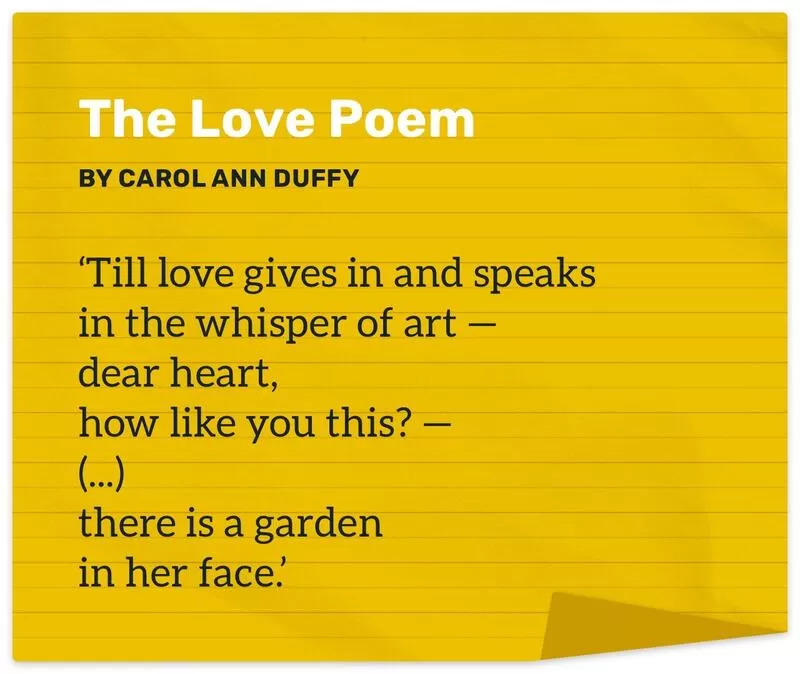
From her collection Rapture, which traces a love affair, Carol Ann Duffy gets meta-poetical in ‘The Love Poem’. The poem grapples with the difficulty of finding adequate words to express the depth of love. Duffy acknowledges the challenge of writing a true love poem, referencing other famous works while striving to articulate something unique about her own experience. It reflects on the inadequacy of language to capture the full intensity of emotion, a recurring theme in the exploration of poetry about love.
“Before You Came” by Faiz Ahmed Faiz
Faiz Ahmed Faiz, a celebrated Urdu poet known for his works on love, politics, and community, writes about the transformative impact of love in ‘Before You Came’. The poem depicts how the arrival of a beloved changes the speaker’s perception of reality, making the world appear as it truly is. The lover’s presence brings clarity and meaning, highlighting love’s power to anchor and illuminate existence, making everything feel right and true.
“Lines Depicting Simple Happiness” by Peter Gizzi
Peter Gizzi’s poetry often finds beauty in simplicity and genuine observation. In ‘Lines Depicting Simple Happiness’, he expresses adoration for his loved one through straightforward yet profound statements. He notices the “shiny things” and wants to know everything about them. The poem avoids cliché, emphasizing that with this person, nothing is simple, yet nothing is simpler. It’s a personal and affecting portrayal of finding deep happiness in the presence and particulars of a loved one.
“Six Sonnets: Crossing the West” by Janice Gould
Janice Gould’s work often explores themes of love, identity (as a Maidu lesbian), and connection. In ‘Six Sonnets: Crossing the West’, she equates her lover to a dreamlike presence, using ethereal descriptions. The poem captures the pain of separation and the intense longing felt when apart from the beloved. It highlights the deep emotional bond and the difficulty of being away, even temporarily, from someone so integral to one’s life.
“For Keeps” by Joy Harjo
Joy Harjo, a Mvskoke Nation poet and musician, frequently draws inspiration from nature. In ‘For Keeps’, she uses comparisons between love and the natural world to illustrate the enduring strength and beauty of her feelings. Contrasting love with natural elements creates a sense of an unbreakable, fundamental bond, suggesting that her love is as constant and beautiful as the natural world itself. This connection between nature and love is a powerful motif in poetry about love.
 Joy Harjo
“You Are the Penultimate Love of My Life” by Rebecca Hazelton
Rebecca Hazelton offers an unconventional and strikingly honest perspective on love in ‘You Are the Penultimate Love of My Life’. This poem moves away from the idea of a single soulmate, focusing instead on the reality and imperfections of a present relationship. It acknowledges that this love might not be the “ultimate” one, yet finds beauty and reasons to stay in the shared life, the imperfect vows, and the simple presence of the other person. It’s a unique exploration of love’s reality over its fantasy.
“Yours” by Daniel Hoffman
Daniel Hoffman uses carefully chosen metaphors to express complete dedication in ‘Yours’. Comparing his beloved to essential natural elements like summer air, linden blossoms, and moonlight on a snowcap, he conveys that his existence is dependent on her presence. Without her, he feels like a barren tree in a bleak landscape. The poem is a powerful testament to how love can feel vital and all-encompassing, integrated into the very fabric of existence through changing seasons.
“A Love Song for Lucinda” by Langston Hughes
Langston Hughes, a central figure of the Harlem Renaissance, employs natural metaphors in ‘A Love Song for Lucinda’ to describe different facets of love. Each stanza compares love to something specific in nature, like a high mountain, emphasizing its exhilarating but potentially perilous height. The poem captures the enchantment and intensity of falling in love, suggesting it’s a breathtaking experience, perhaps advising caution while celebrating its heights.
 Langston Hughes
“Poem for My Love” by June Jordan
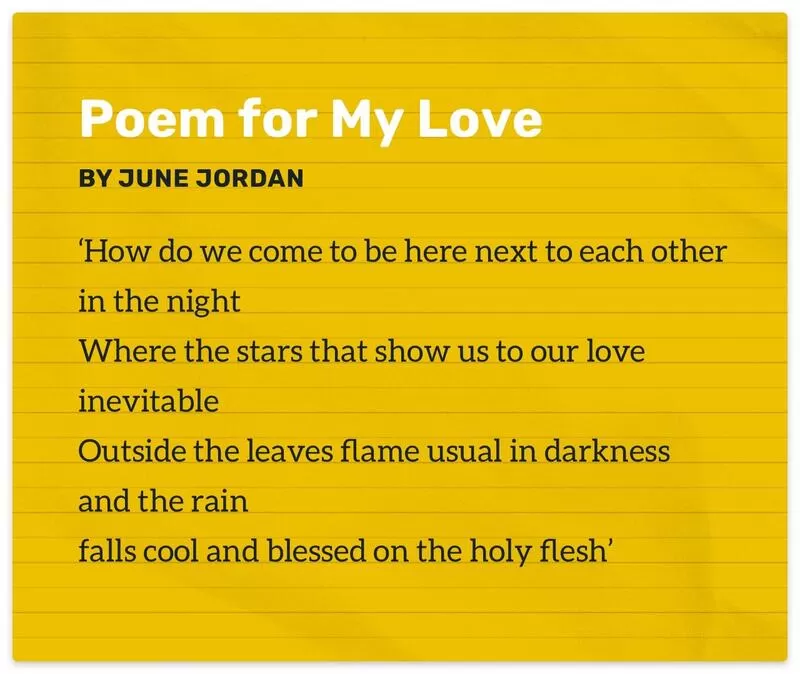
June Jordan, a prominent Jamaican American writer and activist, expresses profound spiritual awe for her partner in ‘Poem for My Love’. The speaker feels a transcendent connection, marveling at the beloved’s presence and the nature of their relationship. The poem conveys a sense of deep reverence and gratitude for a love that feels elevated and spiritually significant, highlighting the capacity of love to inspire awe and wonder.
“for him” by Rupi Kaur
Rupi Kaur, known for her accessible and emotionally resonant work often shared on Instagram, offers a concise yet powerful perspective in “for him.” This poem speaks of love not as a sudden revelation, but as a deep recognition, a sense of having known the person before, perhaps even embodying the qualities one admires. The reference to a mother’s wisdom adds a layer of inherited understanding, making the connection feel destined and profoundly right. This reflects a modern take on discovering love through resonance and values.
Untitled by Rupi Kaur
Another brief but impactful piece from Rupi Kaur’s milk and honey, this untitled poem offers a bittersweet perspective on love’s challenges. It acknowledges that love can bring hurt, but emphasizes that this hurt is rarely intentional. Love is portrayed as genuine and uncomplicated, a force that understands life’s existing hardships and doesn’t seek to add to them through games or malice. It’s a world-weary but ultimately generous view, highlighting love’s inherent kindness despite its potential for pain.
“Poem To An Unnameable Man” by Dorothea Lasky
Dorothea Lasky, a prolific contemporary poet, uses celestial imagery in ‘Poem To An Unnameable Man’ to explore a dynamic within a romantic relationship. The speaker asserts her strength and wisdom to a lover who may underestimate her. The poem suggests a power imbalance or a struggle for recognition, with the speaker ultimately claiming her own knowledge and possession within the relationship, portraying love as a complex interplay of power and understanding.
“Movement Song” by Audre Lorde
Audre Lorde, a renowned poet, activist, and feminist, addresses the aftermath of a broken relationship in ‘Movement Song’. While acknowledging the sorrow and heartbreak that come with loss, the poem ultimately moves towards hope. It suggests that despite the pain, both individuals can find new beginnings apart. It’s a poem about healing, resilience, and the possibility of moving forward after love has ended, a poignant piece within poetry about love that touches on its endings.
 Audre Lorde
“Camomile Tea” by Katherine Mansfield
Katherine Mansfield, known for her short stories, also crafted evocative poetry. ‘Camomile Tea’ paints a picture of quiet, comfortable domestic love. It depicts a couple finding simple happiness and deep contentment in shared mundane moments – drinking tea, sitting close, observing the quiet domestic scene. The poem highlights the underrated joy of peaceful familiarity and the profound comfort found in the shared intimacy of everyday life within a relationship.
We might be fifty, we might be five,
So snug, so compact, so wise are we!
Under the kitchen-table leg
My knee is pressing against his knee.
This excerpt beautifully captures the simple, timeless comfort of shared presence. For those interested in the quiet moments of home and connection, exploring themes like [quilting poems] might resonate.
“Love Elegy in the Chinese Garden, with Koi” by Nathan McClain
Nathan McClain’s ‘Love Elegy in the Chinese Garden, with Koi’ explores the anxiety and emotional baggage that can arise when attempting to start a new relationship after past heartbreak. Set in a specific, serene location, the poem contrasts the peaceful setting with the internal turmoil of the speaker, who questions the possibility of loving again so intensely after being hurt. It’s a reflection on vulnerability, past wounds, and the hesitant hope for new connection, adding layers to the narrative of poetry about love.
“I think I should have loved you presently (Sonnet IX)” by Edna St. Vincent Millay
Edna St. Vincent Millay subverts the traditional sonnet form and theme in ‘I think I should have loved you presently’. The speaker reflects on her inability to fully reciprocate a lover’s genuine affection, choosing superficial charm and flirtation over true connection. The poem expresses a lament for this missed opportunity for deeper love, highlighting the speaker’s self-awareness of her limitations and the potential loss of a meaningful relationship.
“Love Sonnet XI” by Pablo Neruda
Pablo Neruda, the Nobel Prize-winning Chilean poet, is celebrated for his passionate love poetry. ‘Love Sonnet XI’ is a powerful expression of intense longing and obsession. The speaker is consumed by thoughts of his beloved, finding no nourishment or peace without her. The poem blurs the line between romance and a kind of desperate need, portraying love as a force that infiltrates every aspect of existence, driving the speaker to the point of distraction in his constant search for her presence.
I crave your mouth, your voice, your hair.
Silent and starving, I prowl through the streets.
Bread does not nourish me, dawn disrupts
me, all day
I hunt for the liquid measure of your steps.
“Your Feet” by Pablo Neruda
In ‘Your Feet’, Neruda extends his intense devotion to every part of his beloved, focusing specifically on her feet. This seemingly unusual focus becomes a way to express complete admiration and gratitude for the entire person and the journey they have taken together. The poem finds beauty and significance even in the most mundane parts of the beloved, reinforcing the idea that love encompasses the whole person and the sense that fate brought them together.
 Pablo Neruda
“Dear One Absent This Long While” by Lisa Olstein
Lisa Olstein’s ‘Dear One Absent This Long While’ captures the anxious anticipation and longing for a loved one’s return. The speaker is hyper-aware of every sight and sound, mistaking natural phenomena for the beloved’s arrival. The poem portrays the way absence makes the heart restless, filling mundane surroundings with a nervous energy. It highlights the sense that life feels incomplete, like a puzzle with a missing piece, until the loved one returns, bringing comfort and a return to normalcy.
“My Lover Is a Woman” by Pat Parker
Pat Parker, an American poet and activist, wrote powerfully about her experiences as an African-American lesbian feminist. ‘My Lover Is a Woman’ is a testament to the safety and strength found in love amidst external struggles. The poem speaks to the challenges faced by the speaker but emphasizes the profound sense of security and well-being she feels in her lover’s presence. It portrays love as a vital source of refuge and affirmation in a challenging world.
“It Is Here” by Harold Pinter
Harold Pinter, renowned playwright and Nobel laureate, also wrote concise and impactful poetry. ‘It Is Here’ explores the enduring nature of love, suggesting that the essence of the connection remains present, perhaps lingering in memory or a shared space, even as time passes. By asking his lover to recall their first meeting, he suggests that the foundational moment of their connection is not lost but is still palpable, reminding them that their love’s origin and depth are always accessible.
“Untitled” by Christopher Poindexter
Christopher Poindexter’s untitled poem offers a raw and relatable portrait of love that transcends language. The speaker expresses an overwhelming longing that exists even when the beloved is physically present, and a deep fascination that extends to dreams. The simple, direct lines convey the feeling that even the words “I love you” are insufficient to capture the depth and complexity of such intense affection. It speaks to a love that feels paradoxical in its simultaneous presence and felt absence.
“Love Is Not A Word” by Riyas Qurana
Riyas Qurana’s “Love Is Not A Word” is an ambiguous poem that personifies love, inviting the reader to consider its nature beyond linguistic definition. By keeping a “falling flower in the mid-air,” love poses a question to the seeker, suggesting that its essence is not found in words (“Darling”) but in experience and presence (“come and sit on it / And make love”). The poem encourages a deeper understanding of love as an elemental, active force rather than a passive concept.
“[Again and again, even though we know love’s landscape]” by Rainer Maria Rilke
Rainer Maria Rilke, an Austrian poet who believed loving was a difficult task, explores the continuous, conscious choice of love in ‘[Again and again, even though we know love’s landscape]’. Despite knowing the potential for pain (“the terrible reticent gorge”), the speaker and beloved repeatedly choose to walk together, lie among flowers, and look up at the sky. The poem celebrates the courage and resilience required to love fully, knowing the risks, and finding strength and beauty in the shared journey and everyday moments.
“Echo” by Christina Rossetti
Christina Rossetti, a prominent Victorian poet, captures the profound sorrow of lost love in ‘Echo’. The speaker desperately longs for her departed lover to return, imagining their presence like an echo that repeats and lingers but remains just out of reach. The poem conveys a deep sense of despair and yearning, portraying heartbreak as a haunting experience where the past love continues to resonate painfully in the present, a common theme in poetry about love that explores loss.
 Christina Rossetti
“I loved you first: but afterwards your love” by Christina Rossetti
In ‘I loved you first: but afterwards your love’, Christina Rossetti explores the dynamic of reciprocal love and the feeling of complete unity it creates. While the opening lines seem to measure whose love was initially greater, the poem quickly moves to describe how their individual feelings combine to form a single, powerful bond that is “greater than the sum of its parts.” It highlights the profound understanding and merging of identities that can occur in deep, shared love.
“Defeated by Love” by Rumi
The words of the 13th-century Persian poet Rumi have resonated across cultures for centuries, expressing a passionate and often mystical devotion. In ‘Defeated by Love’, Rumi describes love as an overwhelming, transformative force, likening its power to the splendor of the moon that makes him fall to the ground. The poem portrays a complete surrender to love, a willingness to forsake the ordinary world for the magnificence of the beloved’s being, embodying the ecstatic, all-consuming nature of love often found in Sufi poetry.
“Shall I compare thee to a summer’s day? (Sonnet 18)” by William Shakespeare
One of the most famous poems in the English language, William Shakespeare’s Sonnet 18 is a timeless declaration of love that promises immortality. While beginning with a seemingly simple comparison, the poem argues that the beloved’s beauty is superior to a summer’s day and, crucially, that this beauty will endure forever because it is captured within the lines of the poem itself. It’s a testament to the power of art to preserve the beloved and the love felt for them, a cornerstone of poetry about love.
 William Shakespeare
“Let me not to the marriage of true minds (Sonnet 116)” by William Shakespeare
Shakespeare’s Sonnet 116 offers a definition of true love, portraying it as an unwavering, constant force that is not subject to change or external pressures. Love is an “ever-fixed mark,” a guiding star that endures storms and time. The poem argues that if love alters or fades when faced with difficulties or the passage of time, then it was never true love to begin with. It’s a powerful statement on the permanence and resilience of genuine affection.
Let me not to the marriage of true minds
Admit impediments. Love is not love
Which alters when it alteration finds,
Or bends with the remover to remove.
O no! it is an ever-fixed mark
“My mistress’ eyes are nothing like the sun” (Sonnet 130) by William Shakespeare
In Sonnet 130, Shakespeare playfully subverts conventional Petrarchan love poetry, which often uses exaggerated comparisons to idealize the beloved. Instead, Shakespeare describes his mistress using realistic, even unflattering comparisons (eyes not like the sun, lips less red than coral). However, the poem concludes by asserting that despite her lack of idealized beauty, his love for her is just as “rare” and true as any love idealized by false comparisons. It’s a celebration of real love for an imperfect person.
“Love’s Philosophy” by Percy Bysshe Shelley
Percy Bysshe Shelley, a major figure of Romanticism, presents a logical argument for love’s necessity in ‘Love’s Philosophy’. He observes how everything in nature mingles and unites – fountains with rivers, rivers with oceans, winds with emotion. Given this universal law of mingling, he questions why he and his beloved should not also mix and unite. The poem uses natural phenomena to suggest that their union is not just desirable but a natural and inevitable part of the world’s order.
“One Day I Wrote her Name (Sonnet 75)” by Edmund Spenser
Edmund Spenser’s Sonnet 75, part of his sonnet sequence Amoretti dedicated to his wife Elizabeth Boyle, explores the attempt to immortalize love. The speaker writes his beloved’s name in the sand, only for waves to wash it away. This repeated act and erasure lead to a realization: his love cannot be physically monumented but will be made eternal through his verse. The poem contrasts the fleeting nature of physical existence with the enduring power of poetry to preserve love and memory.
“I Am Not Yours” by Sara Teasdale
Sara Teasdale’s ‘I Am Not Yours’ expresses a deep longing for a transformative, all-consuming love that feels like a complete surrender. The speaker feels a lack of belonging in her current state or relationship and yearns to be so lost in love that she is utterly possessed by it. The poem speaks to a desire for passionate connection that transcends the self, highlighting a quest for a love that feels utterly consuming and definitive.
Sara Teasdale, an American lyric poet, often explored themes of love, nature, and beauty with emotional depth.
“Now Sleeps the Crimson Petal” by Alfred, Lord Tennyson
From Alfred, Lord Tennyson’s longer narrative poem The Princess, ‘Now Sleeps the Crimson Petal’ is a song inspired by the Persian ghazal form. It’s a sensuous invitation to a beloved during a quiet, twilight moment in a beautiful garden setting. The detailed natural imagery creates a rich, evocative atmosphere, portraying love within a scene of hushed beauty and shared intimacy. It’s a masterclass in using description to build romantic mood.
Now sleeps the crimson petal, now the white;
Nor waves the cypress in the palace walk;
Nor winks the gold fin in the porphyry font.
The firefly wakens; waken thou with me.
This passage sets a scene of tranquil beauty ripe for shared intimacy. This focus on sensory details and emotional connection through verse can also be found in different forms of personal expression, such as a [poem to nephew from aunt], where specific memories and feelings are rendered poetically.
“poem I wrote sitting across the table from you” by Kevin Varrone
Kevin Varrone captures a spontaneous moment of affection and connection in ‘poem I wrote sitting across the table from you’. Written while seemingly distracted or procrastinating, the poem expresses the speaker’s desire to include their beloved in every part of their life, no matter how small or seemingly insignificant (“into the hole in my pocket”). It’s an intimate and relatable portrayal of wanting constant companionship and shared experience in love.
“On Earth We’re Briefly Gorgeous” by Ocean Vuong
Known for his evocative and deeply felt writing, Ocean Vuong’s poem ‘On Earth We’re Briefly Gorgeous’ (which shares its title with his acclaimed novel) explores themes of desire, impermanence, and the tangible reality of love amidst difficulty. The poem contemplates why we crave connection (“For hunger is to give / the body what it knows / it cannot keep”) and finds poignant beauty in the physical anchor of love, like a hand pinned to a chest, even when shadowed by external hardship or fleeting existence.
“Love After Love” by Derek Walcott
Nobel laureate Derek Walcott offers a powerful message of self-love and healing in ‘Love After Love’. Addressed to someone experiencing heartbreak, the poem advises returning to and embracing the “stranger who was your self” – the person you were before and perhaps lost in the relationship. It encourages self-acceptance and reconnection with one’s inner self, portraying this relationship with oneself as the most enduring and foundational love of all. It’s a crucial piece of poetry about love that reminds us of the importance of loving ourselves.
“I Love You” by Ella Wheeler Wilcox
Ella Wheeler Wilcox’s ‘I Love You’ is a passionate and detailed expression of physical and emotional attraction. The speaker lists the specific physical attributes and moments (lips wet with wine, eyes with lovelight, arms in embrace) that fuel her passion. By contrasting these desired qualities with those she is “not looking for,” the poem emphasizes the specific and intense nature of her love, highlighting the individual aspects of the beloved that make the connection special.
I love your lips when they’re wet with wine
And red with a wild desire;
I love your eyes when the lovelight lies
Lit with a passionate fire.
“We Have Not Long to Love” by Tennessee Williams
Tennessee Williams, most famous as a playwright, was also a poet who explored themes of transience and human connection. In ‘We Have Not Long to Love’, Williams emphasizes the preciousness of time and the urgency of cherishing love while it lasts. The poem serves as a poignant reminder that life and love are fleeting, urging the reader to fully appreciate and hold onto the love they have, knowing that nothing is permanent. This perspective adds a layer of melancholic beauty to poetry about love.
 Tennessee Williams
“Poem to First Love” by Matthew Yeager
Matthew Yeager’s ‘Poem to First Love’ is a bittersweet reflection on a formative past relationship. The speaker reminisces about their first love, attempting to quantify its significance by comparing the feeling of being told “I love you” to iconic structures like the Chrysler building. The poem captures the unique and often illogical way we remember and value first love, acknowledging its lasting impact even if it wasn’t the “tallest” or most enduring relationship, portraying it as perhaps the most exquisitely shaped peak on one’s emotional graph.
The Enduring Power of Poetry About Love
This exploration of various forms of poetry about love reveals the universal human desire to express and understand this complex emotion. From ancient verses to modern free verse, poets have provided us with language to navigate the ecstasies, sorrows, and quiet comforts that love brings. These poems serve as mirrors to our own experiences and windows into the diverse ways love manifests across lives and times. They remind us that whether passionate, platonic, enduring, or fleeting, love is a fundamental part of the human condition, endlessly worthy of contemplation and expression through the art of poetry.
Exploring these poems offers more than just literary appreciation; it provides a connection to the vast, shared landscape of human emotion. We encourage you to seek out these works, read them aloud, and allow their verses to resonate with your own understanding and experience of love. Poetry has the unique power to touch the heart and illuminate the soul, making the journey through poetry about love a deeply rewarding one.