
The reindeer, often associated with images of snow-covered landscapes and the magic of the festive season, is far more than just a figure of myth or folklore. This resilient creature, known as the caribou in North America, embodies the spirit of the wild north, migration, and a deep connection to the rugged environments it inhabits. Poetry, with its unique ability to capture the essence of place, feeling, and the natural world, offers profound insights into the life and symbolism of the reindeer. Exploring a reindeer poem invites us to journey through icy plains, dense forests, and the rich cultural tapestries woven around these magnificent animals.
Contents
From ancient oral traditions of indigenous peoples who live alongside reindeer herds to contemporary reflections on their place in nature and human consciousness, the reindeer has inspired countless verses. These poems often explore themes of survival, the changing seasons, the relationship between humans and the animal kingdom, and the sheer, quiet beauty of the northern wilderness.
Reindeer in the Wild: Poems of Caribou and Landscape
The caribou, the wild counterpart to the domesticated reindeer, embodies the freedom and immense scale of the North American wilderness. Poets reflecting on caribou often focus on their epic migrations, their adaptation to harsh climates, and their integral role in the ecosystem. Richard Kelly Kemick, in his collection Caribou Run, delves into the life cycle of these animals, offering unique perspectives. His poem, “The Love Poem as Caribou,” uses the animal as an extended metaphor, challenging conventional romantic notions:
It’s hard to imagine. As doves, yes,
or even vultures. But there’s nothing of a ballad
in the hard weight of antlers. You can’t cut
into an ode, stripping its skin to bones cabled
with muscle, or search its creased face for something
you can almost explain. And a sonnet has never
made me see myself inadequate beneath
the bright light of evolution’s long apprenticeship,
acutely aware of the many failings of my own form.
But maybe it’s in how a love poem will cross
a body of water without being about to see
the other side. Or maybe it’s in the deep prints
left in the drifts, that speak of how hard
it must have been to move on from here.
This poem is not a simple ode to the caribou’s beauty but a deeper reflection on its physicality, resilience, and the sheer effort of its existence, drawing parallels to the complex effort and often challenging nature of love. It highlights the non-traditional aspects of the animal – the “hard weight of antlers,” the “bones cabled with muscle” – presenting a stark, unsentimental image that forces a reconsideration of what a “love poem” can be. The image of the caribou crossing water without seeing the other side and the deep prints left in the snow evoke perseverance and the indelible mark left by difficult journeys, aspects that resonate when considering profound human connections.
Nature poets also find inspiration in the environments where reindeer and caribou roam. Mary Oliver, known for her keen observations of the natural world, captures the quiet contemplation inspired by wild landscapes. While her poem “The Poet Dreams of the Mountain” doesn’t explicitly mention reindeer, it evokes the spirit of the remote, mountainous regions they inhabit, focusing on patience, the vastness of time, and the silent “poetry” of nature itself:
Sometimes I grow weary of the days, with all their fits and starts.
I want to climb some old gray mountain, slowly, taking
the rest of my lifetime to do it, resting often, sleeping
under the pines or, above them, on the unclothed rocks.
I want to see how many stars are still in the sky
that we have smothered for years now, a century at least.
I want to look back at everything, forgiving it all,
and peaceful, knowing the last thing there is to know.
All that urgency! Not what the earth is about!
How silent the trees, their poetry being of themselves only.
I want to take slow steps, and think appropriate thoughts.
In ten thousand years, maybe, a piece of the mountain will fall.
This poem’s slow rhythm and focus on the mountain’s ancient presence mirror the enduring nature of the northern ecosystems and the animals within them. It suggests that true understanding comes not from haste or human ambition, but from slow immersion and deep connection with the natural world, a connection shared by the reindeer who move deliberately through these landscapes. The imagery of stars “smothered” and the vast timescale of geological change provide a humbling perspective, placing human concerns against the backdrop of the enduring, silent world of the mountains where reindeer roam.
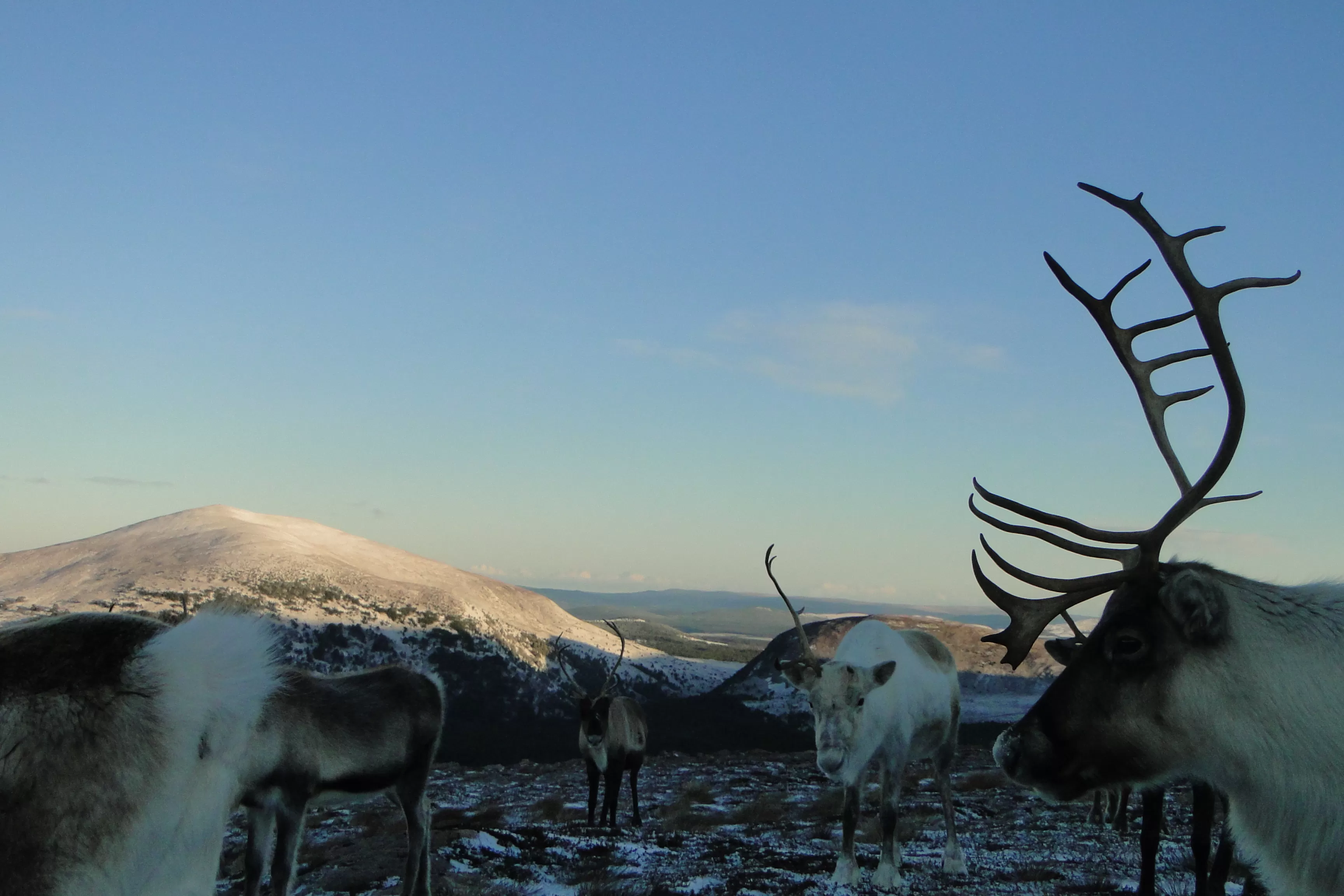 Reindeer herd stands in deep snow
Reindeer and Human Culture: Songs of Connection and Survival
For many indigenous cultures in the Arctic and sub-Arctic, reindeer are central to life, providing sustenance, materials, and forming a deep spiritual bond. Their presence is woven into creation stories, myths, and daily existence. The poetry and songs of these peoples often reflect this intrinsic connection, highlighting dependence, respect, and the shared fate of humans and herds. A powerful example comes from the Eveny people of Siberia, whose livelihoods depend entirely on reindeer herding. A song translated in Piers Vitebsky’s Reindeer People starkly illustrates this bond:
I have come from afar,
I have not beheld you for so long,
With all my heart I love you,
My Homeland!
The Autumn leaves fall,
My voice echoes far,
My song is about you, my homeland,
Birthplace of my ancestors
If the reindeer do not come,
If the herd turns away,
If the reindeer do not come,
There will be no more Eveny!
This short excerpt, though simple in language, carries immense weight. It links the very identity and survival of the Eveny people directly to the presence and health of the reindeer herd. The cyclical imagery of autumn leaves and echoing voice contrasts with the existential threat posed by the potential disappearance of the reindeer. It is a potent reminder that for some cultures, the relationship with the reindeer is not merely one of utility but of mutual existence – the fate of the people is inextricably tied to the fate of the animals. This type of reindeer poem or song functions as a cultural cornerstone, transmitting essential truths about their way of life across generations.
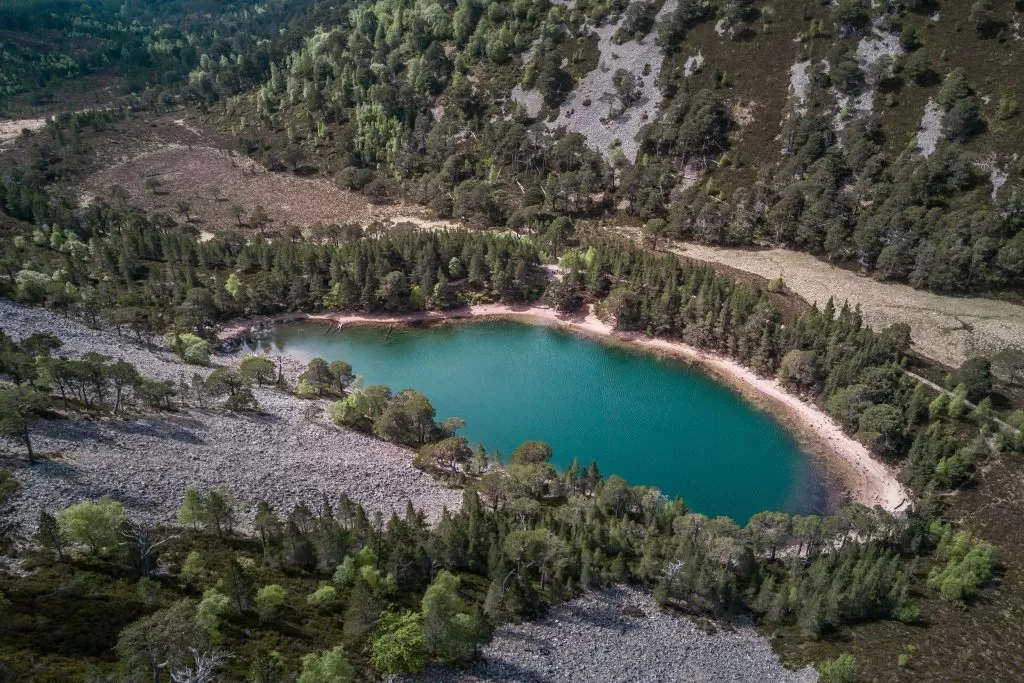 The Green Lochan, An Lochan Uaine, reflecting surrounding hills
Reindeer in Specific Landscapes: The Scottish Cairngorms
Reindeer also hold a unique place in specific geographic contexts, such as the Cairngorms in Scotland, where a herd was reintroduced in the mid-20th century. The presence of these animals in a landscape primarily known for red deer has inspired local reflections, sometimes questioning their place, sometimes celebrating their return. The “Stag party” poem, found in the book Hoofprints celebrating the 60th anniversary of reindeer in the Cairngorms, captures some of this historical tension and reflection:
O Lords of misty moor and ben!
O monarchs of the mountain glen!
Crowned with your proudly branching span
Surveys your kingdom while you can.
Where Affrie’s corried glen divides,
In Atholl’s furthest forest rides,
Amid the firs that fringe Loch Shin
Will feed the herds that fed the Finn.
Their splayed and hairy hooves will pound,
Your ancient Highland stamping ground
And Stalkers (snug in hats with flaps)
WIll hunt the quarry of the Lapps.
Will later landseers art portray
Proud Scandinavian stags at bay,
And (taxidermic’ly prepared)
Will foreign heads delight the laird?
Will other antlers grace the walls
As hatstands in suburban halls-
Sad pointers to the fact that you
Have yielded to the Caribou?
Shall reindeer, blue of flesh and blood,
Reign where the ruling red deer stood,
Or will one more invasion fail
And wiser councils yet prevail?
This poem, with its slightly provocative title “Stag party,” uses traditional Scottish imagery (“moor and ben,” “mountain glen”) to set the scene before introducing the “Finn” (Finnish) or “Lapps” (Sami) reindeer and their herds. It plays on the historical dominance of the red deer (“Stag,” “monarchs”) and contemplates the arrival of the reindeer, even referencing the initial plan for them to be a food source (“hunt the quarry,” “fed the Finn”). The final stanza directly poses the question of whether the reindeer will successfully establish themselves (“Reign where the ruling red deer stood”) or if this “invasion” will fail. It’s a fascinating glimpse into the specific cultural conversation around the reintroduction of reindeer into the Scottish Highlands, using poetic language to explore themes of native versus foreign species and changing landscapes.
Another poem linked to the Cairngorms region, though not directly about reindeer, is the Ryvoan Bothy poem. It speaks of the landscape the reindeer herd calls home, describing a journey through familiar hills and lochs:
I shall leave tonight from Euston by the seven-thirty train,
And from Perth in the early morning I shall see the hills again.
From the top of Ben Macdhui I shall watch the gathering storm,
And see the crisp snow lying at the back of Cairngorm.
I shall feel the mist from Bhrotain and the pass by Lairig Ghru
To look on dark Loch Einich from the heights of Sgoran Dubh.
From the broken Barns of Bynack I shall see the sunrise gleam
On the forehead of Ben Rinnes and Strathspey awake from dream.
And again in the dusk of evening I shall find once more alone
The dark water of the Green Loch, and the pass beyond Ryvoan.
For tonight I leave from Euston and leave the world behind;
Who has the hills as a lover, will find them wondrous kind.
This poem, often found pinned inside the rustic shelter it’s named after, paints a vivid picture of a journey into the heart of the Cairngorms. It names specific peaks and locations, grounding the verse firmly in the geography of the region. For anyone familiar with the area, or those who dream of visiting, this poem evokes the feeling of immersion in the mountain landscape – the changing weather, the specific quality of light at different times of day, and the deep connection felt by someone who considers the hills their “lover.” While devoid of reindeer, it captures the essence of the home where the Cairngorms herd thrives. Exploring christmas eve poems or a short christmas poem can offer a different, often more festive, perspective on reindeer, highlighting their symbolic role in winter celebrations.
 Nan Shepherd featured on a Scottish £5 banknote
Nan Shepherd, a celebrated writer and poet deeply connected to the Cairngorms, also captures the spirit of this landscape. Her poem “Loch Avon” (Loch A’an) speaks to the mysterious depth and enduring power of a specific mountain loch:
Loch A’an, Loch A’an, hoo deep ye lie!
Tell nane yer depth and nane shall I.
Bricht though yer deepmaist pit may be,
Ye’ll haunt me till the day I dee.
Bricht, an’ bricht, an’ bricht as air,
Ye’ll haunt me noo for evermair.
Shepherd’s use of the Doric dialect connects the poem intrinsically to the North East of Scotland. The focus on the hidden depth of the loch and its haunting beauty speaks to the profound, almost spiritual connection one can feel with such wild places. It reflects the sense of wonder and mystery that the mountains, and the creatures like reindeer that inhabit them, can inspire. For younger readers, exploring famous poems for kids might introduce animal themes that later bridge to appreciating a more complex reindeer poem.
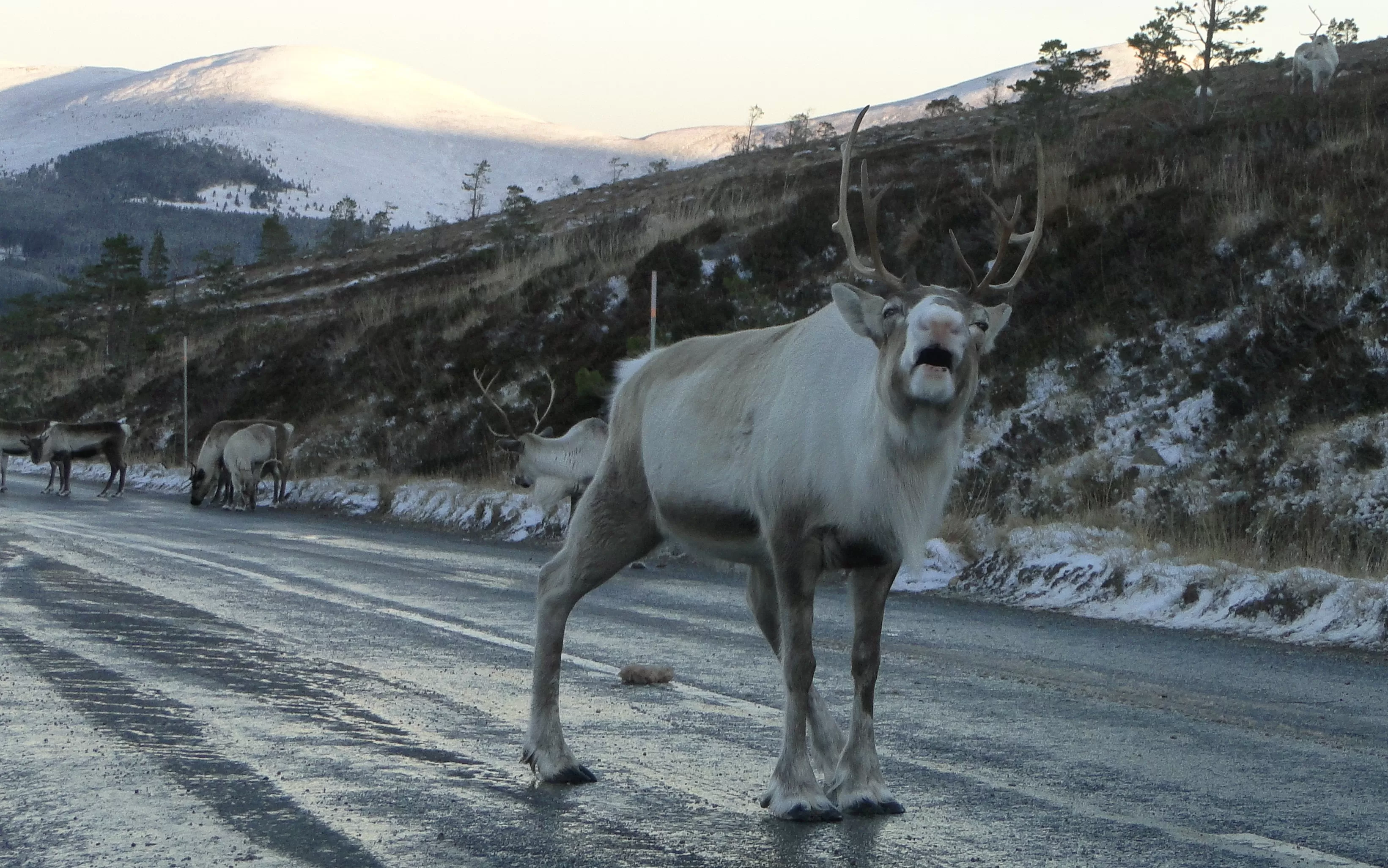 Reindeer walking on a snow-covered road
The Festive Reindeer in Poetry
While many poems about reindeer focus on their natural or cultural significance in northern regions, the figure of the reindeer is perhaps most widely known through festive traditions. The enduring image of rudolph the red nosed reindeer poem is a prime example of how this animal has been adopted into global folklore. While initially a commercial creation, the story of Rudolph and his luminous nose has become a beloved narrative, particularly in christmas eve poem and children’s literature. These poems, while different in tone and purpose from those celebrating the wild or cultural reindeer, highlight the animal’s capacity for inspiring stories of perseverance, acceptance, and festive magic. They demonstrate the versatility of the reindeer as a poetic subject, capable of representing both the stark realities of the wild and the joyful fantasy of the holidays.
Nan Shepherd featured on a Scottish £5 banknote
Conclusion
The reindeer poem, in its various forms, offers a window into the diverse ways these animals intersect with human life and imagination. From the epic migrations of the wild caribou captured in contemporary verse to the ancient songs of indigenous herders and the unique narrative woven into the Scottish landscape, reindeer inspire poetry that is as varied as the terrains they traverse. Whether evoking the stark beauty of the tundra, the deep bond between humans and herds, or the simple magic of a festive tale, poems about reindeer connect us to the northern world and the enduring power of nature and culture. They remind us that the spirit of the reindeer, much like the best poetry, can transport us to distant places and evoke powerful emotions, capturing the essence of a creature that is both wild and deeply intertwined with the human story. Exploring these poems allows us to appreciate the reindeer not just as an animal, but as a symbol rich with meaning and poetic potential.