
The experience of losing someone we love is profoundly difficult, leaving us grappling with a whirlwind of emotions. While grief is a deeply personal journey, poetry often serves as a poignant companion, offering words and structures to articulate the inexpressible pain. Sad poems on death provide a unique avenue for processing sorrow, validating feelings, and finding a shared sense of understanding in the face of loss. Instead of suppressing grief, engaging with these verses can be a cathartic release, helping us navigate the complex landscape of mourning.
Contents
- Verses of Profound Sorrow
- After the Funeral
- Tears on My Pillow
- Conversation Interrupted
- Death Has Parted Us
- Untimely Death of a Child
- I Thought We Had More Time
- I’ll See You Again Someday
- Short Reflections on Death’s Impact
- Death’s Reality
- Shroud of Grief
- Lost Without You
- You Can Never Lose a Friend
- Forever My Family
- Finding Your Way Through Sadness
The act of reading sad poetry about death isn’t about dwelling in despair; it’s about acknowledging the reality of loss and allowing the heart space to heal. These poems capture the raw ache, the quiet emptiness, and the lingering love that death leaves behind.
Verses of Profound Sorrow
Poems exploring death and dying often delve into the immediate aftermath of loss, the painful silence, and the struggle to envision a future without the departed. They speak to the abruptness of absence and the deep sense of dislocation experienced by those left behind.
After the Funeral
By Kelly Roper
The funeral is over,
And everyone has gone home.
It’s just me and my thoughts now,
And I’m sitting here alone.
The house seems so quiet,
and I’m not sure what to do.
I can’t remember how I lived
Before the day that I met you.
Maybe I should just stop thinking.
And take myself to bed.
I’ll crawl beneath the covers,
And lay down my weary head.
Tomorrow is a new day,
The first of many that I’ll face
Without you here beside me,
Without your strength, your wit, your grace.
I’ll try to carry on
Or at least I’ll try to exist.
Until one day you reach for me,
And guide me into death’s mist.
This poem captures the stark reality that sets in after the formalities of saying goodbye are complete. The speaker is left alone with the quiet void, struggling to recall a time before the presence of the lost loved one defined their world. It moves from the immediate disorientation to a tentative look towards a future marked by absence, culminating in a longing for eventual reunion. The simplicity of the language reflects the raw, unadorned nature of profound sadness.
Tears on My Pillow
By Kelly Roper
 Woman sitting on a bed, head in hands, looking sad after a loss
Tears on my pillow,
I can’t count how many I’ve cried.
I feel so awfully hollow,
Almost like it’s me that died.
How long will I feel so empty,
Will this heartache ever end?
How long will I have to wait,
Until we meet in Heaven, my friend?
The physical manifestation of grief – tears – is central to this short piece. The feeling of hollowness is so intense that it mirrors the state of death itself. The poem voices the common questions of duration and relief from pain, characteristic of early grief, and finds solace only in the hope of a future meeting.
Conversation Interrupted
By Kelly Roper
There’s so much left unspoken,
Too soon for our conversation to end.
I thought we’d have so many more years,
And so much more time to spend.
I wasn’t finished with my “I love yous,”
I had a million more to go.
You were my life, my lover, my friend,
And I wanted you to know.
I’m not ready to let you go
Off into that brilliant light.
I’d rather have kept you here with me,
And hung on with all my might.
But it’s too late, death has stolen you away
And there’s nothing left I can do.
So I’ll have to be patient until the day comes
When I can talk again with you.
This poem speaks to the suddenness of loss and the regret of unsaid words and unrealized future moments. It emphasizes the depth of the relationship lost (“my life, my lover, my friend”) and the futile wish to cling to the past. The final lines express a reluctant acceptance born out of powerlessness, resting hope in a future reunion.
Reflecting on themes of loss and longing can sometimes cast a new light on aspects of poetry that celebrate enduring connection or memory, much like the timeless verses found in the sonnets of shakespeare.
Death Has Parted Us
By Kelly Roper
Death has parted us my dear,
Something no mortal could do.
And I am left behind now,
Feeling oh so lost and blue.
No more will I rise each morning,
To see your dear, sweet face,
To hear you say good morning,
And fold me in your embrace.
We’ve kissed our final good night,
And we’ve said our last goodbye.
And now there’s nothing for me to do
But remember you my love, and cry.
The finality imposed by death is the core sorrow here. The poem lists the simple, cherished daily interactions that are now forever gone – seeing a face, hearing a greeting, receiving an embrace, saying good night. The contrast between the powerful force of “death” and the simple, domestic acts it has severed highlights the profound disruption to the speaker’s life. All that remains is the act of remembering and grieving.
Loss is perhaps most acutely felt when a life is cut short, before its potential could be fully realized. The death of a child is a particularly devastating form of grief, touching on themes of injustice and broken futures.
Untimely Death of a Child
By Kelly Roper
 Handwritten poem titled 'Tears on My Pillow' on aged paper background
A life so young and full of hope,
Cut down in its shining prime.
The death of a child never seems right,
A child should have so much more time.
A child should laugh and play and sing,
Not listen to the death knell ring.
Oh death, you are a heartless thing
To steal the life of a child.
This poem articulates the specific tragedy of losing a child. It focuses on the stark contrast between the child’s natural state – full of hope, meant for laughter, play, and song – and the unnatural stillness imposed by death. Death is personified as a “heartless thing” that steals what should never be taken, emphasizing the profound wrongness of a young life ending prematurely.
I Thought We Had More Time
By Thomma Lyn Grindstaff
You brought me into this world,
And you raised me up strong.
I thought we had more time,
But I know now I was wrong.
If I could see you one more time,
See your much-loved face.
If only I could tell you thanks
And feel your sweet embrace.
Did you know how much I love you
Before you had to pass?
If we only had more time,
I wouldn’t have to ask.
Why did I have to wait?
You’re gone, and it’s too late.
I worry about you not knowing,
And my tears will not stop flowing.
Death snatched you away,
And I must bear my shame.
I can say I love you in my heart,
But it’s just not the same.
This poem reflects on the specific grief following the death of a parent, focusing on the regret of missed opportunities for expressing love and gratitude. The speaker questions whether their parent knew the depth of their feelings before it was too late. This uncertainty becomes a source of guilt and sorrow, adding another layer to the pain of absence. The final line underscores the inadequacy of internal feelings when they can no longer be shared.
Loss extends beyond human relationships to the beloved animal companions who are like family. Their absence creates a unique and deeply felt sadness.
I’ll See You Again Someday
By Thomma Lyn Grindstaff
With your tail wagging
And your warm eyes so bright,
You were always happy to greet me,
Ever my heart’s delight.
I’ll no longer see you in this life
Tomorrow or today
But I know, somehow, some way,
I’ll see you again someday.
We’ll run straight to each other,
And my tears of joy will flow.
I’ll kiss your fur and sweet, wet nose
And never let you go.
For now, I have my memories,
Your toys and an old chewed shoe.
And I have a ragged hole in my heart
Shaped exactly like you.
This poem addresses the grief of losing a beloved pet. It highlights the simple, unconditional joy the animal brought (“always happy to greet me,” “heart’s delight”) through vivid sensory details like a wagging tail and bright eyes. The pain of present absence is countered by the hope of a future reunion, painted with imagery of running and joyful tears. The final stanza beautifully captures the physical remnants of the pet’s life (toys, shoe) and the enduring, specifically shaped void (“a ragged hole… shaped exactly like you”) left in the owner’s heart.
Contemplating the varied shapes of loss reminds us how deeply connection is woven into our lives, a theme beautifully explored in classic literary forms like a sample of a sonnet.
Short Reflections on Death’s Impact
Sometimes, the weight of grief can be captured in just a few lines. Short sad poems on death offer concise yet powerful expressions of sorrow, suitable for moments when longer verses feel overwhelming.
Death’s Reality
By Kelly Roper
 Stylized depiction of Death as a dark, hooded figure
Death,
The taker of life…
The bringer of sorrow…
The comforter of the afflicted…
The enemy of loved ones…
The ultimate destiny of every living being.
This short poem presents death not as an abstract concept but as an entity with multiple, often contradictory, roles. It is a “taker” and “bringer of sorrow,” but also, perhaps for the suffering, a “comforter.” Yet, for those left behind, it is an “enemy.” The final line anchors these varied roles in the universal truth of mortality, acknowledging death as the inevitable end for all.
Shroud of Grief
By Kelly Roper
Death is like a cold, gray shroud.
It lays heavy on my shoulders, and wraps me in its comfortless embrace.
Using a potent metaphor, this poem equates grief to a physical burden – a “cold, gray shroud.” It emphasizes the oppressive weight (“lays heavy”) and the lack of warmth or solace in its embrace (“comfortless embrace”), vividly conveying the isolating and chilling nature of deep sorrow.
Lost Without You
By Michele Meleen
Map without compass, night sky without the North Star, I’m lost without you.
This haiku-like poem uses simple, powerful metaphors of navigation to express disorientation caused by loss. A map and a compass, or the night sky and the North Star, are tools for finding one’s way. Without the loved one, who served as a guide or fixed point, the speaker feels utterly adrift and unable to find direction.
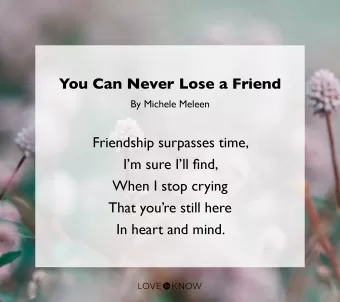
You Can Never Lose a Friend
By Michele Meleen
 Empty baby crib in a nursery with a handmade mobile hanging above
Friendship surpasses time,
I’m sure I’ll find,
When I stop crying
That you’re still here
In heart and mind.
This poem offers a glimmer of hope amidst sadness. While acknowledging the present tears, it asserts the enduring nature of true friendship. It suggests that despite physical absence, the essence of the friend remains alive within the speaker’s memories and feelings, transcending the limitations of time and physical presence.
The idea of enduring connection despite separation echoes through much of literature. Contemplating such bonds, whether friendly or romantic, can lead one to appreciate works like “shall i compare thee,” which immortalizes love through verse.
Forever My Family
By Michele Meleen
In life and death we’re family.
Through thick and thin,
Happiness and grief.
Wherever you’ve gone,
I’ll try to see,
You are forever my family.
This poem emphasizes the unbreakable bond of family, asserting that it persists even beyond death. It acknowledges the shared journey through life’s ups and downs (“thick and thin, Happiness and grief”) and finds strength in the conviction that the familial connection is eternal, regardless of physical separation.
Finding Your Way Through Sadness
Engaging with sad poems on death is a valid and healthy part of processing grief. These verses provide a voice for the pain, ensuring that the complexity of loss is acknowledged and honored. While the sadness may feel overwhelming at times, remember that grief is a process, not a permanent state. Allowing yourself to feel, to mourn, and to connect with the experiences captured in these poems can be a step towards finding solace and healing. Over time, the intense ache may soften, leaving space for cherished memories and a renewed appreciation for the life that was shared.