
The concept of a “pilgrim poem” often evokes images of weary travelers on a spiritual quest, seeking solace or revelation. In Kaveh Akbar’s profound collection, Pilgrim Bell, this journey is less about physical distance and more about the fraught interior landscape of language, faith, suffering, and the body. It is a book preoccupied with the difficult, often disorienting pilgrimage through self-knowledge and uncertainty, framed by the resonant, sometimes jarring, chime of the titular bell. Akbar’s poems serve as meditations on this inner journey, grappling with profound questions about what we know, what that knowing costs us, and whether relief might lie in surrender rather than certainty.
Contents
Pilgrim Bell invites readers into a space where language itself is both a vessel for truth and a source of pain, like seawater filling the lungs. The collection delves into the inherent struggles within communication – the effort to express faith, doubt, self-loathing, and praise. This makes the collection’s focus on the “pilgrim poem” less about arriving at a destination and more about the arduous, ongoing act of seeking itself.
The Language of the Pilgrim’s Struggle
One of the central conflicts in Pilgrim Bell is the struggle with language. Akbar’s speakers wrestle with the inadequacy of words to capture deep spiritual or emotional states. Language can feel heavy, a burden that pushes down on history and self. Yet, there’s also the recognition that even within this struggle, there’s potential. As one poem notes, “there is room in the language for being / without language.” This suggests moments of transcendence or understanding that exist beyond the confines of explicit articulation.
The desire to translate – whether texts, experiences, or the self – is also a form of pilgrimage. There’s an urge to move meaning from one form to another, to bridge gaps in understanding, much like a translator interpreting a score. Yet, the experience of hearing a language not one’s own can also highlight the limits of translation, leaving one buoyed on the surface of sound without grasping the underlying meaning. This duality underscores the pilgrim’s path: sometimes clarity is sought through definition and understanding, while at other times, a state of unknowing allows the mind to wander free.
Sound, Vibration, and Sacred Space
The recurring image of the bell in Pilgrim Bell highlights the significance of sound and vibration. The collection explores how sound moves through space and the body, alerting us to presence and absence. A voice’s vibration, the violence in the middle ear, the way new sounds resonate in a foreign language – all speak to how external forces impact our physical and internal landscapes. This resonates with the experience of walking into a resonant space like a mosque or cathedral, where one’s own voice changes the perception of the space itself.
This attention to vibration connects deeply with sacred practices, such as the recitation of Islamic Scripture with tajweed. This practice emphasizes the physical production of sound, pulling language into the body’s nooks and crannies. It suggests that spiritual experience is not purely intellectual but deeply physical, a vibration that seeks spaces within us where it can live and transform. The poems in Pilgrim Bell, through their focus on sound and the body, become spaces themselves – hollows waiting to be filled, perhaps with understanding, perhaps with something more divine.
The Body as a Site of Pilgrimage and Suffering
The pilgrim’s journey is often endured by the body, and Pilgrim Bell powerfully portrays the body as a site of both suffering and potential revelation. The collection is replete with tactile sensations, wounds, and physical impacts. The line “real faith passes first through the body / like an arrow” strikingly connects spiritual experience with physical vulnerability, perhaps echoing the imagery associated with figures like St. Sebastian, shot through with arrows as a test of faith.
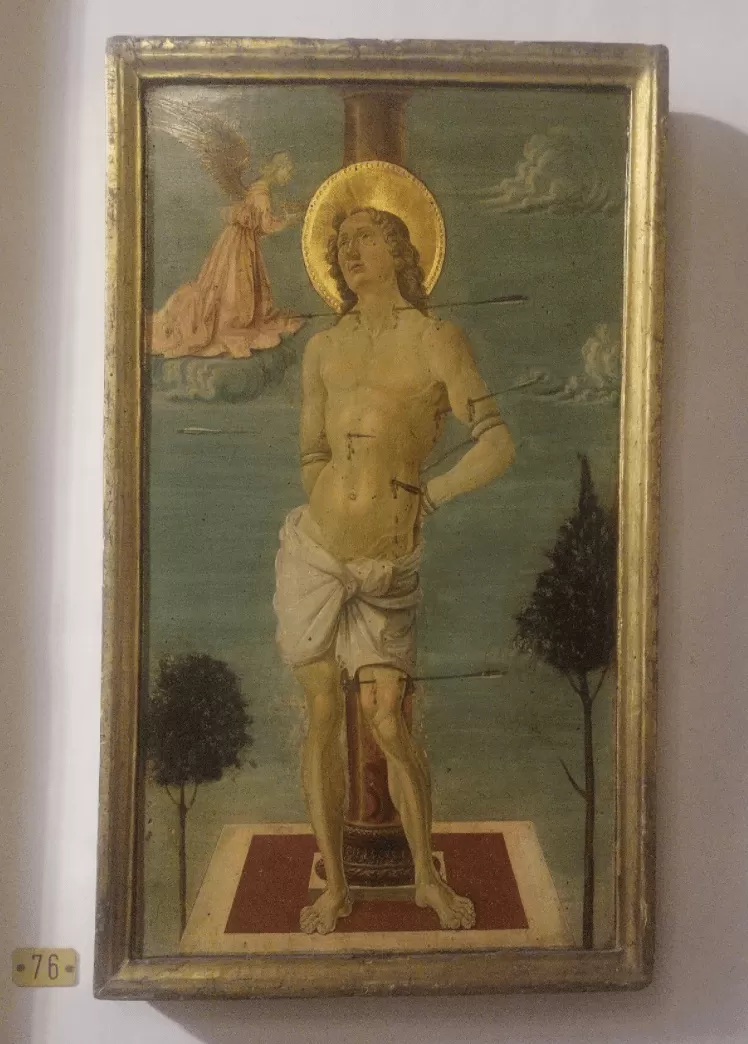 Painting of St. Sebastian pierced by arrows, illustrating suffering and faith
Like St. Sebastian, who survived his ordeal only to face death later, the speakers in Pilgrim Bell often express a longing for an end to their suffering or uncertainty. Yet, the poems often leave them, and the reader, surviving, carrying the marks of their journey forward. This duality – the pain that reveals our humanity and the necessity of continuing – is central to the collection’s exploration of incompleteness. The metaphor of atomic bonding, where atoms seek relief from turmoil by gaining or losing electrons to achieve stability, mirrors the human struggle for wholeness or peace, highlighting the inherent instability of being.
Divine Call and Human Response
The recurring motif of the bell, specifically its six rings compared to the typical five calls to Islamic prayer, raises questions about grace, mistakes, and second chances. Is the sixth ring an error, rendering the precise call inexact? Or is it an offering of grace, another opportunity to answer the call, to stand and begin again despite past failures or “sloppy postures of praise”? This ambiguity reflects the uncertainty of the spiritual path, where precision can be elusive, and faith may require embracing imperfection and the possibility of renewal.
The collection is rich with religious references, drawing from Islam, Christianity, and various spiritual traditions, featuring figures from St. Augustine to the prophet Muhammad, poets like John Donne, and contemporary writers like Anne Carson. This breadth of reference positions the pilgrim’s journey not within a single dogma but as a universal human experience of seeking, questioning, and engaging with the divine across different expressions of faith.
Living the Pilgrim’s Way
Ultimately, Pilgrim Bell doesn’t offer easy answers or a clear destination for the pilgrim. The journey is messy, filled with doubt, pain, and the limitations of language. The collection concludes by suggesting a way to navigate this ongoing journey, a path of survival that involves embracing the mundane alongside the profound: “How to live? reading poems, breathing shallow, spinning lettuce.”
This advice, seemingly simple, encapsulates the collection’s core message: the spiritual pilgrimage is interwoven with daily life. Reading poetry keeps us engaged with language and feeling; breathing reminds us of the body’s constant presence; spinning lettuce grounds us in simple, necessary tasks. The journey is not completed in a grand gesture but in the continuous, sometimes painful, sometimes ordinary, act of living and seeking. Engaging with poetry, discussing its complexities and emotional truths, feels like a deep, full breath on this challenging but essential path.
Pilgrim Bell stands as a powerful collection of “pilgrim poems,” chronicling an internal journey marked by intense suffering, a complex relationship with language, and a persistent grappling with faith and the body. It doesn’t shy away from the difficulty of this path but ultimately suggests that living, breathing, and continuing to engage with the world – and with words – is the most vital act of all.
For those interested in exploring the interplay of spirituality and the human condition in verse, Kaveh Akbar’s Pilgrim Bell offers a compelling example of the modern “pilgrim poem,” reminding us that the most significant journeys often occur within. Exploring themes of suffering and redemption can also be found in various literary works, including famous poems about friendship and death.