
Love, in its myriad forms, has been an inexhaustible source of inspiration for poets across ages and cultures. From the dizzying heights of newfound passion to the quiet comfort of enduring companionship, the ache of longing, or the resilience after heartbreak, the spectrum of human emotion surrounding love finds its most profound expression in poetry. For anyone seeking to understand, celebrate, or simply feel the weight of love through language, exploring poems about love offers a journey into the deepest recesses of the heart as articulated by history’s most eloquent voices. This collection brings together a selection of beautiful and significant love poems, offering a glimpse into the diverse ways poets have captured this universal experience.
Contents
- A Journey Through Love’s Poetic Landscape
- 1. “Come, And Be My Baby” by Maya Angelou
- 2. “Bird-Understander” by Craig Arnold
- 3. “Habitation” by Margaret Atwood
- 4. “Variations on the Word Love” by Margaret Atwood
- 5. “The More Loving One” by W.H. Auden
- 6. “To My Dear and Loving Husband” by Anne Bradstreet
- 7. “Always For The First Time” by André Breton
- 8. “Love and Friendship” by Emily Brontë
- 9. “To Be In Love” by Gwendolyn Brooks
- 10. “How Do I Love Thee? (Sonnet 43)” by Elizabeth Barrett Browning
- 11. “A Red, Red Rose” by Robert Burns
- 12. “She Walks in Beauty” by Lord Byron
- 13. “Love is a fire that burns unseen” by Luís Vaz de Camões
- 14. “Beautiful Signor” by Cyrus Cassells
- 15. “Rondel of Merciless Beauty” by Geoffrey Chaucer
- 16. “Love Comes Quietly” by Robert Creeley
- 17. “[i carry your heart with me(i carry it in]” by E. E. Cummings
- 18. “[love is more thicker than forget]” by E.E. Cummings
- 19. “Sthandwa sami (my beloved, isiZulu)” by Yrsa Daley-Ward
- 20. “Married Love” by Guan Daosheng
- 21. “Heart, we will forget him!” by Emily Dickinson
- 22. “Air and Angels” by John Donne
- 23. “Flirtation” by Rita Dove
- 24. “Heart to Heart” by Rita Dove
- 25. “Love” by Carol Ann Duffy
- 26. “The Love Poem” by Carol Ann Duffy
- 27. “Before You Came” by Faiz Ahmed Faiz
- 28. “Lines Depicting Simple Happiness” by Peter Gizzi
- 29. “Six Sonnets: Crossing the West” by Janice Gould
- 30. “For Keeps” by Joy Harjo
- 31. “You Are the Penultimate Love of My Life” by Rebecca Hazelton
- 32. “Yours” by Daniel Hoffman
- 33. “A Love Song for Lucinda” by Langston Hughes
- 34. “Poem for My Love” by June Jordan
- 35. “for him” by Rupi Kaur
- 36. Untitled by Rupi Kaur
- 37. “Poem To An Unnameable Man” by Dorothea Lasky
- 38. “Movement Song” by Audre Lorde
- 39. “Camomile Tea” by Katherine Mansfield
- 40. “Love Elegy in the Chinese Garden, with Koi” by Nathan McClain
- 41. “I think I should have loved you presently (Sonnet IX)” by Edna St. Vincent Millay
- 42. “Love Sonnet XI” by Pablo Neruda
- 43. “Your Feet” by Pablo Neruda
- 44. “Dear One Absent This Long While” by Lisa Olstein
- 45. “My Lover Is a Woman” by Pat Parker
- 46. “It Is Here” by Harold Pinter
- 47. “Untitled” by Christopher Poindexter
- 48. “Love Is Not A Word” by Riyas Qurana
- 49. “[Again and again, even though we know love’s landscape]” by Rainer Maria Rilke
- 50. “Echo” by Christina Rossetti
- 51. “I loved you first: but afterwards your love” by Christina Rossetti
- 52. “Defeated by Love” by Rumi
- 53. “Shall I compare thee to a summer’s day? (Sonnet 18)” by William Shakespeare
- 54. “Let me not to the marriage of true minds (Sonnet 116)” by William Shakespeare
- 55. “My mistress’ eyes are nothing like the sun” (Sonnet 130) by William Shakespeare
- 56. “Love’s Philosophy” by Percy Bysshe Shelley
- 57. “One Day I Wrote her Name (Sonnet 75)” by Edmund Spenser
- 58. “I Am Not Yours” by Sara Teasdale
- 59. “Now Sleeps the Crimson Petal” by Alfred, Lord Tennyson
- 60. “poem I wrote sitting across the table from you” by Kevin Varrone
- 61. “On Earth We’re Briefly Gorgeous” by Ocean Vuong
- 62. “Love After Love” by Derek Walcott
- 63. “I Love You” by Ella Wheeler Wilcox
- 64. “We Have Not Long to Love” by Tennessee Williams
- 65. “Poem to First Love” by Matthew Yeager
- The Enduring Resonance of Poems About Love
Throughout history, poets like Rumi, Shakespeare, and contemporary voices such as Rupi Kaur have delved into the complexities of love. These verses not only provide solace or inspiration but also illuminate the intricate dance between emotion, language, and form. Whether you are looking for words to share, comfort in shared experience, or a deeper appreciation for the art form, these poems about love resonate with timeless truth and beauty.
A Journey Through Love’s Poetic Landscape
Poetry allows us to articulate feelings that often defy simple explanation. Here, we explore a curated collection of poems, each offering a unique perspective on love’s many facets.
1. “Come, And Be My Baby” by Maya Angelou
Maya Angelou, a celebrated figure in American literature and civil rights, masterfully captures the solace found in love amidst life’s chaos. In ‘Come, And Be My Baby,’ she portrays love as a refuge, a place of comfort and respite from an overwhelming world, even if fleeting.
2. “Bird-Understander” by Craig Arnold
Craig Arnold’s ‘Bird-Understander’ stands out for its raw honesty. The poem reflects on a moment with a partner that deepens his love, using simple yet powerful language and a central metaphor that enhances the reader’s connection to his feelings.
3. “Habitation” by Margaret Atwood
Margaret Atwood, known for her sharp, realistic prose, brings the same candor to ‘Habitation.’ This poem acknowledges the inherent challenges within marriage and the conscious effort required to sustain it, celebrating the beauty found in enduring real-world love.
4. “Variations on the Word Love” by Margaret Atwood
Love manifests in countless ways, from platonic affection to passionate desire and even possessive attachment. Margaret Atwood unflinchingly examines some of these varied forms in her thought-provoking poem ‘Variations on the Word Love,’ exploring the word’s expansive and sometimes contradictory meanings.
5. “The More Loving One” by W.H. Auden
While often associated with joy, love also encompasses the pain of loss. W.H. Auden’s ‘The More Loving One’ uses a celestial extended metaphor to explore the ache of unrequited love or heartbreak, concluding with the poignant acceptance of being the one who loved more deeply, despite the sorrow it brings.
6. “To My Dear and Loving Husband” by Anne Bradstreet
Reflecting her Puritan faith and view of marriage as a divine gift, Anne Bradstreet’s ‘To My Dear and Loving Husband’ is a powerful declaration of marital devotion. Read today, its genuine gratitude and unwavering commitment make it a deeply moving testament to enduring love.
7. “Always For The First Time” by André Breton
André Breton, a pioneer of the surrealist movement, offers an ode to a woman he anticipates meeting in ‘Always For The First Time.’ The poem blurs reality and dreams, portraying a whimsical, persistent love that finds renewal and discovery in every awaited moment.
8. “Love and Friendship” by Emily Brontë
Love is not limited to romance; the bond between friends can be equally profound. Emily Brontë’s ‘Love and Friendship’ contrasts romantic love, likened to a beautiful but fleeting rose, with friendship, depicted as an enduring holly tree capable of withstanding all seasons.
 Person walking through a field of tall, colorful flowers, symbolizing the enduring beauty of nature and potentially, the depth of friendship as described by Brontë.
9. “To Be In Love” by Gwendolyn Brooks
Gwendolyn Brooks, the first African-American Pulitzer Prize winner, captures the transformative power of falling in love in ‘To Be In Love.’ The poem conveys the intense emotions and altered perspective that accompany deep affection, suggesting love allows one to “touch with a lighter hand” and feel profoundly well within oneself.
10. “How Do I Love Thee? (Sonnet 43)” by Elizabeth Barrett Browning
One of the most iconic love poems in the English language, Elizabeth Barrett Browning’s ‘How Do I Love Thee?’ offers an ardent yet clear enumeration of the ways the speaker’s soul loves her beloved. Its enduring resonance lies in its heartfelt declaration of a love that reaches spiritual depths.
11. “A Red, Red Rose” by Robert Burns
Robert Burns’s ‘A Red, Red Rose’ is a classic expression of passionate love. He compares his ‘Luve’ to a vibrant rose and a melodious song, emphasizing its intensity and beauty. The poem’s simple, heartfelt comparisons highlight a love that surpasses even the loveliest language.
12. “She Walks in Beauty” by Lord Byron
Lord Byron, though known for a life of adventure, penned a strikingly pure appreciation of beauty in ‘She Walks in Beauty.’ The poem focuses on the serene, internal beauty of a woman, comparing her to the night sky and its harmonious light, presenting a romantic admiration distinct from mere physical passion.
13. “Love is a fire that burns unseen” by Luís Vaz de Camões
Portugal’s renowned poet, Luís Vaz de Camões, explores the paradoxical nature of love in ‘Love is a fire that burns unseen.’ Drawing from his own turbulent experiences, the poem describes love as a complex mix of pleasure and pain, an internal fire, a wound, and a restless contentment.
14. “Beautiful Signor” by Cyrus Cassells
From his collection dedicated to ‘Lovers everywhere,’ Cyrus Cassells’s ‘Beautiful Signor’ is set against the backdrop of the AIDS epidemic. It speaks of an expansive, enduring love (“April-upon-April love”) that leads towards something beautiful and revealed, reminding readers of romantic love’s potent beauty and significance.
15. “Rondel of Merciless Beauty” by Geoffrey Chaucer
Widely regarded as the ‘Father of English poetry,’ Geoffrey Chaucer explores the pain of unrequited or lost love in ‘Rondel of Merciless Beauty.’ The speaker pledges everlasting devotion to a love who left him, emphasizing the torment caused by her beauty and the depth of his enduring pain.
16. “Love Comes Quietly” by Robert Creeley
Robert Creeley’s brief, impactful poem ‘Love Comes Quietly’ captures the feeling of profound connection and the desire for constant togetherness that love can bring. It suggests a love so absorbing it makes one forget a time before the beloved was present.
 Abstract image with soft, flowing lines, suggesting the quiet, natural arrival of love.
17. “[i carry your heart with me(i carry it in]” by E. E. Cummings
E.E. Cummings, a master of form and sentiment, presents one of his most famous love poems in ‘[i carry your heart with me(i carry it in].’ The poem’s unique typography and intimate imagery convey a sense of complete union and infatuation, where the speaker’s identity is inseparable from that of the beloved.
18. “[love is more thicker than forget]” by E.E. Cummings
Another brilliant exploration of love’s complexity by Cummings, ‘[love is more thicker than forget]’ paints love as a paradox. It’s described through seemingly contradictory comparisons – rarer than a wet wave, more frequent than failure – highlighting its profound, elusive, and ever-present nature.
19. “Sthandwa sami (my beloved, isiZulu)” by Yrsa Daley-Ward
From her revealing collection bone, Yrsa Daley-Ward’s ‘Sthandwa sami (my beloved, isiZulu)’ offers a deeply personal account of love. It describes a future envisioned with the beloved and expresses a sense of finally feeling like oneself again in their presence, connecting love to vulnerability and authentic identity.
20. “Married Love” by Guan Daosheng
Guan Daosheng, a poet from the Yuan Dynasty, uses the metaphor of clay figurines in ‘Married Love’ to represent the union of two lovers through marriage. Just as clay is molded and solidified together, the poem suggests love joins two individuals into a single, enduring form.
21. “Heart, we will forget him!” by Emily Dickinson
In her characteristic forceful style, Emily Dickinson’s ‘Heart, we will forget him!’ captures the intense struggle to move on after a passionate love affair ends. The speaker attempts to command her own heart and mind to forget, revealing the futility of such efforts against deep-seated emotion.
 A vintage image of a heart-shaped locket, symbolizing hidden feelings or past love.
22. “Air and Angels” by John Donne
John Donne, known for his metaphysical poetry exploring faith, salvation, and love, compares his love to the pure, elegant movement of angels in ‘Air and Angels.’ The poem concludes by suggesting that two lovers can come together to enhance each other, making their individual loves stronger in union.
23. “Flirtation” by Rita Dove
Rita Dove’s ‘Flirtation’ joyfully captures the exhilarating anticipation at the beginning of a new romance. The poem uses vivid imagery (“night strewn salt across the sky”) and sensory details (“My heart is humming a tune”) to convey the sparkling excitement and hopefulness of early love.
24. “Heart to Heart” by Rita Dove
In ‘Heart to Heart,’ Rita Dove deliberately subverts common love clichés. She speaks directly about the physical heart, noting it “doesn’t melt / or turn over,” to convey a more grounded, perhaps less demonstrative, but equally genuine love that exists despite the absence of typical romantic expressions.
25. “Love” by Carol Ann Duffy
Britain’s first female and openly lesbian Poet Laureate, Carol Ann Duffy, describes love as beautifully boundless in her poem ‘Love.’ Using natural imagery like the sea aching for the shore and the sun covering trees in gold, she connects love to elemental forces that transcend reason and season.
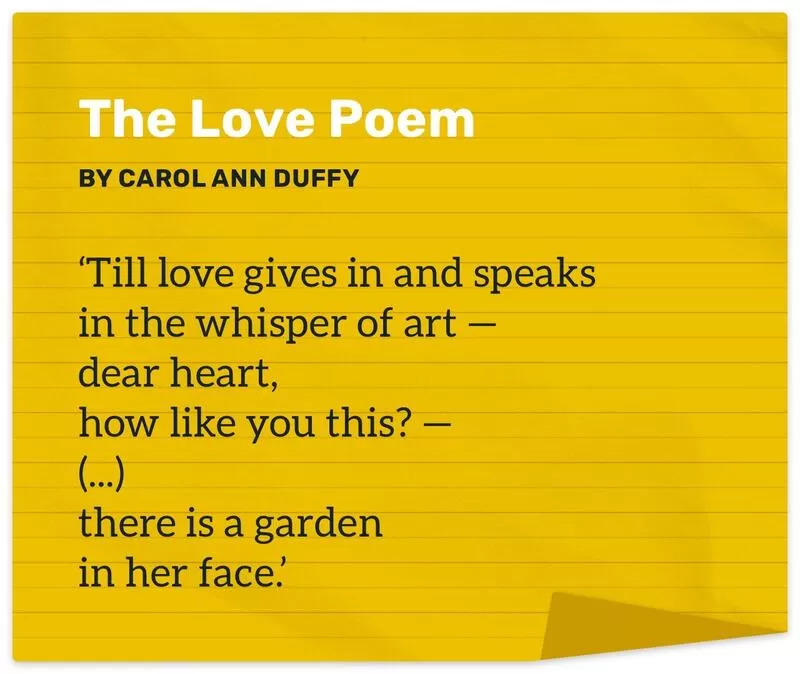
26. “The Love Poem” by Carol Ann Duffy
From her collection Rapture, which charts a love affair, Carol Ann Duffy gets metafictional in ‘The Love Poem,’ exploring the challenge of articulating love itself through poetry. The poem reflects the struggle to find adequate words to capture the depth and complexity of her feelings.
 An image depicting a quill or pen over a piece of paper, symbolizing the act of writing poetry.
27. “Before You Came” by Faiz Ahmed Faiz
Faiz Ahmed Faiz, celebrated for his Urdu poetry, writes about the transformative impact of love on his perception of reality in ‘Before You Came.’ The poem describes how the beloved’s presence restores the world to its true form, emphasizing the speaker’s deep reliance on their love to see clearly.
28. “Lines Depicting Simple Happiness” by Peter Gizzi
Peter Gizzi finds beauty in simplicity in ‘Lines Depicting Simple Happiness.’ His clear adoration for his beloved avoids clichés, making the poem feel personal and genuine. He expresses a deep desire to know everything about the person, acknowledging that love, while not always simple, feels inherently right.
29. “Six Sonnets: Crossing the West” by Janice Gould
Janice Gould’s work often explores themes of love and identity, particularly as a Maidu lesbian. In ‘Six Sonnets: Crossing the West,’ she equates her absent lover to a dream, describing her in ethereal ways and mourning their temporary separation, highlighting the pain of distance in love.
30. “For Keeps” by Joy Harjo
Joy Harjo creates a powerful connection between love and the natural world in ‘For Keeps.’ By comparing her feelings for her lover to the beauty and constancy of nature, she builds an image of an unbreakable bond, illustrating the depth and permanence of her affection.
 An illustration or photo showing diverse natural elements intertwined, representing how love can be woven into the fabric of life, like nature.
31. “You Are the Penultimate Love of My Life” by Rebecca Hazelton
Rebecca Hazelton offers an unorthodox, realistic take on love in ‘You Are the Penultimate Love of My Life.’ The speaker acknowledges the relationship’s imperfections and transient nature (“the vowels / we speak aren’t vows”), yet recognizes a compelling force (“something holding me here, for now”), celebrating a love that is special despite not being the fabled “soulmate” connection.
32. “Yours” by Daniel Hoffman
Daniel Hoffman uses carefully chosen metaphors from the natural world in ‘Yours’ to express complete dedication. Comparing his beloved to elements like summer air, linden blossoms, and moonlight on a snowcap, he emphasizes how essential she is to his existence, suggesting life without her would be bleak and lifeless.
33. “A Love Song for Lucinda” by Langston Hughes
Langston Hughes employs metaphors linking love to the natural world in ‘A Love Song for Lucinda.’ Each stanza compares love to a distinct feeling tied to nature, such as a “high mountain,” emphasizing the exhilaration and all-encompassing enchantment of falling in love, while also hinting at its potential challenges.
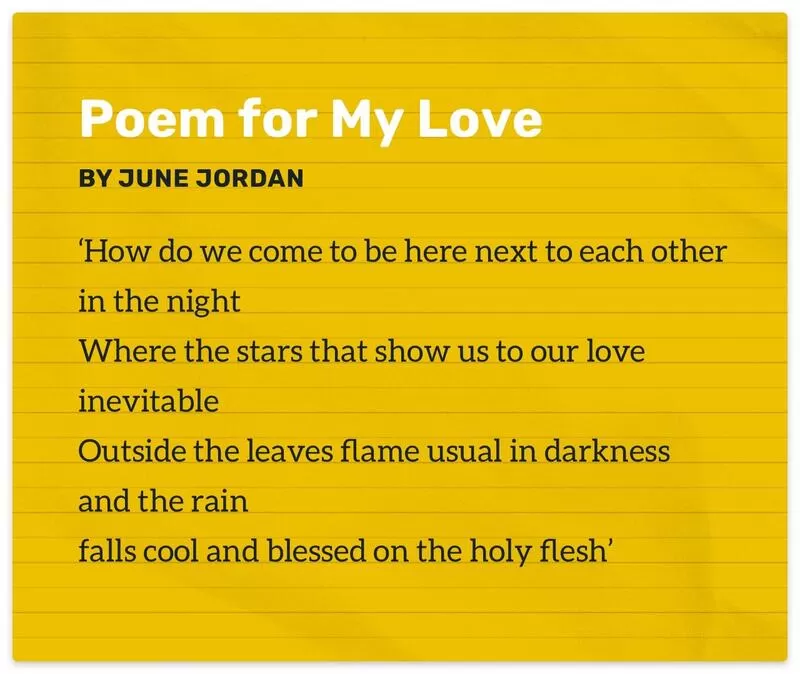
34. “Poem for My Love” by June Jordan
June Jordan, a significant Jamaican American writer and activist, expresses spiritual awe for her partner in ‘Poem for My Love.’ The speaker is profoundly moved by her beloved and the transcendent nature of their connection, highlighting a deep, almost reverent, sense of love.
 A person looking contemplatively at a landscape, suggesting deep emotion or spiritual connection often found in love poems.
35. “for him” by Rupi Kaur
From her widely popular collection milk and honey, Rupi Kaur’s ‘for him’ speaks to the idea of destined love and recognition. She describes meeting her beloved not as “love at first sight” but “love at first remembrance,” suggesting a soul-deep connection recognized even before their meeting through a mother’s wisdom.
36. Untitled by Rupi Kaur
Another short, impactful poem from milk and honey, this untitled piece by Rupi Kaur takes a compassionate view of love’s difficulties. It acknowledges that love can cause pain but asserts that this pain is never intentional, positioning love as inherently gentle despite life’s hardships.
37. “Poem To An Unnameable Man” by Dorothea Lasky
Dorothea Lasky uses celestial imagery in ‘Poem To An Unnameable Man’ to explore a romantic relationship. The speaker conveys a sense of power and insight underestimated by the lover, asserting her profound understanding and claim over him, despite his expectations to the contrary.
38. “Movement Song” by Audre Lorde
Audre Lorde’s ‘Movement Song’ deals with the aftermath of a relationship’s end. While acknowledging the sorrow of heartbreak, the poem ultimately offers a message of hope for a new beginning for both individuals, suggesting that even after separation, the possibility of moving forward exists.
 A path winding through a landscape, symbolizing a journey or new direction after a significant event like the end of a relationship.
39. “Camomile Tea” by Katherine Mansfield
Katherine Mansfield excels at simplifying complex emotions. ‘Camomile Tea’ paints a tranquil, intimate portrait of a couple finding quiet happiness and comfort in their shared, ordinary life. It highlights the often-understated joy of peaceful familiarity within a relationship.
40. “Love Elegy in the Chinese Garden, with Koi” by Nathan McClain
Inspired by a visit to a botanical garden, Nathan McClain’s ‘Love Elegy in the Chinese Garden, with Koi’ explores the anxiety and emotional baggage present between potential lovers, particularly influenced by past failed relationships. The poem questions the capacity for love after being hurt, reflecting on the difficulty of truly moving on.
41. “I think I should have loved you presently (Sonnet IX)” by Edna St. Vincent Millay
Edna St. Vincent Millay’s ‘I think I should have loved you presently’ subverts the traditional sonnet form to lament the speaker’s inability to fully reciprocate genuine affection. Instead of deep connection, she chose superficial flirtation, expressing regret for the potential for true love that was missed.
42. “Love Sonnet XI” by Pablo Neruda
Pablo Neruda’s ‘Love Sonnet XI’ conveys an intense sense of longing and near-obsessive desire. The speaker’s thoughts are consumed by the beloved, to the point that ordinary life is disrupted, portraying a love that is both passionate and overwhelming.
43. “Your Feet” by Pablo Neruda
In ‘Your Feet,’ Neruda expresses devotion by focusing on specific physical details, specifically the beloved’s feet. This unique perspective emphasizes a love that appreciates every part of the person, giving thanks for the forces that brought them together, creating an intimate and grateful portrayal of love.
Focusing on a small detail, like feet or hands, symbolizing an intimate and personal appreciation of the beloved.
44. “Dear One Absent This Long While” by Lisa Olstein
Lisa Olstein’s ‘Dear One Absent This Long While’ captures the nervous anticipation of waiting for a loved one’s return. The speaker sees glimpses of the beloved everywhere but is met with natural elements, highlighting the anxiety of absence and the deep longing to return to the comfort and completeness their presence brings.
45. “My Lover Is a Woman” by Pat Parker
Pat Parker, an African-American lesbian feminist poet and activist, finds refuge and safety in her love in ‘My Lover Is a Woman.’ The poem speaks to the struggles faced by marginalized individuals and portrays the beloved as a safe harbor and source of strength amidst external challenges.
46. “It Is Here” by Harold Pinter
Harold Pinter’s ‘It Is Here’ explores the transcendent nature of relationships. The speaker reflects on the enduring presence of a foundational moment (“the breath we took when we first met”), suggesting that the essence of their connection remains accessible and real, bridging time and space.
47. “Untitled” by Christopher Poindexter
Christopher Poindexter’s untitled poem offers an honest and relatable depiction of a love that surpasses language. The speaker describes an overwhelming and paradoxical longing for the beloved, even when they are physically present, suggesting the depth of feeling cannot be contained by words like “I love you.”
48. “Love Is Not A Word” by Riyas Qurana
Riyas Qurana’s “Love Is Not A Word” is an ambiguous poem exploring the elemental nature of love from a personified perspective. Comparing love to a falling flower held mid-air, it challenges the reader to engage with and define love beyond mere vocabulary, emphasizing its intrinsic connection to human experience and nature.
49. “[Again and again, even though we know love’s landscape]” by Rainer Maria Rilke
Rainer Maria Rilke, who believed love was a difficult task, celebrates the continuous, everyday effort of shared love in this untitled poem. Despite acknowledging love’s potential for pain (“lamenting names,” “terrible reticent gorge”), the poem finds strength and beauty in the repeated choice to walk out together, vulnerable yet united.
50. “Echo” by Christina Rossetti
Christina Rossetti’s ‘Echo’ is a poignant reflection on lost love and the desperate yearning for its return. The speaker longs for her ex-lover, wishing their connection could echo back to her, creating a heartbreaking yet beautiful portrayal of grief and enduring desire after loss.
 A person standing alone in a vast, empty space, suggesting loneliness or the echo of absence after loss.
51. “I loved you first: but afterwards your love” by Christina Rossetti
Also by Christina Rossetti, this poem explores the dynamic between two lovers’ affections. Despite initially questioning who loved whom more intensely, a strong sense of “oneness” emerges. The poem describes how their individual feelings combine to create a single, profound love, a whole greater than its parts.
52. “Defeated by Love” by Rumi
The 13th-century Persian poet Rumi’s words transcend time and culture, offering powerful expressions of devotion. In ‘Defeated by Love,’ the speaker is overwhelmed (“fell to the ground”) and transformed by the sheer power and magnificence of divine or earthly love, ready to forsake the material world for its intensity.
53. “Shall I compare thee to a summer’s day? (Sonnet 18)” by William Shakespeare
Perhaps the most famous love poem in English, William Shakespeare’s ‘Sonnet 18’ begins with an iconic line that leads to a deeper exploration of love’s ability to immortalize beauty. Unlike the transient beauty of a summer day, the beloved’s beauty will live forever within the “eternal lines” of this verse.
 An aged book or manuscript, symbolizing timeless literary works and the enduring power of classic poetry.
54. “Let me not to the marriage of true minds (Sonnet 116)” by William Shakespeare
In ‘Sonnet 116,’ Shakespeare defines true love by its unwavering constancy. He argues that love is not genuine if it changes when circumstances change or if the beloved alters. Instead, true love is an “ever-fixed mark,” a steadfast beacon that endures storms and time itself.
55. “My mistress’ eyes are nothing like the sun” (Sonnet 130) by William Shakespeare
Shakespeare playfully challenges idealized beauty standards in ‘Sonnet 130.’ He describes his mistress’s physical attributes frankly, admitting she doesn’t fit conventional poetic comparisons. However, he concludes that his love is as “rare” and valuable as any falsely praised beauty, celebrating a love that is real rather than idealized.
56. “Love’s Philosophy” by Percy Bysshe Shelley
Percy Bysshe Shelley presents a logical, almost persuasive argument for love in ‘Love’s Philosophy.’ He observes how all elements in nature mingle and connect (“The fountains mingle with the river”), suggesting it is a natural law for things to unite. He uses this observation to ask why he and his beloved should not also mingle and unite in love.
57. “One Day I Wrote her Name (Sonnet 75)” by Edmund Spenser
From his sonnet sequence Amoretti, Edmund Spenser’s ‘Sonnet 75’ reflects on attempts to immortalize his love by writing her name in the sand, only for the waves to wash it away. Despite this physical impermanence, he asserts that their love, recorded in verse, will achieve eternal fame and endure beyond the transient world.
58. “I Am Not Yours” by Sara Teasdale
Sara Teasdale’s ‘I Am Not Yours’ expresses a profound longing for a deeper, more consuming love than the speaker currently possesses. The poem conveys a sense of not truly belonging in her present relationship and a strong desire to find a connection where she can feel completely lost and immersed in the other’s affection.
 A single person walking towards a bright light or horizon, symbolizing a search or longing for something more fulfilling in love.
59. “Now Sleeps the Crimson Petal” by Alfred, Lord Tennyson
A sensual song from Tennyson’s The Princess, ‘Now Sleeps the Crimson Petal’ draws inspiration from the Persian ghazal, a form often dealing with unsustainable love. Tennyson uses rich, evocative natural imagery (“crimson petal,” “milk-white peacock,” “firefly”) to create a masterclass in sensual description and invite the beloved to awaken to desire.
The beauty of poetry lies in its ability to bottle complex feelings within carefully chosen words and forms. Whether exploring romantic connections, the bonds of friendship, or the solitary experience of longing, poems for easter sunday and other thematic collections remind us of the power of verse to connect us to our emotions and shared human experiences.
60. “poem I wrote sitting across the table from you” by Kevin Varrone
Kevin Varrone’s ‘poem I wrote sitting across the table from you’ captures an intimate, in-the-moment feeling of closeness. Written while working in a coffee shop, it expresses the speaker’s desire for his beloved to accompany him on all his journeys, from the mundane to the fantastical, highlighting a simple yet deep connection.
61. “On Earth We’re Briefly Gorgeous” by Ocean Vuong
Known also for his novel of the same name, Ocean Vuong’s poem ‘On Earth We’re Briefly Gorgeous’ explores themes of desire, impermanence, and craving within love. It invites readers to slow down and absorb the language, reflecting on the transient yet powerful nature of human connection and the indelible mark it leaves.
62. “Love After Love” by Derek Walcott
Nobel laureate Derek Walcott offers a poem of reassurance and self-love in ‘Love After Love.’ Addressed to someone recovering from heartbreak, it encourages the reader to embrace their own self, the “stranger who was your self,” suggesting that the most important love is the one for oneself, which has been there all along.
63. “I Love You” by Ella Wheeler Wilcox
Ella Wheeler Wilcox’s ‘I Love You’ lists specific, often sensual, details that ignite the speaker’s passion – lips “wet with wine,” eyes “lit with a passionate fire,” arms in a “fond embrace.” By juxtaposing these vivid descriptions with a rejection of colder, less passionate attributes, the poem emphasizes the special intensity of the love being described.
64. “We Have Not Long to Love” by Tennessee Williams
While primarily known as a playwright, Tennessee Williams was also an accomplished poet. In ‘We Have Not Long to Love,’ he stresses the importance of cherishing the present moments in love. The poem serves as a reminder of life’s impermanence and the need to appreciate the love we have before it is gone.
 A serene image of a couple or figures silhouetted against a sunset, symbolizing the beauty and preciousness of shared time in love.
65. “Poem to First Love” by Matthew Yeager
Matthew Yeager’s ‘Poem to First Love’ is a bittersweet reflection on a formative past relationship. The speaker attempts to quantify the impact of being told “I love you” for the first time, comparing it to a significant landmark like the Chrysler building – perhaps not the tallest, but the most beautiful and meaningful peak in their emotional history.
The Enduring Resonance of Poems About Love
This collection merely scratches the surface of the vast and varied world of poems about love. Each verse, whether ancient or modern, familiar or new, offers a window into the profound and often complex ways humans experience connection, desire, loss, and comfort. These poems stand as testaments to love’s power to inspire, wound, heal, and transform, ensuring that this central theme will continue to bloom in poetry for generations to come.