
Beatrice, a name synonymous with ethereal beauty and spiritual love, holds a central place in the poetic universe of Dante Alighieri. Her presence, both earthly and divine, permeates his works, most notably La Vita Nuova and The Divine Comedy. While her historical existence remains shrouded in some mystery, her impact on Dante’s literary output is undeniable, cementing her status as one of literature’s most captivating muses.
Contents
 Dante and Beatrice
The Enigmatic Beatrice: History and Legend
The question of Beatrice’s true identity has long fascinated scholars. Was she merely a figment of Dante’s poetic imagination, a symbolic embodiment of idealized love? Or was she a real woman who walked the streets of Florence, inspiring Dante’s profound artistic expressions?
The prevailing scholarly consensus identifies Beatrice with Bice di Folco Portinari, a Florentine woman mentioned in historical documents, including her father’s will. This identification aligns with details provided by Dante in La Vita Nuova, lending credence to the theory that Beatrice was indeed a flesh-and-blood individual. However, the scarcity of documented evidence surrounding her life leaves room for speculation and continues to fuel the debate.
Beatrice Portinari: A Glimpse into Her World
Beatrice, daughter of the influential Florentine banker Folco Portinari, lived near Dante’s family home. This proximity suggests that their paths may have crossed frequently during their youth. She married Simone de’ Bardi, another prominent figure in Florence, and tragically died at the young age of twenty-four, just three years after her marriage. This untimely demise deeply affected Dante and profoundly shaped his artistic vision.
Dante and Beatrice: A Love Story for the Ages
Dante’s first encounter with Beatrice, as recounted in La Vita Nuova, occurred at a May Day party when he was nine and she was eight. This fleeting childhood encounter sparked a lifelong devotion in Dante, a love that transcended the earthly realm. While Dante later married Gemma Donati and had children, Beatrice remained the enduring object of his affections, a source of both inspiration and spiritual yearning.
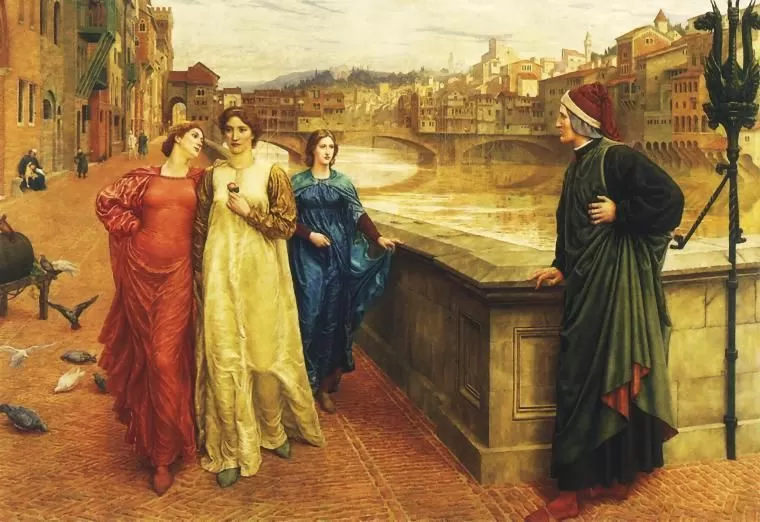 The encounter between Dante and Beatrice in Florence
Their subsequent meetings, brief and infrequent, were etched into Dante’s memory. He describes a chance encounter on the Lungarno, a street along the Arno River, where Beatrice, dressed in white, offered him a simple greeting. This seemingly insignificant gesture ignited a flame within Dante, fueling his poetic imagination and inspiring the first sonnet of La Vita Nuova.
Beatrice’s Enduring Legacy in Dante’s Works
Beatrice’s influence on Dante’s writing extends beyond mere inspiration; she becomes a vital character in his literary masterpieces. La Vita Nuova, a collection of poems and prose dedicated to Beatrice, chronicles Dante’s love for her, his emotional turmoil, and his spiritual awakening. This work lays the groundwork for her even more significant role in The Divine Comedy.
In The Divine Comedy, Beatrice transcends her earthly existence and becomes a divine guide, leading Dante through the realms of the afterlife. She intercedes for him in Inferno, motivates his journey through Purgatorio, and ultimately guides him through Paradiso to the very presence of God. Her transformation from earthly beloved to heavenly intercessor highlights the spiritual depth of Dante’s love and underscores her crucial role in his journey toward salvation.
Beatrice: More Than a Muse
Beatrice’s significance in Dante’s work goes beyond that of a simple muse. She represents an ideal of beauty, grace, and spiritual purity, embodying the transformative power of love. While her historical identity may remain partially obscured, her impact on literature is undeniable. Through Dante’s immortal verses, Beatrice Dante Alighieri continues to captivate readers and inspire contemplation on the nature of love, loss, and the journey of the human soul.