
Geoffrey Chaucer’s The Canterbury Tales stands as a cornerstone of English literature, a vibrant tapestry woven from diverse stories and unforgettable characters. However, accessing this masterpiece presents a unique challenge for modern readers: the text was written in Middle English, a linguistic landscape significantly different from our own. This linguistic divide has led to a multitude of translations and editions, leaving many readers wondering: what is the best Canterbury Tales translation? Is it one that smooths over the difficulties for easy reading, or one that strives to preserve the original’s complex music and meaning?
Contents
The quest for the ideal translation often begins with understanding the original obstacle. Middle English, spoken in England from roughly the late 11th to the late 15th century, possesses different vocabulary, grammar, and pronunciation patterns than modern English. While the language is recognizable, it requires effort to read fluently. For students and general readers alike, this can be a barrier to engaging with Chaucer’s wit, social commentary, and profound observations on human nature.
[internal_links]
Different Approaches to Translating Chaucer
Translators grapple with fundamental questions when bringing Chaucer into modern English. Should the translation be in prose or verse? Should it prioritize a word-for-word literal rendering or capture the spirit and flow of the original, even if it means deviating slightly? Two major approaches emerge:
- Modern English Verse Translations: These translations aim to recreate Chaucer’s original rhyming verse structure (often iambic pentameter couplets) in modern English. The goal is to make the poetry accessible while retaining its form and rhythm.
- Modern English Prose Translations: These strip away the original verse, presenting the stories as narrative prose. This approach prioritizes clarity and ease of understanding over replicating Chaucer’s poetic form.
- Middle English Editions with Glossaries/Notes: These editions present Chaucer’s original text, often with modernized spelling for easier reading, accompanied by extensive glossaries and annotations to explain difficult words and phrases. This approach demands more effort but allows direct engagement with Chaucer’s own language.
The choice among these often depends on the reader’s purpose. Someone studying the linguistic features or poetic technique might prefer a Middle English edition, while a casual reader seeking to enjoy the stories might lean towards a modern prose version.
Comparing Key Translations: Coghill vs. The Original
For decades, Nevill Coghill’s modern English verse translation, widely available in the Penguin Classics edition, has been a popular entry point into The Canterbury Tales. It’s celebrated for its readability and success in rendering Chaucer’s tales into engaging modern verse. However, as with any translation, especially of poetry, something is inevitably gained and something is lost.
A common critique, shared by many including seasoned scholars and even those introduced to Chaucer through Coghill, is that while the translation is accessible, it can sometimes feel… smoothed over. The raw, rhythmic energy, the specific texture of Chaucer’s word choices in Middle English, can feel diluted. Consider the famous opening lines of the General Prologue:
When in April the sweet showers fall
And pierce the drought of March to the root, and all
The veins are bathed in liquor of such power
As brings about the engendering of the flower,
When also Zephyrus with his sweet breath
Exhales an air in every grove and heath
Upon the tender shoots, and the young sun
His half-course in the sign of the Ram has run,
And the small fowl are making melody
That sleep away the night with open eye
(So nature pricks them and their heart engages)
Then people long to go on pilgrimages
And palmers long to seek the stranger strands
Of far-off saints, hallowed in sundry lands,
And specially, from every shire’s end
Of England, down to Canterbury they wend
To seek the holy blissful martyr,* quick
To give his help to them when they were sick.
Compare this with Chaucer’s original Middle English:
Whan that Aprille with his shoures sote
The droghte of Marche hath perced to the rote,
And bathed every veyne in swich licour,
Of which vertu engendred is the flour;
Whan Zephirus eek with his swete breeth
Inspired hath in every holt and heeth
The tendre croppes, and the yonge sonne
Hath in the Ram his halfe cours y-ronne,
And smale fowles maken melodye,
That slepen al the night with open yë,
(So priketh hem nature in hir corages):
Than longen folk to goon on pilgrimages
(And palmers for to seken straunge strondes)
To ferne halwes, couthe in sondry londes;
And specially, from every shires ende
Of Engelond, to Caunterbury they wende,
The holy blisful martir for to seke,
That hem hath holpen, whan that they were seke.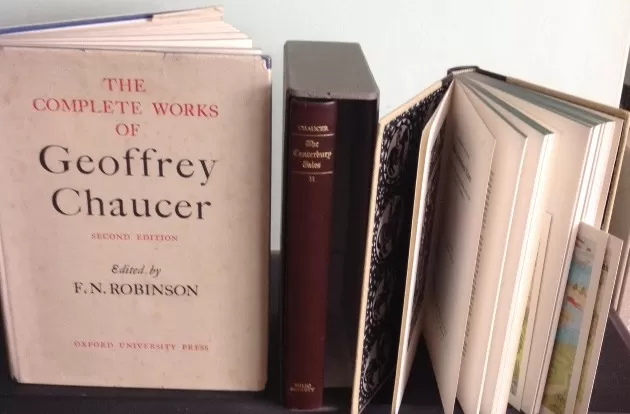
Reading Chaucer’s Middle English aloud, even with imperfect pronunciation, reveals a different cadence and muscularity in the language. Words like “shoures sote” (sweet showers), “perced to the rote” (pierced to the root), and “swich licour” (such liquor) have a specific sonic and semantic weight that is difficult to perfectly replicate in modern English equivalents, which can feel more conventional or “prosaic” when placed side-by-side, as noted by many readers comparing Coghill to the original.
Scholarly editions, such as the widely respected The Riverside Chaucer (edited by F.N. Robinson and later others), present the Middle English text with rigorous notes and glossaries. This approach honors Chaucer’s language and requires readers to do some work, but the reward is a direct connection to the poet’s voice. For those who invest the effort, reading Chaucer in his original (with help) can feel less like a translation and more like an authentic encounter with the past.
So, Which is the “Best” Canterbury Tales Translation?
The answer, as is often the case in literary matters, is that there is no single “best” translation for everyone.
- For the student seeking a deep understanding of Chaucer’s artistry and language, or the scholar analyzing poetic technique, a Middle English edition with comprehensive notes (like the Riverside Chaucer) is arguably the most valuable. It requires dedication but offers the most direct access to the source.
- For the general reader primarily interested in the stories, characters, and themes without getting bogged down in linguistic challenges, a skilled modern English verse or prose translation can be an excellent choice. Translations by Nevill Coghill, Burton Raffel (often more dynamic), or Seamus Heaney (known for his poetic sensibility) each offer different strengths and reading experiences.
Ultimately, the “best” translation depends on your reading goals and your willingness to engage with the text on its own terms. While modern translations provide accessibility, they may inadvertently sacrifice some of the unique poetic magic of Chaucer’s Middle English. Engaging with the original language, even if challenging at first, can be a deeply rewarding experience that reveals the enduring power and beauty of Chaucer’s voice.
Conclusion
Exploring The Canterbury Tales is a journey well worth taking, regardless of the translation you choose. While modern versions offer a convenient path, spending time with Chaucer’s Middle English, aided by good scholarly resources, can unlock a deeper appreciation for his genius and the vibrant world he created. The effort required to navigate the original language is not merely academic; it is part of connecting with the historical and artistic context that makes Chaucer’s work so vital. Perhaps the truest “best” approach is to sample different versions and discover which one resonates most deeply with you, allowing the words, whether Middle or modern, to bloom into poetry.