
When we think of William Shakespeare, the image of towering plays like Hamlet or Romeo and Juliet often comes first. Yet, “The Bard’s” prolific output includes a significant body of poetic work beyond his 37 dramas, totaling over 150 poems. Overlooking these shakespear poems would be a disservice to his legacy and the rich tapestry of English verse. These poems, ranging from intimate sonnets to ambitious narrative works, offer unique insights into his linguistic mastery, thematic depth, and the literary landscape of the Elizabethan era.
Contents
The Power of the Sonnets
Shakespeare is most celebrated for his collection of 154 sonnets, a remarkable achievement in the form. The sonnet, a fourteen-line poem with a specific rhyme scheme, was a popular vehicle for exploring themes of love, beauty, time, and mortality during his time. Shakespeare didn’t just adopt the form; he perfected and put his name on a variation known as the Shakespearean or English sonnet. Understanding the lineage of English literature, from works like the chaucer canterbury tales general prologue through the Renaissance, provides crucial context for Shakespeare’s innovations.
The Shakespearean Sonnet Form
The defining structure of a Shakespearean sonnet consists of three quatrains (four-line stanzas) followed by a concluding couplet (two lines). The typical rhyme scheme is ABAB CDCD EFEF GG. This structure allows for the development of an argument or theme across the quatrains, often presenting variations or explorations of an idea, culminating in a resolution or surprising turn in the final couplet. Let’s look at his very first sonnet:
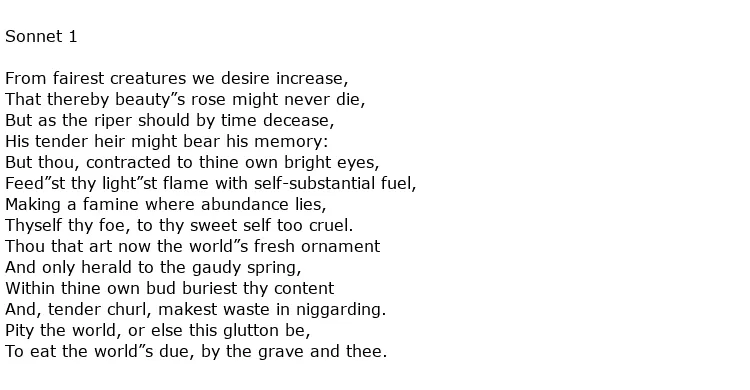 Text of William Shakespeare's Sonnet 1, 'From fairest creatures we desire increase'
Sonnet 1, “From fairest creatures we desire increase,” exemplifies this form. It explores the theme of procreation and the continuation of beauty through legacy. While the rhyme scheme is standard, Shakespeare’s genius lies in weaving complex thoughts and vivid imagery within these constraints. The sonic quality and rhythm of the lines contribute as much to the poem’s impact as the end rhymes. Much like navigating the intricate structure presented in the canterbury tales summary prologue, appreciating the mechanics of the sonnet enhances the reading experience.
Themes and Elizabethan Context
While love is a central theme in many shakespear poems, his sonnets also delve into friendship, the destructive power of time, the immortality granted by verse, and the complexities of human emotion. The context of their creation is vital. During the Elizabethan era, poetry was highly valued, especially by the nobility and upper classes who often acted as patrons. Plays were a public spectacle, but privately circulated poetry was seen as a mark of refinement.
Poets often sought patronage, and the economic realities meant tailoring works to appeal to potential benefactors. Writing sonnets, particularly those praising beauty or virtue, was a way to gain favor. This practical aspect doesn’t diminish their artistic merit; rather, it highlights Shakespeare’s ability to create profound and lasting art within the commercial and social structures of his time. Understanding the poetic landscape, from attempts to render works like canterbury tales prologue in modern english to the flourishing of Renaissance verse, helps frame Shakespeare’s contribution.
The Significant Narrative Poems
Lesser known than the sonnets are Shakespeare’s two major narrative poems: Venus and Adonis (1593) and The Rape of Lucrece (1594). These works are substantially longer and more ambitious in scope than the sonnets, tackling mythological and historical subjects with dramatic intensity.
Venus and Adonis
This poem is a vibrant, sensual retelling of the myth of Venus, the goddess of love, and her futile attempt to win the affection of the beautiful youth, Adonis, who is more interested in hunting. Venus and Adonis was immensely popular in Shakespeare’s time, becoming a bestseller. It showcases his gift for lavish description, psychological insight into unrequited passion, and rich engagement with classical mythology – elements that also permeate his plays. The poem served not only as a display of poetic skill but also as a dedication to his patron, the Earl of Southampton, demonstrating his ability to handle weighty literary subjects, much like engaging with the scale of a work like the chaucer canterbury tales general prologue summary.
The Rape of Lucrece
A stark contrast to the sensuality of Venus and Adonis, The Rape of Lucrece is a dark and tragic poem based on a story from Roman history. It recounts the violation of the virtuous Lucrece by Tarquin, the son of the Roman king, and her subsequent suicide, an act that famously led to the overthrow of the monarchy and the establishment of the Roman Republic. The poem is an intense exploration of themes like honor, tyranny, shame, and despair. Its dramatic monologues and psychological focus reveal Shakespeare developing skills evident in his later tragedies like Hamlet or Macbeth. Analyzing this work provides a deeper appreciation for the development of his dramatic sensibilities within a different poetic form, building on literary traditions that, though different in theme and form, share a lineage with older English narratives captured by a canterbury tales general prologue summary.
The Bard’s Poetic Legacy
Exploring shakespear poems offers a fuller understanding of his genius. The sonnets demonstrate his unparalleled command of language, form, and intricate emotion within a concise structure. The narrative poems reveal his ambition in storytelling and his engagement with classical and historical sources. For aspiring poets, Shakespeare’s verse provides essential lessons in craft, rhythm, and thematic exploration. For readers, his poems open another window into the human experience, rendered with the depth and beauty only “The Bard” could achieve. To truly appreciate the foundations of English poetry, one must engage with these foundational works.