
Poesie, ähnlich wie ein kunstvoll gefertigter Quilt, ist eine Kunstform, die unterschiedliche Elemente – Worte, Bilder, Emotionen und Ideen – zusammenfügt, um etwas Zusammenhängendes, Schönes und tief Resonantes zu schaffen. So wie eine Quilterin Stoffe auswählt, Muster zuschneidet und sie sorgfältig zusammennäht, wählt ein Dichter Sprache, strukturiert Verse und verbindet sie mit Rhythmus und Metaphern. Es überrascht daher nicht, dass das Handwerk des Quiltens unzählige Dichter inspiriert hat und zu einer reichen Sammlung von Quilt-Gedichten geführt hat. Diese Werke erfassen die Essenz des Quiltens: das taktile Gefühl von Stoff, die Geduld des Stichs, die Geschichten, die in jedem Stoffrest stecken, und die Gemeinschaft, die sich um den Rahmen bildet.
Contents
- Gedichte über das Quilting Bee
- Quilts als Gefäße der Erinnerung und des Vermächtnisses
- Die humorvolle Seite des Quiltens
- To Stash or not to Stash….is that the question?
- Husbands
- 14,287 Pieces of Fabric
- Disappearing Act
- Many Starts, Mini Finishes
- The Deadline
- SOS
- Foot Note
- Quilting Frustrations
- The Frankenstein Quilt
- 100 Ways to Hide Your Stash
- It Ain’t Finished Yet
- A Christmas Quilter
- Muster, Ausstellungen und die Welt des Quiltens
- red, orange, yellow, green, blue, indigo, violet
- the blocks of the builders
- Quilt-Folklore und Aberglauben
- Quilting Superstition and Folklore
- Follow the Stars
- Quilts und Verbindung
- Baby’s Quilt
- Quilter’s Poem
- Just For You
- Quilt-Sprüche und Weisheiten
- Quilt Teacher’s Ten Commandments
- A Quilter’s Blessing:
- Short Quilt Sayings
- And More Quilt Sayings!
- MORE Quilt Sayings Added in As I Find Them!:
- Fazit
Diese Sammlung erkundet die vielen Facetten des Quiltens aus der Sicht von Dichtern. Von der Kameradschaft des Quilting Bee bis zur persönlichen Reise des Sortierens eines Stoffvorrats, von den Erinnerungen, die in abgenutzten Stoffresten eingebettet sind, bis zu den humorvollen Frustrationen des Handwerks, zeigen diese Gedichte die Fäden auf, die Leben, Liebe und Vermächtnis durch den einfachen Akt des Zusammennähens von Stoffstücken verbinden. Tauchen Sie ein in diese Welt, in der jeder Stich eine Geschichte birgt und jeder Quilt ein Gedicht ist, das darauf wartet, sich zu entfalten.
Gedichte über das Quilting Bee
Das Quilting Bee ist mehr als nur ein Treffen; es ist eine Tradition der Gemeinschaft, der geteilten Arbeit und blühender Freundschaften. Frauen (und manchmal Männer) kamen zusammen, um an einem großen Quilt zu arbeiten, und verwandelten das einsame Nähen in ein geselliges Ereignis voller Gespräche, Lachen und gemeinsamer Ziele. Das Gedicht „Quilting Bee“ fängt diesen Gemeinschaftsgeist wunderschön ein und hebt die Gemeinschaft und die Mischung aus Arbeit und sozialer Interaktion hervor.
**Quilting Bee**(Autor: unbekannt)In Fellowship they meet, Their long days to invest, Snipping and sewing, only slowing To visit, to eat or rest.
Calico scraps, heaped on laps, Each one an exact size and hue. Fingers nimble with thread and thimble, Create pretty patterns anew. Heads bent to the task, you need not ask If these ladies love to quilt. Their talented touch, expresses as much As piece onto piece it is built.
Friends try to perceive who will receive Each quilt that is stitched from the heart, With needlework fine, the patterns entwined A treasure, a true work of art.
Quilts als Gefäße der Erinnerung und des Vermächtnisses
Quilts sind oft mehr als nur Bettdecken; sie sind lebende Wandteppiche der Erinnerung, zusammengesetzt aus dem Stoff unseres Lebens und des Lebens derer, die vor uns kamen. Stoffreste von alten Kleidern, abgenutzten Decken und geschätzten Kleidungsstücken werden zu den Bausteinen einer neuen Kreation und tragen das Gewicht von Geschichte und Emotionen. Diese Gedichte reflektieren, wie Quilts die Vergangenheit bewahren und Generationen verbinden.
Teresa Palomo Acostas „Mother Pieced Quilts“ ist eine ergreifende Erkundung des emotionalen Gewichts und der Geschichte, die in den Quilts einer Mutter enthalten sind. Was wie einfache Decken aussah, waren in Wirklichkeit lebendige Leinwände, die die Geschichten und Materialien des Familienlebens festhielten.
**Mother Pieced Quilts**by Teresa Palomo Acosta
they were just meant as covers in winters as weapons against pounding january winds
but it was just that every morning I awoke to these october ripened canvases passed my hand across their cloth faces and began to wonder how you pieced all these together these strips of gentle communion cotton and flannel nightgowns wedding organdies dime store velvets
how you shaped patterns square and oblong and round positioned balanced then cemented them with your thread a steel needle a thimble
how the thread darted in and out galloping along the frayed edges, tucking them in as you did us at night oh how you stretched and turned and re-arranged your michigan spring faded curtain pieces my father’s santa fe work shirt the summer denims, the tweed and fall
in the evening you sat at your canvas our cracked linoleum floor the drawing board me lounging on your arm and you staking out the plan; whether to put the lilac purple of easter against the red plaid of winter-going-into-spring whether to mix a yellow with blue and white and paint the corpus christi noon when my father held your hand whether to shape a five-point star from the somber black silk you wore to grandmother’s funeral
you were the river current carrying the roaring notes forming them into pictures of a little boy reclining a swallow flying you were the caravan master at the reins driving your thread needle artillery across the mosaic cloth bridges delivering yourself in separate testimonies
oh mother you plunged me sobbing and laughing into our past into the river crossing at five into the spinach fields into the plain view cotton rows into tuberculosis wards into braids and muslin dresses sewn hard and taut to withstand the thrashings of twenty-five years
stretched out they lay armed/ready/shouting/celebrating
knotted with love the quilts sing on
Patricia Eversons „Memories“ greift dieses Thema auf und verwendet einen Quilt als narratives Mittel, um Familiengeschichte und persönliche Geschichten Stück für Stück zu teilen.
Memoriesby Patricia Everson Sit down and I’ll tell you a story Wrap yourself up in my quilt. Here’s a cup of my coffee The wood stove is filled to the hilt.
Quilting is more than a hobby. To me it is a record of life, Recording for me all the good times, Remembering for me all the strife.
This patch was made from a bunting. The baby had now moved away. And this one came from my sister, From a dress that was yellow and grey. Below this one from my brother Is one from my aunt who just died. If you look close you can cipher Her signature on the left side.
And here over next to the corner Is a piece from my mother’s old skirt. And this one right in the middle Was made from my father’s red shirt.
This one came out a bit crooked. The material was faded and worn. No wonder it looks so dejected, It was woven before I was born.
Beneath this one at the bottom Is one that is worth more than gold. It came from my old winter jacket, It kept me safe from the cold.
This blue one I found in the cellar When we moved to this house long ago. Who knows what story it covets, This old, faded, worn calico.
Above the green one in the center Is my most favorite one of all. It looks like the leaves by the river Just after they drop in the fall.
And let’s not forget this pink gingham, I know that it’s seen better days, But I like the way that it mingles With the yellows and purples and greys.
Before you finish your coffee And you have to be on your way, Take a look at this one near the bottom, It came from my Great Uncle Ray.
He traveled the world in a schooner, He brought back such wonderful things. The material is of the richest, Fit only for princes and kings.
Some store their treasures in bank vaults, Some keep them hidden away, But I keep mine here on my quilt top Where I can enjoy them each day.
Sandra E. Andersens „A Legacy of Stitches“ spricht direkt die Idee an, durch das Handwerk einen bleibenden Eindruck zu hinterlassen, und erkennt an, dass jeder Stich Teil einer Geschichte ist, die fortbesteht.
A Legacy of StitchesSandra E. Andersen 2001-2008 A Legacy of Stitches is what we leave behind; the imprint of our very soul that lasts beyond our time. The heart that quilts knows, oh, so well the peace that can be found, as needle meets with fabric, for there is no sweeter sound.
Whether quiet piecing done by hand or on our sewing machine, there’s rhythm to our stitches as we sew along each seam.
Those stitches tell the story of our lives as they unfold as we think of quilts that Grandma made with stories left untold.
The humdrum of our daily lives grows elegant and grand, when we start to cut the pieces, then stitch the fabric in our hands.
And whatever is the reason for the quilts we piece and sew, and whoever is the maker, there is one thing that we know.
Each quilt is full of memories, and is a treasured thing. If quilts could talk, imagine how some quilts would surely sing!
For some quilts are sewn in happy times and others when we’re sad, and some are sewn in laughter and others when we’re mad.
Some are sewn to warm us, and some sewn just for fun, and some are “works in progress” that never quite get done!
Some quilts are sewn for beauty, a quilt made just for “show”, but the heart of the true quilter is the one who really knows~
That no matter how the quilt is stitched, we leave our mark in time. This Legacy of Stitches is what we leave behind.
Priscilla Schrocks „Grandmother’s Parlor“ ruft den nostalgischen Trost eines Quilts hervor, der von einem geliebten Familienmitglied gefertigt wurde, und hebt hervor, wie Quilts synonym mit liebgewonnenen Orten und Menschen werden können.
Grandmother’s Parlorby Priscilla Schrock I remember the quilt, made with loving care, Draped over the back of her favorite chair, In my Grandmother’s parlor.
A quilt full of pictures, a quilt full of love, With birds stitched in gold, seen flying above, In my Grandmother’s parlor. Made with purples and reds and colors so bright, The browns and the greens and even some white, In my Grandmother’s parlor.
As I sat on the floor my fingers would glide, Tracing designs over threads narrow and wide, In my Grandmother’s parlor.
I would give all I have for a chance to be there, In my Grandmother’s lap, in her favorite chair, In my Grandmother’s parlor.
Dallas Reeds „Secrets of the Old Quilt“ deutet die unausgesprochenen Geschichten und vielleicht sogar den Klatsch an, der unter Quilterinnen der Vergangenheit geteilt wurde, und erinnert uns daran, dass Quilts nicht nur Stoff sind, sondern Echos menschlicher Verbindung und Konversation.
Secrets of the Old QuiltAuthor: Dallas Reed Today, I went up to the attic, and found a quilt that grandma made.
The binding was worn, the pieces tattered, and the colors had begun to fade.
There were silks and wools and calicos, in a pattern of the nine patch kind.
They were precision cut and precision sewn, with an intricate quilting design.
She pieced the top and the quilting bee, helped her quilt the days away.
And they talked about everybody, Who didn’t help quilt that day.
Only if that quilt could talk. Oh, the words that would be conveyed, of the gossip at the quilting bee,
in the quilt that grandma made…..
Das anonyme Gedicht „Untitled“ (oft als „Neighbor“-Gedicht bezeichnet) präsentiert einen geistreichen Vergleich zwischen der flüchtigen Arbeit im Haushalt und dem dauerhaften Vermächtnis eines handgemachten Quilts und deutet an, dass Letzteres für zukünftige Generationen mehr Wert hat.
**Untitled**(Author Unknown)My neighbour is washing her windows , And scrubbing and mopping her floors,
But my house is all topsy and turvey,
And dust is behind all the doors.
My neighbour, she keeps her house spotless, And she goes all day on a trot:
But no one would know in a fortnight
If she swept today or not.
The task I am at is enticing – My neighbour is worn to a rag – I am making a quilt out of pieces
I saved in a pretty chintz bag.
And the quilt, I know my descendants Will exhibit with credit to me
„So lovely – my grandmother made it
Long ago in 1933.“
But will her grandchildren remember Her struggles with dirt and decay?
They will not –
they will wish she had made them
The quilt I am making today. (Author: unknown)
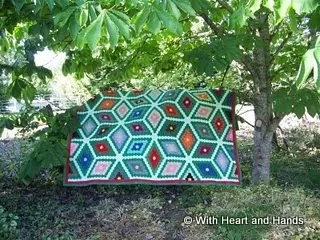 Detaillierte Aufnahme von hexagonalen Quiltblöcken mit hellem Blumenmuster, ausgelegt in sonniger Umgebung im Freien, lebendige Farben und geometrisches Design zeigend.
Die humorvolle Seite des Quiltens
Quilten, obwohl oft als ruhige und künstlerische Beschäftigung angesehen, ist auch reich an nachvollziehbaren Frustrationen und humorvollen Momenten. Von überwältigenden Stoffvorräten bis hin zu schwer auffindbaren Werkzeugen und dem allgegenwärtigen UFO (Unfertiges Objekt)-Stapel finden Quilterinnen oft gemeinsames Lachen im Chaos ihrer kreativen Räume. Diese Quilt-Gedichte heben die leichteren, oft komischen, Aspekte des Handwerks hervor.
Juanita K Bard bietet eine spielerische Interpretation eines klassischen Monologs in „To Stash or not to Stash…is that the question?“, die humorvoll mit dem ewigen Kampf der Quilterin ringt: der Verwaltung einer ständig wachsenden Stoffkollektion.
To Stash or not to Stash….is that the question?
by Juanita K Bard (With apologies to Shakespeare’s HAMLET) Whether ‚tis nobler in the mind to suffer The slings and arrows of outrageous mis-organization Or to take arms against a sea of clutter And by opposing end it? To organize? To give away? To sew not more? Nay…To sew I must..perchance a new patchwork Or try a new paper piece pattern For who can bear the whips and scorns of The ever present 1/2 price sale ads That makes a calamity of our credit cards..
To file or not to file my patterns To group by pastels and darks And by organization to say we end The heartache of rummaging around For just that right piece of fabric
That our sewing is heir to, ‚tis a consummation Devoutly to be wish’d..to organize, To conceal in boxes…and boxes galore In plastic containers that overflow on the floor To organize, perchance to achieve it….ay, there’s the rub;
For in that great organization of fabric what dreams may come When we have shuffled off this mortal unorganization Must give us pause there’s the respect That makes calamity of so organized a sewing room; For who can bear to whittle down her Stash…
The pangs of that separation of fabric To grunt and sweat under the strain Of not seeing forever the beloved Stash… But that the dread of something after death, The undiscover’d boxes…from who boundary
No traveler returns, puzzles the will And make us rather think we have To give to others that we know not of? Thus conscience does make swappers of us all; And thus the native hue of resolution
Gives way to the pale thought and enterprises Of that great moment with this regard To our current Stash…Organize…give away!!!! And lose the name of clutter… Soft you now! Oh, fair quilters… in they orisons Be all my Stash remember’d…..
Ray Hartsell bietet in „Husbands“ die Perspektive eines Ehemanns, eine kurze, humorvolle Betrachtung der Prioritäten einer Quilterin, die andeutet, dass die Leidenschaft für das Quilten manchmal (scherzhaft) andere Verpflichtungen überwiegen kann.
Husbands
(Author: Ray Hartsell (husband of a quilter)) A quilter’s husband died on Friday. Her heart was torn and wilting
To have the funeral on Monday,
She’d have to miss her quilting.
She asked her sister to fill in, An act so torn and wilting. „To him it makes no difference —
So why miss out on quilting?“
„The Crazy Quilt,“ ein anonymes Stück aus einer Veröffentlichung von 1890, nutzt Humor, um die überwältigende Popularität und das leicht chaotische Wesen der Crazy-Quilt-Manie des späten 19. Jahrhunderts zu beschreiben, selbst auf Kosten der Haushaltspflichten.
The Crazy Quilt Oh, say, can you see by the dawn’s early light, What you failed to perceive at the twilight’s last gleaming; A crazy concern that through the long night O’er the bed where you slept was so saucily streaming; The silk patches so fair, Round, three-cornered and square Gives proof that the lunatic bed-quilt is there. Oh, the crazy-quilt mania triumphantly raves, And maid, wife, and widow are bound as its slaves
On that quilt dimly seen as you rouse from your sleep Your long-missing necktie in silence reposes, And the filoselle insects that over it creep, A piece of your vest half-conceals, half discloses; There is Kensington-stitch In designs that are rich, Snow-flake, arrasene, point russe and all such. Oh, the crazy-quilt mania, how long will it rave? And how long will fair woman be held its slave?
And where is the wife who so vauntingly swore That nothing on earth her affections could smother? She crept from your side at the chiming of four And is down in the parlor at work on another. Your breakfasts are spoiled, And your dinners half-boiled, And your efforts to get a square supper are foiled By the crazy-quilt mania that fiendishly raves, And to which all the women are absolute slaves.
And thus it has been since the panic began, In many loved homes it has wrought desolation, And cursed is the power by many a man, That has brought him so close to the verge of starvation, But make it she must, She will do it or bust, Beg, swap, and buy pieces or get them on trust, Oh, the crazy-quilt mania, may it soon cease to rave In the land of the free and the home of the brave. -Anonymous
Jean Ray Laurys „14,287 Pieces of Fabric“ übertreibt humorvoll die Größe des Stoffvorrats einer Quilterin und spielt auf die gängige Zurückhaltung der Quilterin an, sich selbst vom kleinsten Stoffrest zu trennen.
14,287 Pieces of Fabric
Written by Jean Ray LauryBehind the painted picket gate There lived a quilter known as Kate She had one son, a boy named John; One daughter, whom she doted on. She had one husband and one house One pup, one cat, one little mouse… And 14,287 pieces of fabric.
Footnote: Many Thanks to Virginia Lane who let me know that this poem is the first poem in the book „14,287 Pieces of Fabric and Other Poems,“ which is both written and illustrated by Jean Ray Laury, published in 1994 by C&T Publishing. „Whenever anyone needs just a piece of fabric – her husband to flag cargo extending from his pickup, the neighbor child to bind an injury, and so on, there’s not one piece that Katy can spare. That color is special, her sister gave her this piece, she got that one at the quilt show, and so on. She finally gets a reason to use her fabric, sews madly, falls asleep, and dreams that she’s used all 14, 287 pieces.“
Thank you, Virginia! I so appreciate my readers!
Jacquie Scuitto, bekannt als „The Muse“, trägt mehrere Gedichte bei, die die alltäglichen Kämpfe und humorvollen Eigenarten des Lebens einer Quilterin aufgreifen, darunter „Disappearing Act“, das das Verschwinden kleiner, wichtiger Werkzeuge wie Nadeln und Fingerhüte beklagt.
Disappearing Act
Author: Jacquie Scuitto known as „The Muse“ Where do all my pins disappear to? I’ve picked up all the ones off the floor. But when I put them back into their box, It looked as though there ought to be more.
What became of the needle I had in my hand When I picked up the spool to thread it? It seems to have vanished into thin air, But that explanation I can’t credit.
How does my thimble disappear From the basket where it was laid? I haven’t heard it rolling ‚round on the floor As it did when the cats with it played.
What did I do with that fabric I need That I had just an hour ago? I put it away, but in what place? It’s somewhere that it doesn’t show.
The magazine with the pattern I liked Was right on top of that pile. I guess it’s sunk, but how far down In such a little while? I know that book went back on its shelf
And should be with books of its kind. But I just can’t find it, though I’ve looked five times. Can it be that I’m going blind? It’s a very good thing that my sewing machine
Is something that’s too big to hide. Not being able to find something as big as that Would really humble my pride! I don’t know why things I know that I had
Disappear when I put them away .I find it annoying but I very much fear It’s a problem that’s here to stay.
Scuitto erfasst auch das endlose Streben der Quilterin nach neuen Projekten in „Many Starts, Mini Finishes“, einer häufigen „Krankheit“ in der Welt des Quiltens.
Many Starts, Mini Finishes
Author: Bee Neeley Kuckelman There once was a quilter named Min
Whatever she’d see, she’d begin.
A large quilt, a small quilt, A doll quilt, a wall quilt. „I’ll finish these later,“ said Min.
„Now what shall I start on today? I guess it will be applique. Some birds in a group, I’ll frame with a hoop. Today, though, I’ll put them away.
I think I will make a new vest, In silk, or cotton would be best Trapunto I’ll do, Then Sunbonnet Sue! But now I will give them a rest.
A tote bag I’ve wanted to sew, And then I’ll try quilt-as-you-go. A radiant Star For next year’s bazaar Just when they’ll be done, I don’t know For Christmas I’ve got projects galore
A tree skirt, a wreath for the door. I’ll make a soft box, And red quilted socks, And what’s not completed, I’ll store.
„Is anything finished?“ asked Son. Her answer could only be, „None. „So, Min made a vow: She would not allow More new projects — well, maybe just one.
Dallas Reeds „The Deadline“ spricht die vertraute Eile an, ein Projekt kurz vor einer Ausstellung oder einem Event fertigzustellen, und erfasst die hektische Energie und das unvermeidliche Chaos.
The Deadline
by Dallas Reed
T’was the night before the quilt show, and at the sewing machine
was the biggest organized clutter, that you have ever seen. There was fabric on the table. Fabric on the chair, Fabric on the floor,
There was fabric everywhere. I couldn’t find my rotary cutter, couldn’t find my mat;
I couldn’t find my scissors, And I’m wondering where they’re at. It’s an hour before the show, Then I’ll get up and leave.
All I need is a few more stitches, The binding…..and the sleeve. But I’m not about to worry, Everything is going to be fine. I’ll get it done in time —
But,I really hate a deadline.
Scuitto’s „SOS“ ist eine weitere Variante des allgegenwärtigen Problems, Platz für eine expandierende Stoffkollektion zu finden, ein nachvollziehbares Dilemma für viele engagierte Quilterinnen.
SOS
by Jacquie Scuitto Where can I store more fabric? My sewing room shelves are crammed!
There’s no more space beneath my bed And the guest room closet is jammed.
I have a friend with an attic Who would let me store some there,
But such separation from my treasures Would be more than I could bear.
Meanwhile there are three bags full From the big sale I went to today
And I can’t think where to put them — Or what my dear husband will say!
„Foot Note,“ ebenfalls von Scuitto, stellt humorvoll die Herausforderungen und Frustrationen beim Maschinenquilten dar und führt die Quilterin zurück zum Komfort und zur Kontrolle des Handnähens.
Foot Note
by Jacquie Scuitto aka The Muse
This foot was made for walking. But not on my machine! It turns out the weirdest quilting That I have ever seen! It sews along quilte nicely, I stop holding my breath, Then it does a little dance step And scares me half tio death! I see a section of stitches Too small for ripping out, Then a leap and then a skip — What is this all about? A seam on top? The batting? Am I doing something wrong? I didn’t dream that machine quilting Would ever take this long. The answer’s out there somewhere, I’ll seek till I understand, But until I get it sorted out I just must quilt by hand!
Cindy Thury Smith bietet mehrere humorvolle Einblicke in das Leben einer Quilterin, darunter „Quilting Frustrations“, eine Litanei häufiger Pannen und Herausforderungen, denen während des Quiltprozesses begegnet wird.
Quilting Frustrations
by Cindy Thury Smith 1986
First I lost my thimble and stuck the needle into my thumb Then I figured the yardages wrong, so I’m short, how dumb! And I can’t understand this piecing diagram ‘cuz my brain’s gone numb Sometimes quilting just doesn’t pay.
Now the tension’s goofed up on my sewing machine The four yards I bought aren’t the right shade of green And how am I to get Grandmother’s unfinished quilt top clean? Sometimes quilting just doesn’t pay.
I’ve pressed under bias until my fingers are all burnt Can’t quite remember that finishing tip I thought I’d learnt Tried to do an edge in scallops, but they weren’t Sometimes quilting just doesn’t pay.
I’ve sewed on this quilt for what seems like a hundred weeks Bringing my quilting skills to a new sewing peak And, surprisingly, getting pretty close to the design I seek Well, maybe quilting’s not so bad.
Hey, I’ve finally got it on the quilting frame As I bend over and stitch my back will never be the same In the corner I’ll label it with the date and my name Well, maybe quilting’s not so bad. Now it’s proudly displayed in all its pomp and glory Conveniently forgotten is how its construction was slightly hoary Currently I’m telling the “masterpiece of needleart” story Yeah, I guess quilting’s not so bad.
„The Frankenstein Quilt“ von Smith erfasst den humorvollen Schrecken eines Projekts, das über sein ursprüngliches einfaches Design hinauswächst und zu einem komplexen und monströsen Unterfangen wird.
The Frankenstein Quilt
by Cindy Thury Smith 1985 I started out with a simple block design And thought I’d add just one or two more lines To come up with a quilt that’d be all mine. Then I started playing with complex borders and sashing
And through my mind new ideas kept flashing Until now my hopes have gone a-dashing! I’ve created an impossible pattern, a monster
Anyone who’d try it would be a fanatical quilter Who’d probably end up cussing out the designer! Since I created it I’d better give it a try As I ripped out stitches I kept asking myself why
If I ever get it done I’ll take this one with me when I die! Now it’s finally done and lies displayed on our bed
Hundreds of hours, yards of fabric, and miles of thread One of those, “It’ll never work” ideas that just popped into my head.
Smiths „ODE TO A QUILTER’S HUSBAND“ bietet eine unbeschwerte Hommage an die geduldigen Partner von Quilterinnen, die die Stoff-Obsession, die Nadeln und das ständige Reden über Quilten tolerieren.
ODE TO A QUILTER’S HUSBANDby Cindy Thury Smith 1983 The husband of this quilter is a very special, patient guy Who doesn’t complain about how much fabric his wife may buy. Through the years he’s picked up a lot of quilting lore Because on this subject his wife can get to be quite a bore. He’s learned better than to throw away any old odd shaped scrap Because it’s likely that’s the one she’ll need to fill her design gap. He know if he enters the quilting room his feet will get pins in And he’s learned there’s not just red, but brick, rust, scarlet and crimson. He knows how she snorts when she sees an ordinary bedspread Cuz in HER house there’s only personally designed quilts instead. He knows when she meets another quilter there’ll be fast and furious talkin’ And at a quilt show there’ll be lots of scribbling and gawkin’. He thinks of quilt-mania as a kind of creative affliction That can only be controlled by regular doses of stitchin’. He knows she quilts for enjoyment, not for money, Cuz she does quilts that are traditional, modern and some just plain funny! And though all my cutting, designing, sewing and quilting through the years He’s always been interested, supportive, patient, and very, very dear. Thanks, honey.
Cathy Miller, bekannt für ihre Quilt-Lieder, liefert humorvolle Liedtexte, die den Lebensstil der Quilterin erfassen, darunter die Mühe, Stoffkäufe zu verstecken („100 Ways to Hide Your Stash“) und den nachvollziehbaren Kampf, ein Projekt bis zu einer Frist fertigzustellen („It Ain’t Finished Yet“). „Toss the Cat“ erweckt ein traditionelles, leicht skurriles, von Folklore inspiriertes Spiel in Liedform zum Leben.
100 Ways to Hide Your Stash
(Song by Cathy Miller on her „One Stitch At A Time“ CD) He doesn’t‘ have to know everything A few secrets keep a marriage fresh as spring I’ll have it in, and out of sight in a flash There are 100 ways to hide your stash. Fill up the cupboard, hide the evidence Pile it in the pantry spare no expense Keep it with the kids‘ clothes, lay it with the wine Keep it all together where the sun don’t shine! Put it in a Safeway bag, bring it in with the groceries Call it „Christmas presents – and don’t you peek!“ You’re „keeping it for a friend“ who’s gone to Calgary She’ll be back soon – no there’s none for me! Don’t tell him what you owe the store He might start looking in the dryer or the drawer It’s an affliction breeding secrecy These quilty pleasures that won’t let me be Pack it in the wardrobe, under the chair Stack it with the linen, with the silverware Cram it in the cellar, under the stair With the winter clothes, with the underwear. A woman stored hers in the ceiling overhead For years it stayed there, overtop the bed Her husband never ever heard a sound Until the day it brought the ceiling down
He’s got golfing and his auto parts You’ve got fabric He’s got cigarettes and butter tarts You’ve got fabric!
Pad it in a pillow, buy a bass violin
Cram it in a corner, tuck it in a tin Turn off your freezer, fill up your bin Unplug the oven, you can fit it all in
Buy a few quarters, while you’re at the store Get a little extra – more more more Slip it in the mattress, hide it under the floor No more room in here: buy the house next door! (Author: Cathy Miller)
Toss the Cat(Song by Cathy Miller on her „One Stitch At A Time“ CD)
The bridal quilt is done, take it out of the frame Don’t forget to sign it and give it a name
Sew on some binding and that will be that Only one thing left to be done, and that’s play toss the cat
We’ve sewn in our good wishes for the bride and the groom The red pomegranate, the hearts and the moon
Our vines are unbroken and our apples are fat Now’s the time for our good luck when we play toss the cat
Grab your corner of quilt, in the middle she stands The next one to get hitched is the closest to where she lands
The kitty doesn’t like it much, well fancy that! That’s the price you pay when you play toss the cat
The cat has been a pest from the very first day Pawing the fabric, and clawing the fray
And when it’s time to work, she’s got to lie in your lap It’s only just desserts when you play toss the cat CHORUS
From this day forward she can lie in the sun with a lifetime supply of catnip She can have a nap whenever she wants one and maybe she’ll forget… Because I’ve got a few friends and their chances are good For holy matrimony and motherhood It won’t be too long before they’re buying their batt And another chance for us to play toss the cat. CHORUS (Author: Cathy Miller)
It Ain’t Finished Yet
(Song by Cathy Miller on her „One Stitch At A Time“ CD)
It ain’t finished yet I’m making this quilt for a wedding gift But it ain’t finished yet I’ve spent a small fortune on the fabric and thread
Just to cut it up in little squares
Now I’ve gotta sew it back together again
With my own individual flair
I’ve laid it out 57 different ways I can’t decide what looks the best
The wedding day has come and gone, I’m still in a maze
And I need more of that fabric I bought in Tibet!
I’m ripping out seams that didn’t fit just right I’ve gotta do them over again
My eyesight is fading, working late in the night
I hope this thing is done before the marriage ends!
I thought it would be easy when I got the idea
I even used her dress from the day they met
If anyone had told me how much work it would be I’d have volunteered to cater the banquet!
My husband has had to learn to cook and to bake While I’m fighting with the tangled thread
But I’ve bought the fabric for the next three I make
There must be something wrong with my head!
In final desperation I went down to the guild To get a few tips from the „pros“
Everyone had pages there for show and tell A listing of their UFOs!
(Author: Cathy Miller)
Pat Eversons „A Christmas Quilter“ präsentiert ein festliches, wenn auch hektisches Bild einer Quilterin, die versucht, handgemachte Geschenke für jeden auf ihrer Liste vor der Weihnachtsfrist zu erstellen.
A Christmas Quilter
By Pat Everson T’was a few weeks before Christmas and in my head was a plan To make all of my Christmas gifts by my own hand.
Away to my scrap box in a flash I did fly.
With patterns in my head and a twinkle in my eye. I cut and I sewed as merry as an elf. Making things for others and not for myself.
A quilted vest for a teen-aged niece. Quilts for the grandparents with love sewn in each piece. Quilted covers for aunts‘ tabletops,
Away I go with hardly a stop.
On scissors, on needles, on thimble and thread, Oh, hurry I must, for Christmas day is ahead.
A quilted diaper bag for the baby so new. I may even quilt Santa a coat before I’m through.
Quilted bedspreads for Mother and Sis. I still have a few left on my list.
Cushions with quilted tops and potholders done. It’s now Christmas Eve and I have a gift for each one.
So I sprang to my Volkswagon and made quite a clatter.
The neighbors ran to the windows to see what was the matter. From one house to the other, I leaped like a deer.
Leaving my presents and hopefully cheer. With best wishes to each for a Christmas so bright.
A tired, happy quilter drove away in the night.
Muster, Ausstellungen und die Welt des Quiltens
Die Welt des Quiltens ist gefüllt mit einer schillernden Vielfalt an Mustern, lebendigen Farben und Möglichkeiten, sich mit gleichgesinnten Enthusiasten durch Ausstellungen und Gilden zu verbinden. Diese Gedichte berühren den visuellen Reichtum und die gemeinsamen Erfahrungen innerhalb der Quilting-Gemeinschaft.
Jacquie Scuitto’s „red, orange, yellow, green, blue, indigo, violet“ erfasst die sinnliche Freude und das Staunen, das man bei einer Quiltausstellung erlebt, überwältigt von der Vielfalt an Farben, Mustern und Techniken.
red, orange, yellow, green, blue, indigo, violet
By Jacquie Scuitto
I went to a quilt show And what did I see But more kinds of quilts Than I thought there could be:
There were huge ones and minis And lots in between, Combinations of colors That I’d never seen.
Some quilts were just triangles, Others all squares. I saw appliqued angels, Rabbits and bears.
I saw fanciful shapes And stars all aglow, All the quilts with no ribbons And the grand Best of Show.
I never have known Such excitement before. When is the next show? I want to see more!
In „the blocks of the builders“ taucht Scuitto in das riesige Lexikon der Namen von Quiltblöcken ein, von traditionellen Favoriten wie „Log Cabin“ und „Irish Chain“ bis hin zu skurrileren Titeln, und hebt die reiche Geschichte und Vielfalt des Quilt-Designs sowie die reizvolle Herausforderung bei der Auswahl eines Musters hervor.
the blocks of the builders
by Jacquie Scuitto
I’ve sought inspiration A quilt for to make. There’s a wide choice of patterns, Now which should I take?
Here’s Baltimore Album And Sunbonnet Sue, Seven Sisters, Clay’s Choice And Log Cabin too.
Anvil and Churn Dash, Birds in the Air, Country Crossroads, City Square.
Broken Dishes, Tree of Life, LeMoyne Star, Contrary Wife.
Mexican Star, Pickle Dish, Cherry Basket, Goldfish.
Thousand Pyramids, Irish Chain, True Lover’s Knot, And Airplane.
Tangled Garter, World’s Fair, Kansas Troubles, Windblown Square.
Also Hovering Hawks And Flying Geese. I really don’t know What to piece!
Four-Patch, Nine-Patch, Tumbling Blocks, Grandmother’s Fan, Jack-in-the-Box.
Spiderweb, Kaleidoscope, There must be one. I’ve not lost hope.
I’ve thought and thought, I’m ready to wilt. Eureka! I’ll make a sampler quilt!
Cindy Thury Smiths „The Quiltin‘ Times Are A-Changing“ reflektiert die Entwicklung des Quiltens im Laufe der Zeit, vergleicht die sparsame, von Stoffresten geprägte Vergangenheit mit der internetverbundenen, werkzeugreichen Gegenwart und anerkennt gleichzeitig die bleibenden Kernmotivationen von Wärme, Schönheit und seelenstärkender Kreativität.
The Quiltin‘ Times Are A-Changing by CindyThury Smith 1999
For our Great-Great Grandmothers, in quilting times past A frugal quilter had to scrimp, make every scrap last Today wasting fabric is not such a crime Today what’s scarce is a quilter’s TIME. Patterns used to travel with pioneers going west Now we swap and share instantly on the Internet
Once templates were traced, fabric carefully scissored Now we slice multiple layers, we’re all Olfa wizards. At one time a two fabric quilt was a sign of status
Now Watercolor quilts have hundreds of prints comin’ at us
Quilters used to gather at small local quilting bees
Now we congregate at conferences, national teachers to see. Like our Great-Great Grandmothers our lives are busy, we’re stressed
But with the beauty of our quilts, we feel we are blessed
As with Great-Great Grandmother, our quilting serves many goals
To give warmth, grace our homes, and feed our souls. The following 10 rules for quilt teachers were the result of various discussions on the Quilt Teachers list. We were discussing proper attitude.
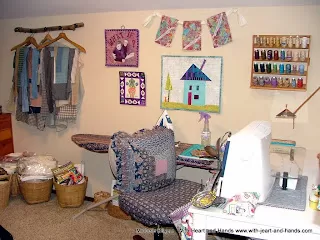 Arbeitsplatz einer Quilterin mit Stoffresten, Faden und Werkzeugen, einen kreativen Prozess im Gange andeutend.
Quilt-Folklore und Aberglauben
Die reiche Geschichte des Quiltens ist mit Folklore und Aberglauben verwoben, die über Generationen weitergegeben wurden. Diese Überzeugungen beziehen sich oft auf Glück, Ehe und den Schaffensprozess selbst und verleihen dem Handwerk eine Schicht von Mystik.
Der Abschnitt über „Quilting Superstition and Folklore“ geht auf verschiedene Überzeugungen ein, wie das Vermeiden, einen Quilt an einem Freitag zu beginnen, die Praktik, einen bewussten Fehler zu hinterlassen (den „Amish-Block“), und die zahlreichen Aberglauben rund um Brautquilts und Aussteuertruhen. Er erörtert auch die umstrittene und weitgehend entlarvte Folklore, dass Quilts als Signale auf der Underground Railroad verwendet wurden, und gibt einen Hinweis auf historische Genauigkeit neben den eher skurrilen Überzeugungen.
Quilting Superstition and Folklore
Needleworking: „Ich kannte eine alte Dame, die, wenn sie an einem Donnerstag eine Handarbeit fast fertig hatte, diese unvollendet beiseite legte und ein paar Stiche in ihrer nächsten Arbeit setzte, um nicht gezwungen zu sein, entweder die neue Aufgabe an einem Freitag zu beginnen oder einen Tag lang untätig zu bleiben.“ (1883) Quilt-Aberglauben sind eng mit der Entstehung von Quilts und dem abschließenden Quilten verbunden. Wie bei vielen anderen Aktivitäten, die vor Jahrhunderten begannen und über Generationen weitergegeben wurden.
Genau wie bei all unseren vielen Quilt- und Quilting-Mustern und -Techniken wurden sie von einer zur anderen weitergegeben … eine Mutter an ihre Tochter, eine Großmutter an ihre Enkelinnen, von Freundinnen in einem Quilting Bee und so weiter.
Quilten war oft die einzige gesellige Zeit im Leben von Frauen und ein so wichtiger Teil ihres Lebens. Und während sie quilteten, teilten sie … Geschichten und Erzählungen, Dinge, die schiefgelaufen waren oder wunderbar funktioniert hatten, basierend auf dem, was sie als Ursache ansahen … und so begannen Aberglauben und Folklore über das Quilten!
Aberglauben bezüglich der Herstellung von Quilts sind mit Religion und anderen tief verwurzelten Ideen über Glauben und Treue verbunden. Ein Quilt sollte niemals an einem Freitag begonnen werden, da dieser Tag „der Tag des Teufels“ war, und so wurde jedes Projekt, das an einem Freitag begonnen wurde, wahrscheinlich nie fertiggestellt. Die einzige Zeit, in der man quilten durfte, war am ‚Karfreitag‘, aber nur, wenn man den Quilt aus Glaubensgründen machte.
Am Sonntag sollte nicht gequiltet werden, da dies der Ruhetag für Christen ist. Mit diesem Aberglauben wurden dann seltsame Strafen oder Bestrafungen verbunden. Jede an diesem Tag genähte Naht musste nur mit den Zähnen der Nähenden aufgetrennt werden. (Sie sehen, wie die Dinge beginnen? Wie oft haben Sie das schon getan? 😉
Und damit verbunden ist ein weiterer Aberglaube, der uns daran erinnert, dass wenn wir unsere Zähne zum Abschneiden des Fadens verwenden, sie verrotten und ausfallen werden. (Nun, das erklärt alle unsere fehlenden Zähne 😉
Ein weiterer sehr bekannter abergläubischer Brauch, der mit dem Quilten verbunden ist, ist die Vorstellung, dass, da nur Gott Vollkommenheit schaffen kann, Quilts einen absichtlichen oder zweckgerichteten Fehler enthalten sollten. Die Idee des Amish-Blocks … wo man ihn bewusst falsch neigt und so weiter.
Viele Aberglauben beziehen sich auf Bräute und die Erstellung einer „Aussteuertruhe“ voller sorgfältig genähter Leinen für ihren zukünftigen Haushalt. Familienmitglieder halfen den jungen Mädchen und Frauen, ein „Bäcker-Dutzend“ Quilts vorzubereiten. Der letzte davon war der Brautquilt, der erst begonnen werden sollte, wenn die Braut verlobt war.
Der Brautquilt trug viele Aberglauben rund um seine Entstehung. Zum Beispiel sollten Herzen nicht als Designelemente in anderen Quilts in der Aussteuertruhe verwendet werden, konnten aber im Brautquilt genäht werden, um in der ersten Hochzeitsnacht verwendet zu werden. Dies stellte sicher, dass alle Träume des jungen Paares wahr würden, während sie in ihrer ersten Nacht darunter schliefen.
Ein Mädchen, das mit einundzwanzig noch keinen Brautquilt hatte, würde nie heiraten und daher eine Jungfer oder alte Jungfer bleiben. Und um diesen Aberglauben zu ergänzen, würde ein Mädchen, das einen Quilt für ihre Aussteuertruhe begann und ihn nicht fertigstellte, ebenfalls nie heiraten.
Des Weiteren sollte es keine Unterbrechungen oder Störungen in den Mustern einer Bordüre geben. Dies würde Unglück für die Ehe bringen. Und es musste große Sorgfalt darauf verwendet werden, dass ein Brautquilt mit Bordüre keine Unterbrechungen im Design hatte. So mussten Ranken, Blumen usw. ihren Fluss als ein Design entlang und um die Bordüre beibehalten … genauso wie im Leben und in der Ehe gewünscht.
Der Brautquilt, der von der Braut begonnen und zusammengesetzt wurde, wurde dann bei einem speziellen Braut-Quilting-Bee mit Familie und Freunden gesteppt. Und jede noch unverheiratete Frau sollte niemals die abschließenden Stiche an diesem Quilt machen, denn der Aberglaube besagt, dass sie dann niemals heiraten würde.
Tossing the Cat
Dann begann die Idee des „Tossing the Cat“ (Die Katze werfen). Sobald der Hochzeitsquilt fertig war, besagte die Folklore, dass alle unverheirateten Mädchen der Gruppe den Quilt an den Rändern festhalten würden und eine Katze auf den Quilt geworfen würde. Das Mädchen, das dem Punkt am nächsten war, an dem die Katze herunterspringen würde, wäre die nächste, die heiratet. Die Quilting-Version des Brautstraußwerfens! Auch wenn der Quilt um ein unverheiratetes Mädchen gewickelt wurde, würde sie innerhalb eines Jahres heiraten. Oh, all ihr Quilterinnen, die ihr jetzt Quilts für eure Blog-Profilfotos um euch wickelt … hat es funktioniert?
Auch junge Männer entkamen dem Quilt-Aberglauben nicht!
Als ein junger Mann das Alter von 21 Jahren erreichte, brauchte er einen ‚Freiheitsquilt‘. Nicht länger unter der Herrschaft seiner Eltern stehend, wurde er nun als Erwachsener und frei von seinen Eltern betrachtet. Das Muster für diesen Quilt musste sehr sorgfältig gewählt werden. Muster wie das Blockmuster „Wandering Foot“ galten als Unglück. Wenn ein junger Mann einen Quilt mit diesem Muster erhielt, würde er wegziehen. Vielleicht war dies der Grund dafür, dass der Name dieses Blocks in „Turkey Tracks“ geändert wurde, und auf diese Weise konnte der Aberglaube vermieden werden. Obwohl Männer, die sich schlecht benehmen, oft als „Truthähne“ betrachtet werden 😉
„The Underground Railroad“
Nicht wirklich Aberglaube, sondern eher Teil der Quilt-Folklore und ein Thema, das von Quilt-Historikern diskutiert wurde, ist die Idee, dass Quilts als Signale in der Underground Railroad verwendet wurden. Dieser Mythos wurde durch die Veröffentlichung eines Buches zu diesem Thema im späten zwanzigsten Jahrhundert angefacht und wurde größtenteils von Quilt-Wissenschaftlern und Historikern entlarvt. Alles begann mit einem Interview und vielen Missverständnissen. Der Artikel wurde veröffentlicht, das Buch geschrieben, und all diese Quilt-Folklore mit ihren vielen Ideen zu bestimmten Farben oder Mustern, die auf Quilts verwendet wurden, die an Wäscheleinen in „sicheren Häusern“ aufgehängt wurden, als Signale für entlaufene Sklaven, begann.
Experten haben diese Geschichten mit Beweisen für falsche Berichterstattung widerlegt. Bedauerlicherweise.
Cathy Millers Liedtext „Follow the Stars“ verwebt traditionelle Namen von Quiltblöcken kreativ mit der Folklore der Underground Railroad und stellt die Muster als geheime Botschaften dar, die versklavte Menschen in die Freiheit führten. Es ist wichtig zu beachten, dass dies eine künstlerische Interpretation ist, die auf der Folklore basiert, und keine historische Tatsache, wie im Prosateil erwähnt.
Follow the Stars
Song by Cathy Miller on her „One Stitch At A Time“ CD
Follow the stars to freedom Flying geese stay on the drunkard’s path and Follow the stars to freedom The quilts will tell you when to get your bag packed Follow the stars to freedom There are secrets hidden in plain view If you can see them, this train is for you And freedom’s waiting at the end of the track Follow, follow, follow the stars to freedom The monkey wrench turns the wagon wheel At the blacksmith’s word, the way is revealed Take the bear’s paw trail through the wilderness Through the Appalachian mountains, the underground express Soon you’ll be tasting a free man’s meal Follow, follow, follow the stars to freedom Danger! Don’t say it out loud Sew it in a pattern, or sing it in a crowd They’ll think you’re just making a joyful sound Till you follow, follow, follow the stars to freedom. The slave’s chains are double wedding rings Your mind and your body get free of those things The crossroads block means Cleveland’s docks Where Peg Leg Joe’ll open up the locks And sail you across to where the angels sing Follow, follow, follow the stars to freedom. (Author: Cathy Miller)
Quilts und Verbindung
Über individuellen Ausdruck und Gemeinschaftstreffen hinaus dienen Quilts als greifbare Symbole der Verbindung, des Trostes und der Liebe, oft geschaffen, um bedeutende Lebensereignisse zu markieren oder einfach nur Wärme und ein Gefühl der Fürsorge zu bieten. Diese Quilt-Gedichte erkunden die tiefen emotionalen Bindungen, die in gesteppten Kreationen verkörpert sind.
M. Robinsons „Baby’s Quilt“ fängt die zärtlichen Gefühle ein, die mit dem Schaffen eines Quilts für ein neues Kind verbunden sind, und näht Hoffnungen und Träume in jede Naht.
Baby’s Quilt
Author: M. (Marilyn) Robinson from the book, „P.S. I Love You“) The sun came up this morning
It’s promise sweet and long A new child shares this day with me The birds begin their songs. A special gift of squares and strips
Was sewn for baby’s cover The sparkling patches quite reflect Our feeling for each other. The beauty of the days ahead
Are sewn in every seam. I’ll wrap you up and hold you tight And anticipate the dream.
Ein anonymes Gedicht setzt Liebe selbst mit einem Quilt gleich und betont gemeinsame Merkmale wie Trost, Wärme, Stärke und Haltbarkeit.
Quilter’s Poem
(Author: unknown Love is a quilt – a quilt is love .
Both love and a quilt should be: Soft enough to comfort you, Bright enought to cheer you, Generous enough to enfold you, Light enough to let you move freely, Strong enough to withstand adversity, Durable enough to last a lifetime,
And given gladly, from the heart.
Ein weiteres anonymes Stück verwendet die Metapher eines Patchwork-Quilts, um eine Familie zu beschreiben, und hebt hervor, wie individuelle Einzigartigkeit („Each piece an original“) durch Liebe und Güte zusammengebracht wird.
Our FamilyOur family is like a patchwork quilt
With kindness gently sewn Each piece an origina
lWith beauty all its own
With threads of warmth and happiness
Its lightly stitched together
To last in love throughout the years
Our family is forever. (Author: unknown)
Ein kurzer, anonymer Vers verstärkt die Idee von Quilts als Quellen des Trostes und der Erinnerung, gebaut aus „kleinen Stoffstücken“ und sowohl physische als auch emotionale Wärme spendend.
Little bits of fabric
Sewn into a quilt
Form a warm and loving blanket
From which memories are built.
And when you seek peace and comfort
In the quiet of the night
It will keep you warm and snug
Until the morning’s light.
Kathy Sherlocks „Just For You“ ist ein herzerwärmendes Gedicht, geschrieben aus der Perspektive einer Quilterin, die einem Kind einen Quilt schenkt, sie ermutigt, ihn frei zu verwenden, und ein Versprechen fortgesetzter Liebe und Schöpfung schafft.
Just For You
by Kathy Sherlock This quilt is made of cloth and thread To place upon your little bed.
It’s not an heirloom just to keep, But to lie upon as you count sheep. Or perhaps the floor’s the perfect place For a Doll and Teddy picnic place.
This quilt can be anything you can dream From Superman’s cape to the robe of a queen. Pretend it’s a raft adrift at sea, Or just cuddle up when you watch TV
So use it up and wear it out. I promise I won’t yell or pout. Just tell me when its days are through, And I’ll make another one just for you.
 Farbenfrohes, abstraktes Quiltmuster auf einem Bett ausgestellt, eine Mischung aus bedruckten und einfarbigen Stoffen in einem dynamischen Design zeigend.
Quilt-Sprüche und Weisheiten
Über formale Poesie hinaus hat die Quilting-Gemeinschaft eine eigene Umgangssprache und Sprüche entwickelt, die oft den Humor, die Hingabe und die gemeinsame Philosophie der Quilterinnen erfassen. Diese Sprichwörter, Segenswünsche und geistreichen Bemerkungen bieten Einblicke in die Denkweise einer Quilterin.
Cindy Thury Smith bietet „Quilt Teacher’s Ten Commandments“ an, eine humorvolle, aber aufschlussreiche Liste von Richtlinien für diejenigen, die das Handwerk unterrichten, und betont Geduld, Klarheit und eine unterstützende Haltung gegenüber den Schülern.
Quilt Teacher’s Ten Commandments
by Cindy Thury Smith 1999
- Thou shalt not ridicule a student’s choice of fabrics nor their colors; a student’s taste should be reflected in their work.
- Thou shalt not require excessive expenditures for a class; thou dost not know a student’s financial situation.
- Thou shalt provide students with clearly written and illustrated handouts. Thou shalt be able to explain a construction step with more than one method (written, verbal, visual).
- Thou shalt provide value for their money; at least one other variation of the quilt in addition to the standard design.
- Thou shalt be on time, start on time and provide time for questions.
- Thou shalt circulate amongst the students, checking progress, even if thy feet dost hurt.
- Thou shalt find something positive to say about each student’s work. Thou shalt not have a “My way or the highway” frame of mind; creativity comes in many forms.
- When a student makes a good suggestion, thou will announce it to the class and give credit where due.
- Thou shalt allow some time after class to help anyone who sews at a more leisurely pace.
- Thou shalt show numerous samples; and if thou dost not have numerous samples done, make suggestions for other applications of the pattern.
Ein „Quilter’s Blessing“ bietet herzliche Wünsche, die spezifisch für die Werkzeuge und Prozesse des Quiltens sind, und hofft auf scharfe Klingen, gerade Nähte und perfekte Spitzen.
A Quilter’s Blessing:
May your rotory cutter always be sharp, may your seams be straight and true. May your points be perfect, your blocks square and even, and may you always see well enough to thread your needles!
Die Sammlung von „Short Quilt Sayings“ und „More Quilt Sayings“ bieten einen schnellen Einblick in die gemeinsamen Witze, Philosophien und die leicht obsessive Natur der Quilterinnen und decken Themen ab, von Stoffvorräten und UFOs bis hin zu Freundschaft und der Vorliebe für Nähen gegenüber Hausarbeit.
Short Quilt Sayings
A family stitched together with love seldom unravels. A Quilt is a blanket of love. Blessed are the Quilters for they are the piecemakers. Friendships are sewn…one stitch at a time… Good friends are like quilts, they never lose their warmth. God put me on this earth to sew and finish a certain number of things. I am so far behind now…..I will never die!
Any day spent sewing, is a good day! Will work for FABRIC! Asking a quilter to mend, is like asking Picasso to paint your garage! Sewing forever, housework whenever! Sewing and crafts fill my day, not to mention the living room, bedroom, and closets. Hubby calls me his „sew & sew“. I think sew! Itching to be stitching. My husband is a human pincushion! Creative clutter is better than idle neatness. Good friends are like quilts. They age with you, yet never lose their warmth. Sew much fabric, sew little time! Friendship is sewn with love and measured by kindness. Constant use has not worn ragged, the fabric of their friendship. LOST: Husband, dog, and sewing machine. Reward offered for sewing machine! She who dies with the most fabric…..wins! „Fabricologist Resource Center“…..now does that sound more impressive than „fabric stash“? Sew on to success!“ My husband lets me buy all the fabric I can hide! One yard of fabric, like one cookie, is never enough! My husband said if I were to buy any more fabric, he would leave me. I’m going to miss him!!! A quilt is something you make to keep someone you love…WARM! Anytime is stitchin‘ time. Memories are stitched with love. In the crazy quilt of life, I’m glad you’re in my block of friends. Quilters never cut corners. I’m in therapy and SEWING is cheaper than a psychiatrist. Quilts are like friends – a great source of comfort. Behind every sewer is a huge pile of fabric. You’re SEW special! Buttons and patches and the cold wind blowing…the days pass quickly when I am sewing! Love is the thread that binds us. Quilts are like mom’s cooking – they both give comfort. Quilts connect the past with the present and the future. Quilting is sharing yourself with others. A quilt is a present you give yourself. To quilt is human, to finish divine. Quilt Fever. Scrap Happy. Just Sew It! Material Girl. Scraps Happen. Fabricoholic. Quilt till you wilt!. If life gives you scraps, make quilts. So many designs, so little time! So many fabrics, so little money! A stitch in time is right before the quilt show deadline. I only quilt on days that end in Y. It’s not just a stash: I am a hoarder/gatherer. A creative mess is better than idle neatness. A block a day keeps the shrink away. Quilters aren’t greedy, they’re just materialistic. A penny saved is a penny to spend on fabric. God, in Her infinite wisdom, does not deduct any time spent quilting from your allotted span.
And More Quilt Sayings!
- May your days be „pieceful“
- Do not run with scissors
- As ye ’sew‘, so shall ye rip
- Days stitched with love rarely unravel
- When life gives you scraps, make a quilt
- A stitch in time saves nine
- Memories are sewn together by friends
- You keep me in stitches
- Don’t snip it, if you can’t stitch it.
- If you feel a little „down“, stuff it in a quilt.
- „A warm quilt makes for a far happier life“
- „On a cold winter night when others are counting sheep to get to sleep you count quiltz“
- „A quilt a day keeps colds away!
- „Two in a quilt are warmer than one in a bed“
- Life is quiltisentially about being together
- May your days always MEASURE up.
- Make the SCRAPS in your life beautiful.
- SHEARS to you.
- Memories are stitched with love.
- Love is the thread that binds us.
- A family stitched together with love, seldom unravels.
- May your bobbin always be full!
- Two threads are better than one.
- As ye Sew, sew Shall Ye Rip
- A day hemmed in prayer seldom unravels.
- Blessed are the piecemakers, for they shall quilt forever!
- In the crazy quilt of life, I am glad you are in my block of friends.
- From my hands to your heart!
- The soul is fed with needle and thread.
- May your sorrows be patched and your joys quilted.
- Count your blessings, stitch them one by one.
MORE Quilt Sayings Added in As I Find Them!:
Old quilters never die, they just go batts. Old Crafter’s never die, they just get more bazaar! Old quilters never die, they just go to pieces. Quilt ‚til you wilt! Quilts are like friends – a great source of comfort. Quilters don’t do buttons Quilters never cut corners. Quilting forever…housework whenever! When life gives you scraps – make a quilt. Quilting is my passion (chocolate comes in a close second) Quilting with a friend will keep you in stitches. Our lives are like quilts – bits and pieces, joy and sorrow, stitched with love. Blessed are the children of the piecemakers . . for they shall inherit the quilts ! I am a quilter and my house is in pieces Those who sleep under a quilt, sleep under a blanket of love. May your sorrows be patched and your joys quilted.
Fazit
Diese Quilt-Gedichte, Sprüche und folkloristischen Schnipsel bieten einen schönen Einblick in die Welt des Quiltens – eine Welt reich an Geschichte, Gemeinschaft, Kreativität und tiefer emotionaler Verbindung. Sie zeigen uns, dass Quilten nicht nur ein Handwerk ist; es ist eine Art, Erinnerungen zu bewahren, Liebe auszudrücken, Humor im täglichen Leben zu finden und sich mit einem Erbe aus Nadel und Faden zu verbinden. Jeder Quilt, ob einfach oder komplex, erzählt eine Geschichte, Stich für Stich, Naht für Naht, Einfassung für Einfassung ins Leben genäht. Durch die Poesie können wir die komplexen Muster sowohl von Stoff als auch menschlicher Erfahrung schätzen und Wärme und Bedeutung in der gemeinsamen Kunst des Schaffens finden.