
Poetry possesses a unique power to illuminate the world around us, inviting us to slow down and truly see the details we might otherwise miss. This heightened awareness often leads to a profound sense of gratitude – a thankfulness not just for grand blessings, but for the simple, intricate gifts woven into the fabric of everyday life. While many seek poems that offer direct statements of thanks, some of the most impactful expressions of gratitude come from poets who simply train their keen eyes on existence itself, revealing its inherent beauty and wonder.
Exploring how poets capture this feeling can deepen our own capacity for appreciation. It’s not always about writing in a specific form, like mastering the rhyme scheme for a sonnet, but about the poet’s unique way of observing and articulating.
One celebrated example that embodies this spirit of grateful observation is Gerard Manley Hopkins’ “Pied Beauty.” Though written in his distinct “sprung rhythm,” which moves away from standard metrical patterns, the poem is a direct hymn of praise and gratitude to God for the diverse, varied, and imperfect beauty of the world.
Pied Beauty

Glory be to God for dappled things—
   For skies of couple-colour as a brinded cow;
      For rose-moles all in stipple upon trout that swim;
Fresh-firecoal chestnut-falls; finches’ wings;
   Landscape plotted and pieced—fold, fallow, and plough;
      And áll trádes, their gear and tackle and trim.

All things counter, original, spare, strange;
   Whatever is fickle, freckled (who knows how?)
      With swift, slow; sweet, sour; adazzle, dim;
He fathers-forth whose beauty is past change:
   Praise him.
Hopkins doesn’t just state he is grateful; he shows us what he is grateful for with vivid, specific imagery: the patchy sky, the spots on a trout, falling chestnuts, the patterns of cultivated land, and the tools of various trades. This granular attention to detail serves as the very foundation of his thankfulness. The poem teaches us that gratitude can be found in the unique, the imperfect, the “counter, original, spare, strange.”
Another famous poem that directly addresses gratitude is e.e. cummings’ “i thank You God for most this amazing day.” Cummings, known for his unconventional use of lower case, punctuation, and structure, here offers a powerful, almost breathless, expression of thanks for the sheer wonder of being alive and experiencing the day.
i thank You God for most this amazing
day:for the leaping greenly spirits of trees
and a blue true dream of sky;and for everything
which is natural which is infinite which is yes

(i who have died am alive again today,
and this is the sun’s birthday;this is the birth
day of life and of love and wings:and of yonder star the
minutest crimson whisper,which was shy:

and it’s this fool of an i who feels a
smarter than anybody else my self is dancing)

i thank You God for this most amazing day
for the leaping greenly spirits of trees
and for the blue heart of the west and for what could not be here and for what is coming

(because minus each next nowhere is my forever)
and it’s your say goodnight dear here comes the
close of day)
Cummings’ structure might not follow traditional rules like those for a sonnet rhyme scheme, but his innovative form mirrors the overwhelming, non-linear feeling of deep gratitude. The poem spills forth with thankfulness for the natural world (“leaping greenly spirits of trees,” “blue true dream of sky”), the sense of rebirth (“i who have died am alive again today”), and the simple fact of existence itself. It’s a visceral feeling of being alive that sparks the thanks.
Finally, Mary Oliver, a beloved contemporary poet famous for her observations of nature, often evokes a sense of gratitude through profound attention. While not always explicitly stating “I am thankful,” her poems, like “The Summer Day,” guide the reader towards a deep appreciation for the present moment and the natural world.
The Summer Day
Who made the world?
Who made the swan, and the black bear?
Who made the grasshopper?
This grasshopper, I mean—
the one who has flung herself out of the grass,
the one who is eating sugar out of my hand,
who is moving her jaws back and forth instead of up and down—
who is gazing around with her enormous and complicated eyes.
Now she lifts her pale forelegs and thoroughly washes her face.
Now she snaps her wings open, and floats away.
I don’t know exactly what a prayer is.
I do know how to pay attention.
I know how to fall down on my knees and be melted into the snow.
I know how to be idle and blessed. I know this dense world I live in.
Sometimes I think attention is a form of prayer.
For seventy years I have lived here on earth.
Given my seventy years, not counting my childhood, of the pure labor of doing
nothing luxuriously.
And all my life
I have been a bride married to amazement.
I stood in the path, I came into the house.
Which was warm and full of light.
Still, I can’t think of anything, in the way of meaning,
that lasts beyond the body’s sweet wilderness:
flowers, and green weeds, the song of the thrush.
The moth crossing the dark barn, the turtle basking in the pond,
the plump woodchuck.
How should I live then
the one life, I can’t remember much about,
except for this moment, and that one, and the other.
What about this snapdragon, this peach, this dusty-velvet leaf?
***
Tell me, what is it you plan to do
with your one wild and precious life?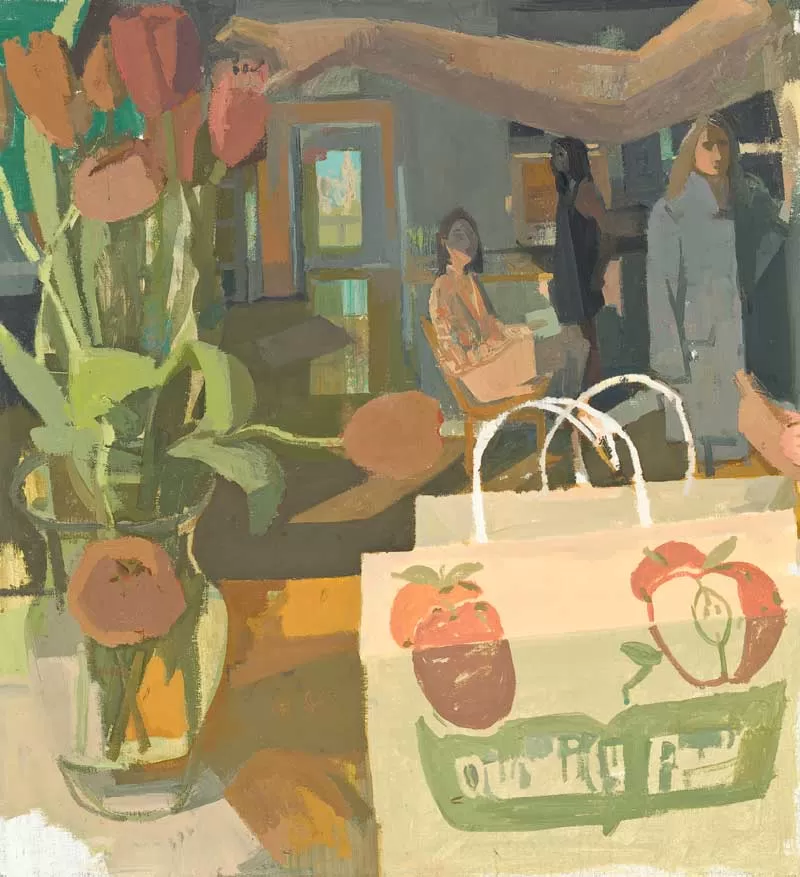 A painting of a basket of fruit and flowers, possibly apples and roses, placed on a table, with a background suggesting an indoor scene with some foliage outside a window. The style is expressive, focusing on texture and light, evoking a sense of domesticity and natural abundance.
Oliver’s poem is a meditation on paying attention, on the interconnectedness of life, and on the simple, physical reality of existence – the grasshopper, the snapdragon, the peach. Her famous closing question, “Tell me, what is it you plan to do / with your one wild and precious life?”, serves not just as a challenge, but as a powerful reminder of the gift of life itself. This focus on noticing the world in its detailed splendor becomes an act of profound gratitude, suggesting that how we live, with attention and appreciation, is our response to this gift. While this poem doesn’t feature a tercet example in poetry or follow a strict spenserian stanza, its power lies in its direct address and vivid imagery, characteristics valuable in exploring any poetic theme.
These famous poems about gratitude, from Hopkins’ celebration of divine creation in its varied forms to cummings’ effervescent joy for the day and Oliver’s quiet insistence on the holiness of attention, demonstrate the myriad ways poets express thankfulness. They remind us that gratitude isn’t just a feeling, but an active way of seeing and engaging with the world. By reading and reflecting on such works, we can cultivate our own capacity to find beauty and give thanks for the countless “dappled things” and “amazing days” that make up our lives.