
Gratitude is more than just a fleeting thank you; it’s a profound recognition of the gifts, large and small, that enrich our lives. It’s the quiet acknowledgment of beauty, the appreciation for kindness, and the deep sense of awe for existence itself. Poetry, with its unique power to distill emotion and illuminate hidden connections, serves as a powerful vehicle for exploring and expressing this fundamental human feeling. Through vivid imagery, heartfelt reflection, and carefully chosen words, poets help us pause, notice, and appreciate the countless blessings that surround us, often in the most unexpected places.
Contents
- The Everyday Sacred in William Carlos Williams’s “The Red Wheelbarrow”
- Nature’s Solace in Wendell Berry’s “The Peace of Wild Things”
- The Ecstasy of Being in Emily Dickinson’s “I taste a liquor never brewed”
- Life’s Wild Gift in Mary Oliver’s “The Summer Day”
- Acceptance and Grace in George Herbert’s “Love (III)”
- Conclusion
In a world often focused on what we lack, poetry can re-attune us to abundance – the abundance of nature, human connection, simple moments, and even the sheer wonder of being alive. This article explores several famous poems where the theme of gratitude, in its various forms, shines through, offering readers a chance to connect with this essential emotion through the lens of renowned poetic voices.
The Everyday Sacred in William Carlos Williams’s “The Red Wheelbarrow”
Often cited for its clarity and focus on the mundane, William Carlos Williams’s famous short poem, “The Red Wheelbarrow,” serves as a profound meditation on the importance of noticing and appreciating the simple things that underpin our reality.
so much depends
upon
a red wheel
barrow
glazed with rain
water
beside the white
chickens.
At first glance, the poem seems merely descriptive. Yet, the opening line, “so much depends / upon,” elevates these ordinary objects to a level of vital significance. The gratitude here is not explicitly stated with “thank you,” but it is deeply embedded in the act of paying such close, reverent attention. The poet’s focus on the visual details – the “glazed” surface, the contrast with the “white / chickens” – suggests a profound appreciation for the concrete, tangible world. It’s a powerful reminder that even the most humble objects in our environment hold value and contribute to the fabric of our lives, deserving of our recognition and quiet thankfulness. The poem encourages us to find the sacred in the everyday, fostering a sense of gratitude for the very ground we walk on and the tools we use.
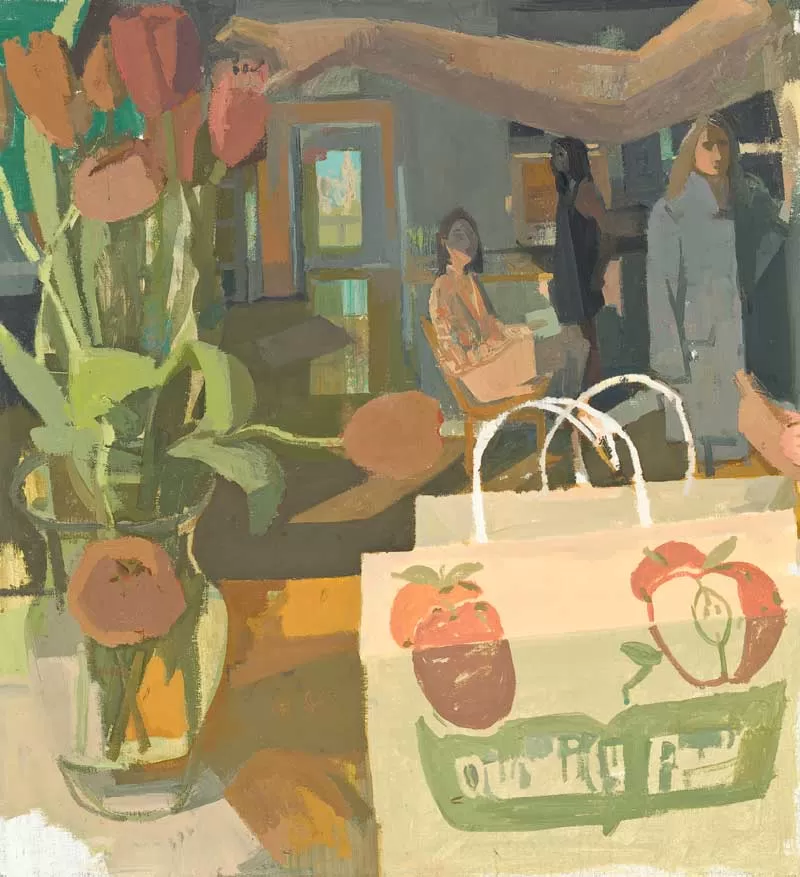 Artwork titled Orchard Bag and Bouquet depicting a still life with fruit, a basket, and flowers
Nature’s Solace in Wendell Berry’s “The Peace of Wild Things”
Wendell Berry, deeply rooted in the natural world and the rhythms of agricultural life, often expresses a profound gratitude for the solace and stability found outside the anxieties of human society. “The Peace of Wild Things” is a poignant example of this appreciation.
When despair for the world grows in me
and I wake in the night at the least sound
in fear of what my life and my children’s lives may be,
I go and lie down where the wood drake rests in his beauty on the water, and the great heron feeds.
I come into the peace of wild things
who do not tax their lives with forethought
of grief. I come into the presence of still water.
And I feel above me the day-blind stars waiting with their light.
For a time
I rest in the grace of the world, and am free.
The poem contrasts human fear and despair with the inherent peace and lack of anxiety found in nature. The speaker doesn’t command nature or try to change it; instead, they go to it, seeking refuge and finding a deep sense of gratitude for its simple, unburdened existence. The “peace of wild things” is a gift, freely given. The final lines, “For a time / I rest in the grace of the world, and am free,” explicitly name this feeling as one of resting in “grace,” a word often associated with unmerited favor and thankfulness. It highlights gratitude for the sheer existence of nature as a source of comfort and freedom from worry.
The Ecstasy of Being in Emily Dickinson’s “I taste a liquor never brewed”
Emily Dickinson’s unique voice often captured moments of intense experience, frequently drawing parallels between natural phenomena and internal states. In “I taste a liquor never brewed,” she expresses an overwhelming sense of rapture and gratitude for the sheer intensity of being alive and connected to the natural world.
I taste a liquor never brewed –
From Tankards scooped in Pearl –
Not all the Vats upon the Rhine
Yield such an Alcohol!
…
Inns of Molten Blue –
Where Bar hovers Crimson –
And I – an earnest Tippler –
Leaning against the Sun –
The poem uses the metaphor of intoxication to describe the speaker’s reaction to nature’s beauty – the “liquor” is the ecstatic feeling derived from experiencing the world, more potent than any man-made drink. This isn’t just observation; it’s a complete immersion that leads to joyful excess. The speaker is a “Tippler” drunk on the world’s glory, “Leaning against the Sun.” This hyperbolic language conveys a profound sense of gratitude for the vibrant, overwhelming sensory experience of existence. It’s thankfulness expressed as sheer, unbounded delight and awe, a powerful testament to finding intoxicating joy in the natural world.
my love for you poems for my husband
Life’s Wild Gift in Mary Oliver’s “The Summer Day”
Mary Oliver is celebrated for her ability to evoke a deep sense of wonder and gratitude for the natural world and the experience of life itself. Her poem “The Summer Day” is a perfect encapsulation of this, culminating in a question that serves as a powerful call to live gratefully.
Who made the world?
Who made the swan, and the black bear?
Who made the grasshopper?
This grasshopper, I mean –
the one who has flung herself out of the grass,
the one who is eating sugar out of my hand,
who is moving her jaws back and forth instead of up and down –
who is gazing around with her enormous and complicated eyes.
Now she lifts her pale forelegs and thoroughly washes her face.
Now she snaps her wings open, and floats away.
I don’t know exactly what a prayer is.
I do know how to pay attention.
I know how to fall down on my knees, amazed and thankful, that I have fallen into the mystery of being alive so simply and so entirely.
Tell me, what else should I have done?
Doesn’t everything die at last, and too soon?
Tell me, what is it you plan to do
with your one wild and precious life?
The poem moves from observing specific, seemingly small details (the grasshopper) to profound questions about creation and existence. The speaker’s “paying attention” is itself an act of reverence and gratitude. The core of the poem’s thankfulness comes in the lines, “I know how to fall down on my knees, amazed and thankful, that I have fallen into the mystery of being alive so simply and so entirely.” This is direct, explicit gratitude for the sheer gift of life, the mystery of existence. The famous closing question, “Tell me, what is it you plan to do / with your one wild and precious life?”, isn’t just a challenge; it’s born from this deep thankfulness. It implies that the most fitting response to the gift of a “wild and precious life” is to live it fully, a form of active gratitude.
Acceptance and Grace in George Herbert’s “Love (III)”
Moving from gratitude for nature and life to gratitude for divine grace, George Herbert’s “Love (III)” is a classic poem exploring the feeling of being welcomed and accepted despite one’s perceived unworthiness, leading to profound thankfulness.
Love bade me welcome: yet my soul drew back,
Guiltie of dust and sinne.
But quick-eyed Love, observing me grow slack
From my first entrance in,
Drew nearer to me, sweetly questioning,
If I lack’d any thing.
A guest, I answer’d, worthy to be here:
Love said, You shall be he.
I the unkinde, ungratefull? Ah my deare,
I cannot look on thee.
Love took my hand, and smiling did reply,
Welcome home, Contrarie.
And know you not, sayes Love, who bore the blame?
My dear, then I will serve.
You must sit down, sayes Love, and taste my meat:
So I did sit and eat.
The poem is a dialogue between the speaker (the soul) and divine Love personified as a host. The speaker is initially hesitant, feeling “Guiltie,” “unkinde, ungratefull.” Yet, Love persistently welcomes, reassures, and ultimately invites the speaker to “sit down, and taste my meat,” a clear reference to communal eating and spiritual nourishment. The speaker’s final line, “So I did sit and eat,” is simple but powerful. It signifies acceptance of the grace offered, a moment of yielding to unconditional love and, by extension, a state of deep gratitude for being accepted and nourished despite flaws. This poem beautifully captures the humble, overwhelming feeling of receiving a gift (acceptance, grace) that feels undeserved, resulting in profound thankfulness.
Conclusion
These famous poems, spanning different eras and styles, demonstrate the diverse ways in which gratitude can be explored and expressed through verse. From the deep appreciation for simple objects and the solace of the natural world to the overwhelming joy of existence and the humble acceptance of grace, poets offer us language and insight into this essential human emotion. They teach us to look closer, feel more deeply, and acknowledge the countless gifts that shape our lives. Engaging with such poems can enrich our own sense of thankfulness, encouraging us to pause, reflect, and perhaps even find the words to articulate the gratitude in our own hearts.