
Love, in its myriad forms, is perhaps the most universally compelling human experience. It inspires, challenges, comforts, and transforms us. For centuries, poets have grappled with capturing this elusive force, translating its intensity, tenderness, and complexity into language that resonates across time and culture. A truly moving poem about love has the power to articulate feelings we struggle to name, offer solace in heartbreak, or simply celebrate the profound connection between souls.
Contents
- 1. “Come, And Be My Baby” by Maya Angelou
- 2. “Bird-Understander” by Craig Arnold
- 3. “Habitation” by Margaret Atwood
- 4. “Variations on the Word Love” by Margaret Atwood
- 5. “The More Loving One” by W.H. Auden
- 6. “To My Dear and Loving Husband” by Anne Bradstreet
- 7. “Always For The First Time” by André Breton
- 8. “Love and Friendship” by Emily Brontë
- 9. “To Be In Love” by Gwendolyn Brooks
- 10. “How Do I Love Thee? (Sonnet 43)” by Elizabeth Barrett Browning
- 11. “A Red, Red Rose” by Robert Burns
- 12. “She Walks in Beauty” by Lord Byron
- 13. “Love is a fire that burns unseen” by Luís Vaz de Camões
- 14. “Beautiful Signor” by Cyrus Cassells
- 15. “Rondel of Merciless Beauty” by Geoffrey Chaucer
- 16. “Love Comes Quietly” by Robert Creeley
- 17. “[i carry your heart with me(i carry it in]” by E. E. Cummings
- 18. “[love is more thicker than forget]” by E.E. Cummings
- 19. “Sthandwa sami (my beloved, isiZulu)” by Yrsa Daley-Ward
- 20. “Married Love” by Guan Daosheng
- 21. “Heart, we will forget him!” by Emily Dickinson
- 22. “Air and Angels” by John Donne
- 23. “Flirtation” by Rita Dove
- 24. “Heart to Heart” by Rita Dove
- 25. “Love” by Carol Ann Duffy
- 26. “The Love Poem” by Carol Ann Duffy
- 27. “Before You Came” by Faiz Ahmed Faiz
- 28. “Lines Depicting Simple Happiness” by Peter Gizzi
- 29. “Six Sonnets: Crossing the West” by Janice Gould
- 30. “For Keeps” by Joy Harjo
- 31. “You Are the Penultimate Love of My Life” by Rebecca Hazelton
- 32. “Yours” by Daniel Hoffman
- 33. “A Love Song for Lucinda” by Langston Hughes
- 34. “Poem for My Love” by June Jordan
- 35. “for him” by Rupi Kaur
- 36. Untitled by Rupi Kaur
- 37. “Poem To An Unnameable Man” by Dorothea Lasky
- 38. “Movement Song” by Audre Lorde
- 39. “Camomile Tea” by Katherine Mansfield
- 40. “Love Elegy in the Chinese Garden, with Koi” by Nathan McClain
- 41. “I think I should have loved you presently (Sonnet IX)” by Edna St. Vincent Millay
- 42. “Love Sonnet XI” by Pablo Neruda
- 43. “Your Feet” by Pablo Neruda
- 44. “Dear One Absent This Long While” by Lisa Olstein
- 45. “My Lover Is a Woman” by Pat Parker
- 46. “It Is Here” by Harold Pinter
- 47. “Untitled” by Christopher Poindexter
- 48. “Love Is Not A Word” by Riyas Qurana
- 49. “[Again and again, even though we know love’s landscape]” by Rainer Maria Rilke
- 50. “Echo” by Christina Rossetti
- 51. “I loved you first: but afterwards your love” by Christina Rossetti
- 52. “Defeated by Love” by Rumi
- 53. “Shall I compare thee to a summer’s day? (Sonnet 18)” by William Shakespeare
- 54. “Let me not to the marriage of true minds (Sonnet 116)” by William Shakespeare
- 55. “My mistress’ eyes are nothing like the sun” (Sonnet 130) by William Shakespeare
- 56. “Love’s Philosophy” by Percy Bysshe Shelley
- 57. “One Day I Wrote her Name (Sonnet 75)” by Edmund Spenser
- 58. “I Am Not Yours” by Sara Teasdale
- 59. “Now Sleeps the Crimson Petal” by Alfred, Lord Tennyson
- 60. “poem I wrote sitting across the table from you” by Kevin Varrone
- 61. “On Earth We’re Briefly Gorgeous” by Ocean Vuong
- 62. “Love After Love” by Derek Walcott
- 63. “I Love You” by Ella Wheeler Wilcox
- 64. “We Have Not Long to Love” by Tennessee Williams
- 65. “Poem to First Love” by Matthew Yeager
From passionate sonnets of devotion to quiet reflections on companionship, the landscape of love poetry is vast and varied. These works offer insights into the human heart and the diverse ways love manifests in our lives. Exploring a collection of renowned poems about love reveals not just individual expressions but a collective human quest to understand and define this powerful emotion.
 Collection of classic books representing a diverse set of poems about love
Here, we delve into a curated selection of beautiful and significant poems about love, spanning different eras, styles, and perspectives. Each piece offers a unique window into the heart, showcasing the enduring power of poetry to illuminate the deepest human bonds.
1. “Come, And Be My Baby” by Maya Angelou
Maya Angelou, a celebrated American poet, memoirist, and civil rights activist, masterfully captures the overwhelming nature of modern life and the sanctuary found in love. In “Come, And Be My Baby,” she uses simple, evocative language to depict a chaotic world and the simple invitation to find refuge in a lover’s presence. This poem suggests that amidst external pressures, the most profound act of love can be offering a space of peace and stability, even if temporary. It’s a poem about love’s ability to create a private world of comfort away from the noise.
 Portrait of poet Maya Angelou, author of 'Come, And Be My Baby', a poignant poem about love's comfort
2. “Bird-Understander” by Craig Arnold
Craig Arnold’s “Bird-Understander” is characterized by its raw honesty and stripped-down language. The poem recounts a simple yet profound moment where observing a partner’s unique way of seeing the world deepens the speaker’s love. The lines:
These are your own words
your way of noticing
and saying plainly
of not turning away
from hurt
you have offered them
to me I am only
giving them back
if only I could show you
how very useless
they are not
highlight the appreciation of a lover’s true nature and the value found even in their vulnerability or perceived “uselessness.” It’s a powerful poem about love that sees and cherishes the authentic self.
3. “Habitation” by Margaret Atwood
Margaret Atwood, renowned for her stark realism, applies a similar lens to the complexities of marriage in “Habitation.” She acknowledges the inherent challenges and the deliberate effort required to sustain a relationship, particularly in the face of adversity (“the edge of the receding glacier”). The powerful final lines – “where painfully and with wonder / at having survived even / this far / we are learning to make fire” – use the metaphor of learning a basic survival skill to represent the ongoing, often difficult, but ultimately wondrous work of building and maintaining a life together. It’s a candid poem about love as a shared effort and resilience.
4. “Variations on the Word Love” by Margaret Atwood
Atwood continues her exploration of love’s nuances in “Variations on the Word Love,” dissecting the term itself. This poem avoids a single definition, instead presenting love as a word capable of embodying numerous, sometimes contradictory, meanings – from the idealized to the mundane, the passionate to the possessive. By laying bare these different “variations,” Atwood underscores the word’s complexity and the vast spectrum of emotions and dynamics it can encompass. It’s a linguistic and conceptual exploration of what it means to say ‘I love you’.
 Author Margaret Atwood, known for exploring different facets of love in poetry like 'Variations on the Word Love'
5. “The More Loving One” by W.H. Auden
While many poems celebrate love’s presence, W.H. Auden’s “The More Loving One” finds beauty in its absence and the quiet dignity of enduring heartbreak. The speaker contemplates an unequal love, where he is the one who loves more. The celestial metaphor beginning, “Were all stars to disappear or die, / I should learn to look at an empty sky / And feel its total dark sublime, / Though this might take me a little time,” beautifully captures the pain of loss and the difficult process of adaptation. This poem about love explores the bittersweet reality of unreciprocated feeling and the strength found in one’s own capacity to love deeply.
6. “To My Dear and Loving Husband” by Anne Bradstreet
Anne Bradstreet, a key figure in early American poetry, reflects her Puritan beliefs about marriage as a divine gift in “To My Dear and Loving Husband.” While grounded in religious conviction, the poem is a fervent and moving declaration of spousal love and gratitude. Lines like “Thy love is such I can no way repay; / The heavens reward thee manifold, I pray. / Then while we live, in love let’s so persever, / That when we live no more, we may live ever,” express deep appreciation for her husband’s affection and a hope for their love to transcend earthly life. It stands as a powerful historical poem about love within marriage.
7. “Always For The First Time” by André Breton
André Breton, the founder of Surrealism, infuses “Always For The First Time” with dreamlike imagery. This poem is an ode to a longed-for, perhaps idealized, lover. The image of a “silk ladder unrolled across the ivy” and leaning “over the precipice / Of the hopeless fusion of your presence and absence” evokes a sense of yearning and the blurring of reality and desire characteristic of Surrealism. The title itself suggests a perpetual renewal of love’s initial intensity, celebrating the enduring freshness of feeling.
8. “Love and Friendship” by Emily Brontë
Emily Brontë’s “Love and Friendship” draws a clear distinction between romantic love and the bond of friendship using natural metaphors. Romantic love is likened to a “rose,” beautiful and passionate but ultimately fleeting. Friendship, however, is compared to the enduring “holly tree,” capable of withstanding the harshness of “all seasons.” This poem about love emphasizes the constancy and resilience of platonic affection as a sturdy, unwavering support.
 An image representing the theme of love and friendship, inspired by Emily Brontë's poem comparing romantic love and enduring friendship
9. “To Be In Love” by Gwendolyn Brooks
Gwendolyn Brooks, the first African-American to win a Pulitzer Prize for poetry, captures the transformative power of love in “To Be In Love.” Her straightforward yet profound lines convey the intense emotional and psychological shifts that accompany falling in love. “To be in love / Is to touch with a lighter hand. / In yourself you stretch, you are well.” These lines suggest that love brings a sense of ease, expansion, and wholeness, fundamentally altering one’s perception and interaction with the world. It’s a poem about love’s capacity for personal elevation.
10. “How Do I Love Thee? (Sonnet 43)” by Elizabeth Barrett Browning
One of the most iconic love poems in the English language, Elizabeth Barrett Browning’s “How Do I Love Thee? (Sonnet 43)” is an ardent and direct declaration of love’s depth and breadth. The opening line, “How do I love thee? Let me count the ways,” immediately establishes a personal, almost conversational tone before launching into a series of comparisons that quantify the immeasurable nature of her love. She loves spiritually (“to the depth and breadth and height / My soul can reach”), passionately (“with the breath, / Smiles, tears, of all my life!”), and with the hope of enduring love “after death.” This sonnet exemplifies a passionate poem about love’s all-consuming nature.
11. “A Red, Red Rose” by Robert Burns
Robert Burns’ “A Red, Red Rose” is a quintessential example of using simple, natural imagery to express profound love. The famous simile comparing his love to a “red, red rose, / That’s newly sprung in June” conveys freshness, beauty, and passion. He then uses further comparisons to underscore the depth and longevity of his feelings, promising to love “Till a’ the seas gang dry” and “While the sands o’ life shall run.” The poem’s lyrical quality and accessible metaphors have made it an enduring symbol of deep affection.
 A vibrant red rose, symbolizing passionate love as described in Robert Burns' famous poem 'A Red, Red Rose'
12. “She Walks in Beauty” by Lord Byron
Contrary to his reputation for scandalous romantic entanglements, Lord Byron’s “She Walks in Beauty” focuses on a more ethereal, almost spiritual, appreciation of beauty. The poem describes a woman whose physical appearance reflects her inner goodness and grace. “She walks in beauty, like the night / Of cloudless climes and starry skies; / And all that’s best of dark and bright / Meet in her aspect and her eyes.” Byron admires the harmonious balance within her, suggesting that her beauty is not superficial but a manifestation of a pure soul. It’s a poem about love that celebrates the connection between outward appearance and inner virtue.
13. “Love is a fire that burns unseen” by Luís Vaz de Camões
Luís Vaz de Camões, a towering figure in Portuguese literature, delves into the paradoxical nature of love in “Love is a fire that burns unseen.” Drawing from his own turbulent experiences, the poem presents love as a series of contradictions: “a wound that aches yet isn’t felt,” “an always discontent contentment,” “a pain that rages without hurting.” This masterful use of oxymoron highlights love’s ability to simultaneously inflict suffering and bring pleasure, to be both hidden and intensely felt. It’s a complex poem about love’s inherent conflicts and mysteries.
14. “Beautiful Signor” by Cyrus Cassells
From his collection dedicated to “Lovers everywhere,” Cyrus Cassells’ “Beautiful Signor” explores love within a specific cultural and historical context, hinted at by the backdrop of the AIDS epidemic mentioned in the original article’s context. The poem speaks of an intense, perhaps transformative, connection described with images like “endless wanderlust” and “April-upon-April love.” The journey towards “the one vast claiming heart, / the glimmering, / the beautiful and revealed Signor” suggests a pursuit of ultimate, perhaps divine or spiritual, love, underscored by the beauty found in earthly connection.
15. “Rondel of Merciless Beauty” by Geoffrey Chaucer
Geoffrey Chaucer, often called the “Father of English poetry,” showcases his skill even in shorter forms. “Rondel of Merciless Beauty” (translated from Middle English) is a poignant expression of heartbreak and enduring devotion despite rejection. “Upon my word, I tell you faithfully / Through life and after death you are my queen; / For with my death the whole truth shall be seen.” The speaker is wounded by the lover’s “merciless beauty,” yet pledges everlasting loyalty. It’s a poem about love’s painful persistence in the face of unrequited affection.
16. “Love Comes Quietly” by Robert Creeley
Robert Creeley’s minimalist style shines in “Love Comes Quietly.” This short, impactful poem suggests that love doesn’t always arrive with fanfare but can sneak in almost unnoticed. Its quiet arrival is powerful enough to make the past seem insignificant, highlighting how the presence of the loved one becomes the defining point of existence. The brevity of the poem mirrors the subtle, yet profound, way love can integrate itself into life.
 Abstract imagery evoking the quiet arrival and profound impact of love, reflecting Robert Creeley's poem 'Love Comes Quietly'
17. “[i carry your heart with me(i carry it in]” by E. E. Cummings
E. E. Cummings is celebrated for his unique use of typography and syntax, which often reflects the intimacy and fluidity of his themes, particularly love. “[i carry your heart with me(i carry it in]” is arguably his most famous love poem. The merging of phrases within parentheses visually embodies the inseparable connection between the lovers. “i am never without it(anywhere / i go you go,my dear;and whatever is done / by only me is your doing,my darling)” beautifully expresses a complete merging of identities and experiences, where the beloved’s presence is woven into the very fabric of the speaker’s being. It is a powerful poem about love as a shared existence.
18. “[love is more thicker than forget]” by E.E. Cummings
Another innovative poem by Cummings, “[love is more thicker than forget]” continues his exploration of love’s undefinable nature. Using unconventional comparisons, Cummings describes love through paradoxes. It is “more thicker than forget / more thinner than recall,” suggesting it is more substantial than forgetting but less tangible than memory. It is “more seldom than a wave is wet / more frequent than to fail,” portraying it as both rare and pervasive. This poem delights in highlighting love’s resistance to simple definition, presenting it as a complex, contradictory, and ultimately profound force.
19. “Sthandwa sami (my beloved, isiZulu)” by Yrsa Daley-Ward
Yrsa Daley-Ward’s work is known for its vulnerability and honesty. “Sthandwa sami (my beloved, isiZulu)” from her collection bone offers a deeply personal glimpse into the comfort and healing found in love. The speaker envisions a simple, domestic future (“make our own vegetables out back / and drink warm wine out of jam jars”) which, while ordinary, represents a deep connection and peace. The line “wena you make me feel like myself again” is particularly powerful, suggesting that this love is not about transformation into someone new, but a return to one’s authentic self, made possible by the beloved’s presence.
20. “Married Love” by Guan Daosheng
Guan Daosheng, a respected Chinese artist and poet, uses a striking metaphor in “Married Love” to depict the union of two people through marriage. The image of baking two clay figurines – one of the speaker, one of the beloved – and then breaking them and mixing the clay to create new figurines represents the profound merging of two individuals into one entity. This act symbolizes the inseparability and shared identity forged through the marital bond. It’s a cultural and artistic poem about love within marriage.
21. “Heart, we will forget him!” by Emily Dickinson
Emily Dickinson’s unique voice and forceful style are evident in “Heart, we will forget him!” This poem is not about love’s presence but the difficult, often futile, attempt to erase its memory after heartbreak. The speaker addresses her own heart, attempting to command it to forget. “You may forget the warmth he gave, / I will forget the light.” The distinction between forgetting the physical “warmth” and the spiritual “light” underscores the deep impact of the lost love on both body and soul. The speaker’s struggle reveals the enduring hold of love, even when actively resisted.
22. “Air and Angels” by John Donne
John Donne, known for his metaphysical poetry exploring themes of faith, love, and mortality, examines the nature of love in “Air and Angels.” He initially compares his love to angels, suggesting a pure, ethereal quality. However, he questions if love requires a physical form (“some less pure, and more ingrateful kind / A thing, not infinite, yet infinite”). His conclusion points towards the union of souls and bodies in human love, suggesting that love, like angels, needs a physical manifestation (“Air”) to be truly comprehensible and strong. This philosophical poem about love bridges the spiritual and the physical.
 Image suggesting spiritual or pure love, aligning with themes in John Donne's poem 'Air and Angels' about love's elegance
23. “Flirtation” by Rita Dove
Rita Dove captures the exhilarating anticipation and joy at the beginning of a new romance in “Flirtation.” The poem uses sensory details – the setting sun, the “salt / across the sky” – to create a scene charged with potential. The line, “My heart / is humming a tune / I haven’t heard in years!” beautifully conveys the feeling of awakening, of a dormant part of the self coming alive through the prospect of love. It’s a relatable poem about love’s playful and exciting initial stages.
24. “Heart to Heart” by Rita Dove
In contrast to cliché, Rita Dove’s “Heart to Heart” offers a grounded perspective on love by rejecting conventional metaphors for the heart. She states, “It’s neither red / nor sweet. / It doesn’t melt / or turn over, / break or harden, / so it can’t feel / pain, / yearning, / regret.” By dismantling these romantic tropes, Dove emphasizes a love that exists beyond idealized notions. This down-to-earth approach suggests a deeper, perhaps more resilient, form of love that exists regardless of external expression or sentimental expectations.
25. “Love” by Carol Ann Duffy
Carol Ann Duffy, the first female and openly lesbian UK Poet Laureate, often employs monologues and sensory language. In her poem simply titled “Love,” she describes love as a powerful, boundless force linked to natural elements. The speaker connects her presence (“you’re where I stand”) to the sea’s movement (“crazy / for the shore”) and the moon’s pull (“seeing the moon ache and fret / for the earth”). The arrival of the beloved is described as being “out of the season, out of the light love reasons,” suggesting a love that transcends conventional boundaries and logic. It’s a poem about love as an elemental, overwhelming force.
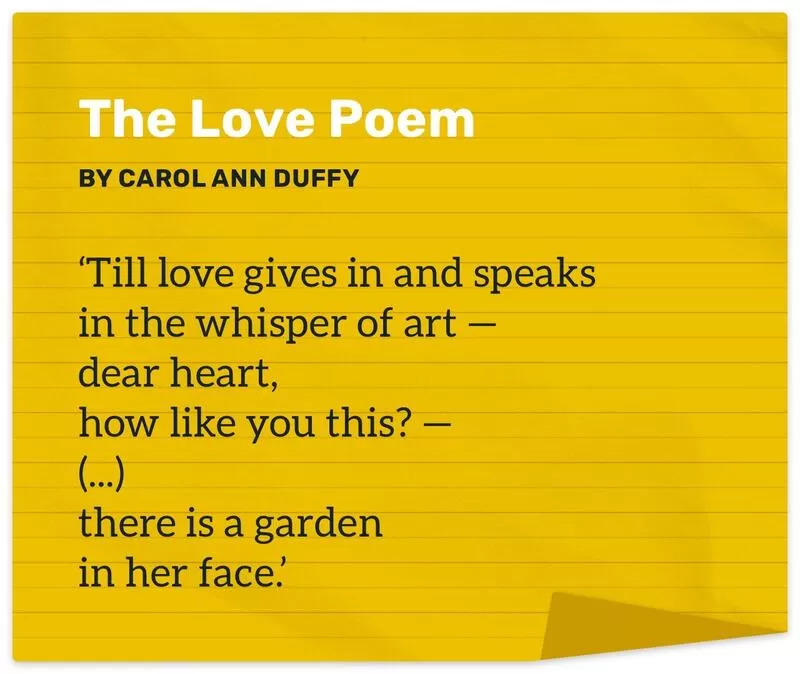
26. “The Love Poem” by Carol Ann Duffy
From her collection Rapture, which charts a love affair, Carol Ann Duffy’s “The Love Poem” is meta-poetic – it’s a poem about the difficulty of writing a poem about love. The speaker struggles to find adequate words to capture the profound experience, acknowledging the limitations of language in expressing such intense emotion. By referencing other famous love poems implicitly or explicitly, Duffy highlights the tradition she is working within and the perpetual human challenge of articulating the ineffable nature of love.
 Symbolic image representing the search for words to describe love, a theme in Carol Ann Duffy's meta-poetic piece 'The Love Poem'
Many aspiring poets seek to capture the same intensity. Understanding how to write poem about love involves grappling with these same challenges of language and emotional expression.
27. “Before You Came” by Faiz Ahmed Faiz
Faiz Ahmed Faiz, a celebrated Urdu poet, often blended themes of love, politics, and resistance. In “Before You Came,” he writes about how love fundamentally altered his perception of the world, bringing clarity and authenticity. “Don’t leave now that you’re here— / Stay. So the world may become like itself again: / so the sky may by the sky, / the road a road, / and the glass of wine not a mirror, just a glass of wine.” This transformation suggests that before love, the world felt distorted or unreal, but the beloved’s presence stripped away illusion, allowing him to see things as they truly are. It’s a poem about love as a force of clarity and truth.
28. “Lines Depicting Simple Happiness” by Peter Gizzi
Peter Gizzi finds beauty in the seemingly simple aspects of love and connection. “Lines Depicting Simple Happiness” celebrates the act of noticing and appreciating the small details about a loved one. “It feels right to notice all the shiny things about you / About you there is nothing I wouldn’t want to know / With you nothing is simple yet nothing is simpler.” This paradox highlights how love can make complex things feel simple while simultaneously revealing the profound complexity within the beloved. It’s a poem about love found in observation, acceptance, and shared ease.
29. “Six Sonnets: Crossing the West” by Janice Gould
Janice Gould, a Maidu lesbian poet, infuses her work with themes of identity, love, and connection to the natural world. In “Six Sonnets: Crossing the West,” the physical act of travel becomes a backdrop for reflecting on absence and longing. “In that communion of lovers, thick sobs / break from me as I think of my love / back home, all that I have done / and cannot say. This is the first time / I have left her so completely, so alone.” The poem beautifully captures the pain of separation and the intense bond that makes even temporary distance feel like a profound loss. It is a tender poem about love and the ache of absence.
30. “For Keeps” by Joy Harjo
Joy Harjo, a Muscogee Nation poet, links love to the natural world in “For Keeps,” creating an image of enduring connection rooted in the land. Comparing love to natural elements lends it a sense of permanence and organic growth. While the original text only mentions the comparison, exploring this poem reveals how Harjo often weaves together personal experience with broader themes of indigeneity, spirituality, and the earth. Her approach suggests that true love is as fundamental and sustaining as nature itself.
 Nature scene, connecting love to the natural world as seen in Joy Harjo's poem 'For Keeps'
31. “You Are the Penultimate Love of My Life” by Rebecca Hazelton
Rebecca Hazelton offers an unconventional, refreshingly honest perspective in “You Are the Penultimate Love of My Life.” This is not a poem about soulmates or destiny, but about finding value and connection in a relationship that is acknowledged as potentially not the final one. The lines “the vowels / we speak aren’t vows, / but there’s something / holding me here, for now,” capture the reality of love that is genuine and meaningful in the present, even without guarantees of forever. It challenges traditional romantic ideals, offering a poem about love that is real, imperfect, and appreciated for what it is now.
32. “Yours” by Daniel Hoffman
Daniel Hoffman’s “Yours” uses carefully crafted metaphors drawn from nature to express complete devotion. Comparing himself to “an unleaded tree / Blasted in a bleakness with no Spring” without his beloved, Hoffman vividly illustrates the desolation of a life untouched by her presence. Conversely, her presence is like the linden blossom’s scent in summer air or the moon’s light on snow, suggesting beauty, vitality, and illumination. It is a poem about love that shows how the beloved becomes essential to the speaker’s very existence and experience of the world.
33. “A Love Song for Lucinda” by Langston Hughes
Langston Hughes, a central figure of the Harlem Renaissance, uses accessible metaphors in “A Love Song for Lucinda” to describe the exhilaration and potential pitfalls of love. Comparing love to a “high mountain / Stark in a windy sky,” he captures its thrilling, breathtaking quality. The warning, “If you / Would never lose your breath / Do not climb too high,” suggests caution and awareness of love’s intensity, implying that unchecked passion can be overwhelming or dangerous. It’s a lyrical poem about love’s intoxicating heights and the wisdom needed to navigate them.
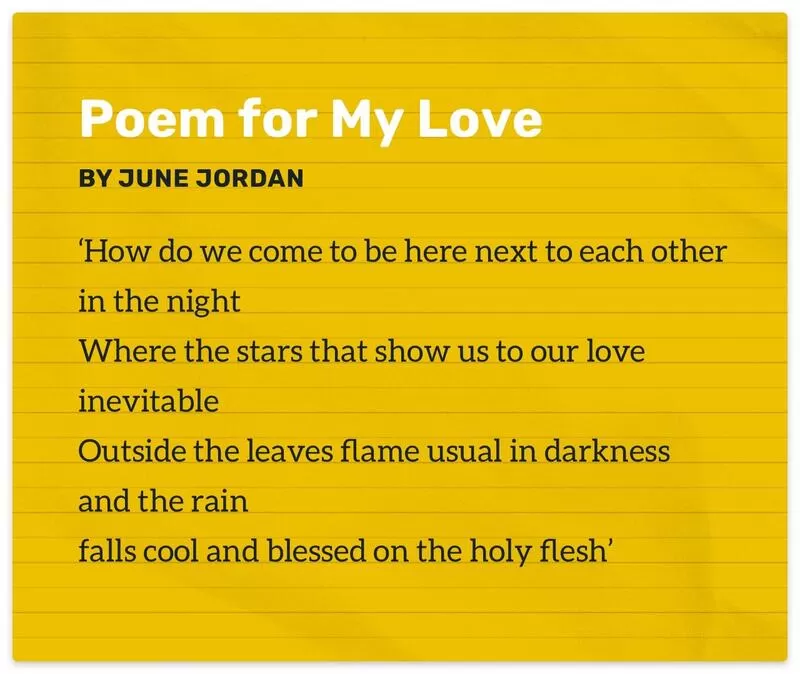
34. “Poem for My Love” by June Jordan
June Jordan, a highly influential Jamaican American writer and activist, expresses profound spiritual awe towards her partner in “Poem for My Love.” While the original excerpt is brief, Jordan’s work often connects personal relationships to broader themes of justice, identity, and transcendence. This poem likely sees the beloved as a source of profound inspiration and spiritual connection, elevating the concept of love beyond the merely romantic to something sacred and world-altering.
 Portrait or symbolic image related to June Jordan's powerful and spiritual 'Poem for My Love'
35. “for him” by Rupi Kaur
Rupi Kaur, a prominent “Instapoet,” connects personal love to familial wisdom in “for him.” Her accessible style often features short verses that pack an emotional punch. The concept of love as “first remembrance” rather than “first sight” is powerful, suggesting a sense of recognition and predestination. The connection to her mother’s advice (“marry the type of man you’d want to raise your son to be like”) grounds this romantic love in a lineage of practical wisdom and shared values, highlighting love’s connection to family and future generations. It’s a contemporary poem about love rooted in a sense of destined recognition. For those seeking 1st love poems, Kaur’s piece offers a unique perspective on initial connection.
36. Untitled by Rupi Kaur
Another short, poignant piece from Kaur’s milk and honey, this untitled poem offers a world-weary but compassionate view on love’s potential for pain. “love will hurt you but / love will never mean to / love will play no games / cause love knows life / has been hard enough already.” This acknowledges the inherent risks and inevitable hurts in love while simultaneously portraying love itself as fundamentally benevolent and understanding. It’s a poem about love’s difficult nature and its underlying kindness.
37. “Poem To An Unnameable Man” by Dorothea Lasky
Dorothea Lasky, known for her distinct, often surreal and emotionally charged voice, explores themes of power and perception within a romantic context in “Poem To An Unnameable Man.” The speaker asserts her inner strength and foresight in the face of a lover’s underestimation. “I was wiser too than you had expected / For I knew all along you were mine.” This suggests a dynamic where the speaker holds a deeper understanding or innate power within the relationship, challenging conventional portrayals of vulnerability in love poems.
38. “Movement Song” by Audre Lorde
Audre Lorde, a prolific writer and activist, addresses the difficult theme of separation and resilience in “Movement Song.” While it reflects the sorrow of a broken heart, the poem ultimately moves towards a message of hope and the possibility of new beginnings for both individuals. It acknowledges the pain of the end (“While the sorrow felt after the speaker’s heart has been broken is clear”) but focuses on the forward momentum and the potential for healing and self-rediscovery after loss. It’s a poem about love’s aftermath and the journey toward healing.
 Image evoking movement or transition, relating to Audre Lorde's 'Movement Song' about the end of a relationship and new beginnings
39. “Camomile Tea” by Katherine Mansfield
Katherine Mansfield, celebrated for her ability to capture subtle emotions, depicts the quiet intimacy and comfort of a long-term relationship in “Camomile Tea.” The poem paints a picture of domestic peace and contentment: “We might be fifty, we might be five, / So snug, so compact, so wise are we!” The simple details – “the fire is low, / The tap is dripping peacefully; / The saucepan shadows on the wall” – create an atmosphere of settled happiness. It highlights the often-underrated beauty of familiar, comfortable love that requires no grand gestures.
40. “Love Elegy in the Chinese Garden, with Koi” by Nathan McClain
Nathan McClain’s “Love Elegy in the Chinese Garden, with Koi” uses a specific setting to explore the anxiety and emotional baggage that prior heartbreaks bring to new romantic possibilities. The speaker reflects on the tendency to love intensely even after being hurt (“Loved so intently even after everything / has gone? Love something that has washed / its hands of you?”). The poem acknowledges the difficulty of shedding this history (“who am I kidding?”) while navigating potential new connections. It’s a thoughtful poem about love, vulnerability, and the lasting impact of past experiences.
41. “I think I should have loved you presently (Sonnet IX)” by Edna St. Vincent Millay
Edna St. Vincent Millay subverts the traditional sonnet form in “I think I should have loved you presently (Sonnet IX).” The speaker confesses an inability to offer genuine, deep affection, opting instead for superficial flirtation (“my pretty follies”) that won the beloved’s attention. The poem is a lament for the speaker’s own emotional unavailability or perhaps a critique of the games played in courtship that prevent true connection. It’s a self-aware poem about love that explores the gap between genuine feeling and performative affection.
42. “Love Sonnet XI” by Pablo Neruda
Pablo Neruda, one of the most significant poets of the 20th century, is renowned for his passionate love poetry. “Love Sonnet XI” is an intense expression of longing and infatuation. The speaker is consumed by thoughts of the beloved, to the point where basic existence feels disrupted: “Bread does not nourish me, dawn disrupts / me, all day / I hunt for the liquid measure of your steps.” This hyperbolic language emphasizes the overwhelming nature of his desire and how the beloved’s absence makes the world feel incomplete or even hostile. It’s a powerful poem about love as a consuming need. This is a classic example of love is poem, where love itself becomes the driving force behind the verse.
43. “Your Feet” by Pablo Neruda
Continuing his passionate adoration, Pablo Neruda’s “Your Feet” demonstrates a unique perspective on loving another person wholly. Instead of focusing solely on the face or heart, Neruda expresses deep affection and reverence for his beloved’s feet, seeing them as having journeyed to him inevitably. “I love your feet / because they have walked / upon the earth / and upon the wind and upon the waters, / until they found me.” This focus on a seemingly ordinary part of the body elevates it to something sacred, symbolizing the entire path that led the beloved to him. It’s a poem about love that finds the extraordinary in the ordinary aspects of the loved one.
44. “Dear One Absent This Long While” by Lisa Olstein
Lisa Olstein captures the poignant anxiety of waiting for a loved one’s return in “Dear One Absent This Long While.” The speaker’s heightened anticipation leads to misinterpretations of ordinary sights and sounds – “you at the base of the drive,” “you in a shiver of light” – which are revealed to be merely “leaves in wind” or “the retreating shadow of a fox.” This demonstrates how longing can fill the world with false signs of the beloved’s presence. The inclusion of the cat, bluebirds, and even the stove waiting emphasizes how the entire domestic world feels incomplete without the missing person. It is a tender poem about love and the ache of separation.
45. “My Lover Is a Woman” by Pat Parker
Pat Parker, an influential African-American lesbian feminist poet and activist, directly addresses her experience in “My Lover Is a Woman.” Against the backdrop of societal prejudice and struggle, the poem finds strength, safety, and affirmation in the bond with her female lover. “my lover is a woman / & when i hold her / feel her warmth / i feel good / feel safe.” This simple, declarative language underscores the profound comfort and refuge found in a love that is both personal and, for Parker, politically significant in its defiance of heteronormativity. It’s a powerful poem about love as a source of safety and self-acceptance.
46. “It Is Here” by Harold Pinter
Harold Pinter, the Nobel laureate playwright, also penned poetry. “It Is Here” is a minimalist yet powerful reflection on the enduring presence of love’s beginning. The speaker questions the turning away and turning back within a relationship (“What is this stance we take”). The answer points to the foundational moment of connection: “What did we hear? / It was the breath we took when we first met. / Listen. It is here.” This suggests that the essence of their love resides not just in the present or future, but is perpetually available by recalling that initial shared breath, the spark of recognition. It is a poem about love’s timeless origin point.
47. “Untitled” by Christopher Poindexter
Christopher Poindexter, known for his accessible, often Instagram-shared poetry, offers a deeply honest portrayal of love’s paradoxical longing in this untitled piece. “I miss you even when you / are beside me. / I dream of your body / even when you are sleeping / in my arms.” These lines express an overwhelming feeling that transcends physical presence, suggesting a yearning so profound it exists even in moments of closeness. The conclusion, “The words I love you / could never be enough,” highlights the inadequacy of language to fully capture the depth of such intense emotion.
48. “Love Is Not A Word” by Riyas Qurana
Riyas Qurana’s “Love Is Not A Word” is an intriguing, somewhat ambiguous poem written from the perspective of personified Love itself. It posits Love as an elemental force (“I keep a falling flower in the mid-air / Not to fall on the earth”) that exists independently of human action or definition. The lines “Is it not up to you who search for it / To come and sit on it / And make love? / Don’t forget to bring the word / Darling / When you come,” challenge the reader to actively engage with Love, suggesting it requires participation, yet also playfully acknowledges the human need for verbal endearments like “Darling.” It’s a philosophical poem about love’s nature and human interaction with it.
49. “[Again and again, even though we know love’s landscape]” by Rainer Maria Rilke
Rainer Maria Rilke, a profound Austrian poet, believed that love was one of life’s most difficult tasks. His poem “[Again and again, even though we know love’s landscape]” reflects this perspective, acknowledging the inherent risks and potential pain (“the little churchyard with its lamenting names / and the terrible reticent gorge”). Despite this awareness of love’s dangers and inevitable losses, the poem celebrates the conscious choice to repeatedly embrace love (“again and again the two of us walk out together”). It finds beauty and strength in the vulnerability and shared experience of navigating love’s difficult terrain together. It is a courageous poem about love’s conscious effort.
50. “Echo” by Christina Rossetti
Christina Rossetti, a Victorian poet associated with the Pre-Raphaelites, captures the haunting persistence of lost love in “Echo.” The speaker longs for a past love to return, much like an echo repeats a sound. The desire is palpable, wishing the beloved could come back “In a dream, if not to the waking eyes.” The poem evokes a sense of despair and yearning for a connection that exists now only in memory and longing. It is a beautiful, melancholic poem about love’s enduring echo after it is gone.
51. “I loved you first: but afterwards your love” by Christina Rossetti
In this sonnet, Rossetti explores the dynamic of mutual love, moving beyond an initial concern about who loved whom first. “I loved you first: but afterwards your love / Outsoaring mine, sang such a loftier song / As drowned the friendly cooings of my dove.” While it begins by measuring love’s intensity, the poem ultimately arrives at a sense of “oneness,” where their individual loves combine into something greater than the sum of its parts. It celebrates the profound mutual understanding and shared identity that deep love can create. This poem about love highlights the beautiful synergy in a reciprocal relationship.
52. “Defeated by Love” by Rumi
Jalāl al-Dīn Muḥammad Rūmī, the 13th-century Persian poet and Sufi mystic, wrote with unparalleled passion about both divine and human love. In “Defeated by Love,” the speaker describes love as an overwhelming force that eclipses the physical world and self. “The sky was lit / by the splendor of the moon / So powerful / I fell to the ground / Your love / has made me sure / I am ready to forsake / this worldly life / and surrender / to the magnificence / of your Bering.” The language is ecstatic, portraying love as a surrender to a higher power or presence, transforming and consuming the individual. It’s a fervent, spiritual poem about love’s transformative power.
53. “Shall I compare thee to a summer’s day? (Sonnet 18)” by William Shakespeare
Perhaps the most famous love poem in English, William Shakespeare’s Sonnet 18 is a masterclass in eternalizing beauty and love through verse. While it begins with a seemingly simple comparison to a summer’s day, Shakespeare quickly asserts the beloved’s superiority (“Thou art more lovely and more temperate”). He contrasts the transient nature of summer’s beauty with the enduring quality of his beloved’s beauty, which will live forever in the “eternal lines” of his poem. It’s a poem about love that promises immortality through the power of art. This is a perfect example of why Shakespeare is synonymous with poems for lovers.
54. “Let me not to the marriage of true minds (Sonnet 116)” by William Shakespeare
Another iconic Shakespearean sonnet, Sonnet 116, attempts to define true love by stating what it is not. “Let me not to the marriage of true minds / Admit impediments. Love is not love / Which alters when it alteration finds, / Or bends with the remover to remove.” Shakespeare presents love as an unwavering, constant force, a “ever-fixed mark” that withstands challenges (“tempests”) and the passage of time (“alters not with his brief hours and weeks”). It is a philosophical poem about love’s steadfast and enduring nature.
55. “My mistress’ eyes are nothing like the sun” (Sonnet 130) by William Shakespeare
In a delightful subversion of conventional Petrarchan love poetry, Shakespeare’s Sonnet 130 humorously debunks exaggerated comparisons. Instead of idealizing his mistress’s features, he lists her imperfections: her eyes are “nothing like the sun,” her lips are “far more red than coral.” However, the volta (turn) in the final couplet reveals the poem’s true purpose: “And yet, by heaven, I think my love as rare / As any she belied with false compare.” By rejecting false idols, Shakespeare affirms a genuine love that appreciates reality over unrealistic ideals. It is a realistic and deeply affectionate poem about love.
56. “Love’s Philosophy” by Percy Bysshe Shelley
Percy Bysshe Shelley employs natural harmony to argue for the necessity of romantic union in “Love’s Philosophy.” He observes how elements in nature mingle and connect – fountains with rivers, rivers with oceans, winds with emotions. “Nothing in the world is single; / All things by a law divine / In one spirit meet and mingle / Why not I with thine?” Shelley uses this observed natural law as a logical, almost playful, argument for his beloved to reciprocate his feelings. It’s a persuasive and lyrical poem about love seeking unity.
57. “One Day I Wrote her Name (Sonnet 75)” by Edmund Spenser
Part of his Amoretti sequence, Edmund Spenser’s Sonnet 75 addresses the ephemeral nature of earthly things compared to the lasting power of poetry. The speaker’s attempts to immortalize his beloved’s name by writing it in the sand are repeatedly erased by the waves. The beloved argues that trying to eternalize something mortal is futile. The speaker, however, refutes this, promising that “My verse your vertues rare shall eternize, / And in the heavens write your glorious name.” This poem about love asserts that poetry can conquer time and grant immortality to the subject of its praise.
58. “I Am Not Yours” by Sara Teasdale
Sara Teasdale’s “I Am Not Yours” is a powerful expression of longing for a love that is utterly consuming and transformative, a love that makes one feel completely surrendered. The speaker is in a relationship but feels a lack of true belonging (“I Am Not Yours”). She yearns to be so deeply lost in love that her identity dissolves into the connection, wishing for “The drowning of my soul in shoreless seas.” This poem contrasts the safety of a conventional relationship with the intense desire for a boundless, perhaps overwhelming, passionate love.
Finding such a profound connection often involves hope. Explore how love intertwines with hope in a poem about love and hope.
59. “Now Sleeps the Crimson Petal” by Alfred, Lord Tennyson
From Tennyson’s longer work The Princess, “Now Sleeps the Crimson Petal” is a richly sensual and lyrical serenade. Inspired by the Persian ghazal form, which often explores themes of unattainable love, the poem uses vivid natural imagery – sleeping flowers, still cypress, waking fireflies – to create a tranquil, nocturnal setting. The invitation “The firefly wakens; waken thou with me” shifts from description to a personal plea, inviting the beloved to join in the night’s quiet sensuality. It’s a poem about love steeped in atmosphere and longing.
60. “poem I wrote sitting across the table from you” by Kevin Varrone
Kevin Varrone offers a candid glimpse into an intimate moment of connection in “poem I wrote sitting across the table from you.” Written impulsively, perhaps in a coffee shop, the poem captures a feeling of wanting to share every experience, no matter how small or absurd, with the beloved. The lines “I would fold myself / into the hole in my pocket and disappear / into the pocket of myself… but before I did / like some ancient star / I’d grab your hand” use whimsical imagery to express a deep desire for shared existence and connection before retreating into the self. It’s a charming poem about love found in shared moments and quirky affection.
61. “On Earth We’re Briefly Gorgeous” by Ocean Vuong
Ocean Vuong’s powerful poem (which shares its title with his acclaimed novel) explores love within the context of fragility, impermanence, and historical weight. “Tell me it was for the hunger / & nothing less. For hunger is to give / the body what it knows / it cannot keep.” This suggests love is a fundamental need, pursued despite the knowledge of its fleeting nature or the hardships of life (“another war”). The image of light pinning his hand to the beloved’s chest conveys both tenderness and a sense of being held together by external forces. It’s a profound poem about love’s urgency and vulnerability in a challenging world.
62. “Love After Love” by Derek Walcott
Derek Walcott, a Nobel laureate from Saint Lucia, offers a poem of self-love and healing after a relationship ends in “Love After Love.” The poem serves as gentle advice, encouraging the reader to welcome back the “stranger who was your self” after perhaps having lost themselves in loving another. “Give wine. Give bread. Give back your heart / to itself, to the stranger who has loved you / all your life, whom you ignored / for another, who knows you by heart.” It emphasizes the importance of returning to and cherishing one’s own inner being as a form of love, suggesting that self-love is a necessary foundation.
63. “I Love You” by Ella Wheeler Wilcox
Ella Wheeler Wilcox’s “I Love You” builds its declaration by focusing on specific, often sensual, details of the beloved. She lists the aspects she loves – “lips when they’re wet with wine,” “eyes when the lovelight lies,” “arms when the warm white flesh,” “hair when the strands enmesh.” This accumulation of physical details creates a vivid picture of the beloved and the speaker’s intense attraction. By contrasting these desired traits with those she doesn’t seek, the poem amplifies the specific qualities that ignite her passion.
64. “We Have Not Long to Love” by Tennessee Williams
Tennessee Williams, primarily known as a playwright, also wrote poignant poetry. “We Have Not Long to Love” carries a sense of urgency and melancholic beauty, reflecting on the limited time we have for love and connection. It emphasizes the importance of cherishing the present moments of love because, like all things, they are transient (“remembering that nothing will last forever”). The poem serves as a reminder to appreciate the love we have while we have it, underscored by an awareness of life’s brevity.
65. “Poem to First Love” by Matthew Yeager
Matthew Yeager’s “Poem to First Love” reflects on the significance of a first romantic experience with a mix of nostalgia, attempts at quantification, and quirky comparisons. The speaker tries to measure the impact of being told “I love you” for the first time, comparing it to a significant landmark (“the Chrysler building / might not be the tallest building… but is / the best, the most exquisitely spired”). This blends genuine emotion with a relatable, slightly awkward attempt to categorize its monumental feeling. It’s a poem about love that captures the unique, often undefinable, place a first love holds in memory.
These poems, spanning centuries and diverse voices, demonstrate the endless ways poets have sought to articulate the complex, powerful, and multifaceted experience of love. From declarations of eternal devotion to quiet moments of shared comfort, these works offer solace, inspiration, and deeper understanding for anyone who has ever loved.