
Elizabeth Barrett Browning’s Sonnet 43, often known by its opening line “How do I love thee?”, stands as one of the most enduring and beloved expressions of love in the English language. Published in 1850 as part of Sonnets from the Portuguese, this poem attempts to quantify the immeasurable – the depth and breadth of true affection. Understanding the “how do I love thee meaning” involves delving into the poet’s personal context, her masterful use of poetic form, and the powerful declarations she makes within the sonnet’s fourteen lines. It’s a poem that moves beyond simple sentimentality to explore the many dimensions, both spiritual and everyday, of a profound love.
Elizabeth Barrett Browning (1806-1861) was already a highly respected poet when she met the equally talented Robert Browning in 1845. Their famous courtship, conducted largely through letters and secret meetings due to her father’s disapproval, culminated in their elopement to Italy in 1846. The Sonnets from the Portuguese were a private collection written by Elizabeth during this period, secretly chronicling her overwhelming love for Robert. She initially hesitated to share them, deeming them too personal, but Robert persuaded her to publish, using the deceptive title to imply they were translations and thus soften their intensely personal nature for the Victorian public.
The sonnet itself is a direct and passionate response to an unspoken question, likely posed by her beloved Robert or perhaps an internal musing: “How do I love thee?” The speaker takes on the task of itemizing the ways, attempting to articulate the scope of a love that feels boundless.
How do I love thee? Let me count the ways.
I love thee to the depth and breadth and height
My soul can reach, when feeling out of sight
For the ends of being and ideal grace.
I love thee to the level of every day’s
Most quiet need, by sun and candle-light.
I love thee freely, as men strive for right;
I love thee purely, as they turn from praise.
I love thee with the passion put to use
In my old griefs, and with my childhood’s faith.
I love thee with a love I seemed to lose
With my lost saints. I love thee with the breath,
Smiles, tears, of all my life; and, if God choose,
I shall but love thee better after death.
The opening lines leap into the metaphysical, describing a love that extends to the furthest reaches of the soul, grasping for ultimate existence and divine beauty. This suggests a love that transcends the physical realm, touching upon the spiritual and the infinite. But the poem quickly grounds this lofty declaration by contrasting it with the practical, constant needs of daily life – “by sun and candle-light.” This duality is crucial to the “how do i love thee meaning”; the love is both grand and essential, extraordinary yet woven into the fabric of ordinary existence.
Barrett Browning further defines this love by comparing it to fundamental human actions and states. She loves “freely,” like those who champion justice and right, implying a love that is unforced and inherent. She loves “purely,” like those who turn away from worldly acclaim towards more genuine devotion. This love isn’t conditional or seeking external reward; it is its own justification.
Perhaps most poignantly, she describes loving with the intensity of “passion put to use / In my old griefs, and with my childhood’s faith.” Her deep emotional capacity, previously channeled into sorrow or longing, now finds its positive expression in love for Robert. She also connects this love to the unwavering belief of childhood and the devotion once held for “lost saints,” suggesting this new love has a sacred quality, restoring a faith or purpose that might have been absent. The repetition of “I love thee” at the beginning of multiple lines acts like a steady, powerful pulse, reinforcing the mantra of devotion and listing the facets of this all-encompassing emotion.
Formally, the poem is a Petrarchan sonnet, structured into an octave (the first eight lines) and a sestet (the final six lines). The rhyme scheme follows the traditional abbaabba cdcdcd pattern, although Barrett Browning uses some near or slant rhymes (like “ways”/”grace,” “light”/”right,” “faith”/”breath”) that add a subtle complexity to the sound. Written mostly in iambic pentameter, the poem maintains a regular rhythm, creating a sense of measured, thoughtful declaration, occasionally punctuated by extra stressed syllables for emphasis, particularly in the opening line. Understanding these poetry formats helps reveal how form complements meaning, providing a structured vessel for unrestrained emotion.
The concluding lines offer a breathtaking assertion of love’s permanence. This is not a love bound by mortal life. She loves with “the breath, / Smiles, tears, of all my life,” encompassing every emotional state and physical existence. And then, in a final, powerful statement, she declares that if it is God’s will, her love will not only survive death but will intensify beyond the grave: “I shall but love thee better after death.” This moves the poem from a profound human love to one bordering on the divine, promising an eternal bond that transcends earthly limits.
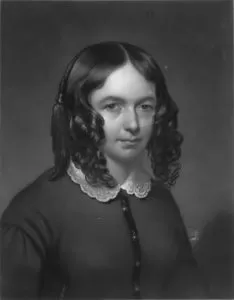 Portrait of the poet Elizabeth Barrett Browning
Ultimately, the “how do I love thee meaning” resides in this comprehensive exploration of love – its spiritual height, its daily necessity, its inherent freedom and purity, its power to heal past pain, and its promise of eternal life. Barrett Browning uses simple, direct language combined with elevated concepts and traditional form to create a declaration that resonates with universal human experience, making Sonnet 43 a timeless testament to the boundless nature of love. While contrasting with the lighthearted fun found in pieces like funny children’s christmas poems, this sonnet demonstrates the profound emotional depth poetry can achieve. It invites readers to reflect on their own capacity for love and the myriad ways it can enrich a life, both here and, perhaps, beyond.