
Meter in poetry refers to the rhythmic pattern created by stressed and unstressed syllables within a line. Understanding meter can significantly enhance your appreciation of poetry, revealing how sound contributes to meaning. This article explores various types of meter, providing clear meter poem examples to illustrate each.
Contents
Iambic Pentameter: A Steady Beat
Perhaps the most common meter in English poetry, iambic pentameter consists of five “iambs” per line. An iamb is a metrical foot comprising an unstressed syllable followed by a stressed syllable (da-DUM). This creates a gentle, rhythmic pulse.
Shakespeare’s Sonnet 18 provides a classic example:
Shall I compare thee to a summer’s day?
 Iambic Pentameter
Each line adheres to this da-DUM pattern, creating a sense of balance and harmony. The predictability of the rhythm allows the reader to focus on the beauty of the language and the depth of the sentiment.
Trochaic Octameter: A Driving Force
Trochaic octameter uses eight “trochees” per line. A trochee is the opposite of an iamb, consisting of a stressed syllable followed by an unstressed syllable (DA-dum). This meter creates a more forceful, driving rhythm.
Edgar Allan Poe’s “The Raven” demonstrates this meter:
Once upon a midnight dreary, while I pondered, weak and weary
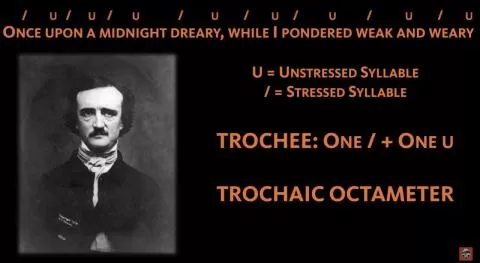 trochaic octameter
The strong initial stress in each trochee gives the poem a sense of urgency and dramatic tension.
Anapestic Tetrameter: A Lively Pace
Anapestic tetrameter employs four “anapests” per line. An anapest consists of two unstressed syllables followed by a stressed syllable (da-da-DUM). This meter imparts a light, galloping rhythm.
Clement Clarke Moore’s “A Visit from St. Nicholas” uses this meter:
‘Twas the night before Christmas when all through the house
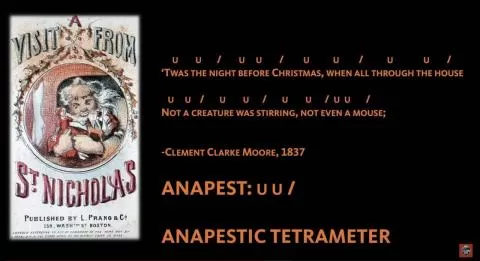 anapestic tetrameter
The two unstressed syllables leading up to the stress create a sense of anticipation and excitement.
Dactylic Hexameter: An Epic Meter
Dactylic hexameter uses six “dactyls” per line. A dactyl is a stressed syllable followed by two unstressed syllables (DA-dum-dum). This meter has a grand, sweeping feel, often associated with epic poetry.
Henry Wadsworth Longfellow’s “Evangeline” showcases this meter:
This is the forest primeval, the murmuring pines and the hemlocks
 dactylic hexameter
The initial stress followed by two unstressed syllables creates a sense of majesty and flow. Interestingly, modern artists like Migos also utilize this form, as seen in their song “Versace”:
Drownin’ in compliments, pool in the backyard that look like Metropolis
 Dactyl Meter 2
This demonstrates the versatility of dactylic hexameter and its enduring appeal.
Breaking the Meter: A Source of Meaning
While consistent meter establishes a rhythmic foundation, poets often deviate from it for emphasis or to create specific effects. Identifying these breaks can provide insights into the poem’s meaning. For example, in John Milton’s “Paradise Lost,” written primarily in iambic pentameter, a break occurs:
Of Man’s First Disobedience, and the Fruit
Of that Forbidden Tree, whose mortal tast
Brought Death into the World, and all our woe
 Paradise Lost opening Lines
The disruption in the third line, specifically the emphasis on “Death,” draws attention to the gravity of the fall.
Conclusion
By understanding the different types of meter and how poets use them, we can gain a deeper appreciation for the artistry of poetry. Examining meter poem examples allows us to hear the music within the words and unlock the layers of meaning embedded in the rhythmic patterns. Recognizing and analyzing metrical variations can enrich our understanding and enjoyment of poetry’s subtle complexities.