
Poetry doesn’t always have to follow strict rules of rhythm and rhyme. While many classic forms rely on meter and consistent rhyme schemes, some of the most powerful and resonant poems written throughout history, and especially in modern times, are poems without rhyme. These poems, often referred to as free verse, break free from traditional constraints, allowing language and emotion to forge their own path on the page.
Contents
- What a Poem Without Rhyme (Free Verse) Typically Lacks
- Meter
- Fixed Rhyme Scheme
- Fixed Form
- What Defines a Poem Without Rhyme?
- Cadence and Flow
- Form Follows Language
- Non-Uniform Lines and Stanzas
- Experiments With Space
- Prosaic Qualities
- Concise Imagery
- Free Verse vs. Blank Verse: Clarifying the Distinction
- Examples of the Poem Without Rhyme (Free Verse)
- “Shoulders” by Naomi Shihab Nye
- “The Heaven” by Franz Wright
- “First Memory” by Louise Glück
- “little prayer” by Danez Smith
- “On a Train” by Wendy Cope
- How to Write a Poem Without Rhyme
- 1. Start with a Strong Image, Emotion, or Idea
- 2. Follow the Natural Voice
- 3. Use Line Breaks Intentionally
- 4. Focus on Word Choice and Imagery
- 5. Read Aloud and Revise for Flow and Impact
- The Value of the Poem Without Rhyme
A Poem Without Rhyme, or a free verse poem (from the French vers libre), doesn’t adhere to a particular form, meter, or rhyme scheme. Instead of being dictated by predefined structures, the poem’s shape emerges organically from the interplay of its words, sounds, rhythm, and literary devices. This approach shifts the focus from external pattern to internal logic, emphasizing the natural cadences of spoken language and the visual layout on the page.
Understanding what a poem without rhyme is begins with understanding what it deliberately avoids.
What a Poem Without Rhyme (Free Verse) Typically Lacks
While formal poetry builds structure through predictable patterns, a poem without rhyme intentionally foregoes these fixed elements.
Meter
Meter refers to the organized pattern of stressed and unstressed syllables within a line of poetry. In metrical verse, like iambic pentameter, this pattern is consistent across lines. Think of words like “away” (unstressed-stressed, an iamb) or “beautiful” (stressed-unstressed-unstressed, a dactyl). Metrical poems often aim for a specific number of these “feet” per line, creating a discernible rhythm.
A poem without rhyme does not follow a predetermined metrical pattern. Its rhythm is not externally imposed but arises naturally from the poet’s word choice, sentence structure, and line breaks.
Fixed Rhyme Scheme
A rhyme scheme is the ordered pattern of rhymes, usually at the end of lines. An AABB scheme means consecutive lines rhyme, while ABAB means alternate lines rhyme. Rhyme can create musicality and link ideas structurally within a stanza or poem.
Example of a rhyme scheme (ABAB) from Henry Wadsworth Longfellow’s “A Psalm of Life”:
Tell me not, in mournful numbers, (A)
Life is but an empty dream!— (B)
For the soul is dead that slumbers, (A)
And things are not what they seem. (B)
While free verse poems might occasionally use internal rhyme, slant rhyme, or even end rhyme for specific effect, they do not maintain a consistent, overarching rhyme scheme throughout the entire poem. The absence of a fixed rhyme scheme is a defining characteristic of a poem without rhyme.
Fixed Form
Poetic forms like sonnets, haikus, or villanelles combine requirements for meter, rhyme scheme, and length (number of lines, stanzas). A sonnet, for example, typically has 14 lines in iambic pentameter with a specific rhyme scheme.
A poem without rhyme does not adhere to these comprehensive formal requirements. It has no set number of lines, stanzas, or syllable counts per line. This freedom allows the content to dictate the form, rather than the other way around.
What Defines a Poem Without Rhyme?
If a poem without rhyme lacks these traditional structures, what gives it shape and meaning? Free verse relies on other poetic tools and principles to create coherence, rhythm, and impact.
Cadence and Flow
Without meter, the rhythm of a poem without rhyme is built through cadence – the natural rise and fall of language, much like in speech or music. This cadence is influenced by factors like line length, pauses (created by line breaks or punctuation), word choice, and the strategic use of sound devices such as alliteration, assonance, and consonance. The resulting “flow” is the overall feeling of movement and pacing when reading the poem aloud.
Form Follows Language
In free verse, the poet lets the language itself determine the structure. The length of lines, where stanzas break, the use of repetition, and the overall arrangement on the page are decided by the poet based on the ideas, images, and emotions being expressed. The words don’t have to be bent to fit a pre-existing mold; the mold is created by the words.
Non-Uniform Lines and Stanzas
A visual characteristic of many poems without rhyme is the varied length of their lines and stanzas. One line might be just a few words, while the next is much longer. Stanza breaks can occur after any number of lines, often used to create pauses, shift focus, or group related ideas. This visual variety contributes to the poem’s rhythm and can emphasize certain words or phrases.
Experiments With Space
The absence of a fixed form allows poets writing poems without rhyme to use the physical space of the page as part of the poem’s structure and meaning. Lines might be indented, centered, or spread across the page. Unusual spacing or line breaks can slow the reader down, create visual patterns, or highlight isolation or connection between words.
Prosaic Qualities
While distinct from prose poetry (which uses paragraphs and sentences rather than lines and stanzas), a poem without rhyme can sometimes borrow qualities from prose. It might use more conversational language, syntax, or sentence structures than traditional metrical verse. This can create a sense of directness or intimacy.
Concise Imagery
Since a poem without rhyme doesn’t rely on the musicality or structure provided by rhyme and meter, vivid and precise imagery becomes crucial. Strong, memorable images help ground the poem, evoke emotion, and convey complex ideas economically. For instance, William Carlos Williams’ famous short free verse poem, “The Red Wheelbarrow,” uses simple, concrete images to provoke thought:
so much depends
upon
a red wheel
barrow
glazed with rain
water
beside the white
chickens.
The poem’s power lies in the stark juxtaposition of these ordinary objects and the mysterious assertion that “so much depends / upon” them. The lack of rhyme or meter draws the reader’s attention directly to the images and the line breaks, which emphasize key words like “depends,” “wheel / barrow,” and “chickens.” This is a prime example of how a simple poem without rhyme can generate profound meaning through careful arrangement and imagery.
Free Verse vs. Blank Verse: Clarifying the Distinction
The terms “free verse” and “blank verse” are sometimes confused, as neither requires a rhyme scheme. However, the key difference lies in meter.
- Blank Verse: A poem written with a regular metrical pattern, but without rhyme. The most common form is unrhymed iambic pentameter (like Shakespeare’s plays or Milton’s Paradise Lost). Each line follows the da-DUM da-DUM da-DUM da-DUM da-DUM pattern, but the last words of the lines don’t rhyme.
- Free Verse: A poem without rhyme and without a regular metrical pattern. Its rhythm is organic and variable.
Blank verse sits between strictly formal rhyming poetry and the complete metrical freedom of free verse. It maintains meter but discards rhyme. Free verse discards both.
Examples of the Poem Without Rhyme (Free Verse)
To truly appreciate the poem without rhyme, exploring examples is essential. These poems demonstrate how structure can emerge from language and feeling.
“Shoulders” by Naomi Shihab Nye
 man carrying child in rain
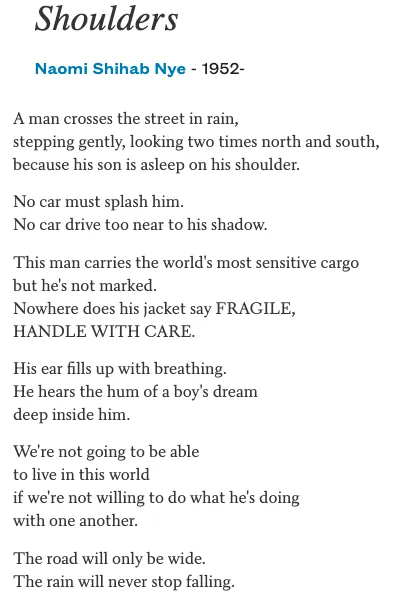
This poem, available here in the Academy of American Poets, is a beautiful illustration of finding profound meaning in a simple, observed moment. Nye describes a man carrying his sleeping son across a rainy street, shielding him from the harsh elements and sounds.
She notes the absence of a “FRAGILE” label on the child, highlighting that the father’s tenderness isn’t mandated but freely given. The poem’s power culminates in a reflection on how the world is often a difficult, “wide and rainy” place, suggesting that this same instinct for tenderness and care is essential for human survival. The lines vary in length, mimicking the natural flow of thought and observation, emphasizing certain images like the rain, the light, and the sleeping son. The poem is a quintessential example of how a poem without rhyme can elevate an everyday scene into a universal meditation on vulnerability and compassion.
“The Heaven” by Franz Wright
I lived as a monster, my only hope is to die like a child. In the otherwise vacant and seemingly ceilingless
vastness of a snowlit Boston
church, a voice said: I can do that
if you ask me, I will do it for you.
Wright’s brief free verse poem uses striking juxtapositions and a sense of spaciousness created by the line breaks and the image of the “seemingly ceilingless / vastness.” The opening line’s stark confession is contrasted with the potential for childlike innocence in death and the redemptive voice heard in the church. The varying line lengths and the break between “ceilingless” and “vastness” emphasize the immense, echoing quality of the space, mirroring the speaker’s internal plea. This poem without rhyme uses sound and visual layout to amplify its themes of sin, hope, and grace.
“First Memory” by Louise Glück
Found here in Poetry Society.
Glück’s concise poem delves into the complex nature of childhood pain and its lasting impact.
Long ago, I was wounded. I lived to revenge myself against my father, not for what he was— for what I was: from the beginning of time, in childhood, I thought that pain meant I was not loved. It meant I loved.
This poem without rhyme strips away ornamental language to deliver a raw, psychological insight. The speaker’s initial belief—that pain signified a lack of love—is sharply dismantled in the final lines, revealing the deeper, more painful truth: the pain stemmed from her own enduring love for her father. The poem uses simple, direct language and relies on the power of its final, revelatory statement, unadorned by rhyme or strict rhythm. Short free verse poems often achieve their impact through such powerful, unvarnished declarations and precise psychological observation.
“little prayer” by Danez Smith
Found here in the Academy of American Poets.
let ruin end herelet him find honey where there was once a slaughterlet him enter the lion’s cage & find a field of lilacslet this be the healing & if not let it be
Smith’s poem is a series of hopeful, almost defiant wishes presented without capitalization or standard punctuation, enhancing the sense of urgent prayer or incantation. The power comes from the unexpected pairings: honey replacing slaughter, lilacs found in a lion’s cage. These sharp, vivid images create a powerful emotional landscape. The simple, repetitive structure (“let him find,” “let this be”) builds a rhythm without rhyme, focusing the reader’s attention on the transformative images and the raw hope expressed. This poem without rhyme uses stark imagery and deliberate minimalist formatting to amplify its plea for healing. Exploring diverse themes like hope and healing in non-rhyming forms can be deeply impactful, much like delving into depressing poems about death or finding levity in short poems that are funny.
“On a Train” by Wendy Cope
Found here in The Poetry Archive.
The book I’ve been reading rests on my knee. You sleep.
It’s beautiful out there— fields, little lakes and winter trees in February sunlight, every car park a shining mosaic.
Long, radiant minutes, your hand in my hand, still warm, still warm.
Cope’s poem captures a moment of quiet intimacy and appreciation for simple beauty. The free verse form allows the lines to flow naturally, like observations drifting through the speaker’s mind on a train journey. The short, declarative sentences (“You sleep.”) create pauses, while longer lines describe the scenery with evocative imagery (“every car park a shining mosaic”). The repetition of “still warm, still warm” at the end emphasizes the tangible comfort and emotional connection felt by the speaker. This poem without rhyme finds loveliness in the everyday, proving that powerful emotional resonance doesn’t require formal constraints, similar to how specific themes like poems about 4th of july or a poem about strong women can be explored effectively without rhyme.
How to Write a Poem Without Rhyme
Writing a poem without rhyme might seem simpler than writing a sonnet, but the freedom comes with its own challenges. Without external rules, the poet must develop an internal sense of form and rhythm. Here are some tips:
1. Start with a Strong Image, Emotion, or Idea
Instead of focusing on finding rhymes or fitting a meter, begin with what you want the poem to convey. What specific image is vivid in your mind? What emotion are you trying to explore? What idea feels urgent? Let this core element be the seed from which the poem grows. A strong starting point provides the poem’s internal compass. For example, if you want to write soulmate poetry for him, start with the specific feelings or images that come to mind when you think of that connection.
2. Follow the Natural Voice
Free verse often aims to capture the rhythms of natural speech or thought. Write initially without worrying about line breaks or structure. Let the words come out as they would if you were speaking or thinking about the subject. This can help you find the inherent cadence of your language.
3. Use Line Breaks Intentionally
This is crucial in a poem without rhyme. Line breaks create pauses and emphasize the last word or phrase of a line.
- End-stopped lines: End with punctuation, creating a strong pause.
- Enjambed lines: Carry the thought over to the next line without punctuation, creating a sense of continuity or urgency, sometimes creating surprising juxtapositions.
Experiment with where you break lines to control the poem’s pace and highlight meaning. Reading your poem aloud can help you find the most effective breaks.
4. Focus on Word Choice and Imagery
Every word counts in a poem without rhyme. Choose words that are precise, evocative, and sensory. Build vivid images that allow the reader to experience the poem with their senses. Pay attention to the sound of words (alliteration, assonance, consonance) to create musicality without relying on end rhyme.
5. Read Aloud and Revise for Flow and Impact
Once you have a draft, read it aloud repeatedly. This will help you identify awkward phrasing, clunky rhythms, or unclear sections. Pay attention to where your natural breath falls. Refine your line breaks and word choices to enhance the poem’s flow and ensure it builds towards its intended emotional or intellectual impact. Does the ending feel right? Does the poem leave a lasting impression?
The Value of the Poem Without Rhyme
Writing a poem without rhyme offers incredible creative freedom. It allows poets to explore subjects and emotions with a directness and flexibility that traditional forms might constrain. Free verse is particularly well-suited for capturing the complexities and fragmented nature of modern life, the nuances of personal experience, and the natural rhythms of thought and observation.
While formal poetry provides a valuable framework and challenge, free verse allows the poet to build the structure from the ground up, letting the content dictate the form. Both approaches are valid and offer unique opportunities for artistic expression. The choice of whether or not to use rhyme is ultimately a creative decision based on what best serves the poem’s message and intent.
Understanding and appreciating the poem without rhyme opens up a vast and diverse landscape of poetic expression, revealing that the heart of poetry lies not just in predictable patterns, but in the careful, intentional shaping of language to evoke feeling and insight.