
Haiku, a poetic form originating in Japan, is celebrated for its brevity, evocative imagery, and ability to capture fleeting moments with profound depth. Despite their concise structure, typically consisting of three lines with a 5, 7, 5 syllable count (though this convention is often adapted, especially in English), forms of haiku can convey complex emotions and observations about the world. These short poems often draw inspiration from nature, linking external phenomena to internal human experience. The enduring appeal of haiku lies in their accessibility and the contemplative space they create for the reader. This article delves into 40 celebrated and popular haiku poems that offer a glimpse into the rich tradition and diverse interpretations of this unique art form, showcasing why certain examples have resonated deeply with readers across cultures and time.
Contents
 A collection of diverse haiku poems displayed across a textured background
The Masters of Japanese Haiku
Any discussion of popular haiku poems must begin with the Four Great Masters of Japanese haiku: Matsuo Bashō, Yosa Buson, Kobayashi Issa, and Masaoka Shiki. Their works laid the foundation for the form and continue to be among the most widely read and analyzed haiku in the world.
Matsuo Bashō
Matsuo Bashō (1644–1694) is arguably the most famous haiku poet. His work is characterized by a blend of observation of the natural world and insightful reflection on human existence.
-
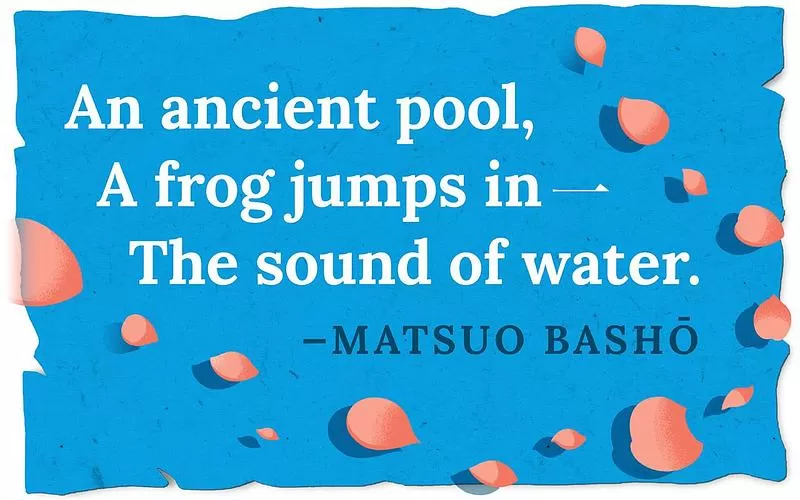
“The Old Pond” by Matsuo Bashō
- furu ike ya
- kawazu tobikomu
- mizu no oto
(Translated)
- The old pond,
- A frog jumps in:
- The sound of the water.
Often cited as the quintessential haiku, this poem’s popularity stems from its stark simplicity and profound resonance. It captures a moment of stillness interrupted by action, symbolizing perhaps the interplay between permanence and change, silence and sound, or the timelessness of nature punctuated by life. Its enduring appeal lies in its openness to interpretation, inviting readers to find their own meaning in this simple, sensory scene.
 Illustration depicting a frog jumping into an old pond, reflecting the famous haiku by Matsuo Basho
 -
“[The first soft snow:]” by Matsuo Bashō
- The first soft snow:
- leaves of the awed jonquil
- bow low
This haiku beautifully illustrates Bashō’s skill in observing nature’s details. The image of jonquil leaves bowing to the snow evokes a sense of reverence or submission to nature’s power. It highlights the delicate yet powerful arrival of winter and the subtle ways the world adapts.
-
“[A caterpillar,]” by Matsuo Bashō
- A caterpillar,
- this deep in fall –
- still not a butterfly.
A seemingly simple observation carries a deeper layer of meaning about growth, transformation, and perhaps unrealized potential. The late season emphasizes a sense of delayed development, relatable to human experiences of waiting or striving for change.
Yosa Buson
Yosa Buson (1716–1784) is known for his painterly style, bringing vivid sensory detail and often a touch of romanticism to his haiku.
-
“The light of a candle” by Yosa Buson
- The light of a candle
- Is transferred to another candle —
- spring twilight.
This haiku paints a gentle, atmospheric scene. The image of light passing from one candle to another against the soft light of spring twilight is visually rich and suggests themes of continuity, sharing, or the subtle spread of warmth and light.
-
“In the moonlight” by Yosa Buson
- In pale moonlight
- the wisteria’s scent
- comes from far away.
Buson masterfully engages the senses beyond sight. The combination of pale moonlight (visual) and the distant wisteria scent (olfactory) creates a strong sense of atmosphere and perhaps nostalgia or longing for something unseen or faraway.
Kobayashi Issa
Kobayashi Issa (1763–1828) is beloved for his empathy, particularly for the less fortunate and small creatures. His poems often carry a tone of gentle melancholy or wry humor.
-
“A World of Dew” by Kobayashi Issa
- This world of dew
- is a world of dew,
- and yet, and yet.
Written after the death of his child, this poignant haiku speaks to the ephemeral nature of life (“a world of dew”) while the repeated “and yet, and yet” conveys a powerful sense of grief, reluctance, or the struggle to accept reality. It’s a deeply emotional example of the form.
-
“O snail” by Kobayashi Issa
- O snail
- Climb Mount Fuji,
- But slowly, slowly!
This haiku exemplifies Issa’s characteristic empathy for small creatures. Addressing the snail directly, he offers encouragement while also injecting a gentle reminder about patience and the value of the journey over speed. It’s a charming and popular piece.
-
“[cherry blossoms]” by Kobayashi Issa
- cherry blossoms
- fall! fall!
- enough to fill my belly
A less common take on the revered cherry blossoms, this haiku uses hyperbole and a touch of humor or childlike wonder. It expresses an overwhelming delight and desire for the abundant beauty, showing Issa’s connection to simple, earthy pleasures.
-
“[Even in Kyoto,]” by Kobayashi Issa
- Even in Kyoto,
- Hearing the cuckoo’s cry,
- I long for Kyoto
This haiku captures a feeling of displacement or nostalgia, even when in a beloved place. The cuckoo’s familiar cry triggers a longing for a different time or aspect of Kyoto, highlighting how emotion and memory can shape our perception of the present.
Masaoka Shiki
Masaoka Shiki (1867–1902) was a contemporary reformer of haiku, advocating for a more realistic and objective style. He suffered from tuberculosis for much of his life, which influenced his work.
-
“I want to sleep” by Masaoka Shiki
- I want to sleep
- Swat the flies
- Softly, please.
This haiku offers an intimate glimpse into the suffering of illness. The desire for rest is juxtaposed with the mundane annoyance of flies, rendered poignant by the request for softness, revealing the speaker’s fragility and exhaustion.
-
“After Killing a Spider” by Masaoka Shiki
- After killing
- a spider, how lonely I feel
- in the cold of night!
A striking example of Shiki’s directness. The act of killing a spider, though seemingly minor, leads to a powerful feeling of loneliness. It suggests the interconnectedness of life or the way small actions can reveal deeper emotional states.
Notable Haiku from Other Japanese Poets
Beyond the four masters, many other Japanese poets have contributed popular and significant haiku.
-
“A Poppy Blooms” by Katsushika Hokusai
- I write, erase, rewrite
- Erase again, and then
- A poppy blooms.
Attributed to the famous artist Hokusai (1760–1849), this haiku uses the creative process as a metaphor for perseverance and the eventual blossoming of something beautiful, much like a poppy appearing after effort. It’s a relatable poem about the struggles and rewards of creation.
-
“Over The Wintry” by Natsume Sōseki
- Over the wintry
- forest, winds howl in rage
- with no leaves to blow.
Written by the acclaimed novelist Natsume Sōseki (1867–1916), this haiku paints a stark image of winter’s power rendered impotent by the season’s barrenness. The howling wind without leaves to disturb evokes a sense of futility or unrestrained energy with no outlet. It can be interpreted metaphorically about age or circumstance.
-
“[The lamp once out]” by Natsume Sōseki
- The lamp once out
- Cool stars enter
- The window frame.
Another beautiful image from Sōseki. Turning off artificial light allows the natural wonder of the stars to become visible. This simple observation can symbolize shifting perspective, the emergence of the subtle when the obvious is removed, or finding natural beauty.
-
“[The snow of yesterday]” by Gozan
- The snow of yesterday
- That fell like cherry blossoms
- Is water once again
Gozan (1761-1836) uses the fleeting nature of snow, likened to the equally ephemeral cherry blossoms, to comment on impermanence. The transformation back to water reinforces the cyclical nature of change and the transient beauty of the world.
-
“[First autumn morning]” by Murakami Kijo
- First autumn morning
- the mirror I stare into
- shows my father’s face.
Murakami Kijo (1865–1938) captures a common, often startling, realization of aging and resemblance to one’s parents. The mirror reflects not just the physical face but a sense of inheritance, time passing, and connection across generations.
-
“[I kill an ant]” by Kato Shuson
- I kill an ant
- and realize my three children
- have been watching.
Kato Shuson (1905–1993) presents a moment of moral awareness prompted by the presence of his children. The focus shifts from the simple act to its potential impact as an example, highlighting the weight of parental responsibility.
-
“[The crow has flown away:]” by Natsume Sōseki
- The crow has flown away:
- Swaying in the evening sun,
- A leafless tree
Sōseki again uses simple images to create a strong atmosphere. The departure of the crow leaves behind a solitary, leafless tree in the evening sun. It’s a poignant image of emptiness, quietness, or the stillness that follows movement.
-
“Childless woman” by Hattori Ransetsu
- The childless woman,
- how tenderly she caresses
- homeless dolls …
Hattori Ransetsu (1654–1707), a student of Bashō, offers a deeply empathetic portrait of a woman’s longing expressed through nurturing inanimate objects. It’s a touching example of how haiku can capture profound human emotion in a concise form.
-
“[On the one-ton temple bell]” by Taniguchi Buson
- On the one-ton temple bell
- A moonmoth, folded into sleep,
- Sits still.
Taniguchi Buson (1716–1784), different from Yosa Buson but sharing the same family name, creates a powerful contrast between the massive, resonant bell and the delicate, silent moonmoth resting upon it. It evokes a sense of fragile peace against the potential for sudden, overwhelming sound.
Popular Western and Modern Haiku
While rooted in Japanese tradition, haiku has been adopted and adapted by poets worldwide, leading to variations in form and theme. These popular examples showcase the global reach and evolution of the haiku. popular styles of poetry often draw on ancient forms like haiku.
-
“Haiku Ambulance” by Richard Brautigan
- A piece of green pepper
- fell
- off the wooden salad bowl:
- so what?
Richard Brautigan (1935–1984) offers a famously unconventional take on haiku. It disregards the traditional syllable count and tone, injecting absurdity and a defiant “so what?”. It challenges expectations and highlights the freedom modern poets take with form.
-
“The earth shakes” by Steve Sanfield
- The earth shakes
- just enough
- to remind us.
Steve Sanfield (1947–2015) uses a natural event as a prompt for existential reflection. A minor earthquake serves as a reminder of vulnerability or the fragility of life, prompting contemplation without being overly dramatic.
-
“In a Station of the Metro” by Ezra Pound
- The apparition of these faces
- in the crowd;
- Petals on a wet, black bough.
Ezra Pound (1885–1972) wrote this influential poem in the Imagist style, heavily influenced by haiku. While not strictly 5-7-5, it uses juxtaposition of images to create a sudden insight or emotional impact. The ephemeral faces in the station are likened to delicate, transient petals.
-
“The Taste of Rain” by Jack Kerouac
- The taste
- of rain
- — Why kneel?
Jack Kerouac (1922–1969), a key figure of the Beat Generation, infuses a sense of spiritual questioning into a simple sensory experience. The natural act of tasting rain leads to a challenge to conventional religious postures or beliefs. popular long poems might explore such themes in detail, but haiku distills them.
-
“Haiku [for you]” by Sonia Sanchez
- love between us is
- speech and breath. loving you is
- a long river running.
Sonia Sanchez (b. 1934) uses the haiku form to express the natural, vital flow of love. Comparing love to fundamental human actions like speech and breath, and then to the expansive, continuous image of a long river, creates a sense of effortless, enduring affection.
-
“Lines on a Skull” by Ravi Shankar
- life’s little, our heads
- sad. Redeemed and wasting clay
- this chance. Be of use.
Ravi Shankar (b. 1975, no relation to the musician) uses the haiku structure to deliver a stark meditation on mortality and purpose. The image of clay (referencing our physical form) is contrasted with the urgency to make use of life’s brief chance.
-
“[snowmelt— ]” by Penny Harter
- snowmelt—
- on the banks of the torrent
- small flowers
Penny Harter (b. 1941) sets the powerful image of a torrent river against the delicate emergence of small flowers. This juxtaposition highlights nature’s resilience and the cycle of destruction and renewal, capturing a specific moment of seasonal transition.
-
[meteor shower] by Michael Dylan Welch
- meteor shower
- a gentle wave
- wets our sandals
Michael Dylan Welch (b. 1960) brings a contemporary, personal focus to the haiku. The cosmic wonder of a meteor shower is followed by the immediate, intimate sensation of a gentle wave. It suggests finding profound moments in both the vast and the small, or grounding oneself in the present.
-
“[The west wind whispered]” by R.M. Hansard
- The west wind whispered,
- And touched the eyelids of spring:
- Her eyes, Primroses.
R.M. Hansard employs personification to depict the arrival of spring. The wind is given voice and touch, awakening spring personified, whose eyes are the first primroses. It’s a classic, gentle image of the season’s soft awakening.
-
“[What is it but a dream?]” by Hakuen Ekaku
- What is it but a dream?
- The blooming as well
- Lasts only seven cycles
Hakuen Ekaku (1584–1653) offers a contemplative, almost pessimistic view on reality and beauty. Likening life to a dream and noting the short duration of blooming (often seven days for some flowers, or perhaps cycles referring to age), it reinforces the theme of impermanence found in many haiku.
-
“[The neighing horses]” by Richard Wright
- The neighing horses
- are causing echoing neighs
- in neighboring barns
Richard Wright (1908–1960), the renowned African American author, explored haiku late in his life. This example shows the spread of sound, creating a sense of connectivity and chain reaction through a simple, aural image.
-
“Lily:” by Nick Virgilio
- Lily:
- out of the water
- out of itself
Nick Virgilio (1928–1989) is a prominent American haiku poet. This haiku uses the kireji (cutting word) effect with the colon. The lily emerges from its aquatic environment and, metaphorically, perhaps transcends its limitations or simply reveals its full form. It’s a poem about emergence and transformation.
-
“[A raindrop from]” by Jack Kerouac
- A raindrop from
- the roof
- Fell in my beer
Kerouac again injects a sense of the mundane or disruptive into the natural image. A simple raindrop interrupts the man-made pleasure of drinking beer, a small collision between nature and human leisure.
-
“[I was in that fire]” by Andrew Mancinelli
- I was in that fire,
- The room was dark and somber.
- I sleep peacefully.
Andrew Mancinelli offers a modern haiku that hints at past trauma or difficulty (“that fire”) followed by a present state of peace. The juxtaposition suggests overcoming hardship and finding resolution, leaving much to the reader’s interpretation.
-
“[Plum flower temple:]” by Natsume Sōseki
- Plum flower temple:
- Voices rise
- From the foothills
Sōseki creates a scene blending natural beauty (plum flowers) with human presence (voices) and a sense of place (temple, foothills). It evokes an atmospheric image of life and nature coexisting in a specific landscape, perhaps suggesting devotion or community amidst natural beauty. formal verse poems like haiku often use structure to enhance imagery.
-
“[losing its name]” by John Sandbach
- losing its name
- a river
- enters the sea
John Sandbach captures the moment of a river merging into the sea. The “losing its name” element adds a layer of identity or individuality dissolving into a larger whole, a metaphorical reflection on unity or anonymity.
-
“[Grasses wilt:]” by Yamaguchi Seishi
- Grasses wilt:
- the braking locomotive
- grinds to a halt.
Yamaguchi Seishi (1901–1994) juxtaposes natural decline (wilting grasses) with mechanical power coming to a stop (locomotive). Both represent cessation or slowing down, creating a sense of transition or ending, perhaps highlighting the parallel between natural and industrial cycles.
-
“[Everything I touch]” by Kobayashi Issa
- Everything I touch
- with tenderness, alas,
- pricks like a bramble
This poignant haiku from Issa expresses a deep-seated pain or difficulty in forming connections. Despite offering tenderness, the speaker experiences hurt, likening interaction to touching a thorny plant. It’s a raw expression of vulnerability and relational pain.
Exploring More Popular Haiku
The beauty of haiku lies in its ability to find the universal in the specific, the profound in the simple. Here are more popular examples that continue to resonate.
-
“JANUARY” by Paul Holmes
- Delightful display
- Snowdrops bow their pure white heads
- To the sun’s glory.
Paul Holmes offers a hopeful image of early spring. The snowdrops, symbols of winter’s end, acknowledge the strengthening sun, signifying the gradual transition towards warmer seasons.
-
“[The first soft snow:]” by Matsuo Bashō
-
The first soft snow:
-
leaves of the awed jonquil
-
bow low
-
(Repeated from #2 for emphasis on Basho’s lasting popularity and connection to season)*
This haiku beautifully illustrates Bashō’s skill in observing nature’s details. The image of jonquil leaves bowing to the snow evokes a sense of reverence or submission to nature’s power. It highlights the delicate yet powerful arrival of winter and the subtle ways the world adapts.
-
-
“[A caterpillar,]” by Matsuo Bashō
-
A caterpillar,
-
this deep in fall –
-
still not a butterfly.
-
(Repeated from #3 for emphasis on Basho’s lasting popularity and connection to season/growth)*
A seemingly simple observation carries a deeper layer of meaning about growth, transformation, and perhaps unrealized potential. The late season emphasizes a sense of delayed development, relatable to human experiences of waiting or striving for change.
-
These 40 popular haiku poems, spanning centuries and continents, demonstrate the form’s remarkable ability to distill moments, emotions, and observations into concise, impactful verses. They invite us to pause, observe the world around us, and connect with the simple yet profound experiences that shape our lives.
Conclusion
The enduring popularity of haiku poems lies in their unique fusion of brevity and depth. From the classic observations of Bashō and Buson to the empathetic verses of Issa and the modern twists of Western poets, haiku continues to capture the imagination. These 40 examples offer just a glimpse into a vast and rich tradition, each poem a small window into a moment of nature, human feeling, or philosophical reflection. Exploring these popular haiku allows us to appreciate the power of carefully chosen words and the beauty found in the world’s simple details. They remind us that even in the shortest forms, poetry can hold immense artistic value and emotional resonance.