
Poetry, much like a finely crafted quilt, is an art form that pieces together disparate elements – words, images, emotions, and ideas – to create something coherent, beautiful, and deeply resonant. Just as a quilter selects fabrics, cuts patterns, and stitches them with care, a poet chooses language, structures verses, and binds them with rhythm and metaphor. It is no wonder, then, that the craft of quilting has inspired countless poets, giving rise to a rich collection of quilting poems. These works capture the essence of quilting: the tactile feel of fabric, the patience of the stitch, the stories held within each scrap, and the community formed around the frame.
Contents
- Poems of the Quilting Bee
- Quilts as Vessels of Memory and Legacy
- The Humorous Side of Quilting
- To Stash or not to Stash….is that the question?
- Husbands
- 14,287 Pieces of Fabric
- Disappearing Act
- Many Starts, Mini Finishes
- The Deadline
- SOS
- Foot Note
- Quilting Frustrations
- The Frankenstein Quilt
- 100 Ways to Hide Your Stash
- It Ain’t Finished Yet
- A Christmas Quilter
- Patterns, Shows, and the Quilter’s World
- red, orange, yellow, green, blue, indigo, violet
- the blocks of the builders
- Quilting Folklore and Superstitions
- Quilting Superstition and Folklore
- Follow the Stars
- Quilts and Connection
- Baby’s Quilt
- Quilter’s Poem
- Just For You
- Quilting Sayings and Wisdom
- Quilt Teacher’s Ten Commandments
- A Quilter’s Blessing:
- Short Quilt Sayings
- And More Quilt Sayings!
- MORE Quilt Sayings Added in As I Find Them!:
- Conclusion
This collection explores the many facets of quilting as seen through the eyes of poets. From the camaraderie of the quilting bee to the personal journey of sorting a fabric stash, from the memories embedded in worn scraps to the humorous frustrations of the craft, these poems reveal the threads that connect life, love, and legacy through the simple act of sewing pieces of fabric together. Dive into this world where every stitch holds a story, and every quilt is a poem waiting to unfold.
Poems of the Quilting Bee
The quilting bee is more than just a gathering; it’s a tradition of community, shared labor, and blossoming friendships. Women (and sometimes men) would come together to work on a large quilt, turning solitary stitching into a social event filled with conversation, laughter, and shared purpose. The poem “Quilting Bee” beautifully captures this communal spirit, highlighting the fellowship and the blend of work and social interaction.
Quilting Bee
(Author: unknown)
In Fellowship they meet,
Their long days to invest,
Snipping and sewing, only slowing
To visit, to eat or rest.
Calico scraps, heaped on laps,
Each one an exact size and hue.
Fingers nimble with thread and thimble,
Create pretty patterns anew.
Heads bent to the task, you need not ask
If these ladies love to quilt.
Their talented touch, expresses as much
As piece onto piece it is built.
Friends try to perceive who will receive
Each quilt that is stitched from the heart,
With needlework fine, the patterns entwined
A treasure, a true work of art.
Quilts as Vessels of Memory and Legacy
Quilts are often more than just bedcovers; they are living tapestries of memory, pieced together from the fabric of our lives and the lives of those who came before us. Scraps from old clothes, worn blankets, and cherished garments become the building blocks of a new creation, carrying the weight of history and emotion. These poems reflect on how quilts preserve the past and connect generations.
Teresa Palomo Acosta’s “Mother Pieced Quilts” is a poignant exploration of the emotional weight and history contained within a mother’s quilts. What seemed like simple covers were, in fact, vibrant canvases holding the stories and materials of a family’s life.
Mother Pieced Quilts
by Teresa Palomo Acosta
they were just meant as covers
in winters
as weapons
against pounding january winds
but it was just that every morning I awoke to these
october ripened canvases
passed my hand across their cloth faces
and began to wonder how you pieced
all these together
these strips of gentle communion cotton and flannel
nightgowns
wedding organdies
dime store velvets
how you shaped patterns square and oblong and round
positioned
balanced
then cemented them
with your thread
a steel needle
a thimble
how the thread darted in and out
galloping along the frayed edges, tucking them in
as you did us at night
oh how you stretched and turned and re-arranged
your michigan spring faded curtain pieces
my father’s santa fe work shirt
the summer denims, the tweed and fall
in the evening you sat at your canvas
our cracked linoleum floor the drawing board
me lounging on your arm
and you staking out the plan;
whether to put the lilac purple of easter against the red
plaid of winter-going-into-spring
whether to mix a yellow with blue and white and paint the
corpus christi noon when my father held your hand
whether to shape a five-point star from the
somber black silk you wore to grandmother’s funeral
you were the river current
carrying the roaring notes
forming them into pictures of a little boy reclining
a swallow flying
you were the caravan master at the reins
driving your thread needle artillery across the
mosaic cloth bridges
delivering yourself in separate testimonies
oh mother you plunged me sobbing and laughing
into our past
into the river crossing at five
into the spinach fields
into the plain view cotton rows
into tuberculosis wards
into braids and muslin dresses
sewn hard and taut to withstand the thrashings
of twenty-five years
stretched out they lay
armed/ready/shouting/celebrating
knotted with love
the quilts sing on
Patricia Everson’s “Memories” echoes this theme, using a quilt as a narrative device to share family history and personal stories, patch by patch.
Memories
by Patricia Everson
Sit down and I’ll tell you a story
Wrap yourself up in my quilt.
Here’s a cup of my coffee
The wood stove is filled to the hilt.
Quilting is more than a hobby.
To me it is a record of life,
Recording for me all the good times,
Remembering for me all the strife.
This patch was made from a bunting.
The baby had now moved away.
And this one came from my sister,
From a dress that was yellow and grey.
Below this one from my brother
Is one from my aunt who just died.
If you look close you can cipher
Her signature on the left side.
And here over next to the corner
Is a piece from my mother’s old skirt.
And this one right in the middle
Was made from my father’s red shirt.
This one came out a bit crooked.
The material was faded and worn.
No wonder it looks so dejected,
It was woven before I was born.
Beneath this one at the bottom
Is one that is worth more than gold.
It came from my old winter jacket,
It kept me safe from the cold.
This blue one I found in the cellar
When we moved to this house long ago.
Who knows what story it covets,
This old, faded, worn calico.
Above the green one in the center
Is my most favorite one of all.
It looks like the leaves by the river
Just after they drop in the fall.
And let’s not forget this pink gingham,
I know that it’s seen better days,
But I like the way that it mingles
With the yellows and purples and greys.
Before you finish your coffee
And you have to be on your way,
Take a look at this one near the bottom,
It came from my Great Uncle Ray.
He traveled the world in a schooner,
He brought back such wonderful things.
The material is of the richest,
Fit only for princes and kings.
Some store their treasures in bank vaults,
Some keep them hidden away,
But I keep mine here on my quilt top
Where I can enjoy them each day.
Sandra E. Andersen’s “A Legacy of Stitches” speaks directly to the idea of leaving a lasting mark through the craft, recognizing that each stitch is part of a story that endures.
A Legacy of Stitches
Sandra E. Andersen 2001-2008
A Legacy of Stitches is what we leave behind;
the imprint of our very soul that lasts beyond our time.
The heart that quilts knows, oh, so well the peace that can be found,
as needle meets with fabric, for there is no sweeter sound.
Whether quiet piecing done by hand
or on our sewing machine,
there’s rhythm to our stitches
as we sew along each seam.
Those stitches tell the story
of our lives as they unfold
as we think of quilts that Grandma made
with stories left untold.
The humdrum of our daily lives
grows elegant and grand,
when we start to cut the pieces,
then stitch the fabric in our hands.
And whatever is the reason
for the quilts we piece and sew,
and whoever is the maker,
there is one thing that we know.
Each quilt is full of memories,
and is a treasured thing.
If quilts could talk, imagine how
some quilts would surely sing!
For some quilts are sewn in happy times
and others when we’re sad,
and some are sewn in laughter
and others when we’re mad.
Some are sewn to warm us,
and some sewn just for fun,
and some are “works in progress”
that never quite get done!
Some quilts are sewn for beauty,
a quilt made just for “show”,
but the heart of the true quilter
is the one who really knows~
That no matter how the quilt is stitched,
we leave our mark in time.
This Legacy of Stitches is what we leave behind.
Priscilla Schrock’s “Grandmother’s Parlor” evokes the nostalgic comfort of a quilt made by a beloved family member, highlighting how quilts can become synonymous with cherished places and people.
Grandmother’s Parlor
by Priscilla Schrock
I remember the quilt, made with loving care,
Draped over the back of her favorite chair,
In my Grandmother’s parlor.
A quilt full of pictures, a quilt full of love,
With birds stitched in gold, seen flying above,
In my Grandmother’s parlor.
Made with purples and reds and colors so bright,
The browns and the greens and even some white,
In my Grandmother’s parlor.
As I sat on the floor my fingers would glide,
Tracing designs over threads narrow and wide,
In my Grandmother’s parlor.
I would give all I have for a chance to be there,
In my Grandmother’s lap, in her favorite chair,
In my Grandmother’s parlor.
Dallas Reed’s “Secrets of the Old Quilt” hints at the unspoken stories and perhaps even the gossip shared among quilters of the past, reminding us that quilts are not just fabric, but echoes of human connection and conversation.
Secrets of the Old Quilt
Author: Dallas Reed
Today, I went up to the attic,
and found a quilt that grandma made.
The binding was worn, the pieces tattered,
and the colors had begun to fade.
There were silks and wools and calicos,
in a pattern of the nine patch kind.
They were precision cut and precision sewn,
with an intricate quilting design.
She pieced the top and the quilting bee,
helped her quilt the days away.
And they talked about everybody,
Who didn’t help quilt that day.
Only if that quilt could talk.
Oh, the words that would be conveyed,
of the gossip at the quilting bee,
in the quilt that grandma made…..
The anonymous poem “Untitled” (often referred to as the “Neighbor” poem) presents a witty comparison between the transient labor of housekeeping and the enduring legacy of a handmade quilt, suggesting that the latter holds more value for future generations.
Untitled
(Author Unknown)
My neighbour is washing her windows ,
And scrubbing and mopping her floors,
But my house is all topsy and turvey,
And dust is behind all the doors.
My neighbour, she keeps her house spotless,
And she goes all day on a trot:
But no one would know in a fortnight
If she swept today or not.
The task I am at is enticing –
My neighbour is worn to a rag –
I am making a quilt out of pieces
I saved in a pretty chintz bag.
And the quilt, I know my descendants
Will exhibit with credit to me
“So lovely – my grandmother made it
Long ago in 1933.”
But will her grandchildren remember
Her struggles with dirt and decay?
They will not –
they will wish she had made them
The quilt I am making today.
(Author: unknown)
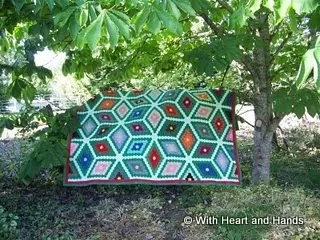 Detailed shot of hexagonal quilt blocks with a bright floral pattern laid out in a sunny outdoor setting, capturing vibrant colors and geometric design.
The Humorous Side of Quilting
Quilting, while often seen as a serene and artistic pursuit, is also ripe with relatable frustrations and humorous moments. From overwhelming fabric stashes to elusive tools and the ever-present UFO (Unfinished Object) pile, quilters often find shared laughter in the chaos of their creative spaces. These quilting poems highlight the lighter, often comical, aspects of the craft.
Juanita K Bard offers a playful take on a classic soliloquy in “To Stash or not to Stash…is that the question?”, humorously grappling with the quilter’s eternal struggle: managing an ever-growing collection of fabric.
To Stash or not to Stash….is that the question?
by Juanita K Bard (With apologies to Shakespeare’s HAMLET)
Whether ’tis nobler in the mind to suffer
The slings and arrows of outrageous mis-organization
Or to take arms against a sea of clutter
And by opposing end it? To organize? To give away? To sew not more?
Nay…To sew I must..perchance a new patchwork
Or try a new paper piece pattern
For who can bear the whips and scorns of
The ever present 1/2 price sale ads
That makes a calamity of our credit cards..
To file or not to file my patterns
To group by pastels and darks
And by organization to say we end
The heartache of rummaging around
For just that right piece of fabric
That our sewing is heir to, ’tis a consummation
Devoutly to be wish’d..to organize,
To conceal in boxes…and boxes galore
In plastic containers that overflow on the floor
To organize, perchance to achieve it….ay, there’s the rub;
For in that great organization of fabric what dreams may come
When we have shuffled off this mortal unorganization
Must give us pause there’s the respect
That makes calamity of so organized a sewing room;
For who can bear to whittle down her Stash…
The pangs of that separation of fabric
To grunt and sweat under the strain
Of not seeing forever the beloved Stash…
But that the dread of something after death,
The undiscover’d boxes…from who boundary
No traveler returns, puzzles the will
And make us rather think we have
To give to others that we know not of?
Thus conscience does make swappers of us all;
And thus the native hue of resolution
Gives way to the pale thought and enterprises
Of that great moment with this regard
To our current Stash…Organize…give away!!!!
And lose the name of clutter…
Soft you now! Oh, fair quilters… in they orisons
Be all my Stash remember’d…..
Ray Hartsell provides a husband’s perspective in “Husbands,” a short, humorous take on a quilter’s priorities, suggesting that the passion for quilting can sometimes (jokingly) outweigh other commitments.
Husbands
(Author: Ray Hartsell (husband of a quilter))
A quilter’s husband died on Friday.
Her heart was torn and wilting
To have the funeral on Monday,
She’d have to miss her quilting.
She asked her sister to fill in,
An act so torn and wilting.
“To him it makes no difference —
So why miss out on quilting?”
“The Crazy Quilt,” an anonymous piece from a 1890 publication, uses humor to describe the overwhelming popularity and slightly chaotic nature of the late 19th-century crazy quilt craze, even at the expense of household duties.
The Crazy Quilt
Oh, say, can you see by the dawn’s early light,
What you failed to perceive at the twilight’s last gleaming;
A crazy concern that through the long night
O’er the bed where you slept was so saucily streaming;
The silk patches so fair,
Round, three-cornered and square
Gives proof that the lunatic bed-quilt is there.
Oh, the crazy-quilt mania triumphantly raves,
And maid, wife, and widow are bound as its slaves
On that quilt dimly seen as you rouse from your sleep
Your long-missing necktie in silence reposes,
And the filoselle insects that over it creep,
A piece of your vest half-conceals, half discloses;
There is Kensington-stitch
In designs that are rich,
Snow-flake, arrasene, point russe and all such.
Oh, the crazy-quilt mania, how long will it rave?
And how long will fair woman be held its slave?
And where is the wife who so vauntingly swore
That nothing on earth her affections could smother?
She crept from your side at the chiming of four
And is down in the parlor at work on another.
Your breakfasts are spoiled,
And your dinners half-boiled,
And your efforts to get a square supper are foiled
By the crazy-quilt mania that fiendishly raves,
And to which all the women are absolute slaves.
And thus it has been since the panic began,
In many loved homes it has wrought desolation,
And cursed is the power by many a man,
That has brought him so close to the verge of starvation,
But make it she must,
She will do it or bust,
Beg, swap, and buy pieces or get them on trust,
Oh, the crazy-quilt mania, may it soon cease to rave
In the land of the free and the home of the brave.
-Anonymous
Jean Ray Laury’s “14,287 Pieces of Fabric” humorously exaggerates the size of a quilter’s fabric stash, playing on the common quilter’s reluctance to part with even the smallest scrap.
14,287 Pieces of Fabric
Written by Jean Ray Laury
Behind the painted picket gate
There lived a quilter known as Kate
She had one son, a boy named John;
One daughter, whom she doted on.
She had one husband and one house
One pup, one cat, one little mouse…
And 14,287 pieces of fabric.
Footnote: Many Thanks to Virginia Lane who let me know that this poem is the first poem in the book “14,287 Pieces of Fabric and Other Poems,” which is both written and illustrated by Jean Ray Laury, published in 1994 by C&T Publishing. “Whenever anyone needs just a piece of fabric – her husband to flag cargo extending from his pickup, the neighbor child to bind an injury, and so on, there’s not one piece that Katy can spare. That color is special, her sister gave her this piece, she got that one at the quilt show, and so on. She finally gets a reason to use her fabric, sews madly, falls asleep, and dreams that she’s used all 14, 287 pieces.”
Thank you, Virginia! I so appreciate my readers!
Jacquie Scuitto, known as “The Muse,” contributes several poems that tap into the everyday struggles and humorous quirks of the quilter’s life, including “Disappearing Act,” which laments the vanishing of small, crucial tools like pins and thimbles.
Disappearing Act
Author: Jacquie Scuitto known as “The Muse”
Where do all my pins disappear to?
I’ve picked up all the ones off the floor.
But when I put them back into their box,
It looked as though there ought to be more.
What became of the needle I had in my hand
When I picked up the spool to thread it?
It seems to have vanished into thin air,
But that explanation I can’t credit.
How does my thimble disappear
From the basket where it was laid?
I haven’t heard it rolling ’round on the floor
As it did when the cats with it played.
What did I do with that fabric I need
That I had just an hour ago?
I put it away, but in what place?
It’s somewhere that it doesn’t show.
The magazine with the pattern I liked
Was right on top of that pile.
I guess it’s sunk, but how far down
In such a little while?
I know that book went back on its shelf
And should be with books of its kind.
But I just can’t find it, though I’ve looked five times.
Can it be that I’m going blind?
It’s a very good thing that my sewing machine
Is something that’s too big to hide.
Not being able to find something as big as that
Would really humble my pride!
I don’t know why things I know that I had
Disappear when I put them away
.I find it annoying but I very much fear
It’s a problem that’s here to stay.
Scuitto also captures the quilter’s endless pursuit of new projects in “Many Starts, Mini Finishes,” a common affliction in the quilting world.
Many Starts, Mini Finishes
Author: Bee Neeley Kuckelman
There once was a quilter named Min
Whatever she’d see, she’d begin.
A large quilt, a small quilt,
A doll quilt, a wall quilt.
“I’ll finish these later,” said Min.
“Now what shall I start on today?
I guess it will be applique.
Some birds in a group,
I’ll frame with a hoop.
Today, though, I’ll put them away.
I think I will make a new vest,
In silk, or cotton would be best
Trapunto I’ll do,
Then Sunbonnet Sue!
But now I will give them a rest.
A tote bag I’ve wanted to sew,
And then I’ll try quilt-as-you-go.
A radiant Star
For next year’s bazaar
Just when they’ll be done, I don’t know
For Christmas I’ve got projects galore
A tree skirt, a wreath for the door.
I’ll make a soft box,
And red quilted socks,
And what’s not completed, I’ll store.
“Is anything finished?” asked Son.
Her answer could only be, “None.
“So, Min made a vow:
She would not allow
More new projects — well, maybe just one.
Dallas Reed’s “The Deadline” speaks to the familiar rush to finish a project just before a show or event, capturing the frantic energy and inevitable clutter.
The Deadline
by Dallas Reed
T’was the night before the quilt show,
and at the sewing machine
was the biggest organized clutter,
that you have ever seen.
There was fabric on the table.
Fabric on the chair,
Fabric on the floor,
There was fabric everywhere.
I couldn’t find my rotary cutter,
couldn’t find my mat;
I couldn’t find my scissors,
And I’m wondering where they’re at.
It’s an hour before the show,
Then I’ll get up and leave.
All I need is a few more stitches,
The binding…..and the sleeve.
But I’m not about to worry,
Everything is going to be fine.
I’ll get it done in time —
But,I really hate a deadline.
Scuitto’s “SOS” is another take on the ever-present problem of finding space for an expanding fabric collection, a relatable dilemma for many dedicated quilters.
SOS
by Jacquie Scuitto
Where can I store more fabric?
My sewing room shelves are crammed!
There’s no more space beneath my bed
And the guest room closet is jammed.
I have a friend with an attic
Who would let me store some there,
But such separation from my treasures
Would be more than I could bear.
Meanwhile there are three bags full
From the big sale I went to today
And I can’t think where to put them —
Or what my dear husband will say!
“Foot Note,” also by Scuitto, humorously depicts the challenges and frustrations of machine quilting, leading the quilter back to the comfort and control of hand stitching.
Foot Note
by Jacquie Scuitto aka The Muse
This foot was made for walking.
But not on my machine!
It turns out the weirdest quilting
That I have ever seen!
It sews along quilte nicely,
I stop holding my breath,
Then it does a little dance step
And scares me half tio death!
I see a section of stitches
Too small for ripping out,
Then a leap and then a skip —
What is this all about?
A seam on top? The batting?
Am I doing something wrong?
I didn’t dream that machine quilting
Would ever take this long.
The answer’s out there somewhere,
I’ll seek till I understand,
But until I get it sorted out
I just must quilt by hand!
Cindy Thury Smith offers several humorous takes on the quilter’s life, including “Quilting Frustrations,” a litany of common mishaps and challenges faced during the quilting process.
Quilting Frustrations
by Cindy Thury Smith 1986
First I lost my thimble and stuck the needle into my thumb
Then I figured the yardages wrong, so I’m short, how dumb!
And I can’t understand this piecing diagram ‘cuz
my brain’s gone numb
Sometimes quilting just doesn’t pay.
Now the tension’s goofed up on my sewing machine
The four yards I bought aren’t the right shade of green
And how am I to get Grandmother’s unfinished quilt top clean?
Sometimes quilting just doesn’t pay.
I’ve pressed under bias until my fingers are all burnt
Can’t quite remember that finishing tip I thought I’d learnt
Tried to do an edge in scallops, but they weren’t
Sometimes quilting just doesn’t pay.
I’ve sewed on this quilt for what seems like a hundred weeks
Bringing my quilting skills to a new sewing peak
And, surprisingly, getting pretty close to the design I seek
Well, maybe quilting’s not so bad.
Hey, I’ve finally got it on the quilting frame
As I bend over and stitch my back will never be the same
In the corner I’ll label it with the date and my name
Well, maybe quilting’s not so bad.
Now it’s proudly displayed in all its pomp and glory
Conveniently forgotten is how its construction was slightly hoary
Currently I’m telling the “masterpiece of needleart” story
Yeah, I guess quilting’s not so bad.
“The Frankenstein Quilt” by Smith captures the humorous horror of a project that grows beyond its original simple design, becoming a complex and monstrous undertaking.
The Frankenstein Quilt
by Cindy Thury Smith 1985
I started out with a simple block design
And thought I’d add just one or two more lines
To come up with a quilt that’d be all mine.
Then I started playing with complex borders and sashing
And through my mind new ideas kept flashing
Until now my hopes have gone a-dashing!
I’ve created an impossible pattern, a monster
Anyone who’d try it would be a fanatical quilter
Who’d probably end up cussing out the designer!
Since I created it I’d better give it a try
As I ripped out stitches I kept asking myself why
If I ever get it done I’ll take this one with me when I die!
Now it’s finally done and lies displayed on our bed
Hundreds of hours, yards of fabric, and miles of thread
One of those, “It’ll never work” ideas that just popped into my head.
Smith’s “ODE TO A QUILTER’S HUSBAND” offers a lighthearted tribute to the patient partners of quilters, who tolerate the fabric obsession, the pins, and the constant talk of quilting.
ODE TO A QUILTER’S HUSBAND
by Cindy Thury Smith 1983
The husband of this quilter is a very special, patient guy
Who doesn’t complain about how much fabric his wife may buy.
Through the years he’s picked up a lot of quilting lore
Because on this subject his wife can get to be quite a bore.
He’s learned better than to throw away any old odd shaped scrap
Because it’s likely that’s the one she’ll need to fill her design gap.
He know if he enters the quilting room his feet will get pins in
And he’s learned there’s not just red, but brick, rust, scarlet and crimson.
He knows how she snorts when she sees an ordinary bedspread
Cuz in HER house there’s only personally designed quilts instead.
He knows when she meets another quilter there’ll be fast and furious talkin’
And at a quilt show there’ll be lots of scribbling and gawkin’.
He thinks of quilt-mania as a kind of creative affliction
That can only be controlled by regular doses of stitchin’.
He knows she quilts for enjoyment, not for money,
Cuz she does quilts that are traditional, modern and some just plain funny!
And though all my cutting, designing, sewing and quilting through the years
He’s always been interested, supportive, patient, and very, very dear.
Thanks, honey.
Cathy Miller, known for her quilting songs, provides humorous lyrics that capture the quilter’s lifestyle, including the lengths gone to hide fabric purchases (“100 Ways to Hide Your Stash”) and the relatable struggle to finish a project by a deadline (“It Ain’t Finished Yet”). “Toss the Cat” brings a traditional, slightly quirky, folklore-inspired game to life in song.
100 Ways to Hide Your Stash
(Song by Cathy Miller on her “One Stitch At A Time” CD)
He doesn’t’ have to know everything
A few secrets keep a marriage fresh as spring
I’ll have it in, and out of sight in a flash
There are 100 ways to hide your stash.
Fill up the cupboard, hide the evidence
Pile it in the pantry spare no expense
Keep it with the kids’ clothes, lay it with the wine
Keep it all together where the sun don’t shine!
Put it in a Safeway bag,
bring it in with the groceries
Call it “Christmas presents – and don’t you peek!”
You’re “keeping it for a friend” who’s gone to Calgary
She’ll be back soon – no there’s none for me!
Don’t tell him what you owe the store
He might start looking in the dryer or the drawer
It’s an affliction breeding secrecy
These quilty pleasures that won’t let me be
Pack it in the wardrobe, under the chair
Stack it with the linen, with the silverware
Cram it in the cellar, under the stair
With the winter clothes, with the underwear.
A woman stored hers in the ceiling overhead
For years it stayed there, overtop the bed
Her husband never ever heard a sound
Until the day it brought the ceiling down
He’s got golfing and his auto parts
You’ve got fabric
He’s got cigarettes and butter tarts
You’ve got fabric!
Pad it in a pillow, buy a bass violin
Cram it in a corner, tuck it in a tin
Turn off your freezer, fill up your bin
Unplug the oven, you can fit it all in
Buy a few quarters, while you’re at the store
Get a little extra – more more more
Slip it in the mattress, hide it under the floor
No more room in here: buy the house next door!
(Author: Cathy Miller)
Toss the Cat
(Song by Cathy Miller on her “One Stitch At A Time” CD)
The bridal quilt is done, take it out of the frame
Don’t forget to sign it and give it a name
Sew on some binding and that will be that
Only one thing left to be done, and that’s play toss the cat
We’ve sewn in our good wishes for the bride and the groom
The red pomegranate, the hearts and the moon
Our vines are unbroken and our apples are fat
Now’s the time for our good luck when we play toss the cat
Grab your corner of quilt, in the middle she stands
The next one to get hitched is the closest to where she lands
The kitty doesn’t like it much, well fancy that!
That’s the price you pay when you play toss the cat
The cat has been a pest from the very first day
Pawing the fabric, and clawing the fray
And when it’s time to work, she’s got to lie in your lap
It’s only just desserts when you play toss the cat
CHORUS
From this day forward she can lie in the sun with a lifetime supply of catnip
She can have a nap whenever she wants one and maybe she’ll forget…
Because I’ve got a few friends and their chances are good
For holy matrimony and motherhood
It won’t be too long before they’re buying their batt
And another chance for us to play toss the cat.
CHORUS
(Author: Cathy Miller)
It Ain’t Finished Yet
(Song by Cathy Miller on her “One Stitch At A Time” CD)
It ain’t finished yet
I’m making this quilt for a wedding gift
But it ain’t finished yet
I’ve spent a small fortune on the fabric and thread
Just to cut it up in little squares
Now I’ve gotta sew it back together again
With my own individual flair
I’ve laid it out 57 different ways I can’t decide what looks the best
The wedding day has come and gone, I’m still in a maze
And I need more of that fabric I bought in Tibet!
I’m ripping out seams that didn’t fit just right
I’ve gotta do them over again
My eyesight is fading, working late in the night
I hope this thing is done before the marriage ends!
I thought it would be easy when I got the idea
I even used her dress from the day they met
If anyone had told me how much work it would be
I’d have volunteered to cater the banquet!
My husband has had to learn to cook and to bake
While I’m fighting with the tangled thread
But I’ve bought the fabric for the next three I make
There must be something wrong with my head!
In final desperation I went down to the guild
To get a few tips from the “pros”
Everyone had pages there for show and tell
A listing of their UFOs!
(Author: Cathy Miller)
Pat Everson’s “A Christmas Quilter” presents a festive, albeit frantic, image of a quilter trying to create handmade gifts for everyone on their list before the holiday deadline.
A Christmas Quilter
By Pat Everson
T’was a few weeks before Christmas and in my head was a plan
To make all of my Christmas gifts by my own hand.
Away to my scrap box in a flash I did fly.
With patterns in my head and a twinkle in my eye.
I cut and I sewed as merry as an elf.
Making things for others and not for myself.
A quilted vest for a teen-aged niece.
Quilts for the grandparents with love sewn in each piece.
Quilted covers for aunts’ tabletops,
Away I go with hardly a stop.
On scissors, on needles, on thimble and thread,
Oh, hurry I must, for Christmas day is ahead.
A quilted diaper bag for the baby so new.
I may even quilt Santa a coat before I’m through.
Quilted bedspreads for Mother and Sis.
I still have a few left on my list.
Cushions with quilted tops and potholders done.
It’s now Christmas Eve and I have a gift for each one.
So I sprang to my Volkswagon and made quite a clatter.
The neighbors ran to the windows to see what was the matter.
From one house to the other, I leaped like a deer.
Leaving my presents and hopefully cheer.
With best wishes to each for a Christmas so bright.
A tired, happy quilter drove away in the night.
Patterns, Shows, and the Quilter’s World
The world of quilting is filled with a dazzling array of patterns, vibrant colors, and opportunities to connect with fellow enthusiasts through shows and guilds. These poems touch upon the visual richness and the shared experiences within the quilting community.
Jacquie Scuitto’s “red, orange, yellow, green, blue, indigo, violet” captures the sensory delight and wonder experienced at a quilt show, overwhelmed by the variety of colors, patterns, and techniques on display.
red, orange, yellow, green, blue, indigo, violet
By Jacquie Scuitto
I went to a quilt show
And what did I see
But more kinds of quilts
Than I thought there could be:
There were huge ones and minis
And lots in between,
Combinations of colors
That I’d never seen.
Some quilts were just triangles,
Others all squares.
I saw appliqued angels,
Rabbits and bears.
I saw fanciful shapes
And stars all aglow,
All the quilts with no ribbons
And the grand Best of Show.
I never have known
Such excitement before.
When is the next show?
I want to see more!
In “the blocks of the builders,” Scuitto delves into the vast lexicon of quilt block names, from traditional favorites like “Log Cabin” and “Irish Chain” to more whimsical titles, highlighting the rich history and variety of quilt design and the delightful challenge of choosing a pattern.
the blocks of the builders
by Jacquie Scuitto
I’ve sought inspiration
A quilt for to make.
There’s a wide choice of patterns,
Now which should I take?
Here’s Baltimore Album
And Sunbonnet Sue,
Seven Sisters, Clay’s Choice
And Log Cabin too.
Anvil and Churn Dash,
Birds in the Air,
Country Crossroads, City Square.
Broken Dishes, Tree of Life,
LeMoyne Star, Contrary Wife.
Mexican Star, Pickle Dish,
Cherry Basket, Goldfish.
Thousand Pyramids, Irish Chain,
True Lover’s Knot, And Airplane.
Tangled Garter, World’s Fair,
Kansas Troubles, Windblown Square.
Also Hovering Hawks
And Flying Geese.
I really don’t know
What to piece!
Four-Patch, Nine-Patch,
Tumbling Blocks,
Grandmother’s Fan, Jack-in-the-Box.
Spiderweb, Kaleidoscope,
There must be one.
I’ve not lost hope.
I’ve thought and thought,
I’m ready to wilt.
Eureka! I’ll make a sampler quilt!
Cindy Thury Smith’s “The Quiltin’ Times Are A-Changing” reflects on the evolution of quilting over time, comparing the frugal, scrap-driven past with the internet-connected, tool-rich present, while acknowledging the enduring core motivations of warmth, beauty, and soul-feeding creativity.
The Quiltin’ Times Are A-Changing
by CindyThury Smith 1999
For our Great-Great Grandmothers, in quilting times past
A frugal quilter had to scrimp, make every scrap last
Today wasting fabric is not such a crime
Today what’s scarce is a quilter’s TIME.
Patterns used to travel with pioneers going west
Now we swap and share instantly on the Internet
Once templates were traced, fabric carefully scissored
Now we slice multiple layers, we’re all Olfa wizards.
At one time a two fabric quilt was a sign of status
Now Watercolor quilts have hundreds of prints comin’ at us
Quilters used to gather at small local quilting bees
Now we congregate at conferences, national teachers to see.
Like our Great-Great Grandmothers our lives are busy, we’re stressed
But with the beauty of our quilts, we feel we are blessed
As with Great-Great Grandmother, our quilting serves many goals
To give warmth, grace our homes, and feed our souls.
The following 10 rules for quilt teachers were the result of various discussions on the Quilt Teachers list. We were discussing proper attitude.
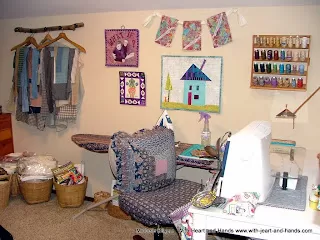 Quilter's workspace with fabric scraps, thread, and tools, suggesting a creative process in progress.
Quilting Folklore and Superstitions
The rich history of quilting is intertwined with folklore and superstitions passed down through generations. These beliefs often relate to luck, marriage, and the process of creation itself, adding a layer of mystique to the craft.
The section on “Quilting Superstition and Folklore” delves into various beliefs, such as avoiding starting a quilt on a Friday, the practice of leaving an intentional mistake (the “Amish block”), and the numerous superstitions surrounding bridal quilts and hope chests. It also discusses the controversial and largely debunked folklore regarding quilts being used as signals on the Underground Railroad, providing a nod to historical accuracy alongside the more whimsical beliefs.
Quilting Superstition and Folklore
Needleworking: “I knew an old lady who, if she had nearly completed a piece of needlework on a Thursday, would put it aside unfinished, and set a few stitches in her next undertaking, that she might not be obliged either to begin the new task on Friday or to remain idle for a day.” (1883) Quilting superstitions are closely tied to the creation of quilts and the final quilting. As with many other activities that started centuries ago and have been passed down the generations.
Just as with all of our many quilt and quilting patterns and techniques, they were passed down from one to another…a mother to her daughter, a grandmother to her granddaughters, by friends in a quilting bee and so on.
Quilting was often the one social time in the lives of women and such an important part of their lives. And as they quilted, they shared..stories and tales, things that had gone wrong or turned out wonderfully well based on what they believed to be the causes…and superstitions and folk lore about quilting began!
Superstitions regarding making quilts are tied to religion and other deep seated ideas about faith and faithfulness. A quilt should never be started on a Friday, as this day was “the devil’s day”, so any project started on a Friday was likely never to be finished.The only time one might quilt was on ‘Good Friday’ but only if one was making the quilt for reasons of faith.
There should be no quilting done on Sunday, as this is the day of rest for Christians. Strange penalties or punishments were then associated with this superstition. Any stitching done on this day needed to be ripped out with the sewer’s teeth only. (you see how things start? now how many times have you done this 😉
And associated with this, another superstition that reminds us that if we use our teeth to cut thread, they will rot and fall off. (well, that explains any of our missing teeth 😉
Another very well known superstitious custom associated to quilting is the idea that since only God can create perfection, quilts should include an intentional or purposeful mistake. The idea of the Amish block…where one deliberating tilts it the wrong way and so on.
Many superstitions have to do with brides and the making of a “hope chest” full carefully sewn linens for her future household . Family members would help the young girls and women to prepare a “bakers’ dozen” quilts. The last of these was the bridal quilt, which was not supposed to be started until the bride was engaged to be married.
The bridal quilt carried many superstitions surrounding its creation. For example, hearts should not be used as design elements in any of the other quilts in the hope chest, but could be stitched in the bridal quilt, to be used on the first wedding night.This ensured that all of young couple’s dreams would come true as they slept under it their very first night.
A girl who had no bridal quilt by the time she turned twenty-one, would never marry and therefore be a spinster or old maid. And to go along with this superstition if, a girl started a quilt for her hope chest and didn’t finish it, she would also never be married.
Furthermore, there should not be any breaks or disruptions in the patterns on a border. This would create bad luck for the marriage . And great care needed to be taken that when a bridal quilt included a border, should have no breaks in the design.So vines, flowers etc. must maintain their flow as one design all along and around the border..just as they desired in life and marriage.
The bridal quilt, started and pieced by the bride would then would quilted at a special bridal quilting bee with family and friends. And any as yet unmarried female should never do the finishing stitches on this quilt, for superstition has it that she should never be married.
Tossing the Cat
Then began the idea of “tossing the cat”. Once the wedding quilt was complete, the folklore directed that all of the unmarried girls in the party would hold the quilt by the edges and a cat would be thrown on the quilt. The closest girl to the spot where the cat would jump down would be the next to be married. The quilting version of tossing the bridal bouquet! Also, if the quilt were wrapped around an unmarried girl, she would be married within a year. Oh, all you quilters who wrap quilts around you now for your blog’s profile photos..did it work?
And young men did not escape quilting superstitions either!
When a young man reached the age of 21, he needed a ‘freedom quilt”. No longer under the domination of his parent, he was now considered an adult and free from his parents. The pattern for this quilt had to be very carefully chosen. Patterns like the “Wandering Foot” block pattern was deemed to be bad luck. If a young male was given a quilt made with this pattern, he would move away. Perhaps this was what caused the name of this block to be changed to “Turkey Tracks” and this way, the superstition could be avoided. Although men who behave badly are often considered to be turkeys 😉
“The Underground Railroad”
Not really superstition, but rather part of quilting folklore and a subject that has been argued by quilt historians is that of quilts being used as signals in the Underground Railroad. This myth was fueled by the publication of a book on the subject during the latter part of the twentieth century and has been debunked for the most part by quilt scholars and historians. It all began with an interview and a lot of misunderstandings. The article was published, the book was written and all this quilt folklore with its many ideas of certain colors or patterns used on quilts that were hung in clotheslines in “safe houses”as signals to runaway slaves was begun.
Experts have disapproved these stories with evidence of falsehood reporting. Sorry to say.
Cathy Miller’s song lyrics “Follow the Stars” creatively intertwine traditional quilt block names with the folklore of the Underground Railroad, portraying the patterns as secret messages guiding enslaved people to freedom. It’s important to note this is artistic interpretation based on the folklore, not historical fact, as mentioned in the prose section.
Follow the Stars
Song by Cathy Miller on her “One Stitch At A Time” CD
Follow the stars to freedom
Flying geese stay on the drunkard’s path and
Follow the stars to freedom
The quilts will tell you when to get your bag packed
Follow the stars to freedom
There are secrets hidden in plain view
If you can see them, this train is for you
And freedom’s waiting at the end of the track
Follow, follow, follow the stars to freedom
The monkey wrench turns the wagon wheel
At the blacksmith’s word, the way is revealed
Take the bear’s paw trail through the wilderness
Through the Appalachian mountains, the underground express
Soon you’ll be tasting a free man’s meal
Follow, follow, follow the stars to freedom
Danger! Don’t say it out loud
Sew it in a pattern, or sing it in a crowd
They’ll think you’re just making a joyful sound
Till you follow, follow, follow the stars to freedom.
The slave’s chains are double wedding rings
Your mind and your body get free of those things
The crossroads block means Cleveland’s docks
Where Peg Leg Joe’ll open up the locks
And sail you across to where the angels sing
Follow, follow, follow the stars to freedom.
(Author: Cathy Miller)
Quilts and Connection
Beyond individual expression and community gatherings, quilts serve as tangible symbols of connection, comfort, and love, often created to mark significant life events or simply to provide warmth and a sense of being cared for. These quilting poems explore the deep emotional bonds embodied in quilted creations.
M. Robinson’s “Baby’s Quilt” captures the tender feelings associated with creating a quilt for a new child, stitching hopes and dreams into every seam.
Baby’s Quilt
Author: M. (Marilyn) Robinson
from the book, “P.S. I Love You”)
The sun came up this morning
It’s promise sweet and long
A new child shares this day with me
The birds begin their songs.
A special gift of squares and strips
Was sewn for baby’s cover
The sparkling patches quite reflect
Our feeling for each other.
The beauty of the days ahead
Are sewn in every seam.
I’ll wrap you up and hold you tight
And anticipate the dream.
An anonymous poem equates love itself with a quilt, emphasizing shared characteristics like comfort, warmth, strength, and durability.
Quilter’s Poem
(Author: unknown
Love is a quilt – a quilt is love .
Both love and a quilt should be:
Soft enough to comfort you,
Bright enought to cheer you,
Generous enough to enfold you,
Light enough to let you move freely,
Strong enough to withstand adversity,
Durable enough to last a lifetime,
And given gladly, from the heart.
Another anonymous piece uses the metaphor of a patchwork quilt to describe a family, highlighting how individual uniqueness (“Each piece an original”) is brought together by love and kindness.
Our Family
Our family is like a patchwork quilt
With kindness gently sewn
Each piece an origina
lWith beauty all its own
With threads of warmth and happiness
Its lightly stitched together
To last in love throughout the years
Our family is forever.
(Author: unknown)
A short, anonymous verse reinforces the idea of quilts as sources of comfort and memory, built from “Little bits of fabric” and providing warmth both physical and emotional.
Little bits of fabric
Sewn into a quilt
Form a warm and loving blanket
From which memories are built.
And when you seek peace and comfort
In the quiet of the night
It will keep you warm and snug
Until the morning’s light.
Kathy Sherlock’s “Just For You” is a heartwarming poem written from the perspective of a quilter giving a quilt to a child, encouraging them to use it freely and creating a promise of continued love and creation.
Just For You
by Kathy Sherlock
This quilt is made of cloth and thread
To place upon your little bed.
It’s not an heirloom just to keep,
But to lie upon as you count sheep.
Or perhaps the floor’s the perfect place
For a Doll and Teddy picnic place.
This quilt can be anything you can dream
From Superman’s cape to the robe of a queen.
Pretend it’s a raft adrift at sea,
Or just cuddle up when you watch TV
So use it up and wear it out.
I promise I won’t yell or pout.
Just tell me when its days are through,
And I’ll make another one just for you.
 Colorful abstract quilt pattern displayed on a bed, showcasing a mix of prints and solid fabrics in a dynamic design.
Quilting Sayings and Wisdom
Beyond formal poetry, the quilting community has developed its own vernacular and sayings, often capturing the humor, dedication, and shared philosophy of quilters. These proverbs, blessings, and witty remarks offer insights into the quilter’s mindset.
Cindy Thury Smith offers “Quilt Teacher’s Ten Commandments,” a humorous yet insightful list of guidelines for those who teach the craft, emphasizing patience, clarity, and a supportive attitude towards students.
Quilt Teacher’s Ten Commandments
by Cindy Thury Smith 1999
- Thou shalt not ridicule a student’s choice of fabrics nor their colors; a student’s taste should be reflected in their work.
- Thou shalt not require excessive expenditures for a class; thou dost not know a student’s financial situation.
- Thou shalt provide students with clearly written and illustrated handouts. Thou shalt be able to explain a construction step with more than one method (written, verbal, visual).
- Thou shalt provide value for their money; at least one other variation of the quilt in addition to the standard design.
- Thou shalt be on time, start on time and provide time for questions.
- Thou shalt circulate amongst the students, checking progress, even if thy feet dost hurt.
- Thou shalt find something positive to say about each student’s work. Thou shalt not have a “My way or the highway” frame of mind; creativity comes in many forms.
- When a student makes a good suggestion, thou will announce it to the class and give credit where due.
- Thou shalt allow some time after class to help anyone who sews at a more leisurely pace.
- Thou shalt show numerous samples; and if thou dost not have numerous samples done, make suggestions for other applications of the pattern.
A “Quilter’s Blessing” offers warm wishes specific to the tools and processes of quilting, hoping for sharp blades, straight seams, and perfect points.
A Quilter’s Blessing:
May your rotory cutter always be sharp, may your seams be straight and true. May your points be perfect, your blocks square and even, and may you always see well enough to thread your needles!
The collection of “Short Quilt Sayings” and “More Quilt Sayings” offer a rapid-fire glimpse into the shared jokes, philosophies, and slightly obsessive nature of quilters, covering topics from stashes and UFOs to friendship and the preference for sewing over housework.
Short Quilt Sayings
A family stitched together with love seldom unravels.
A Quilt is a blanket of love.
Blessed are the Quilters for they are the piecemakers.
Friendships are sewn…one stitch at a time…
Good friends are like quilts, they never lose their warmth.
God put me on this earth to sew and finish a certain number of things.
I am so far behind now…..I will never die!
Any day spent sewing, is a good day!
Will work for FABRIC!
Asking a quilter to mend, is like asking Picasso to paint your garage!
Sewing forever, housework whenever!
Sewing and crafts fill my day, not to mention the living room, bedroom, and closets.
Hubby calls me his “sew & sew”. I think sew!
Itching to be stitching.
My husband is a human pincushion!
Creative clutter is better than idle neatness.
Good friends are like quilts. They age with you, yet never lose their warmth.
Sew much fabric, sew little time!
Friendship is sewn with love and measured by kindness.
Constant use has not worn ragged, the fabric of their friendship.
LOST: Husband, dog, and sewing machine. Reward offered for sewing machine!
She who dies with the most fabric…..wins!
“Fabricologist Resource Center”…..now does that sound more impressive than “fabric stash”?
Sew on to success!”
My husband lets me buy all the fabric I can hide!
One yard of fabric, like one cookie, is never enough!
My husband said if I were to buy any more fabric, he would leave me. I’m going to miss him!!!
A quilt is something you make to keep someone you love…WARM!
Anytime is stitchin’ time.
Memories are stitched with love.
In the crazy quilt of life, I’m glad you’re in my block of friends.
Quilters never cut corners.
I’m in therapy and SEWING is cheaper than a psychiatrist.
Quilts are like friends – a great source of comfort.
Behind every sewer is a huge pile of fabric.
You’re SEW special!
Buttons and patches and the cold wind blowing…the days pass quickly when I am sewing!
Love is the thread that binds us.
Quilts are like mom’s cooking – they both give comfort.
Quilts connect the past with the present and the future.
Quilting is sharing yourself with others.
A quilt is a present you give yourself.
To quilt is human, to finish divine.
Quilt Fever. Scrap Happy. Just Sew It! Material Girl. Scraps Happen. Fabricoholic. Quilt till you wilt!.
If life gives you scraps, make quilts.
So many designs, so little time!
So many fabrics, so little money!
A stitch in time is right before the quilt show deadline.
I only quilt on days that end in Y.
It’s not just a stash: I am a hoarder/gatherer.
A creative mess is better than idle neatness.
A block a day keeps the shrink away.
Quilters aren’t greedy, they’re just materialistic.
A penny saved is a penny to spend on fabric.
God, in Her infinite wisdom, does not deduct any time spent quilting from your allotted span.
And More Quilt Sayings!
- May your days be “pieceful”
- Do not run with scissors
- As ye ‘sew’, so shall ye rip
- Days stitched with love rarely unravel
- When life gives you scraps, make a quilt
- A stitch in time saves nine
- Memories are sewn together by friends
- You keep me in stitches
- Don’t snip it, if you can’t stitch it.
- If you feel a little “down”, stuff it in a quilt.
- “A warm quilt makes for a far happier life”
- “On a cold winter night when others are counting sheep to get to sleep you count quiltz”
- “A quilt a day keeps colds away!
- “Two in a quilt are warmer than one in a bed”
- Life is quiltisentially about being together
- May your days always MEASURE up.
- Make the SCRAPS in your life beautiful.
- SHEARS to you.
- Memories are stitched with love.
- Love is the thread that binds us.
- A family stitched together with love, seldom unravels.
- May your bobbin always be full!
- Two threads are better than one.
- As ye Sew, sew Shall Ye Rip
- A day hemmed in prayer seldom unravels.
- Blessed are the piecemakers, for they shall quilt forever!
- In the crazy quilt of life, I am glad you are in my block of friends.
- From my hands to your heart!
- The soul is fed with needle and thread.
- May your sorrows be patched and your joys quilted.
- Count your blessings, stitch them one by one.
MORE Quilt Sayings Added in As I Find Them!:
Old quilters never die, they just go batts.
Old Crafter’s never die, they just get more bazaar!
Old quilters never die, they just go to pieces.
Quilt ’til you wilt!
Quilts are like friends – a great source of comfort.
Quilters don’t do buttons
Quilters never cut corners.
Quilting forever…housework whenever!
When life gives you scraps – make a quilt.
Quilting is my passion (chocolate comes in a close second)
Quilting with a friend will keep you in stitches.
Our lives are like quilts – bits and pieces, joy and sorrow, stitched with love.
Blessed are the children of the piecemakers . . for they shall inherit the quilts !
I am a quilter and my house is in pieces
Those who sleep under a quilt, sleep under a blanket of love.
May your sorrows be patched and your joys quilted.
Conclusion
These quilting poems, sayings, and snippets of folklore offer a beautiful glimpse into the world of quilting – a world rich in history, community, creativity, and deep emotional connection. They show us that quilting is not merely a craft; it is a way of preserving memories, expressing love, finding humor in daily life, and connecting with a heritage of needle and thread. Each quilt, whether simple or complex, tells a story, stitched into existence one piece, one seam, one binding at a time. Through poetry, we can appreciate the intricate patterns of both fabric and human experience, finding warmth and meaning in the shared art of making.